Fraud Prevention Is Costing You More Than Fraud
Last Updated on July 31, 2026 by Dimitri Akhrin
Why overfitted fraud filters quietly block your best customers — and how processors profit from your lost revenue
Learn why false declines cost most eCommerce businesses more than actual fraud. This piece exposes how processor-default fraud filters are tuned to minimize their risk, not maximize your revenue, and what smarter calibration looks like.
TL;DR
- False declines can outweigh actual fraud losses – Mastercard reports $443 billion in annual merchant losses from false declines, while global eCommerce fraud losses exceeded $48 billion in 2023.
- Your processor’s default fraud settings protect them, not you – Chargebacks cost processors money, but false declines cost only you. Default filters are calibrated accordingly.
- Fraud prevention and revenue suppression are the same tool, miscalibrated – The right question isn’t how much fraud you’re stopping. It’s how much revenue you’re sacrificing to stop it.
- Approval rate improvements translate directly to growth – Refining fraud rules and authentication logic can boost approvals by nearly 10%, recovering significant revenue without any new marketing spend.
Your Fraud Filter Is Quietly Firing Your Best Customers
There’s a strange irony in eCommerce right now. The tool you bought to protect your revenue is probably the thing bleeding it dry. Fraud prevention is supposed to stop bad actors. But for most online businesses with 10 to 50 employees, the bigger threat isn’t the fraudster who slips through. It’s the loyal customer who gets blocked at checkout, never comes back, and never tells you why.
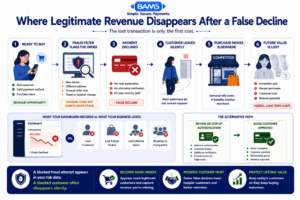
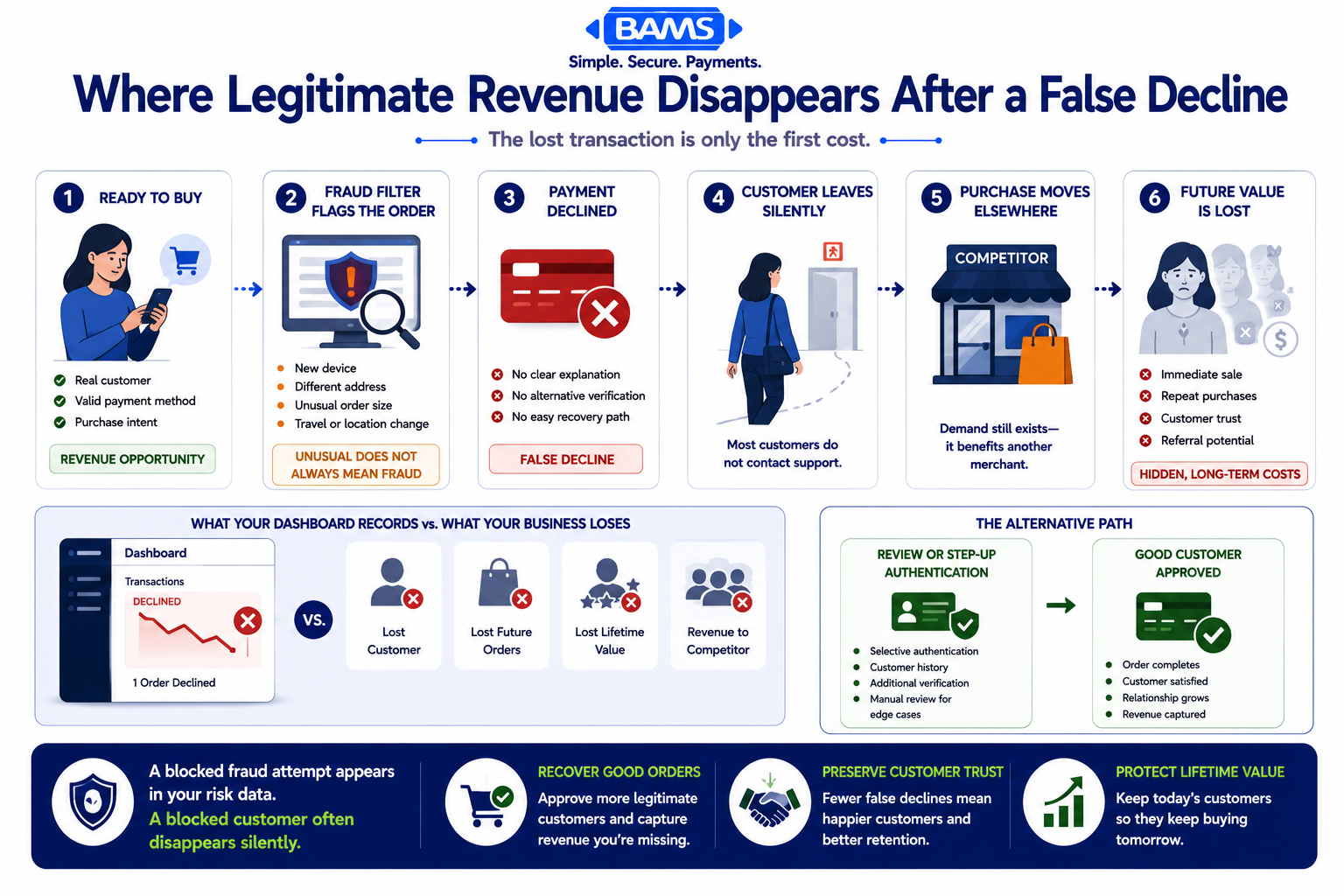
False declines rarely create a support ticket. Most blocked customers leave silently, taking the immediate sale and future purchases with them.
The “Better Safe Than Sorry” Trap in Fraud Prevention
The payments industry has spent years selling a simple story: tighter fraud filters equal safer business. Processors roll out aggressive rule sets, crank up velocity limits, and flag anything that looks slightly unusual. And merchants accept it because chargebacks are painful, dispute ratios are scary, and nobody wants to be the one who let a fraudulent order through.
This made sense when eCommerce fraud was cruder and less sophisticated. Block the obvious bad stuff, and you’re fine. But the landscape has changed. Fraud tools got smarter, and then they got overfitted. Today, the default settings on most processor-provided fraud filters are tuned to minimize the processor’s risk, not to maximize your revenue. That distinction matters enormously, and almost nobody talks about it.
The Real Problem Isn’t Fraud. It’s Over-Blocking.
Here’s what we actually believe: for most growing eCommerce businesses, false declines are a bigger financial threat than fraud itself, and the processors selling you “protection” have little incentive to tell you so.
This isn’t contrarianism for its own sake. The numbers are staggering.
Payment Optimization Starts with Seeing What You’re Losing
False declines cost merchants worldwide $443 billion annually. By comparison, Mastercard reported that global eCommerce fraud losses exceeded $48 billion in 2023.
False declines do more than cancel an individual order. They create unnecessary payment friction, increase transaction retries, and can push legitimate customers toward another payment method or merchant.
Let that sink in. A typical eCommerce business declines about 6% of orders, and nearly two-thirds of those are real people trying to give you real money.
We’ve seen this pattern repeatedly with established online brands. A customer places an order from a new device. The fraud filter flags it. The order gets declined. The customer, confused and slightly insulted, goes to a competitor. No complaint filed. No support ticket. Just silence and a lost lifetime value that never shows up on any report.
Fraud rules should be treated as an ongoing optimization effort, not a one-time configuration. Visa recommends monitoring authorization rates, soft declines, false positives, fraud losses, and authentication outcomes, then refining payment flows as customer behavior and fraud patterns change.
And this is the core issue. Aggressive fraud controls may reduce exposure, but they can also reject legitimate customers and suppress revenue. Visa reports that 40% of consumers will not place another order with a merchant after experiencing a declined transaction. The immediate loss is one order; the longer-term loss may be the entire customer relationship.
This is where the connection between chargeback prevention and faster deposits becomes critical. Keeping your dispute ratio low is important, but doing it by carpet-bombing your approval rates is like curing a headache by skipping meals. The symptom improves; the patient gets weaker.
Mastercard explains that sharing richer buyer data with issuers can help prevent false declines, increase approval rates, and improve checkout conversion. For a business doing $2 million in annual online revenue, even a modest improvement in legitimate approvals can recover meaningful sales without additional advertising or acquisition spending.
What Changes If You Stop Treating Every Customer Like a Suspect
If this thesis is right, the implications are uncomfortable. It means the “set it and forget it” fraud setup your processor gave you on day one is actively costing you money every single day. It means your cash flow problems might not be a sales problem or a traffic problem. They might be an approval rate problem hiding in plain sight.
It also means that faster deposits and better payment optimization for eCommerce aren’t just about settlement speed or interchange-plus pricing. They’re about the entire chain: approving more good orders, defending against chargebacks proactively (not reactively), and working with a processor who actually shows you the data on what’s being declined and why.
This is one area where BAMS takes a different approach. Their model pairs proactive chargeback defense with dedicated account management, so someone is actually reviewing your decline patterns and dispute ratios with you, not just handing you a dashboard and disappearing. That human layer matters because fraud rules aren’t a “configure once” problem. They need ongoing calibration as your business, your customer base, and fraud patterns evolve.
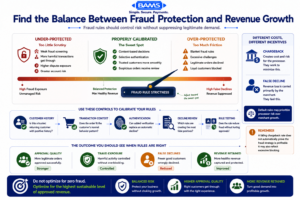
A Better Way to Think About It: Protection vs. Suppression
Here’s the reframe we keep coming back to: fraud prevention and revenue suppression are not opposites. They’re the same tool, miscalibrated.
The question isn’t “how much fraud are we stopping?” The question is “how much revenue are we suppressing to stop it, and is the tradeoff rational?” Most eCommerce operators have never been asked that question by their processor. Most have never seen the data that would let them answer it.
Think of your fraud filter less like a security guard and more like a bouncer at a club. A good bouncer keeps out troublemakers. A bad bouncer turns away half your paying guests because they “looked suspicious.” You wouldn’t tolerate the second bouncer for a week. But that’s exactly what many merchants tolerate from their payment stack for years.
Stop Optimizing for Zero Fraud. Start Optimizing for Maximum Revenue.
The goal was never zero chargebacks. The goal is a business that grows. Fraud filters should serve that growth, not quietly undermine it. If your processor can’t show you your false decline rate, can’t explain how their rules are calibrated, and can’t tell you the revenue cost of their “protection,” that’s not a partner. That’s a liability wearing a security badge.
Ask the uncomfortable question this week: how many good customers did we turn away last month? The answer might be the most important number in your business that nobody is tracking.
Frequently Asked Questions
How do false declines impact customer relationships in eCommerce?
Most falsely declined customers never contact support. They leave silently and shop elsewhere. Over time, this erodes customer trust and lifetime value in ways that never appear on a chargeback report.
When should merchants conduct a payment processing audit?
If you haven’t reviewed your decline rates and fraud rule settings in the last 90 days, you’re overdue. Fraud patterns shift constantly, and rules that made sense six months ago may be suppressing revenue today.
How can eCommerce businesses optimize payment processing to reduce declines?
Start by requesting a full decline report from your processor, broken down by reason code. Then A/B test your fraud rules, refine authentication logic, and work with a processor that offers proactive review rather than a set-it-and-forget-it approach.
Sources
- https://www.mastercard.com/news/eemea/en/newsroom/press-releases/en/2026/may/checkout-com-and-mastercard-report-reveals-mena-emerges-as-one-of-the-fastest-growing-regions-to-adopt-tokenization-at-344-9/
- https://corporate.visa.com/en/solutions/visa-protect/insights/authentication-and-identity.html
- https://www.mastercard.com/us/en/business/cybersecurity-fraud-prevention/identity/trusted-transactions.html