
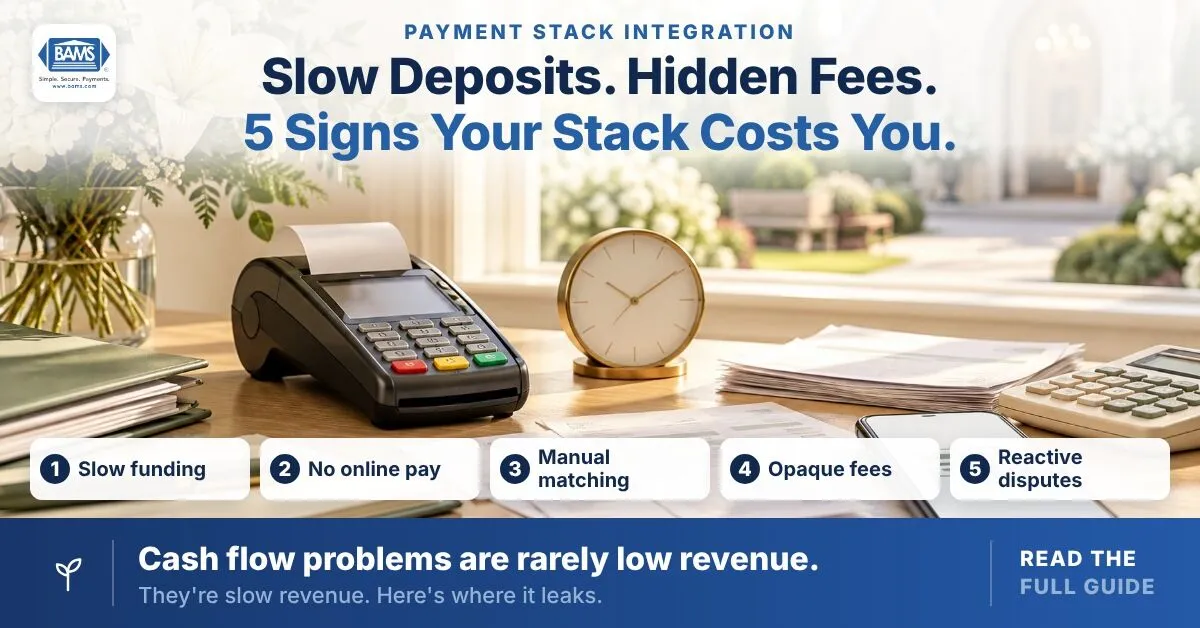
5 Signs Your Payment Stack Integration Is Costing You
Your Payment Stack Is Quietly Costing You Thousands
Most funeral home operators know when a casket supplier raises prices. They notice when utility bills climb. But few connect their payment stack integration gaps to the cash flow problems they live with every month. The culprit is rarely one dramatic failure. It is a collection of small frictions. A deposit takes four days to land. An invoice requires a phone call. Reconciliation eats two hours every Friday.
For family-owned funeral homes handling high-ticket services (often $10,000 to $20,000 per case), these frictions compound quickly. A single day of delayed funding on a $15,000 service means real money sitting in limbo instead of covering payroll, flowers, or supplier invoices. And because most operators manage just one to ten locations, there is no corporate treasury team absorbing the impact. You feel it directly.
TL;DR
- Delayed deposits drain working capital – If your processor takes three or more business days to fund transactions, you are financing every case out of pocket. For a home processing about $240,000 a month, cutting two days of delay frees roughly $22,000 that would otherwise sit in transit.
- No online payment option slows collections – Families who can only pay by check or phone add days of delay and increase your PCI compliance burden. Secure online invoicing links solve both problems.
- Manual reconciliation is a hidden labor cost – Re-keying payments across disconnected systems eats staff time and invites errors. Integrated payment and accounting tools remove most of it.
- Opaque processing fees erode margins on high-ticket services – On $12,000 services, even a 0.5% pricing gap is $60 per case. Request a transparent interchange-plus breakdown.
- Reactive chargeback handling is expensive – A single disputed $12,000 service can trigger fees, a higher chargeback ratio and account risk. Proactive monitoring and documentation at the point of arrangement are essential defenses.
What This Diagnostic Covers
This guide is for family-owned funeral service operators who suspect their payment stack integration is underperforming but can’t pinpoint the drag. It is not a setup checklist or a product comparison. Instead, it treats your payment stack as something to diagnose, the same way you would investigate a persistent operational bottleneck.
Each of the five signs below maps to a specific cash flow cost. Some are obvious once you name them. Others have been part of your workflow so long they feel normal. Our cost examples are illustrative, based on a funeral home averaging 20 cases per month with an average service value of $12,000 (about $240,000 in monthly card volume).
How We Identified These Five Signs
We judged each payment stack integration gap on three criteria. How long does revenue take to become usable cash? How much manual labor does each transaction need? And how many disconnected systems does one payment touch? If a gap met all three, it made the list.
Five Signs Your Payment Stack Is Slowing Down Cash Flow
1. Deposits Take Three or More Business Days to Reach Your Account
Why it matters: Funeral services involve front-loaded costs. You pay embalmers, order flowers, coordinate with cemeteries and cover transportation before the family’s payment clears. When deposits take three to five business days, you are financing each case out of pocket. A home averaging 20 cases per month at $12,000 processes about $11,000 per business day, so every extra day of settlement leaves roughly $11,000 in transit. Two extra days is about $22,000.
What it looks like today: Many processors settle on a two-to-three-day cycle and operators accept the lag as standard. But next-day funding is widely available and the gap between a three-day and one-day settlement cycle is significant working capital.
How to address it: Ask your processor for a written funding timeline, not the estimate on their website, but the actual average for your merchant category code. If you are consistently waiting more than one business day, that is a structural issue. Providers like BAMS offer next-day funding for qualifying merchants at no extra cost, with funds in as little as ten hours after transactions are batched.
2. Families Cannot Pay Online, So You Chase Checks and Phone Calls
Why it matters: When a family arranges services, they are navigating grief, logistics and often coordinating among multiple relatives. If your only payment options are in-person card swipes, mailed checks, or over-the-phone transactions, you create friction at the worst possible moment. Checks add mailing and deposit time. Phone payments require staff time and carry higher PCI compliance risk because card data is handled verbally.
What it looks like today: Roughly four in five small firms face challenges with the payments they receive, according to the Federal Reserve. Integrated online invoicing solutions let families pay from a secure link at home, on their own schedule. Your staff never handles sensitive card data.
How to address it: Implement a payment gateway that supports emailed or texted invoice links with built-in secure payment integration. This removes your staff from the card-data chain (reducing PCI scope) and gives families the flexibility to split payments among relatives. Every family that pays by link instead of check gets funds into your account sooner and saves your staff a trip to the bank.
3. Reconciliation Requires Matching Transactions Across Three or More Systems
Why it matters: If your case management software, payment terminal and accounting platform do not share data, someone on your team is manually matching transactions. In Italy, 19% of SMEs reported faster payment reconciliation after adopting e-invoicing, according to a 2024 European Commission report. That points to disconnected systems as a measurable drag on operations.
What it looks like today: In a common funeral home workflow, staff enter the arrangement in case management software and run the payment on a separate terminal. Then someone logs it by hand in QuickBooks or a similar tool. Each handoff introduces delay and error risk. Across 20 cases and several payments per case, that re-keying adds up to hours of staff time every month.
How to address it: Audit your current workflow by counting the number of times a single payment is manually entered or transferred between systems. If the answer is more than once, you need tighter integration. For a smoother payment stack integration, look for processors that offer payment gateway integrations compatible with your existing tools, so transactions flow from point of sale to ledger without re-keying.
4. You Have No Visibility Into Processing Fees Until the Monthly Statement Arrives
Why it matters: Many funeral home operators are on tiered or bundled pricing models where the actual per-transaction cost is obscured. On a $15,000 service, every 0.5% of hidden markup costs $75. Over 20 monthly cases, that adds up to $1,500 a month in payment processing fees you cannot see until after the fact (illustrative).
What it looks like today: Tiered pricing groups transactions into “qualified,” “mid-qualified” and “non-qualified” buckets with markups that are difficult to audit. Interchange-plus pricing separates the card network’s base cost from the processor’s margin, making every line item transparent. Many small operators stay on legacy pricing simply because no one has offered to review it.
How to address it: Request a full interchange-plus breakdown from your current processor. If they cannot or will not provide one, that is diagnostic information in itself. Compare your effective rate (total fees divided by total volume) against the interchange rates Visa publishes and Mastercard’s equivalents. A large gap above interchange on high-ticket transactions signals room for savings. Our guide to choosing merchant services with transparent fee structures walks through what to ask.
5. Chargebacks and Disputes Are Reactive, Not Defended
Why it matters: Funeral services are high-ticket, emotionally charged transactions. Disputes can arise when a family member who did not authorize the payment contests it, or when grief leads to buyer’s remorse weeks later. A single chargeback on a $12,000 service does not just cost you the revenue. It can trigger a dispute fee, increases your chargeback ratio and can eventually lead to account holds or termination by your processor.
What it looks like today: Many small operators learn about chargebacks only when funds are withdrawn from their account. By then the response window is already running: Mastercard notes acquirer deadlines average 10 to 35 days. Dispute tools such as BAMS Dispute Responder send immediate chargeback notifications with a clear action plan, so you can gather documentation fast.
How to address it: Track your chargeback ratio monthly (total disputes divided by total transactions). If it climbs toward 0.5%, treat that as an early warning and build a systematic response, not just case-by-case reactions. Ensure your processor provides transaction monitoring tools and dispute alerts. Pair this with clear documentation at the arrangement: a signed service agreement, an itemized invoice and the cardholder’s explicit payment consent.

Start with what hits every case. Example figures are illustrative.
The Pattern Behind These Five Signs
Each sign points to the same issue. Your payment stack was assembled in pieces rather than designed as one payment stack integration. The terminal came from one vendor. The gateway came from another. Invoicing lives in a spreadsheet. Reconciliation happens in someone’s head. Individually, each component works. Together, they create drag.
The common thread is that cash flow problems in funeral homes are rarely caused by low revenue. They are caused by slow revenue. Money enters the pipeline but takes too long to become usable, or it leaks through fees, labor and disputes along the way. Fixing any one of these five signs improves cash flow. Fixing three or more changes the financial posture of your operation.
Notice, too, that the solutions overlap. A processor offering next-day funding, integrated eCommerce payment processing, transparent pricing and dispute support addresses multiple signs at once. This is not a coincidence. It is the advantage of treating your payment stack as a unified system rather than a collection of parts.
Where to Start
You do not need to overhaul everything at once. Start with the sign that costs you the most. For most funeral homes, that is either delayed funding (Sign 1) or manual reconciliation (Sign 3), because these affect every single case.
If you address just one of these, aim for the change that removes a daily or weekly manual task. The compounding value of recovered staff time often exceeds the direct financial savings. Once that friction is gone, move to fee transparency (Sign 4), because the savings there fund the remaining improvements.
The goal is not a perfect payment stack. It is a payment stack that stops quietly working against you, so you can focus on serving families instead of chasing deposits.
Frequently Asked Questions
What is a payment stack and why does it matter for funeral homes?
A payment stack is the combination of tools and services that handle how you accept, process, record and receive payments. For funeral homes, it typically includes a card terminal, a payment gateway (for online or remote payments), invoicing software and an accounting platform. When these components do not communicate with each other, you experience slower funding, manual data entry and limited visibility into costs. A well-integrated stack reduces those frictions and gets revenue into your account faster.
How does next-day funding actually work?
With next-day funding, your payment processor settles approved transactions and deposits the funds into your bank account by the following business day. This contrasts with the two-to-five-day timelines common with other processors. For a funeral home processing $200,000 a month (about $9,000 per business day), moving from three-day to next-day funding frees roughly $18,000 that would otherwise be in transit. At BAMS, next-day funding is available to qualifying merchants.
How can funeral homes ensure PCI compliance when accepting online payments?
The simplest approach is to use a payment gateway that handles card data on its own secure servers, so your staff and systems never touch sensitive information directly. This is called “hosted” or “redirect” payment processing and it significantly reduces your PCI scope. Avoid taking card numbers over the phone or writing them down. With online invoicing with an embedded payment link, the family enters card details directly into the gateway’s secure form. Your business stays out of the data chain.
What does interchange-plus pricing mean and is it better than tiered pricing?
Interchange-plus pricing separates the base cost set by the card networks (Visa, Mastercard) from the markup charged by your processor. You see both numbers on every transaction. Tiered pricing bundles everything into opaque categories, making it difficult to know what you are actually paying. For high-ticket transactions common in funeral services, interchange-plus pricing is more transparent and often less expensive, because the processor cannot quietly shift transactions into higher-cost tiers.
When should a funeral home consider switching payment processors?
Consider a switch if funding takes more than one business day or you cannot offer families an online payment option. Other triggers: your statement doesn’t itemize interchange versus markup, or you have no support for chargeback disputes. Any one of these is a sign that your current setup is costing you money. A combination of two or more suggests the issue is structural, not incidental.
Can families split funeral payments among multiple people using online invoicing?
Yes, if your payment gateway supports partial payments or multiple payment links per invoice. Many modern online invoicing solutions allow you to send a secure payment link that accepts partial amounts, so siblings or extended family members can each contribute. This reduces the burden on any single family member and often results in faster full payment for your business.
Sources
- Federal Reserve Banks: 2024 Report on Payments, Findings from the 2023 Small Business Credit Survey
- European Commission (EU Payment Observatory): How Electronic Invoicing Helps Reduce Late Payments, July 2024
- Visa: Credit Card Processing Fees and Interchange Rates
- Mastercard: Disputing Chargebacks, Practical Guidance for Merchants


