
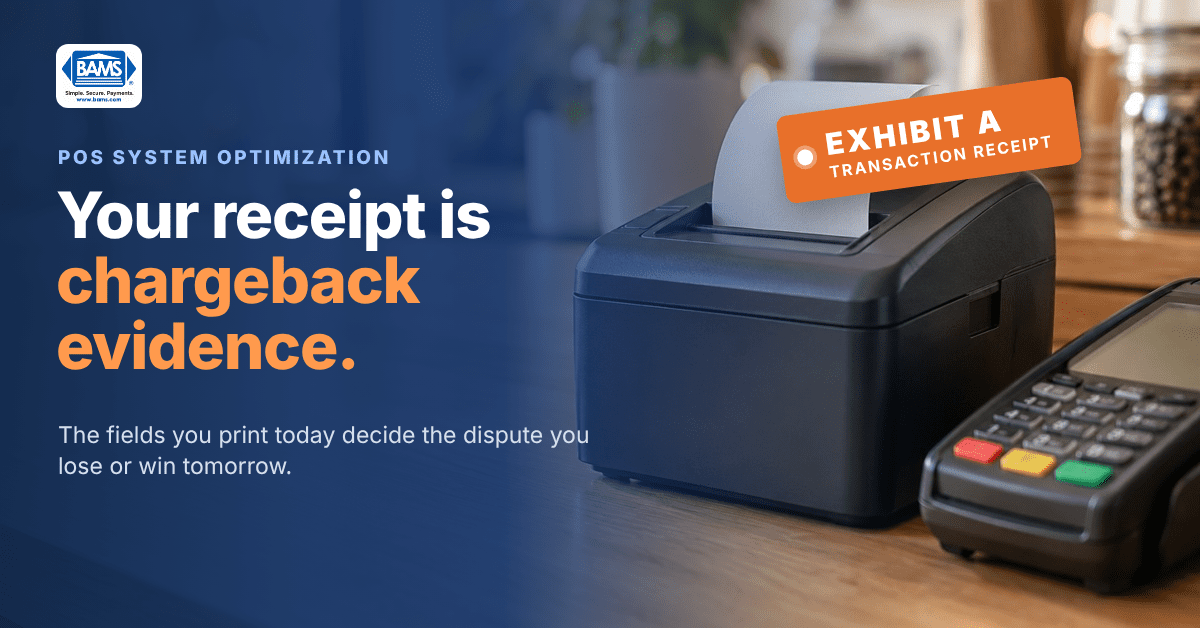
POS System Optimization: Why Your Receipt Is Evidence
The Receipt Nobody Reads Until It Costs You About $169
Every transaction your POS system prints or emails generates a small legal artifact. Not a thank-you note. Not a branding opportunity. A piece of evidence. That’s why POS system optimization starts with the receipt. For many small and midsize merchants, winning or losing a chargeback dispute comes down to what that receipt says and what it omits. It also depends on whether the payment processing integration behind it captured the right data at the right moment.
The average chargeback cost merchants $165 in 2023 and it was projected to reach about $169 in 2024. It’s also only part of the cost. There are the hours spent on representment, the operational drag and the strain on your relationship with your acquiring bank.
TL;DR
- Receipts are evidence, not decoration. Every omitted field (authorization code, entry method, billing descriptor, surcharge disclosure) weakens your chargeback defense before a dispute even exists.
- Default POS templates leave you exposed. Many out-of-the-box receipt configurations leave out fields that matter in a dispute. Merchants running surcharge or dual-pricing programs also face disclosure requirements that defaults may not cover.
- Payment processing integration determines receipt quality. Tightly integrated POS and processor systems can fill in defensible fields automatically. Siloed systems need manual configuration that often never happens.
- Digital receipts cut chargebacks when done right. Two-thirds of merchants using digital receipts reported lower chargeback rates. To work as evidence, digital versions should carry the same fields as printed ones.
The “Clean Receipt” Myth
Most merchants think about receipts the way they think about business cards. Keep it clean, put the logo on top and make sure the total is correct. To be fair, this instinct comes from a reasonable place. After all, customers don’t want clutter. Also, simplicity signals professionalism.
Many POS defaults reinforce this. Default receipt templates often prioritize looks. They trim fields to the minimum so the output looks tidy. Merchants then assume that if the POS shipped that way, it must be compliant.
This framing made sense when chargebacks were rare and mostly legitimate. However, that world no longer exists. In one 2024 survey, nearly half of merchants estimated that friendly fraud caused 50% or more of their chargebacks. Nearly three-quarters reported an average 18% increase in friendly fraud over the past three years. The “clean receipt” is a liability dressed up as good design.
Your Receipt Is a Compliance Artifact, Not a Design Choice
Here’s what we believe: POS system optimization for chargebacks starts at the receipt. Not at the contract. Not at the terminal. At the printed or emailed record of what happened, who agreed to it and under what terms. So every field you omit is a gap your acquirer cannot fill when a dispute arrives.
Why POS System Optimization Decides Chargeback Outcomes
Consider what happens when a cardholder disputes a $127 charge. 53% of cardholders go straight to their bank without contacting the merchant first. The issuing bank reviews the dispute and assigns a reason code. The merchant then gets a short window to respond.
At that point, the merchant’s defense rests largely on documentation. And the most immediate, most granular documentation available is the transaction receipt.
Here is where POS system optimization separates protected merchants from exposed ones. Strong POS receipt fields give the merchant something to work with. These include the full billing descriptor (matching the cardholder’s statement), the last four digits of the card and the authorization code. They also include the entry method (chip, swipe, keyed, contactless), a clear itemization and any refund or return policy language. A receipt that shows only a total, a date and a store name gives the merchant almost nothing.
Roughly a third of merchants aren’t sure how their billing descriptor appears on customer statements. In fact, that disconnect alone can trigger disputes from customers who simply don’t recognize the charge.
The Surcharge and Dual-Pricing Compliance Gap
This problem also compounds for merchants running dual-pricing or surcharge programs. For surcharges, Visa requires disclosure at the point of entry and the point of sale, plus the surcharge as a separate line on the receipt. For dual pricing, the receipt should make clear which price the customer paid. See our guide to building a chargeback-proof receipt for field-by-field setup.
Many default POS templates do not handle this well. As a result, merchants end up with receipts that bundle the surcharge into the total or omit the disclosure language. Some display it in a way that doesn’t satisfy card brand audit requirements. When a cardholder disputes a surcharge they didn’t understand, the merchant’s receipt becomes the primary evidence. If that receipt doesn’t show compliant disclosure, the dispute becomes very hard to win.
That’s precisely where payment processing integration matters. A POS system that is tightly integrated with the payment processor can fill in compliant fields automatically. Those include the correct descriptor, the surcharge line, the authorization data and the entry method. By contrast, a loosely integrated system forces the merchant to configure these fields by hand. That includes setups where the POS and terminal run as separate silos and many merchants never finish the job.
For merchants evaluating how their POS and processor work together, a Payment Processing Company like BAMS can help. BAMS offers chargeback management tools for online and in-store merchants. Its team can also review whether your receipts capture the fields a dispute needs.
Digital Receipts as a Defense Layer
There’s also a tactical dimension here that many merchants overlook. Datos Insights found that two-thirds of merchants that implemented digital receipts reported lower chargeback rates. That makes digital receipt chargebacks a lever worth testing. The mechanism is straightforward. A digital receipt sent to a customer’s email or phone creates a record they can check before calling their bank. It can reduce the “I don’t recognize this charge” disputes behind much friendly fraud.
But digital receipts only work as a defense layer if they contain the same POS receipt fields as the printed version. For example, an emailed receipt that shows just a logo and a total is no better than a paper one. So your POS setup has to treat digital and physical receipts as identical compliance documents.
What Changes When POS System Optimization Treats Receipts as Evidence
If this framing is correct, the implications are significant. Every POS implementation decision becomes a risk management decision, not an IT decision. That includes which fields to enable, how the processor integrates and whether digital receipts mirror physical ones.
It also means that merchants running surcharge or dual-pricing programs without receipt-level disclosure are carrying latent liability that won’t surface until a dispute is filed and lost. Similarly, the choice of payment processor deserves a look at whether the POS integration produces audit-defensible receipts out of the box.
Finally, lost chargebacks are not just a function of bad luck or aggressive cardholders. Often, they’re a documentation failure. The evidence existed at the moment of sale. The POS just didn’t capture it.

Six POS receipt fields that win chargeback disputes.
Rethinking the Receipt: From Output to Shield
We think the most useful mental model is this: your receipt is not the output of a transaction. It’s the shield you build before the dispute you don’t see coming.
In other words, every field on that receipt is chargeback receipt evidence. The authorization code proves the transaction was approved. Meanwhile, the entry method shows how the card was presented. Your itemization proves what was purchased. A surcharge disclosure proves the customer was informed. Finally, a matching billing descriptor proves the charge is recognizable.
So if you strip any of those fields away, you’re not simplifying the customer experience. Instead, you’re disarming yourself. The merchants who win representment consistently treat receipt formatting as a compliance function with financial consequences. For them, it’s not a design preference.
The Dispute You Haven’t Filed Yet
U.S. merchants are projected to face up to $15 billion in chargeback volume by 2026. Meanwhile, the receipts printing from your POS right now will be your main evidence in disputes that haven’t been filed yet. That’s why POS system optimization can’t wait. The question isn’t whether your receipts look professional. It’s whether they’ll hold up when someone claims they never made that purchase. Build accordingly.
Frequently Asked Questions
What fields should a chargeback-defensible receipt include?
At minimum, include the billing descriptor (matching the customer’s statement), last four card digits, authorization code and entry method. Add itemized line items and any surcharge or dual-pricing disclosure. These POS receipt fields give your acquirer the documentation needed to build a representment case.
Do digital receipts actually reduce chargebacks?
Research from Datos Insights found that two-thirds of merchants using digital receipts reported lower chargeback rates. However, digital receipts must contain the same compliance fields as printed ones. Only then do they work as both a customer reference and a dispute defense document.
How does dual-pricing affect receipt compliance requirements?
Card brand rules require a surcharge to appear as a separate line on the receipt. With dual pricing, the receipt should show which price applied. If your POS bundles the fee into the total or omits disclosure language, the receipt may not satisfy audit requirements. See our dual pricing signage and receipt guide for setup steps.
Sources
- Chargeback Gurus and The Strawhecker Group: The State of Chargebacks 2024
- Business Wire: 2024 Chargeback Field Report Merchant Survey (Chargebacks911 and Edgar, Dunn & Company)
- Crowdfund Insider: Chargebacks911 Report Chronicles Chargeback Fraud Rise
- Visa: Merchant Surcharging Considerations and Requirements
- Datos Insights: Digital Receipts and Digital Banking, A New Frontier for Growth
- Chargeback Gurus: Industry Metrics One-Pager (2024)

