Why Predictable Recurring Revenue Remains Out of Reach
Last Updated on June 3, 2026 by Dimitri Akhrin
The hidden operational barriers keeping eCommerce businesses from capturing their share of the $166 billion subscription market
Discover why recurring payments support alone won’t stabilize your cash flow. Learn how remote deposit capture and transaction reporting solve the real barriers to subscription revenue success.
TL;DR
- The real barrier to recurring payments isn’t technology – It’s the gap between when charges clear and when deposits hit your account
- Predictable billing without predictable funding is just sophisticated accounts receivable – Next-day funding and remote deposit capture solve this
- Transaction reporting drives subscription success – Visibility into failed payments and authorization patterns prevents churn before it starts
- Infrastructure before features – Solve deposit timing, reporting, and fraud prevention before adding subscription options
The Subscription Revenue Paradox Nobody Talks About
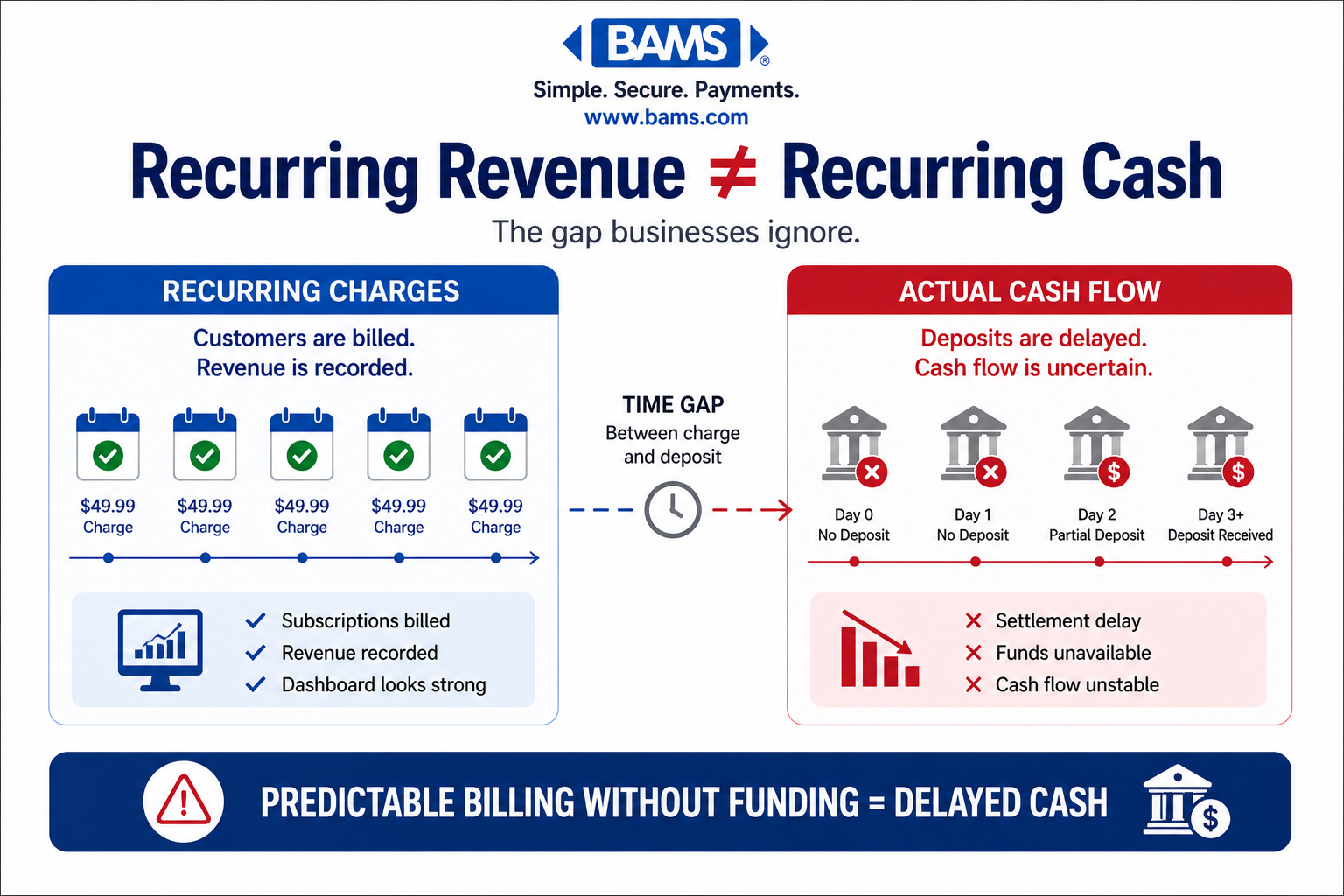
Recurring billing creates predictable revenue on paper, but delayed deposits create a gap between recorded revenue and actual cash flow.
Here’s what keeps me up at night: eCommerce managers know predictable revenue beats the feast-or-famine cycle of one-time purchases. They’ve seen competitors stabilize cash flow with subscription models. Still, they wait.
The hesitation isn’t about wanting recurring payments support. It’s about fearing what happens between the sale and the deposit. Payment timelines depend on how transactions move between banks, networks, and processors, with settlement speed influenced by batching, risk controls, and processing infrastructure as outlined by Visa.
Why “Just Add Subscriptions” Became Bad Advice
The conventional wisdom sounds bulletproof: recurring payments create predictable revenue streams, so adopt them and watch your forecasting problems disappear. Consultants have been preaching this gospel for years. And they’re not wrong about the destination.
The problem is the path. Most businesses that tried recurring billing discovered a brutal truth: predictable charges don’t guarantee predictable cash. Delayed deposits turn subscription revenue into a mirage. You see the numbers in your dashboard, but your bank account tells a different story.
Add in the administrative overhead of managing failed payments, the fraud exposure of storing card data, and the reporting nightmares of reconciling hundreds of micro-transactions. Suddenly that “predictable” revenue stream feels anything but.
Recurring Revenue Only Works When You Can Actually Access It
The real barrier to recurring payment adoption isn’t technical capability. It’s operational confidence. Businesses hesitate because they’ve been burned by the gap between transaction and deposit.
Predictable billing without predictable funding is just sophisticated accounts receivable.
Card payment systems include interchange fees, network assessments, and processor charges that determine how funds move through the payment ecosystem and impact merchant cash flow as outlined by the Federal Reserve.
The Hidden Infrastructure That Makes Subscriptions Actually Work
Let me walk you through what I’ve observed separating successful subscription businesses from those who abandoned the model.
A UK shipping company called Whistl watched subscription adoption jump from 65% to 81% among their customer base in a single year. But the insight wasn’t about consumer appetite. It was about backend infrastructure. They emphasized that seamless integration and customer onboarding determined whether recurring payments became a growth engine or an operational burden.
The businesses thriving with subscriptions share three characteristics that rarely make the marketing materials.
First, they solved the deposit timing problem. Remote deposit capture and next-day funding transformed their relationship with recurring revenue. When a subscription payment clears, the money hits their account within 24 hours. No more floating payroll on projected revenue. No more wondering if this week’s deposits will cover this week’s inventory orders.
Second, they invested in transaction reporting that actually tells them something. Advanced merchant reporting tools let them see failed payment patterns before they become churn problems. They can identify which subscription tiers have the highest authorization rates and which payment methods cause the most friction. This isn’t vanity data. It’s operational intelligence.
Third, they chose payment partners who understood the subscription model’s unique risks. Recurring payments face different fraud patterns than one-time purchases. Card-on-file transactions require different security approaches. Proactive chargeback defense matters more when one disputed charge can cascade into a cancelled subscription.
The data backs this up: businesses with subscription models report 34% higher customer retention rates. But that number hides a critical detail. The retention advantage only materializes when the first 30 days of onboarding go smoothly. Payment friction in that window predicts long-term churn better than almost any other metric.
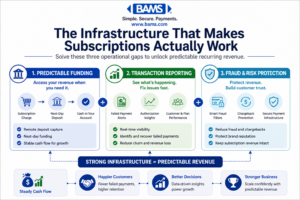
The infrastructure behind successful subscription businesses: predictable funding, real-time transaction reporting, and proactive fraud protection. Solving the deposit timing problem starts with guaranteed next day funding, ensuring subscription revenue becomes usable cash within 24 hours instead of sitting in processing delays.
What Changes If You Get This Right
Consider what predictable revenue actually enables.
- You stop making inventory decisions based on hope.
- You negotiate better terms with suppliers because you can commit to consistent orders.
- You hire ahead of growth instead of scrambling to catch up.
The modern consumer maintains an average of 5.4 active subscriptions. That number keeps climbing. The businesses capturing this demand aren’t the ones with the fanciest subscription management software. They’re the ones who solved the unsexy problems: deposit timing, transaction visibility, and fraud prevention.
If you’re hesitating on recurring payments because you’ve seen the operational chaos it can create, your instincts are right. But the solution isn’t avoidance. It’s infrastructure.
A Better Way to Think About Subscription Readiness
Stop asking “should we offer subscriptions?” Start asking “can we fund our operations on the float between charge and deposit?”
- If the answer is no, you need faster funding before you need recurring billing.
- If the answer is yes but barely, you’re one slow deposit week away from a cash crisis.
- If the answer is comfortably yes, you’re probably already leaving subscription revenue on the table.
The growth of recurring payments will flow to businesses that built the operational foundation first. Understanding how your payment gateway handles recurring transactions, including tokenization and automated billing, determines whether you capture that growth or watch it pass you by.
Understanding how your integrated payment gateway handles recurring transactions, including tokenization and automated billing, determines whether you can turn recurring charges into reliable cash flow.
The Real Question Isn’t Whether to Adopt Recurring Payments
It’s whether your payment infrastructure can turn recurring charges into recurring cash. The businesses winning in subscription eCommerce didn’t just add a billing feature. They rebuilt their relationship with deposits, reporting, and risk.
Predictable revenue is available. Predictable access to that revenue is earned.
Frequently Asked Questions
What are faster deposit strategies in merchant services?
Faster deposit strategies include next-day funding programs and remote deposit capture technology that moves money from transaction to bank account within 24 hours. These eliminate the cash flow gaps that make recurring payments operationally risky.
How can I improve my payment authorization rates for subscriptions?
Focus on transaction reporting to identify which payment methods and card types fail most often. Update stored card information proactively and implement retry logic for soft declines during off-peak processing hours.
What role does fraud protection play in recurring payment optimization?
Recurring payments face unique fraud patterns since card-on-file transactions bypass some traditional verification steps. Proactive chargeback defense and tokenization protect both revenue and customer relationships over the subscription lifecycle.
Sources