Reduce Processing Fees: Strategic Guide for Merchants
Last Updated on April 28, 2026 by Dimitri Akhrin
Uncover Hidden Costs Inflating Average Processing Fees
Learn about overlooked transaction fees that impact eCommerce businesses’ processing costs.
Discover hidden transaction fees that inflate your average processing fees. This list helps eCommerce managers identify and evaluate these costs for better negotiation.
TL;DR
- Over 90% of small businesses overpay on processing – Hidden fees add an average of $2,400 per year beyond quoted rates, with rewards card premiums, CNP surcharges, and PCI fees being the primary culprits.
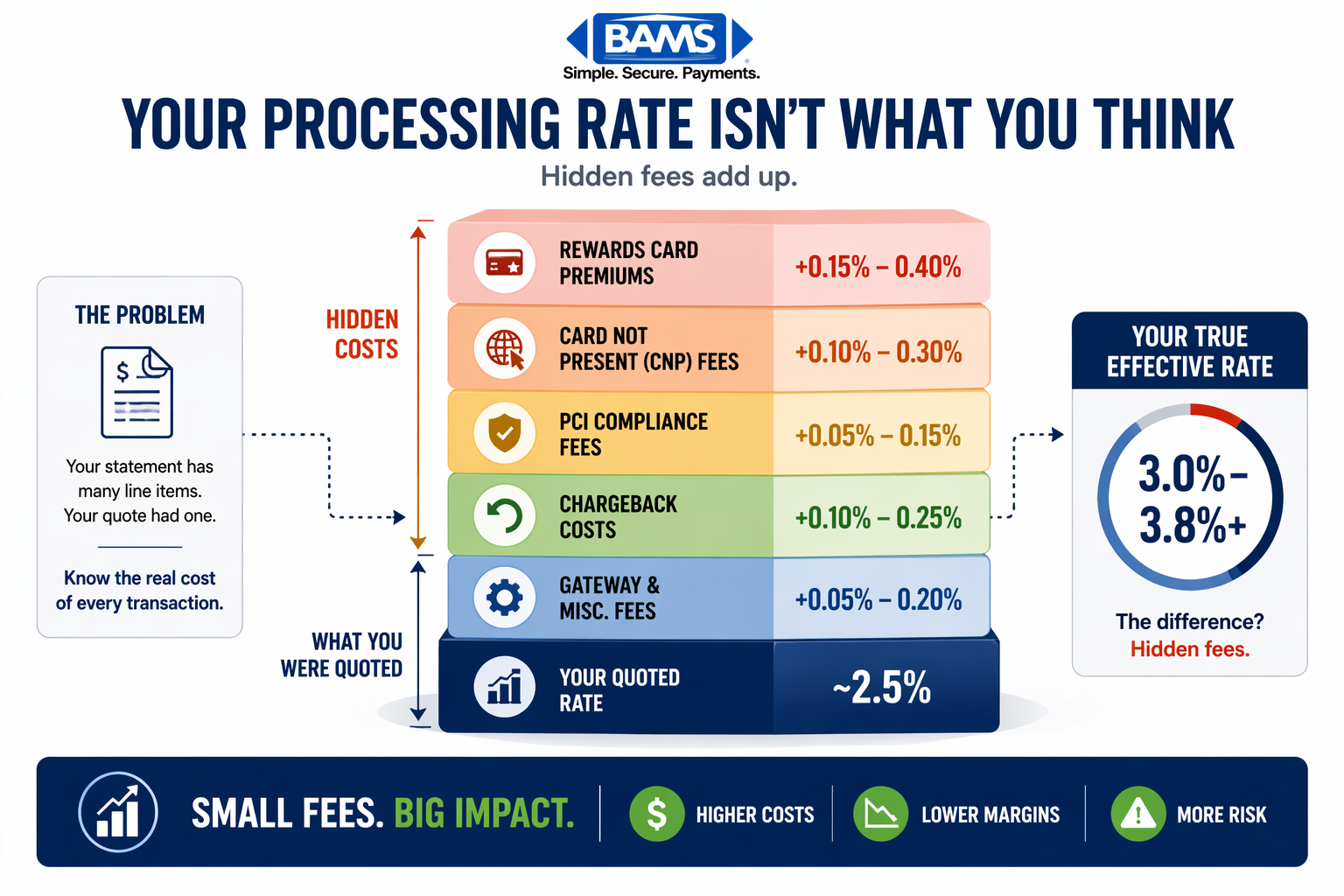
- Your quoted rate is not your actual rate – Rewards cards inflate fees to 1.65% to 2.40% (versus 1.51% for standard cards), and online transactions add 0.10% to 0.30% premiums that rarely appear in initial quotes.
- Chargebacks cost $40 each on average – This includes processor fees, admin time, and lost product, making proactive dispute prevention more valuable than reactive management.
- Complexity benefits processors – The more line items on your statement, the harder it is to calculate your true effective rate. Request interchange-plus pricing for transparency.
- Start with statement analysis – Calculate your actual effective rate (total fees divided by total volume) and compare to your quoted rate. The gap shows your hidden cost exposure and negotiation opportunity.
The Hidden Fee Problem Most eCommerce Managers Miss
Your payment processor quoted you a rate. You did the math. The numbers made sense. Then your monthly statement arrived, and suddenly your average processing fees looked nothing like what you expected.

A stacked breakdown showing how hidden fees build on top of your quoted rate, increasing your true processing cost.
You are not alone. For eCommerce operations processing significant volume, that number climbs fast. Card payment costs continue to represent a significant expense for merchants, driven by interchange, network fees, and processor markups as outlined by the Federal Reserve.
This list identifies the specific hidden costs inflating your processing expenses, so you can evaluate them accurately and negotiate from a position of knowledge.
What This List Covers (And Who It Serves)
This guide targets eCommerce managers at established online businesses processing enough volume that a 0.5% fee increase represents real money. If your team handles payment operations, reconciles monthly statements, or evaluates processor contracts, these insights apply directly to your work.
We focus exclusively on hidden and often-overlooked costs, not the base interchange rates you already know about. We exclude point-of-sale hardware fees and in-person transaction nuances. The goal is simple: help you identify where your money actually goes so you can make informed decisions about your payment processor relationship.
How We Selected These Costs
Each item on this list meets three criteria: it appears on most merchant statements but rarely in initial rate quotes, it compounds over time or volume, and it can be negotiated, avoided, or mitigated with the right approach. We prioritized costs that hit eCommerce operations hardest.
1. Rewards Card Interchange Premiums
Why It Matters
Your quoted interchange rate assumes a mix of card types. Reality looks different. You cannot control which cards customers use, but you can account for this in your projections.
What It Looks Like Today
Premium rewards cards now represent a growing share of consumer spending. Your customer base likely skews toward these cards if you sell mid-to-high-ticket items or target professionals. The gap between quoted rates and actual rates widens as rewards card adoption increases.
How To Apply It
Request a card-type breakdown from your processor for the past six months. Calculate your actual blended rate versus your quoted rate. Use this data when negotiating renewals or evaluating new processors. Some processors offer interchange-plus pricing that makes these premiums transparent rather than hidden in bundled rates.
2. Card-Not-Present Transaction Surcharges
Why It Matters
Every eCommerce transaction is card-not-present by definition. This classification carries inherent risk premiums that add 0.10% to 0.30% per transaction compared to in-person swipes. For a business processing $50,000 monthly, that premium alone costs $600 to $1,800 annually.
What It Looks Like Today
Online transaction volumes continue growing post-pandemic, but the risk premiums established years ago remain baked into fee structures. Some processors advertise rates based on card-present scenarios, then apply CNP surcharges that only appear in statement fine print.
How To Apply It
Confirm whether quoted rates include CNP premiums or add them separately. Implement address verification (AVS) and CVV requirements to potentially qualify for lower-risk CNP categories. Ask your processor about specific rate tiers for verified online transactions.
3. PCI Compliance and Non-Compliance Fees
Why It Matters
Payment Card Industry compliance is mandatory. Some charge compliance fees even when you are compliant. Others charge both a compliance fee and a separate non-compliance penalty if documentation lapses.
What It Looks Like Today
Many processors auto-enroll merchants in PCI compliance programs that charge monthly fees regardless of compliance status. The compliance questionnaire (SAQ) takes 20 to 60 minutes annually, but missing the deadline triggers penalties that continue until you complete it, sometimes retroactively.
How To Apply It
Set calendar reminders for your PCI SAQ deadline. Confirm your processor’s specific compliance fee structure in writing. Ask whether compliance fees can be waived with timely SAQ completion. Some processors include PCI compliance support at no additional charge.
4. Monthly Minimum Processing Fees
Why It Matters
Most processor contracts include monthly minimum thresholds. For seasonal businesses or those with variable sales cycles, these minimums create fixed costs during slow periods.
What It Looks Like Today
Minimums made sense when processors needed guaranteed revenue from low-volume merchants. For established eCommerce operations, they function as a floor that rarely applies, until a slow month hits and suddenly you are paying fees on transactions that did not happen.
How To Apply It
Review your contract for monthly minimum clauses. Calculate your lowest-volume months over the past two years. Negotiate minimums that reflect your actual floor, or request removal entirely if your volume consistently exceeds thresholds. Document seasonal patterns to support your negotiation.
5. Chargeback and Dispute Fees
Why It Matters
For eCommerce businesses facing friendly fraud or unclear return policies, chargebacks represent a compounding cost that rarely appears in initial fee calculations.
What It Looks Like Today
Chargeback rates have increased as consumers learned to dispute transactions directly with card issuers. Each dispute requires documentation, response time, and often results in lost revenue regardless of outcome. The processor fee is just the visible portion of a larger cost.
How To Apply It
Track your chargeback rate and root causes monthly. Implement clear billing descriptors so customers recognize charges. Consider proactive chargeback defense services that intercept disputes before they become formal chargebacks. Some payment partners include chargeback management as part of their service rather than charging per incident.
6. Assessment Fees and Network Costs
Why It Matters
Visa, Mastercard, American Express, and Discover charge assessment fees separate from interchange. These fees fund network operations and typically run 0.13% to 0.15% per transaction. Card transactions involve multiple cost layers, including interchange, assessments, and processing fees, which together determine the total cost of acceptance as outlined by Visa.
What It Looks Like Today
Assessment fees are non-negotiable with networks, but how processors pass them through varies significantly. Some bundle assessments into quoted rates. Others list them separately but mark them up. The lack of standardization makes comparison shopping difficult.
How To Apply It
Request a fee breakdown that separates interchange, assessments, and processor markup. Compare assessment pass-through rates across processors. True interchange-plus pricing should show assessments at cost without markup. Use this transparency as a baseline for evaluating any processor relationship.
7. Gateway and Integration Fees
Why It Matters
Payment gateways connect your eCommerce platform to your processor. Many processors charge separate gateway fees ($10 to $30 monthly) plus per-transaction gateway charges ($0.05 to $0.10 each). For high-transaction-volume businesses, gateway fees can exceed base processing costs.
What It Looks Like Today
Modern payment infrastructure often involves multiple service layers: your platform, your gateway, your processor, and the card networks. Each layer can add fees. Some processors own their gateways and bundle costs. Others partner with third-party gateways that charge independently.
How To Apply It
Map your current payment stack and identify each fee-charging entity. Ask processors whether gateway services are included or additional. Calculate total per-transaction costs including all gateway fees. Consider processors that offer integrated gateway services without separate charges.
Simplifying your payment stack with an integrated payment gateway can reduce redundant fees and provide clearer visibility into transaction-level costs.
Patterns Across These Hidden Costs
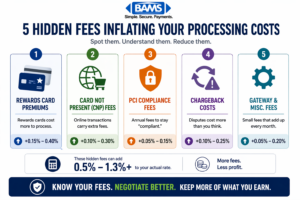
A simple checklist of the five most common hidden fees that inflate your payment processing costs.
Three themes connect these seven cost categories. First, complexity benefits processors. The more line items on your statement, the harder it becomes to calculate your true effective rate. Second, defaults favor the processor. PCI fees, monthly minimums, and tiered pricing all assume you will not ask questions or negotiate. Third, volume creates leverage.
Merchants continue to report challenges with unclear and rising payment-related costs, especially when fee structures lack transparency, as highlighted by Merchant Payments Coalition.
The businesses that pay closest to their quoted rates share common traits: they audit statements monthly, they understand their card-type mix, and they treat processor relationships as ongoing negotiations rather than set-and-forget contracts.
Reducing complexity starts with transparent interchange plus pricing, which separates network costs from processor markup and makes your true effective rate visible.
Where To Start
You cannot address all seven cost categories simultaneously. Start with the highest-impact items for your specific situation.
- If you process high-ticket items, rewards card premiums likely matter most.
- If you experience seasonal swings, monthly minimums deserve attention first.
- If chargebacks appear regularly, dispute management offers immediate ROI.
Request your last six months of statements and calculate your actual effective rate (total fees divided by total volume). Compare this to your quoted rate. The gap between these numbers tells you how much hidden cost exists in your current setup, and how much you stand to save by addressing it systematically.
Frequently Asked Questions
What are credit card processing fees?
Credit card processing fees are charges merchants pay to accept card payments. They include interchange fees (paid to the card-issuing bank), assessment fees (paid to card networks like Visa and Mastercard), and processor markup (paid to your payment processor). Together, these typically range from 1.5% to 3.5% of each transaction, though hidden costs can push effective rates higher.
Why do merchants have to pay processing fees for credit card transactions?
Processing fees compensate the multiple parties involved in each transaction: the customer’s bank (which issued the card and assumes fraud risk), the card network (which maintains the payment infrastructure), and your processor (which handles the technical connection and settlement). These fees fund fraud prevention, network security, and the convenience that drives customers to use cards over cash.
How are credit card processing fees determined?
Fees depend on several factors: card type (rewards cards cost more than standard cards), transaction method (online transactions cost more than in-person), merchant category (some industries carry higher risk premiums), and your negotiated processor markup. Interchange rates are set by card networks and published semi-annually, while processor markups vary by provider and contract terms.
When do interchange fees change, and what factors influence them?
Visa and Mastercard update interchange rates twice yearly, typically in April and October. Changes reflect fraud trends, competitive dynamics between networks, regulatory pressure, and economic conditions. Recent years have seen gradual increases, particularly for rewards cards and card-not-present transactions, as networks respond to rising fraud costs and fund expanded rewards programs.
Which types of transactions incur higher processing fees?
Online (card-not-present) transactions cost 0.10% to 0.30% more than in-person transactions due to higher fraud risk. Rewards cards add 0.15% to 0.90% compared to standard cards. International cards, corporate cards, and transactions without AVS verification also carry premiums. Keyed-in transactions (manually entered card numbers) cost more than chip or contactless payments.
How can businesses minimize their credit card processing fees?
Start by understanding your actual effective rate through statement analysis. Negotiate interchange-plus pricing for transparency. Implement fraud prevention tools (AVS, CVV) to qualify for lower-risk rate categories. Maintain PCI compliance to avoid penalty fees. Consider processors that include services like chargeback defense and gateway access without separate charges. Review contracts annually and use competitive quotes as negotiation leverage.