
Payment System Review: A Pre-Season Audit Guide
Last Updated on September 29, 2026 by Dimitri Akhrin
Cut processing costs and prevent cash flow disruptions before peak season volume arrives
Learn how to run a structured payment system review that catches costly rate structures, funding delays, and fraud control gaps before seasonal volume magnifies them. This guide connects rate audits, volume thresholds, and monitoring setup into one actionable sequence.
TL;DR
- Audit your effective rate, not your contracted rate – Your transaction mix shifts during peak season toward more expensive card categories, which can increase your actual processing cost by 0.3 to 0.6 percentage points even if your contract terms haven’t changed.
- Notify your processor 30 to 45 days before volume spikes – Without advance communication, automated risk systems may flag your legitimate volume surge and impose reserve holds or funding delays at the worst possible time.
- Shorten your funding timeline before peak season – A two-day funding delay at 5x to 10x normal volume creates a massive cash flow gap. Next-day funding turns peak revenue into usable capital within 24 hours.
- Calibrate fraud controls for seasonal patterns – Filters tuned for normal volume will either over-reject legitimate peak-season orders or under-catch the 8.5x increase in fraudulent transaction volume during events like BFCM.
- Build monitoring and response protocols before you need them – Real-time alerts on approval rate, effective rate, funding delay, and chargeback rate let you catch and fix problems in hours instead of discovering them in end-of-month reports.
Guide Orientation: What This Covers and Who It’s For
This guide walks you through a structured payment system review designed to reduce processing costs before seasonal volume arrives. It covers rate audits, volume threshold notifications, funding timeline optimization, fraud control calibration, and monitoring setup as a connected sequence rather than isolated tasks.
It’s written for eCommerce managers at established online businesses (roughly 10 to 50 employees) who’ve already survived at least one peak season and felt the sting of delayed deposits, surprise holds, or rate structures that quietly eroded margins when transaction counts climbed.
By the end, you’ll be able to run a pre-season payment audit that identifies where your costs spike, why your cash flow tightens during high-volume windows, and what specific adjustments to make before the next surge. This guide does not cover checkout UX optimization, platform migration, or gateway selection. It focuses exclusively on the financial and operational mechanics of your existing payment setup.

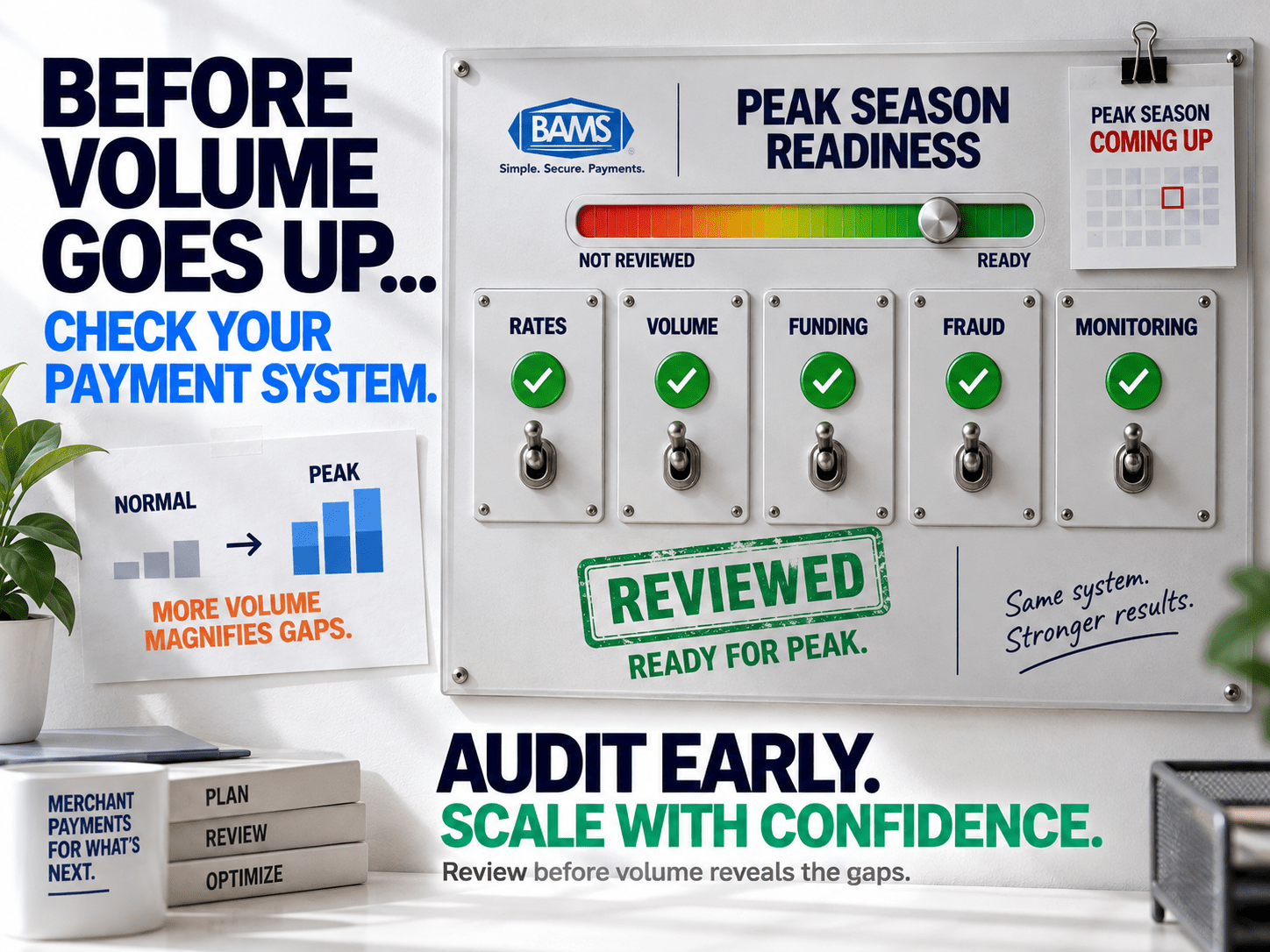
Peak season magnifies weaknesses that are easy to miss at normal volume. A pre-season payment review can uncover cost, funding and risk issues before transaction volume surges.
Why Peak Season Planning for Payment Costs Matters Now
Most eCommerce businesses treat payment processing as infrastructure that just works. That assumption holds at normal volume. It fractures during seasonal spikes, when legitimate order activity and fraud pressure can rise sharply at the same time. Visa reported that suspected fraudulent transactions rose 200% globally during the 2024 Black Friday and Cyber Monday holiday weekend compared with the equivalent 2023 period. At peak volume, every fraction of a percentage point in processing fees and fraud losses compounds into real money.
The problem isn’t just cost. It’s timing. When your processing volume surges, three things tend to happen simultaneously: your effective processing rate may increase due to interchange category shifts, your processor’s risk systems may flag unusual activity and trigger reserve holds, and your deposit timeline may stretch from next-day to two or three business days. You’re spending more on inventory and fulfillment at the exact moment your access to revenue slows down.
As Rachel Hammer, global head of strategy and thought leadership at Worldpay for Platforms, has noted, peak periods expose weak checkout and payment operations because volume spikes quickly compress the margin for error. The businesses that avoid peak-season payment pain aren’t luckier. They audit earlier.
The cost of waiting is concrete. The Merchant Risk Council reports that merchants accept an average of 4.6 payment methods, creating multiple payment flows that teams may need to monitor as seasonal traffic increases. Reviewing your payment setup after something breaks means fixing it under pressure at peak cost with limited leverage. Reviewing it before volume arrives gives you more time to identify problems and respond.
Core Concepts: Understanding What Drives Seasonal Cost Spikes
Interchange Variability
Your processing rate isn’t one number. It’s a composite of interchange fees (set by card networks), processor markup, and assessment fees. During peak season, your transaction mix often shifts: more new customers using rewards cards, more international cards, more card-not-present transactions with higher risk profiles. Each of these can push your effective rate higher even if your contracted rate hasn’t changed.
Volume Thresholds and Risk Flags
Processors model expected behavior for every merchant account. When your transaction volume suddenly doubles or triples, their risk systems may interpret this as anomalous activity. The result: rolling reserves (where a percentage of your deposits are held for 30 to 180 days), funding delays, or manual review queues that slow everything down. These aren’t penalties for doing something wrong. They’re automated responses to deviation from your baseline.
Funding Timelines as a Cash Flow Lever
The gap between when a customer pays and when that money reaches your bank account is a direct cash flow constraint. At normal volume, a two-day funding delay is manageable. During peak season, when you’re processing five to ten times your usual daily volume, that same two-day delay can mean six figures sitting in transit while you need capital for inventory replenishment, ad spend, and fulfillment labor.
Fraud Pressure and Its Cost Multiplier
Seasonal volume doesn’t just bring more legitimate orders. Visa reported that suspected fraudulent transactions rose 200% globally during the 2024 Black Friday and Cyber Monday holiday weekend compared with the equivalent period in 2023. The cost isn’t limited to chargebacks. Overly aggressive fraud filters can also reject legitimate transactions and the Merchant Risk Council reports that merchants lose 3.2% of total annual eCommerce revenue to payment fraud globally. Calibrating fraud controls before peak season is a cost reduction initiative, not just a security task.
The Audit Framework: Five Interconnected Levers
A pre-season payment audit should cover the entire payment operation, from actual processing costs and expected volume to funding speed, fraud controls and monitoring.
This guide organizes pre-season payment preparation into five sequential stages. Each stage builds on the previous one, and skipping ahead creates gaps that surface under pressure. The stages are:
- Rate and Fee Structure Audit — Understand what you’re actually paying and where it shifts under volume.
- Volume Threshold Communication — Notify your processor of expected increases to prevent automated risk responses.
- Funding Timeline Optimization — Shorten the gap between customer payment and cash in your account.
- Fraud Control Calibration — Adjust detection sensitivity to balance protection with approval rates.
- Monitoring and Response Setup — Build dashboards and alerts that surface problems in hours, not days.
These five levers are interconnected. Your rate structure affects your cost sensitivity to fraud, your volume threshold communication affects whether your funding timeline holds and your monitoring setup determines how quickly you can respond when any of the other levers shift unexpectedly. Treat them as a system, not a checklist.
Step-by-Step Breakdown: Running Your Pre-Season Payment System Review
Step 1: Audit Your Rate and Fee Structure
Objective: Know your actual effective processing rate across transaction types, not just the headline rate on your contract.
Pull three months of processing statements from a previous peak season (or your highest-volume quarter if you haven’t been through a major seasonal spike yet). Calculate your effective rate by dividing total processing fees by total processing volume. Then break it down by card type: standard debit, standard credit, rewards credit, corporate cards, and international cards. You’re looking for which card categories drive your costs highest and whether those categories increase as a percentage of your mix during peak periods.
Compare your effective rate to your contracted rate. If the gap is more than 0.15 to 0.25 percentage points, your interchange pass-through may include categories you can influence. For example, ensuring you submit Level 2 data (tax amount, customer code) on B2B transactions can qualify them for lower interchange tiers. Ensuring you settle batches daily, rather than letting them accumulate, prevents downgrades that push transactions into more expensive categories.
Anti-patterns: Don’t focus only on your processor’s markup. Interchange fees typically represent 70 to 80% of your total processing cost, and they vary by transaction characteristics you can control. Also, don’t assume your rate is fixed. Many contracts include tiered pricing that shifts based on volume bands or transaction types.
Success indicators: You can state your effective rate by card category, identify which categories increase during peak season, and pinpoint at least two interchange optimization opportunities before volume arrives.
Step 2: Communicate Volume Thresholds to Your Processor
Objective: Prevent your processor’s risk systems from flagging your legitimate volume surge as suspicious activity.
Contact your processor’s account management team (not general support) at least 30 to 45 days before your expected volume increase. Provide specific projections: expected daily transaction count, expected daily dollar volume, anticipated average ticket size, and the date range of the expected surge. Use last year’s data as a baseline and adjust for growth. If you’re launching a new product line or running a major promotion for the first time, say so explicitly.
This step matters more than most eCommerce managers realize. Processors use automated risk models that flag deviations from your established baseline. A merchant that typically processes $15,000 per day suddenly processing $120,000 per day will trigger review. Without advance notice, that review can result in a rolling reserve (where 5 to 10% of your deposits are held) or a temporary funding hold while the processor investigates. Both outcomes are devastating during peak season.
If your processor doesn’t have a dedicated account manager assigned to your business, that’s a signal worth noting. Proactive communication is difficult when you’re routed through a general support queue. For context on what dedicated account management looks like in practice, this overview of merchant services outlines the difference between transactional support and strategic partnership.
Anti-patterns: Don’t send a vague email saying “we expect higher volume.” Provide numbers. Don’t wait until the week before your sale. Processors need time to adjust risk parameters on your account. Don’t assume that because you’ve processed high volume before, your account is automatically flagged for seasonal spikes. Models reset.
Success indicators: You have written confirmation from your processor acknowledging your projected volume increase, and you’ve confirmed that your account’s risk parameters have been adjusted accordingly.
Step 3: Optimize Your Funding Timeline
Objective: Minimize the gap between customer payment and cash availability in your operating account.
Review your current funding schedule. Standard merchant accounts typically fund in two to three business days. During peak season, when daily processing volume rises sharply, that delay compounds into a significant cash flow gap. If you process $50,000 per day at peak and your funding is on a two-day delay, you have $100,000 in transit at any given time. That’s capital you can’t use for restocking, shipping, or ad spend.
Next-day funding is available from many processors, including BAMS, which offers it as a standard feature rather than a premium add-on. If your current processor charges extra for accelerated funding, calculate whether the fee is less than the cost of the cash flow gap. For most eCommerce businesses processing above $20,000 per month, the math favors faster funding, especially during peak periods when you’re reinvesting revenue into inventory and fulfillment daily.
Also review your batch settlement timing. If you’re settling batches once per day at midnight but your peak order volume arrives between 6 PM and 11 PM, you may benefit from adjusting your batch cutoff time to capture more transactions in the earlier funding cycle. Small timing adjustments can shift tens of thousands of dollars forward by a full business day.
Anti-patterns: Don’t assume funding speed is non-negotiable. It’s one of the most variable terms in merchant services agreements. Don’t overlook weekend and holiday funding gaps. A Friday-to-Monday delay during a peak weekend can create a four-day cash hole. Don’t confuse authorization speed with funding speed. Your customer’s card is charged instantly, but your deposit may not arrive for days.
Success indicators: You know your exact funding timeline in business days, you’ve confirmed whether weekend and holiday deposits are included, and you’ve calculated the peak-season cash flow gap created by your current funding schedule.
Step 4: Calibrate Fraud Controls for Seasonal Volume
Objective: Adjust fraud detection sensitivity to prevent both excessive false declines and increased fraud losses during peak season.
Your fraud filters were likely tuned for normal operating conditions. During peak season, two things change simultaneously: legitimate transaction patterns shift (new customers, higher order values, gift shipping to unfamiliar addresses) and actual fraud attempts increase. If your filters are too tight, you’ll decline good orders. If they’re too loose, you’ll absorb chargebacks 30 to 90 days later.
Start by reviewing your current decline rate. Pull data from your last peak period and categorize declines by reason code. Identify what percentage were processor declines (issuer rejections) versus your own fraud filter declines. For processor declines, consider implementing a transaction retry strategy based on specific decline codes. Soft declines (temporary issuer issues) can often be retried successfully within minutes.
For your own fraud filters, review velocity rules (how many transactions per hour from a single IP or card), AVS mismatch thresholds, and 3D Secure triggers. Consider loosening velocity rules slightly during peak hours while tightening them during off-peak hours when legitimate traffic drops but fraud attempts may persist. If you use 3D Secure, apply it selectively to high-risk transactions (new customers, high order values, international cards) rather than universally, since mandatory authentication on every transaction increases cart abandonment.
The 2025 Global eCommerce Payments and Fraud Report found that merchants now report 3.2% of total annual eCommerce revenue lost to fraud globally. That number is a blend of direct fraud losses and the indirect cost of overly aggressive prevention. The goal isn’t zero fraud. It’s an optimized tradeoff between fraud loss and approval rate.
Anti-patterns: Don’t freeze your fraud rules during peak season “because they work.” They work for normal volume. Don’t implement new fraud tools during peak season. Test and calibrate before volume arrives. Don’t ignore the cost of false declines. A declined legitimate order is lost revenue plus potential lifetime customer value.
Success indicators: You’ve reviewed decline rates by category, adjusted velocity and authentication rules for peak-season patterns, and established a target approval rate that balances fraud prevention with revenue capture.
Step 5: Build Monitoring and Rapid Response Capability
Objective: Detect processing anomalies within hours (not days) and have predefined response actions ready.
During normal operations, you might review processing reports weekly. During peak season, you need real-time or near-real-time visibility into four key metrics: approval rate, effective processing rate, average funding delay, and chargeback rate. A sudden drop in approval rate could indicate a processor issue, a fraud filter miscalibration, or a card network outage. A spike in effective rate could mean transactions are being downgraded to more expensive interchange categories.
Set up automated alerts for each metric. Define thresholds based on your baseline data. For example, if your normal approval rate is 94%, set an alert at 90%. If your effective rate is typically 2.4%, set an alert at 2.7%. These thresholds should be tight enough to catch real problems but wide enough to avoid alert fatigue from normal fluctuation.
Beyond monitoring, define response protocols before you need them. Who contacts the processor if funding is delayed? Who adjusts fraud filters if the decline rate spikes and who has authority to switch to a backup payment method if the primary gateway goes down? The average merchant now accepts 4.6 payment methods, which means you likely have redundancy available if you plan for it.
Document these protocols in a shared, accessible format. During peak season, the person who usually handles payment issues may be unavailable. Cross-functional team collaboration matters most when volume is highest and response windows are shortest.
Anti-patterns: Don’t rely on end-of-day reports during peak season. Problems that compound over eight hours can cost thousands. Don’t assume your processor will alert you to issues. Their monitoring priorities may not align with yours. Don’t build monitoring during peak season. Build it before, test it during a normal week, and refine before volume arrives.
Success indicators: You have automated alerts on four key metrics, documented response protocols with named owners, and have tested your monitoring setup during a normal-volume period to confirm it works.
Practical Examples: How This Plays Out
Scenario A: The Surprise Reserve Hold
An online home goods retailer processes $25,000 per day in Q3. In November, a flash sale pushes daily volume to $180,000. The processor’s risk system flags the account, and a 10% rolling reserve is applied without advance notice. That’s $18,000 per day held for 90 days. Over a two-week sale period, the retailer has $252,000 locked up during the exact window they need capital for fulfillment and restocking.
Had this retailer completed Step 2 (volume threshold communication) 30 days earlier, the processor would have adjusted risk parameters in advance. The reserve hold was entirely preventable.
Scenario B: The Invisible Rate Creep
A fashion eCommerce brand runs a holiday promotion that attracts a large number of first-time buyers using rewards credit cards and international cards. Their contracted rate is 2.3% plus $0.10 per transaction, but their effective rate during the promotion climbs to 2.85% because rewards and international interchange categories are significantly more expensive. On $500,000 in holiday sales, that 0.55% difference costs $2,750 in unexpected processing fees.
A pre-season rate audit (Step 1) would have identified this pattern from prior-year data, allowing the brand to either negotiate a blended rate cap, adjust their pricing to absorb the higher cost, or implement surcharging where legally permitted.
Scenario C: The Cash Flow Squeeze
A specialty food retailer processes $40,000 per day during their holiday peak. Their processor funds on a three-day delay. They need to reorder perishable inventory daily. With $120,000 constantly in transit, they’re forced to draw on a line of credit at 8% APR to cover the gap. Switching to a processor with next-day funding would eliminate the credit line dependency and save approximately $2,600 in interest over the six-week peak period. For businesses facing this exact timing problem, understanding the deposit timing gap is the first step toward solving it.
Common Mistakes and Pitfalls
Treating the payment setup as “set and forget.” Your transaction mix, customer demographics, and order patterns shift seasonally. Your payment configuration should shift with them.
Auditing too late. Rate negotiations, processor switches, and risk parameter adjustments all require lead time. Starting 30 to 45 days before peak season is the minimum. Starting 60 to 90 days out is better.
Optimizing for one metric in isolation. Tightening fraud controls reduces chargebacks but may increase false declines. Faster funding may require a processor change that affects your rate structure. These levers are connected. Pull one without considering the others and you create new problems.
Ignoring the post-peak tail. Payment risk doesn’t end when the promotion does. The Merchant Risk Council reports that 62% of merchants saw an increase in first-party misuse disputes and 57% saw an increase in refund or policy abuse. Your peak season chargeback planning should extend well beyond the sale itself.
Assuming your processor is proactive. Most processors are reactive. They respond to problems after they occur. If you want proactive management, you need to either drive it yourself or work with a merchant services partner that includes it by default.
What to Do Next
Start with Step 1. Pull your last three months of processing statements and calculate your effective rate by card category. This single exercise typically reveals at least one cost reduction opportunity, and it gives you the data foundation for every subsequent step in the audit.
If your peak season is more than 60 days away, you have time to work through all five steps sequentially. If it’s closer than 30 days, prioritize Steps 2 and 3 (volume communication and funding timeline) because those carry the highest risk of disruption and the longest lead time to fix.
Revisit this audit annually. Your transaction patterns evolve, your customer base shifts, and processor terms change. What worked last season may not hold this season. Treat your payment setup as a living system that requires seasonal recalibration, not a contract you sign and forget.
Frequently Asked Questions
When should businesses review their payment processing setup before peak seasons?
Ideally, 60 to 90 days before your expected volume increase. This gives you time to audit rates, negotiate terms, notify your processor of projected volume, and test any configuration changes. If you’re within 30 days, focus on volume threshold communication and funding timeline confirmation, since those carry the highest risk of disruption if left unaddressed.
What is a seasonal volume playbook in merchant services optimization?
A seasonal volume playbook is a documented plan that covers rate audits, processor notifications, fraud control adjustments, funding timeline optimization, and monitoring protocols, all calibrated for the specific transaction patterns your business experiences during peak periods. It turns reactive troubleshooting into a repeatable pre-season process.
How can payment processors optimize their services for seasonal fluctuations in volume?
Processors can adjust risk model parameters to accommodate projected volume increases, offer next-day or same-day funding during peak periods, assign dedicated account managers for real-time issue resolution, and provide transparent interchange reporting so merchants can identify cost drivers. The key is advance communication. Merchants who notify processors early get better outcomes than those who wait for automated risk flags to trigger.
How can businesses use data to forecast transaction volume for seasonal planning?
Start with your prior-year processing statements from the same period. Identify daily transaction counts, average ticket sizes, and card type mix. Adjust for year-over-year growth rate and any new factors (product launches, expanded marketing, new sales channels). Provide these projections to your processor as specific daily numbers, not general estimates.
Why do processing costs increase during peak season even if my rate hasn’t changed?
Your contracted rate is just one component of your total cost. During peak season, your transaction mix often shifts toward more expensive interchange categories: rewards cards, international cards, and higher-risk card-not-present transactions. Your effective rate (total fees divided by total volume) can climb 0.3 to 0.6 percentage points above your contracted rate, depending on how dramatically your customer mix changes.
What causes processor holds or reserve requirements during high-volume periods?
Processors use automated risk models that flag deviations from your established transaction baseline. A sudden spike in daily volume, average ticket size, or transaction count can trigger a manual review, rolling reserve (where a percentage of deposits is held for 30 to 180 days), or temporary funding delay. Advance notification of expected volume increases is the most effective way to prevent these automated responses.


