
Interchange-Plus Pricing: The Cash Flow Leak You Can’t See
Why every month on bundled pricing quietly compounds against your margins and working capital
Learn how bundled processing fees create a hidden structural drain on cash flow management. This piece reframes interchange-plus pricing not as a feature upgrade but as a compounding financial decision that directly impacts inventory, ad spend, and growth timing.
TL;DR
- Interchange-plus pricing is a cash flow operating system, not just a rate – It gives you visibility into exactly what the card networks charge versus what your processor charges, turning processing costs from a black box into a manageable variable.
- Opaque pricing compounds against you – Hidden margins on tiered models can cost $7,000 to $10,000+ annually for a mid-size eCommerce business, and the overpayment grows as interchange rates rise and your volume increases.
- Predictability unlocks faster decisions – When you can forecast processing costs accurately and pair that with next-day funding, you free up working capital for inventory, hiring, and growth instead of waiting on cash you’ve already earned.
- Every month you delay is a compounding cost – Switching pricing models isn’t a payment upgrade. It’s a structural decision about how cash moves through your business.
Your Processing Fees Are Compounding Against You
Every month you stay on a bundled or tiered pricing model, you’re paying a markup you can’t see on top of a cost you can’t verify. That’s not a billing quirk. It’s a structural leak in your cash flow management, and it compounds like interest working against you.
For eCommerce operators running lean teams and reinvesting revenue into inventory, ads, and fulfillment, the difference between transparent and opaque processing costs isn’t academic. It’s the difference between funding a restock this week or next month.

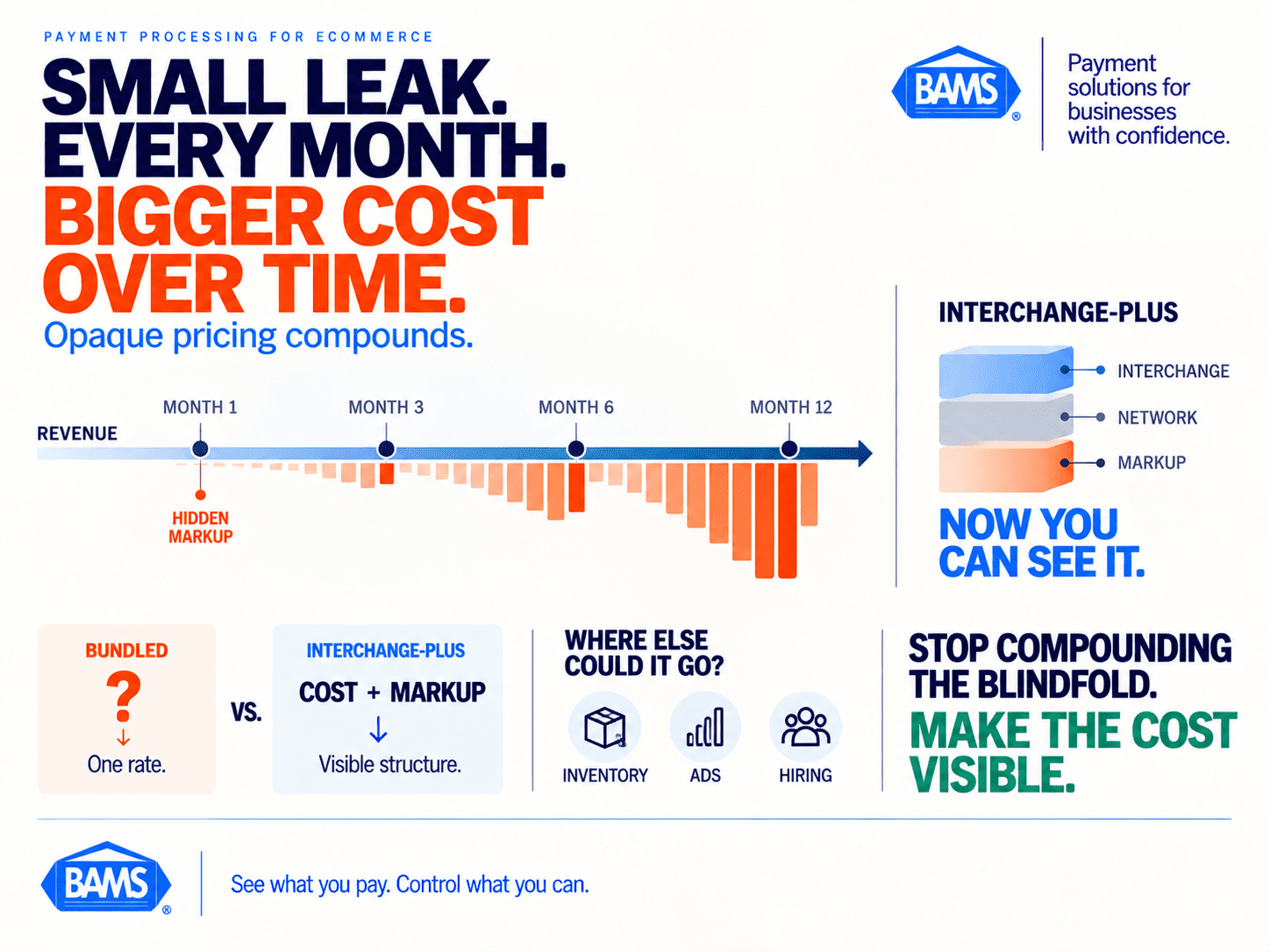
Modern BAMS featured graphic showing how small hidden payment processing costs accumulate over time and how interchange-plus pricing makes processor markup visible.
Why Tiered Pricing Became the Default (and Why It Stuck)
Tiered and bundled pricing models became popular for a simple reason: they’re easy to sell. One rate. One line on the statement. No need to explain interchange categories or network assessments. For processors, it’s a clean pitch. For merchants, it feels simple.
And for a long time, that simplicity seemed like enough. When your monthly volume was modest and your margins were wide, overpaying by a fraction of a percent didn’t register as pain. The statement arrived, the number looked roughly right, and you moved on.
But “roughly right” has a cost. Nilson Report found that U.S. merchants paid $187.20 billion in fees to accept $11.902 trillion in card payments in 2024, up from $172.05 billion in processing fees the year before. At that scale, even relatively small differences in pricing structure can translate into meaningful costs for merchants.
The Real Problem Isn’t the Rate. It’s the Blindfold.
Here’s what we actually believe: interchange-plus pricing isn’t a better deal. It’s a different operating system for how you manage cash leaving your business. The shift matters not because you save a few basis points today, but because you gain the ability to see, forecast, and control processing costs every month going forward.
How Interchange-Plus Pricing Changes the Math on Payment Optimization
Let’s make this concrete. On a tiered model, a processor might quote you a “qualified rate” of 2.9%. That sounds straightforward until you realize that debit transactions, which carry interchange as low as $0.22 per transaction, are getting lumped in at the same rate as premium rewards cards. You’re subsidizing the processor’s margin on every low-cost transaction without knowing it.
With interchange-plus, you see the actual interchange cost (set by the card networks, not your processor) plus a fixed markup. That fixed markup is the only part your processor controls. Suddenly, you can tell the difference between what Visa charges and what your processor charges. That visibility is the foundation of real payment optimization.
The Compounding Effect Nobody Talks About
Hidden processing costs do not disappear because they are difficult to see. As payment volume grows, repeated overpayment can compound while reducing the working capital available for inventory, marketing and hiring.
Consider an eCommerce business processing $150,000 per month. On a tiered model hiding 40 to 60 basis points of excess margin, that’s $600 to $900 per month in fees you can’t identify, question, or negotiate. Over a year, that’s $7,200 to $10,800. Over three years, it’s enough to fund a new hire, a product launch, or a significant ad campaign.
Interchange itself is also not one universal rate. Mastercard explains that interchange qualification can depend on factors including merchant category, the time between authorization and clearing, enhanced transaction data and merchant sales and transaction volume. With interchange-plus pricing, those underlying costs are separated from the processor’s markup, making changes easier to identify and evaluate. That visibility also gives you a clearer basis for improving how transactions qualify, including through the checkout and payment optimization strategies available to your business.
Predictability Is a Cash Flow Tool
The anxiety most eCommerce managers describe isn’t about the total cost of processing. It’s about not knowing what the cost will be next month. Tiered pricing makes that number a moving target because the processor decides which “tier” each transaction falls into, often after the fact.
Interchange-plus eliminates that guesswork. The interchange is published by the card networks. The markup is fixed. You can model your processing costs against projected revenue with actual precision. For teams managing inventory purchases, payroll, and ad spend on tight timelines, that predictability matters more than a marginal rate reduction.
This is where deposit speed amplifies the effect. The Federal Reserve has noted that faster access to customer payments can help businesses manage working capital tied up in inventory and reduce their need for short-term financing. When you pair transparent pricing with faster deposit timing, you’re not just improving visibility into fees. You’re also shortening the period between earning revenue and having that cash available for inventory, payroll and growth.
Partners like BAMS structure their merchant services around this combination: interchange-plus pricing with next-day deposits and a dedicated account manager who can walk you through your statement line by line. That pairing turns payment processing from a cost center you tolerate into a cash flow lever you actually manage.
What Changes If You Stop Treating Pricing as a Feature
If this thesis is right, then every month you stay on a bundled or tiered model, you’re not just overpaying. You’re making decisions (about inventory, hiring, marketing spend) based on cash flow numbers that are less accurate than they should be. You’re planning around a variable you could make predictable but haven’t.
The cost isn’t just the excess fees. It’s the opportunity cost of slower decisions, thinner margins, and the quiet erosion of confidence in your own numbers. When your processing costs are a black box, your P&L has a blurry line right in the middle of it. Every forecast built on top of that line inherits the blur.
For eCommerce operators in the 10 to 50 employee range, where every dollar of working capital gets deployed, that blur is expensive. It shows up as hesitation on a purchase order, a delayed campaign, or a restock that arrives two weeks late because you weren’t sure the cash would clear in time.
A New Way to Think About Your Processor Relationship
Stop evaluating your payment processor on rate alone. Evaluate them on visibility. The question isn’t “what’s my rate?” The question is: “Can I see exactly what I’m paying, why I’m paying it, and when my money arrives?”
Think of your pricing model as the operating system for your cash flow, not a line item on a vendor contract. An opaque pricing model is like running your finances on a spreadsheet where someone else controls the formulas. Interchange-plus hands you the formula. What you do with that transparency (optimize card mix, negotiate markups, choose a gateway that supports faster funding) is where the compounding starts working in your favor.
The Delay Is the Decision
You don’t need to overhaul your entire payment stack tomorrow. But understand that staying on a pricing model you can’t read is itself a choice, and it’s one that costs more every month as interchange rates climb and your volume grows.
Switching pricing models isn’t a payment upgrade. It’s a cash flow decision that compounds every month you delay it. The best time to make it was last year. The second best time is before your next statement arrives.
Frequently Asked Questions
What makes interchange-plus pricing more transparent than tiered pricing?
Interchange-plus separates the card network’s cost (interchange) from your processor’s markup, so you can see exactly what each party charges. Tiered pricing bundles everything into broad rate categories that obscure where your money actually goes.
How does switching pricing models affect cash flow management for eCommerce businesses?
Predictable, visible processing costs let you forecast cash flow with more accuracy, which means faster decisions on inventory, payroll, and marketing spend. Combined with faster deposit timing, the effect on working capital compounds over time.
When should an eCommerce merchant conduct a payment processing audit?
If you can’t identify your processor’s exact markup on your most recent statement, you’re overdue. A good starting point is comparing your effective rate (total fees divided by total volume) against published interchange tables for your card mix.


