
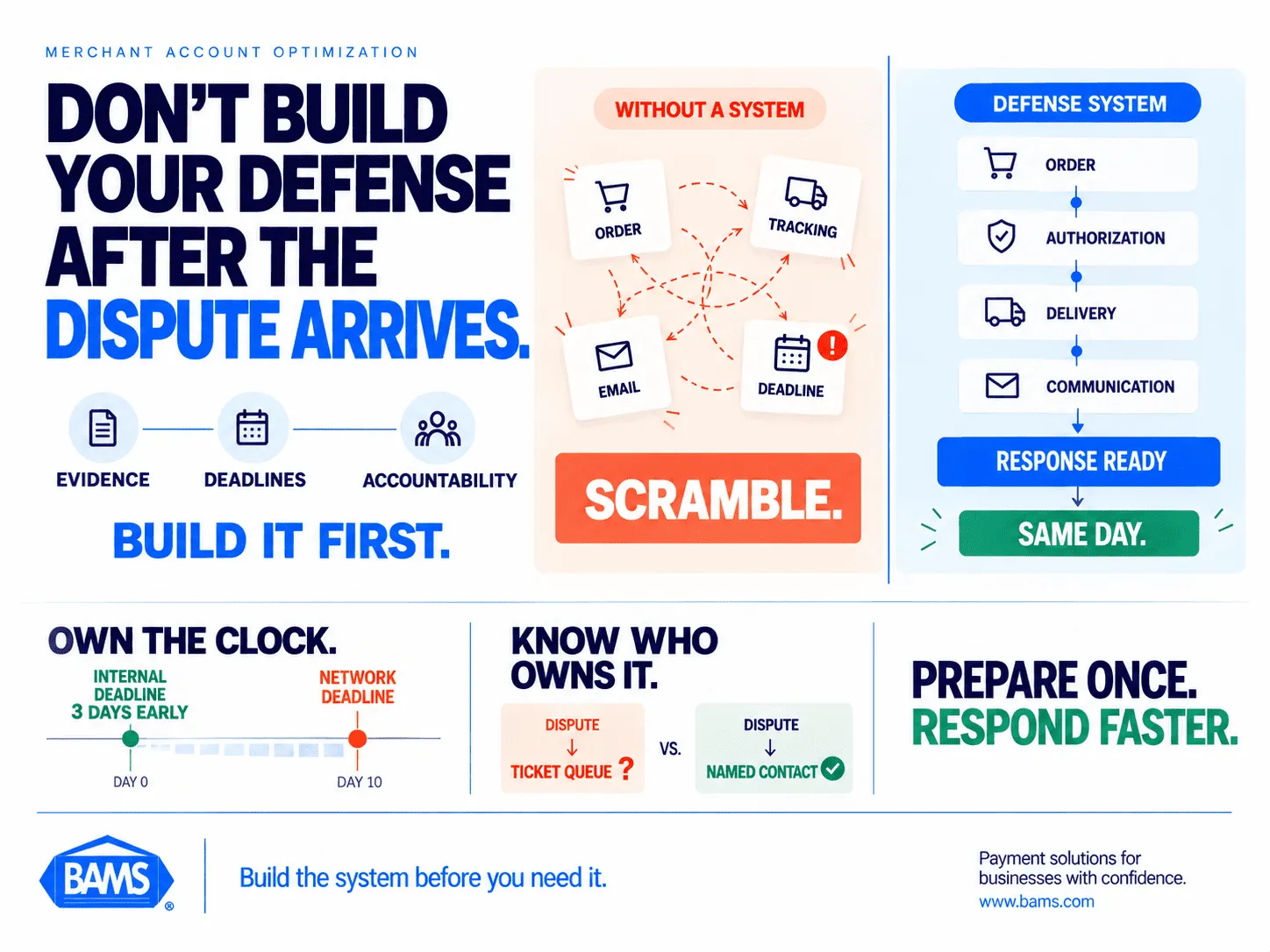
Merchant Account Optimization: Build a Chargeback Defense System
A step-by-step tutorial for eCommerce operators who want to win disputes with documentation, timing, and processor accountability
Learn how to build a repeatable chargeback defense process that includes pre-built evidence templates, card network deadline maps, and processor accountability checklists. This tutorial turns reactive scrambles into same-day responses that protect your revenue.
TL;DR
- Build your defense before the dispute arrives – Create reusable evidence folder templates and rebuttal letters for the five most common chargeback reason codes so you can respond in under an hour instead of scrambling for days.
- Own your timeline – Chargeback response windows vary by network and acquirer. Track the exact deadline supplied with every dispute and set your internal deadline several days earlier so evidence can be reviewed before submission.
- Test your processor’s accountability – Score your payment partner on notification speed, response time, named contacts, evidence submission clarity, and win rate support. If they score below 15 out of 25, they are costing you money.
- Pre-transaction documentation wins disputes – AVS/CVV verification, click-to-agree policies at checkout, and automated order confirmation emails create the evidence trail that defeats friendly fraud claims before they gain traction.
- Review monthly, improve continuously – Track dispute volume, response times, outcomes and reason codes every month. Mastercard estimates merchants incur an average of $128 per chargeback in internal and third-party costs before merchandise or service losses, so even modest dispute volume deserves attention.
What You Will Achieve: A Repeatable Chargeback Defense System

The best time to organize chargeback evidence is before a dispute arrives. A repeatable defense system turns scattered records and tight deadlines into a structured same-day response process.
By the end of this tutorial, you will have a documented, step-by-step chargeback dispute process that you can execute every time a dispute hits your account. You will know exactly what evidence to collect, when to submit it, and how to evaluate whether your payment partner is actually helping you win. This is merchant account optimization applied to one of the most expensive problems in eCommerce: friendly fraud chargebacks that drain revenue and consume hours of staff time.
Your success criteria are concrete. You will have a pre-built evidence folder template, a response timeline mapped to card network deadlines, and a clear accountability checklist for your processor. If a chargeback lands tomorrow morning, you will respond the same day rather than scrambling for a week.
Prerequisites and Setup
Before you begin, confirm you have the following in place. Missing any one of these will slow your response or weaken your case.
- Access to your payment gateway dashboard (Authorize.net, Stripe, NMI, or whichever gateway your processor provides)
- Access to your eCommerce platform’s order management (Shopify, WooCommerce, BigCommerce, or similar)
- Shipping carrier account access with tracking and delivery confirmation records
- A shared drive or folder system (Google Drive, Dropbox, or similar) where your team can store dispute evidence
- Your processor’s chargeback notification email or portal login
- Your current processor’s contact information and average response time for support tickets
Time estimate: Initial setup takes 2 to 3 hours. Each future dispute response should take 30 to 60 minutes once your system is built. Potential blocker: if you cannot reach your processor’s chargeback team within 24 hours, that gap alone may cost you winnable disputes.
Why This Approach Works (and Why Most Operators Lose)
Chargeback defense works best when transaction records and supporting evidence are organized before a dispute arrives. Mastercard recommends collecting transaction details, delivery confirmation, refund or return policies, AVS and CVV results and relevant customer correspondence in advance so merchants can respond quickly when a dispute is received.
Deadlines also require close attention. Mastercard notes that the acquiring bank provides the merchant’s actual response deadline and that chargeback dispute deadlines are typically 20 to 45 days after the merchant is notified. Because the applicable timeframe can vary, use the deadline supplied by your acquirer or processor and maintain an earlier internal deadline for your team.
Step-by-Step: Build Your Chargeback Defense System
Chargeback defense works better as a repeatable operating system than as an emergency response. These ten steps organize the evidence, timing and accountability needed for each dispute.
Step 1: Audit Your Current Chargeback Notification Flow
Action: Log into your payment processor’s dashboard and locate the chargeback or dispute section. Find the most recent dispute notification and note three things: (1) the date the chargeback was filed by the cardholder, (2) the date you were notified, and (3) the response deadline listed.
Expected result: You should see a gap of 1 to 5 days between the filing date and your notification date. If the gap is longer than 3 days, your processor is eating into your response window. Write down the average notification delay for your last five disputes.
Common failure: Some processors send chargeback alerts only via email, and those emails land in spam or go to an old address. Check your spam folder and confirm the correct email is on file. If your processor does not offer real-time alerts, that is a red flag worth addressing in Step 8.
Step 2: Create Your Evidence Folder Template
Action: In your shared drive, create a master folder called “Chargeback Defense.” Inside it, create a subfolder template with these labeled documents:
- Order confirmation (screenshot of the order details page from your eCommerce platform)
- Payment authorization log (transaction ID, AVS match result, CVV match result)
- Shipping confirmation and tracking (carrier name, tracking number, delivery confirmation screenshot)
- Customer communication log (emails, chat transcripts, support tickets related to the order)
- Refund or return policy (the version the customer agreed to at checkout)
- Product description page (screenshot showing what the customer saw before purchasing)
Expected result: A reusable folder structure you can duplicate for every new dispute. Each folder should take under 5 minutes to populate if your records are organized.
Common failure: Operators store order data across three or four systems and cannot pull it together quickly. If your eCommerce platform, shipping dashboard, and email client are not bookmarked and accessible to whoever handles disputes, fix that now.
Step 3: Map Your Response Timeline to Card Network Deadlines
Action: Create a simple timeline document with these columns: Dispute Received Date, Acquirer Deadline, Internal Deadline, Evidence Submitted Date and Outcome. Use the exact response deadline supplied by your processor or acquiring bank for each case. Mastercard notes that network rules and timeframes vary and that merchants must submit their evidence by the deadline provided by the acquirer.
Set your internal deadline several days earlier than the stated deadline so your team has time to review the evidence package and correct any missing documentation.
- Visa: 30 calendar days from the dispute notification date
- Mastercard: 45 calendar days from the chargeback date (but your acquirer may impose a shorter window of 10 to 35 days)
Expected result: A tracking sheet that shows you, at a glance, every open dispute and how many days remain. Set your internal deadline 3 days before the actual deadline to give yourself a buffer.
Common failure: Relying on your processor to remind you of deadlines. Many large processors send a single notification and no follow-up. Own your calendar.
Step 4: Write Your Rebuttal Letter Template
Action: Draft a rebuttal letter template that covers the five most common friendly fraud reason codes: “product not received,” “product not as described,” “unauthorized transaction,” “duplicate charge,” and “subscription not canceled.” Each template should include placeholders for order number, customer name, transaction date, and evidence references.
Expected result: Five rebuttal templates saved in your Chargeback Defense folder. When a dispute arrives, you select the matching template, fill in the transaction-specific details and attach the relevant evidence from Step 2. The goal is to reduce preparation time by organizing the evidence before a dispute occurs rather than rebuilding the process for every case.
Common failure: Writing vague, emotional rebuttals. Card networks evaluate evidence, not frustration. Keep your language factual: “Order #12345 was delivered on [date] to the address provided. Attached: signed delivery confirmation from [carrier].”
Step 5: Strengthen Your Pre-Transaction Documentation
Action: Review your checkout flow and confirm that these elements are visible and recorded:
- A checkbox or click-to-agree for your refund and return policy (with a timestamp in your system)
- AVS (Address Verification Service) enabled on your gateway
- CVV required for all card-not-present transactions
- Order confirmation email sent automatically with itemized details
- Clear product descriptions and images that match what ships
Expected result: Every order generates a paper trail before it even ships. This is the foundation of your defense. Nearly half of surveyed merchants reported that friendly fraud accounted for 50% or more of their chargebacks. Pre-transaction documentation is your strongest weapon against “I didn’t authorize this” claims.
Common failure: Having a return policy page that exists but is not linked at checkout. If the customer never explicitly agreed to it, the policy carries less weight in a dispute. Make the agreement step part of your checkout flow, not a buried footer link.
Step 6: Test Your Processor’s Response Time
Action: Submit a support ticket or call your processor’s chargeback team right now. Ask a specific question: “What is the exact process for submitting chargeback evidence, and what file formats do you accept?” Start a timer when you submit the request.
Expected result: You should receive a substantive answer (not an auto-reply) within 4 hours during business hours. The answer should include specific instructions, not a generic FAQ link. Note the response time and the quality of the answer.
Common failure: Getting routed to a general support queue that has no chargeback expertise. If the person who answers cannot explain reason codes or evidence requirements, your processor is not equipped to support your defense. This is a critical evaluation point. When a dispute deadline is 7 days away and your processor takes 48 hours to respond to a basic question, you are already losing.
Step 7: Establish an Escalation Protocol with Your Processor
Action: Ask your processor for a named contact for chargeback disputes. Not a department, not a ticket queue, but a person. Request their direct email and phone number. If your processor cannot provide this, document that refusal.
Expected result: A direct line to someone who knows your account and can act on urgent disputes. This is where the difference between a faceless national processor and an accountable partner becomes measurable.
For operators using BAMS, this step is built into the relationship: every merchant gets a dedicated account manager who handles chargeback defense proactively rather than reactively. If your current processor cannot match that level of access, it is worth evaluating whether the cost of switching is lower than the cost of losing disputes you should win.
Common failure: Accepting “we’ll get back to you” as an escalation path. During a chargeback with a 7-day window, “we’ll get back to you” is functionally the same as “you lose.”
Step 8: Score Your Payment Partner on Accountability
Action: Using the data you gathered in Steps 1, 6, and 7, score your current processor on these five criteria. Rate each from 1 (poor) to 5 (excellent):
- Notification speed: How quickly do you learn about new disputes?
- Response time: How fast does their chargeback team answer questions?
- Named contact: Do you have a dedicated person, or just a ticket queue?
- Evidence submission process: Is it clear, documented, and easy to use?
- Win rate support: Does your processor provide guidance on building stronger cases?
Expected result: A score out of 25. If your processor scores below 15, the system you built in Steps 1 through 7 will still help, but you are working against your own partner. A score below 10 means your processor is actively costing you money. Consider this your trigger to explore alternatives that prioritize transparent pricing and dedicated support.
Step 9: Automate What You Can
Action: Set up the following automations to reduce manual work:
- Auto-forward chargeback notification emails to a dedicated disputes inbox monitored by your team
- Create a calendar alert that fires 3 days before every dispute deadline
- Set your eCommerce platform to auto-archive order confirmation emails and shipping notifications in a searchable format
Expected result: Disputes land in the right inbox, deadlines are visible, and evidence is pre-organized. You should never miss a notification or deadline because of a process gap.
Common failure: Over-automating. Automated chargeback response tools can help with volume, but they often submit generic evidence. Your rebuttal templates from Step 4, customized with order-specific details, will outperform a fully automated response in most cases.
Step 10: Run a Monthly Chargeback Review
Action: On the first business day of each month, pull your dispute tracking sheet from Step 3 and review total disputes received, disputes responded to on time, disputes won, disputes lost and average response time. Calculate your own win rate by reason code and compare it month over month. The most useful benchmark is whether your evidence quality and outcomes are improving within your own transaction mix.
Expected result: A monthly snapshot that shows whether your system is working. If your win rate is below 30%, review your evidence quality and rebuttal letters. If it is above 40%, your system is outperforming most eCommerce operators. Either way, this review gives you data to hold your processor accountable in quarterly business reviews.
Common failure: Skipping the review because “we only had two chargebacks this month.” Mastercard reports that merchants incur an average of $82 in internal costs and $46 in third-party costs per chargeback, for a combined $128 before accounting for the potential loss of merchandise or services. Even relatively low dispute volume can therefore create recurring operational costs worth monitoring.
Configuration and Customization for Your Business
Your evidence folder template and rebuttal letters should reflect your specific business model. Here are the key variables to adjust:
- Digital products: Replace shipping confirmation with download logs, IP address records, and access timestamps. Include screenshots showing the customer accessed the product.
- Subscription businesses: Add the subscription agreement, renewal notification emails, and cancellation policy. Show that the customer was notified before each billing cycle.
- High-ticket items ($500+): Add signature-required delivery confirmation and consider requiring photo ID verification at checkout. The higher the transaction amount, the stronger your evidence needs to be.
- International orders: Include customs documentation and extended shipping timelines in your rebuttal. International disputes often cite “not received” when the package is still in transit.
Safe defaults: AVS and CVV verification should always be enabled. Order confirmation emails should always be sent. These are non-negotiable. Must-change settings: your rebuttal letter templates, evidence types, and merchant account configuration should match your product type and customer base.
Verification and Testing
Test procedure: Pick a recent order (one that was not disputed) and run it through your system as if it were a chargeback. Pull the evidence, populate the folder template, fill in the rebuttal letter, and check how long the entire process takes. If it takes more than 60 minutes, identify the bottleneck and fix it.
Success definition: You can assemble a complete evidence package for any order within 45 minutes. Your rebuttal letter is specific, factual, and references attached documentation. Your tracking sheet has the correct deadline and your processor’s submission process is documented.
Edge cases to verify: Test with a guest checkout order (no customer account), an order with a partial refund already issued, and an order shipped to a different address than the billing address. These three scenarios cover the most common evidence gaps.
Common Errors and Fixes for Merchant Account Optimization
Error: “Dispute response rejected: insufficient evidence”
Symptom: Your processor or the card network rejects your rebuttal without reviewing it. Cause: You submitted a written explanation without supporting documents. Fix: Always attach at least three pieces of evidence: transaction authorization data, delivery confirmation, and customer communication. A letter alone is never enough.
Error: “Response deadline expired”
Symptom: You receive a notification that the dispute was auto-resolved in the cardholder’s favor. Cause: The notification arrived late, or you did not see it in time. Fix: Implement the auto-forwarding and calendar alerts from Step 9. If your processor consistently delivers late notifications, that is a deal-breaking service failure. Evaluate whether switching to a partner with proactive communication and faster processing would protect your revenue.
Error: “Fraud or dispute activity is triggering monitoring”
Symptom: Your processor warns that your fraud or dispute performance is approaching or exceeding a card-network monitoring threshold. Cause: Network monitoring frameworks change over time and may consider more than a simple chargeback percentage. Visa’s current Visa Acquirer Monitoring Program evaluates fraud and dispute activity through defined program metrics at the acquirer and merchant level. Fix: Confirm the exact metric triggering the warning with your processor, strengthen pre-transaction documentation, improve fraud controls and analyze the dispute reasons contributing to the problem.
Error: “Cannot reach chargeback support”
Symptom: You call or email your processor’s support team and receive no response within 24 hours. Cause: Your processor routes chargeback inquiries through a general support queue with no specialized staff. Fix: This is not a technical problem. It is a partnership problem. Document the response failure, calculate the revenue at risk, and use that data in your next conversation about business cost savings when evaluating alternative processors.
Next Steps and Extensions
Now that your chargeback defense system is built, here are three ways to extend it:
- Add fraud scoring at checkout. Use your gateway’s built-in fraud tools (or a third-party service) to flag high-risk orders before they ship. Preventing a chargeback is always cheaper than fighting one.
- Negotiate lower reserve requirements. A documented, improving chargeback win rate gives you leverage to negotiate better terms with your processor, including lower rolling reserves and reduced security-related costs.
- Build a customer communication sequence. Send proactive emails at key moments (order confirmation, shipping update, delivery confirmation, satisfaction check-in) to reduce “I never received this” disputes before they start.
Your dispute system is only as strong as the partner standing behind it. If your processor cannot meet the accountability standards you defined in Step 8, the system you built today gives you the data and the framework to make a confident switch.
Frequently Asked Questions
How long do I have to respond to a chargeback dispute?
The deadline depends on the network, dispute type and your acquiring bank or processor. Mastercard states that the acquiring bank provides the merchant’s response deadline and that deadlines are typically 20 to 45 days after the merchant is notified. Always use the deadline shown on the specific dispute notice and set an earlier internal deadline so your evidence can be reviewed before submission.
What evidence do I need to win a chargeback dispute?
At minimum, you need three types of documentation: transaction authorization data (AVS and CVV match results), proof of delivery (tracking number and delivery confirmation), and customer communication (emails, chat logs, or support tickets). For “product not as described” disputes, include screenshots of your product listing. For subscription disputes, include the subscription agreement and renewal notifications the customer received.
When should a business consider using merchant account optimization services?
Consider optimization when your chargeback ratio is climbing, your win rate on disputes is below 30%, or your processor takes more than 24 hours to respond to chargeback-related questions. These are signs that your current setup is costing you money through lost disputes, excessive fees, or both. A dedicated merchant services partner can often reduce these losses through proactive defense and transparent pricing structures.
Why do merchants lose most chargeback disputes?
The primary reasons are incomplete evidence, missed deadlines, and generic rebuttal letters. Many merchants also lack organized records, so they spend hours gathering documentation and still submit a weak case. According to industry data, merchants spend an average of 2 to 5 hours per dispute. Building a reusable evidence template and rebuttal letter system cuts that time significantly and improves the quality of each submission.
What is friendly fraud and how common is it?
Friendly fraud occurs when a legitimate customer makes a purchase and then disputes the charge with their bank, often claiming they did not authorize the transaction or did not receive the product. According to the Merchant Risk Council’s 2024 Chargeback Field Report, nearly half of surveyed merchants said friendly fraud accounted for 50% or more of their chargebacks. Nearly three-quarters of merchants reported an 18% average increase in friendly fraud over the past three years.
How do I evaluate whether my payment processor is helping or hurting my chargeback defense?
Score your processor on five criteria: notification speed, response time to chargeback questions, availability of a named contact (not just a ticket queue), clarity of the evidence submission process, and whether they provide guidance on building stronger cases. A score below 15 out of 25 suggests your processor is a liability. A score below 10 means they are actively costing you revenue and it is time to explore alternatives with dedicated account management.


