Why Delayed Payment Deposits Hurt eCommerce Cash Flow
Last Updated on October 6, 2026 by Dimitri Akhrin
The hidden cash flow tax nobody warned you about—and how payment gateway insights can fix it
Discover why delayed deposits aren’t technical necessities but business model choices. Learn how improving authorization rates directly impacts customer retention and cash flow.
TL;DR
- Delayed deposits aren’t technical necessities – They’re business model choices that benefit processors, not merchants
- Float is the hidden cost – Money sitting in transit earns interest for someone, and it’s not you
- Authorization rates directly impact retention – Failed transactions lose customers; smooth payments keep them
- Reframe the relationship – Your processor should be a partner whose success depends on your cash flow improving, not stalling
The Real Reason Your eCommerce Cash Flow Feels Broken
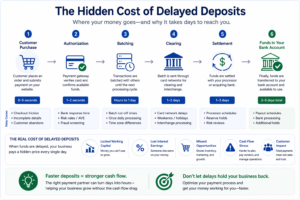
Delayed deposits create hidden costs through lost cash flow, missed opportunities, and capital locked in transit.
You did everything right. The sale closed. The customer clicked “confirm.” The money should be yours.
Yet here you are, three days later, still waiting for funds to hit your account. Meanwhile, payroll looms, inventory needs restocking, and that marketing campaign you planned sits frozen because the cash isn’t actually there.
This isn’t a minor inconvenience. It’s the hidden tax on growth that nobody warned you about.
The Industry Told You Deposits Just Take Time
Somewhere along the way, eCommerce managers accepted delayed deposits as a cost of doing business.
According to Visa, modern payment systems are designed to process transactions securely while maintaining speed and reliability.
“Standard processing takes 2-5 business days.” We’ve all heard it. We’ve all shrugged and moved on.
The reasoning seemed logical: fraud prevention requires time, banks need to verify transactions, and the system is complex. These explanations made delayed deposits feel inevitable, like weather you couldn’t control.
This acceptance made sense when eCommerce was young and margins were fat. But the game has changed. What worked in 2015 is actively hurting you now.
Here’s What I Actually Believe
Delayed deposits aren’t a technical necessity. They’re a business model choice your payment processor made without asking you. One of the biggest causes of delay is fragmented systems, where your checkout, processor, and bank operate separately. An integrated payment gateway reduces these handoffs, allowing transactions to move faster from authorization to settlement by using next day funding without unnecessary delays or additional fees.
The companies holding your money for days aren’t doing it because they have to. They’re doing it because float (the interest earned on money sitting in limbo) adds up. Your cash flow problem is their revenue stream. According to the Federal Reserve, interchange structures and settlement processes significantly impact how quickly funds reach merchants.
Following the Money Trail
Let me show you what I mean. When a customer completes a purchase on your site, the authorization happens in seconds. The payment gateway verifies the card, confirms available funds, and locks in the transaction almost instantly.
So why does the money take days to reach you?
The technical answer involves batch processing and settlement windows. The honest answer is that most processors batch transactions once daily and then take their time moving funds because speed costs them money and slowness earns it.
Here’s the math that should make you uncomfortable. If your business processes $500,000 monthly and your processor holds funds for an average of 3 days, that’s roughly $50,000 perpetually locked in transit. At current interest rates, someone’s earning on that float. It’s not you.
The payment gateway insights that matter most aren’t about fancy features or integration options. They’re about understanding who benefits from the current arrangement and whether that arrangement actually serves your business.
I’ve watched eCommerce managers obsess over conversion rate optimization, A/B testing button colors, and tweaking checkout flows. Meanwhile, the money from those hard-won conversions sits in someone else’s account, earning interest for someone else’s business.
Growth isn’t coming from innovation that benefits merchants. It’s coming from volume, from more transactions flowing through systems designed decades ago.
Authorization Rate Improvement Changes Everything
Here’s where payment gateway insights connect directly to your bottom line. Every declined transaction isn’t just a lost sale. It’s a customer who might not come back.
Authorization rate improvement sounds technical, but the impact is deeply human. A customer tries to buy. The transaction fails. They feel embarrassed, frustrated, or confused. They leave. Maybe forever.
The best customer retention methods aren’t loyalty programs or email sequences.
- They’re invisible.
- They’re transactions that work the first time, every time.
- They’re funds that arrive when expected so you can fulfill orders without delay.
PayPal’s recent expansion into digital assets and stablecoins alongside traditional cards isn’t just about offering options. It’s about reducing the friction points where customers abandon purchases or transactions fail.
The Cost of Ignoring This
If what I’m describing is true, the implications for your business are significant.
Every day you accept delayed deposits as normal, you’re financing your processor’s operations with your revenue. Every authorization failure you don’t investigate is a customer relationship you’re letting slip away.
The PCI Security Standards Council highlights that strong compliance and fraud controls are essential to protect transactions without introducing unnecessary delays.
The processors using “fraud prevention” to justify delays are often the same ones leaving you exposed to actual fraud. Speed and security aren’t opposites. That’s a false choice designed to keep you compliant.
Your competitors who figure this out first will operate with better cash flow, faster fulfillment, and stronger customer retention. The gap compounds over time.
A Different Way to Think About Payment Processing

Integrated payment systems reduce delays by aligning processing, settlement, and funding into a faster, more efficient flow.
Stop thinking of your payment processor as a utility, like electricity or internet. Utilities deliver the same service regardless of provider.
Think of payment processing as a partnership where incentives either align or conflict. If your provider benefits from holding your money longer, you’re paying more than just fees. You’re paying with your cash flow.
This is why more established businesses are moving toward transparent interchange-plus pricing, where costs are clear and funding speed becomes part of the conversation—not an afterthought.
The processors worth partnering with are the ones who compete on speed because they’ve built business models that don’t depend on float. They offer next-day funding not as a premium add-on but as a standard because they understand that your success is their success.
This reframe changes which questions you ask. Instead of “what are your fees?” you ask “when do I get my money?” Instead of “what features do you offer?” you ask “what happens when something goes wrong?”
The Deposits Aren’t the Problem
Delayed deposits are a symptom. The underlying issue is a payment infrastructure built to serve processors, not merchants.
You can keep optimizing around the edges, squeezing pennies from transaction fees while dollars drain from your cash flow. Or you can recognize that the entire arrangement deserves scrutiny.
Your business runs on cash, not promises. The money your customers pay you should be your money, working for your business, as fast as the technology actually allows.
That’s not a radical position. It’s just honest.
Frequently Asked Questions
What are faster deposit strategies in merchant services?
Faster deposit strategies involve choosing processors that offer next-day or same-day funding as standard, not premium add-ons. The key is finding partners whose business model doesn’t depend on holding your funds.
How can I improve my payment authorization rates?
Start by analyzing where declines happen and why. Often, authorization rate improvement comes from offering multiple payment methods, ensuring your gateway routes transactions optimally, and working with processors who actively help resolve recurring decline patterns.
What role does fraud protection play in payment optimization?
Effective fraud protection should speed up legitimate transactions, not slow everything down. Modern systems can verify transactions in milliseconds while blocking actual threats, so “fraud prevention” shouldn’t be an excuse for delayed deposits.
Sources
- Visa – Payment Processing
- PCI Security Standards Council – Merchant Security
- Federal Reserve – Interchange Fees