
7 Payment Processor Fees Quietly Delaying Your Deposits
The merchant agreement terms creating timing gaps between your dashboard revenue and your bank balance
Learn the seven contractual variables hidden in your merchant agreement that shift when and how much money lands in your account. This guide helps eCommerce operators diagnose deposit timing issues and improve fee reconciliation.
TL;DR
- Your dashboard shows gross, your bank gets net – Settlement deductions for fees, refunds, chargebacks, reserves, and holdbacks are subtracted before your deposit is calculated, and they’re often spread across separate reports.
- Batch close timing shifts your deposit by a full day – If your platform’s auto-batch runs after your processor’s cutoff, that day’s sales roll into the next settlement window.
- Rolling reserves can restrict working capital – Acquirers may withhold part of settlement proceeds to cover chargeback or credit risk. The amount, review process and release conditions depend on your merchant agreement rather than a universal industry percentage.
- Fee debit schedules create phantom cash flow swings – Some processors net fees daily, others debit monthly. The difference changes how your bank balance behaves even when total costs are the same.
- Start with three variables, not seven – Map your net settlement deductions, batch close timing, and reserve clause first. These explain most of the mismatch between your dashboard and your bank.
Why Your Bank Balance Never Matches Your Dashboard

Your dashboard reports gross revenue. Your bank receives the result after deductions, holds and settlement timing rules. Understanding what happens between those two numbers makes deposit reconciliation much easier.
You close out a strong sales day, check your dashboard, and see the numbers you expected. Then you log into your bank account the next morning and the deposit is off. Sometimes by a little. Sometimes by a lot. The mismatch triggers a familiar spiral: scanning transaction logs, cross-referencing refunds, wondering if something got lost in transit.
Most eCommerce operators assume the gap is a processing delay or a platform glitch. It’s rarely either. The real cause is usually buried in your merchant agreement terms, where a handful of contractual variables quietly shift when and how much money actually lands in your account. These aren’t bugs. They’re features of how payment processor fees, reserves, and settlement netting work behind the scenes.
The problem isn’t that your processor is broken. The problem is that nobody told you where to look.
What This List Covers (and What It Doesn’t)
This guide is for eCommerce managers at small-to-midsize businesses who handle cash flow planning without a dedicated finance team. If you’ve ever stared at a deposit that didn’t match your gross sales calculation, this is for you.
We’re not covering multi-system ERP reconciliation or enterprise-grade treasury management. Instead, we’re isolating the seven specific contractual and fee-level variables that create timing variance between your dashboard revenue and your bank deposit. Each one includes where to find it in your agreement, why it matters to your cash position, and what to do about it.
How We Selected These Seven Variables
Every item on this list meets three criteria. First, it’s a variable explicitly defined in standard merchant agreements (not a processor quirk or one-off error). Second, it directly affects either the amount or the timing of your deposit. Third, it’s something most operators overlook because it’s buried in legal language, not surfaced in dashboards. We reviewed published merchant agreement terms from multiple processors to identify the patterns that repeat across the industry.
7 Merchant Agreement Terms That Shift Your Deposit Timing
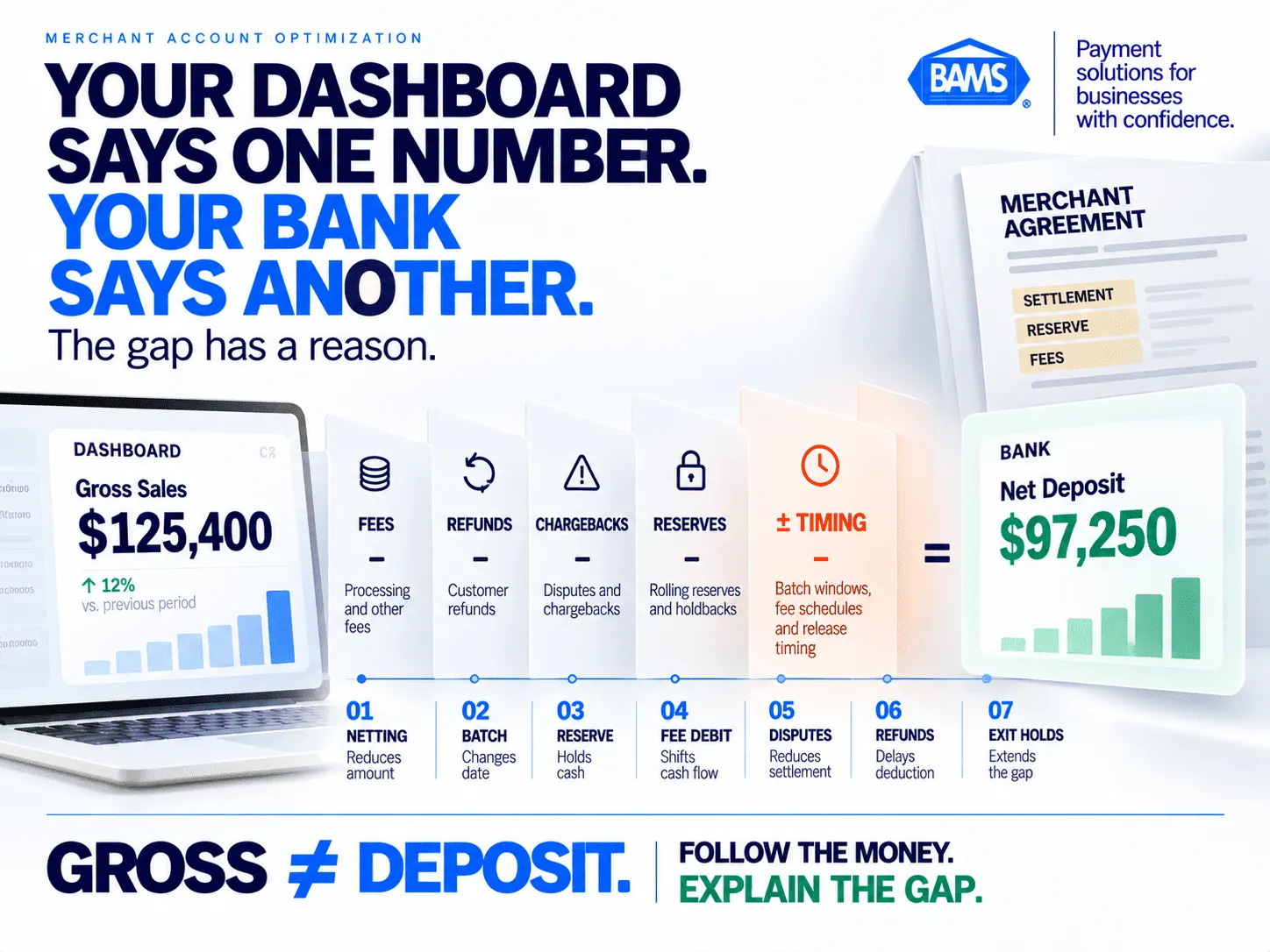
BAMS infographic explaining seven payment processing variables including settlement deductions, batch timing, reserves, fee schedules, disputes, refunds and post-termination holds.
1. Net Settlement Deductions
Why it matters: Your dashboard may show gross transaction activity while the amount ultimately deposited reflects settlement adjustments and processing costs. Authorize.Net explains that after a batch settles, the merchant service provider deducts applicable fees before depositing the remaining funds into the merchant account. Refunds, chargebacks and reserve activity can create additional differences that need to be reconciled separately.
What it looks like today: Most processor dashboards display gross transaction volume prominently. The deductions are often spread across separate reports or buried in monthly statements, making bank deposit matching unnecessarily difficult.
How to apply it: Pull your most recent settlement statement and list every deduction category. Compare that list against your merchant agreement’s settlement clause. If you can’t account for every line item, start with a structured fee reconciliation process to isolate what’s being netted and when.
2. Batch Close Timing and Settlement Windows
Why it matters: Your deposit timeline is affected by when captured transactions enter a settlement batch. Authorize.Net explains that captured transactions are automatically batched after the account’s Transaction Cut-Off Time and that the cutoff determines which transactions belong to each settlement period. Cutoff times and subsequent funding schedules vary by gateway and merchant service provider, so verify the exact settings that apply to your account.
What it looks like today: Many eCommerce platforms auto-batch at end of day, but “end of day” varies by processor, time zone, and platform configuration. A sale at 10 PM might settle a full day later than a sale at 8 PM.
Banking-day timing matters after the batch is released as well. Nacha explains that ACH credits can settle the same banking day, the next banking day or up to two banking days later and that ACH settlement does not currently occur on weekends or federal holidays. Because acquiring banks commonly use ACH credits to pay merchants, weekends and holidays can create timing differences even when the processor has already initiated settlement.
How to apply it: Find the batch cutoff time in your agreement or ask your processor directly. Align your platform’s auto-batch schedule to close before that cutoff. Even a one-hour adjustment can shift an entire day’s revenue forward by 24 hours. For a deeper look at daily settlement timing, see this daily deposit reconciliation guide.
3. Rolling Reserve Holdbacks
Why it matters: Reserve requirements can make part of your processed revenue temporarily unavailable. The OCC explains that acquirers may establish merchant reserve or holdback accounts to mitigate chargeback and credit risk and may fund those reserves by withholding a portion of a merchant’s daily proceeds. The amount withheld, review process and release terms depend on the merchant agreement and the merchant’s risk profile.
What it looks like today: Reserves are common for newer merchants, businesses in higher-risk categories, or accounts with elevated chargeback ratios. The reserve percentage and release schedule are defined in your agreement, but many operators sign without negotiating these terms.
How to apply it: Locate the reserve clause in your agreement. Note the percentage, the hold duration, and the release conditions. If your chargeback rate has improved since you signed, request a reserve reduction or elimination. This is a negotiable term, not a fixed rule.
4. Fee Debit Timing Misalignment
Why it matters: Your sales settle on one schedule. Your fees may be debited on a completely different one. ANZ’s 2024 merchant agreement states that merchant fees and charges are debited on the 12th of each month or the next business day. That means your daily deposits look clean for weeks, then a single large debit pulls fees for the entire prior month.
What it looks like today: Some processors deduct fees daily (netted from each settlement). Others debit monthly from your bank account. The difference creates wildly different cash flow patterns, even if the total fees are identical.
How to apply it: Review your merchant agreement and monthly statement to determine when processing fees, monthly charges and other assessments are collected. If significant fees are debited separately from daily settlements, add those dates to your cash flow forecast and verify each debit during your monthly processor audit.
5. Chargeback and Dispute Holds
Why it matters: Chargebacks can reduce funds available to a merchant and create settlement differences that are easy to miss if dispute activity is reviewed separately from deposit reconciliation. The OCC identifies chargebacks as a core merchant-processing risk and notes that acquirers may use merchant-funded reserves or holdbacks to protect against chargeback exposure.
What it looks like today: Chargeback deductions are typically netted from the next available settlement. If multiple disputes land on the same day, a single deposit can look dramatically wrong. The Moneris agreement confirms that holdbacks can cover chargebacks, fines, and fees, and that repayment only occurs after all obligations are satisfied.
How to apply it: Check your chargeback and dispute reports on the same cadence as your deposit reconciliation. Match every short deposit against open disputes. If chargebacks are a recurring source of timing variance, consider working with a processor like BAMS that offers proactive chargeback defense and dedicated account management to reduce dispute volume before it hits your cash flow.
6. Refund Processing Lag
Why it matters: Refunds issued today may not be deducted from your settlement today. The lag depends on your processor’s refund netting schedule, which can range from same-day to several business days. During that gap, your dashboard shows the refund as processed, but your bank balance hasn’t reflected the deduction yet. The mismatch reverses the usual problem: your bank temporarily looks higher than it should.
What it looks like today: Operators who issue refunds in batches (after a promotion or product recall) often see a delayed but significant settlement drop days later. This makes it hard to trust either your dashboard or your bank balance on any given day.
How to apply it: Track refund issuance dates separately from refund settlement dates. Your processor’s settlement report should show when refunds were actually netted. Use this data to build a rolling cash position that accounts for refunds in transit, not just refunds issued.
7. Post-Termination Liability and Reserve Release Conditions
Why it matters: Ending a processor relationship does not necessarily mean every reserve or settlement obligation disappears immediately. The OCC specifically addresses procedures for refunding merchant reserves according to the terms of the merchant agreement. Outstanding chargebacks, liabilities and contractual reserve conditions can therefore affect the timing of your final available balance.
What it looks like today: Many operators switch processors to get better rates or faster funding without reviewing the termination and post-termination clauses in their current agreement. They’re surprised when a significant portion of their revenue stays locked up after the switch.
How to apply it: Before switching processors, review your current agreement’s termination clause. Note the reserve release timeline, any early termination fees, and the conditions for final settlement. Factor these into your transition plan so you’re not operating with a cash gap during the switch.
The Pattern Behind the Mismatch
All seven variables share a common trait: they create a gap between when you think you have your money and when you actually do. Net settlement deductions reduce the amount. Batch timing, reserves, and fee debiting shift the date. Chargebacks and refunds introduce unpredictable variance. Post-termination holds extend the gap beyond the relationship itself.
The deeper issue is that most merchant agreements are designed to protect the processor’s cash position, not yours. Every clause that adds a deduction, a hold, or a delay is a contractual mechanism that keeps your revenue in someone else’s account for longer. Treating these as isolated annoyances misses the point. Together, they form a system that structurally delays your access to working capital.
The operators who manage cash flow well aren’t the ones with the fewest problems. They’re the ones who’ve mapped every variable in their agreement and built their forecasting around the actual settlement schedule, not the dashboard number.
Where to Start: Prioritizing Your Fee Reconciliation Audit
You don’t need to tackle all seven variables at once. Start with three. First, identify your net settlement deductions and verify every line item against your agreement. Second, confirm your batch close timing and whether it aligns with your processor’s cutoff. Third, check whether you have a reserve clause and what the release conditions are.
These three steps will explain the majority of your timing variance. Once you’ve mapped them, layer in chargeback tracking, refund lag monitoring, and fee debit scheduling. If your current processor makes any of this difficult to see, that’s diagnostic information too. Transparent pricing and clear settlement reporting aren’t luxuries. They’re the baseline for predictable cash flow.
Frequently Asked Questions
What is deposit reconciliation in merchant services?
Deposit reconciliation is the process of matching the transactions your eCommerce platform reports against the actual deposits that land in your bank account. The goal is to verify that every sale, refund, fee, and chargeback is accounted for so you can identify discrepancies and understand your true cash position. For a step-by-step walkthrough, see this daily deposit reconciliation guide.
Why does my bank deposit never match my dashboard sales total?
Your dashboard typically shows gross sales, while your bank receives a net settlement after deductions for processing fees, refunds, chargebacks, reserves, and holdbacks. These deductions may also occur on different schedules (daily netting vs. monthly debiting), which creates timing variance even when the math is correct over a longer period.
Which factors can affect the timing of merchant service deposits?
The primary factors include batch close timing relative to your processor’s cutoff, rolling reserve holdbacks, fee debit schedules (daily vs. monthly), chargeback and dispute holds, refund processing lag, and post-termination reserve release conditions. All of these are typically defined in your merchant agreement.
How can I optimize my merchant services for better reconciliation?
Start by reading your merchant agreement’s settlement, reserve, and fee clauses. Align your batch close schedule with your processor’s cutoff time. Track refunds and chargebacks on the same cadence as your deposit reviews. If your processor doesn’t provide clear, itemized settlement reports, consider switching to one that prioritizes transparent pricing and reporting.
When should I perform deposit reconciliation for my merchant account?
Daily reconciliation is ideal for businesses processing significant volume. At minimum, reconcile weekly to catch discrepancies before they compound. Run a more thorough monthly audit to verify fee totals, reserve balances, and effective rates against your agreement terms.
What is a rolling reserve, and how long can my processor hold it?
A rolling reserve is money withheld from settlement proceeds to protect against potential chargeback or credit exposure. The OCC notes that acquiring banks may fund reserve accounts by withholding part of a merchant’s daily proceeds and that reserve balances and review procedures should be evaluated over time. The percentage, duration and release conditions are specific to your merchant agreement.


