7 Chargeback Protection Signals Hiding in Your Data
Last Updated on November 10, 2026 by Dimitri Akhrin
Your Transaction Data Is Warning You Before Your Processor Does
Reserves feel like a penalty, but they rarely arrive without warning. These chargeback protection signals show up in your transaction data weeks or months before your processor adjusts your terms. Watch for a creeping refund rate, a cluster of disputes tied to one product category or a subtle shift in average order value. These are early indicators that your chargeback exposure is building quietly.
For established eCommerce businesses in growth mode, the consequences are significant. A rolling reserve that locks up 5% to 10% of your monthly volume can freeze tens of thousands of dollars in cash flow. That often happens exactly when you need that capital to fund inventory, marketing and hiring. The irony is that growth itself creates the conditions for reserve escalation, because higher volume amplifies small problems into processor-level concerns.
This guide focuses on the chargeback protection signals that precede reserve increases. It also covers concrete steps to reduce your reserve requirements as you scale.
TL;DR
- Reserves are driven by data patterns you can see first – Refund velocity, dispute clustering and chargeback ratio trends show up in your data first. Your processor adjusts your terms weeks later. Monitor weekly, not monthly.
- Friendly fraud is a fast-growing reserve driver – Nearly half of merchants estimate friendly fraud accounts for 50%+ of chargebacks. It grew 18% on average over three years. Build refund monitoring systems to catch repeat offenders early.
- Documentation turns dispute losses into reserve reductions – Complete transaction records (delivery confirmation, AVS/CVV data, customer communications) help you win disputes. Wins recover revenue and raise the dispute win rate that risk teams weigh in reserve reviews.
- Proactive processor communication changes the math – Quarterly reviews with your processor’s risk team turn operational improvements into actual reserve reductions. Bring your own dispute and refund data. Waiting for them to contact you means the decision is already made.
- Start with three actions – Weekly chargeback ratio tracking, dispute clustering analysis and scheduled processor reviews give you the highest-leverage path to reducing reserves as you grow.
Who This Is For and What It Covers
This is for eCommerce managers at businesses processing enough volume that a reserve hold creates real cash flow pressure. You already have a processor relationship, a functioning checkout and a team handling fulfillment. You are not a high-risk merchant by category; you are a growing business encountering reserves during a scaling phase.
This list does not cover high-risk industry compliance (gambling, CBD, adult content) or basic fraud prevention 101. Instead, it maps the specific data patterns that trigger reserve escalation. It also shows you how to build a track record that earns reduced holds over time.
How These Signals Were Selected
Each item was chosen based on two criteria. First, it directly influences a processor’s reserve calculation. Second, a mid-market eCommerce team can act on it with the data and tools it already has. These are not theoretical risks. They are the variables underwriters and risk teams actually review when deciding whether to increase, maintain, or release your reserve.
7 Signals That Drive Reserve Requirements (and How to Manage Them)
1. Refund Velocity Trending Upward Without a Clear Cause
Why it matters: Processors watch refund rates as a leading indicator of future disputes. A refund is a resolved complaint; a chargeback is an unresolved one. When your refund rate climbs, your processor sees a business generating more customer dissatisfaction. It also expects some of those unhappy customers to skip your refund process entirely and go straight to their bank.
What it looks like today: The National Retail Federation and Happy Returns projected that U.S. retail returns would reach $890 billion in 2024, or 16.9% of annual sales. If your refund rate is rising faster than your own historical baseline without a corresponding increase in order volume or a seasonal explanation, it is a signal worth investigating.
How to apply it: Track your refund rate weekly as a percentage of gross transactions, not just as a dollar figure. Segment by product category and fulfillment method. Look for categories where refund rates exceed 15% and investigate root causes (sizing issues, misleading product images, shipping damage). Document the fixes you implement, because this documentation becomes negotiation leverage with your processor.
2. Dispute Clustering Around Specific Products or Time Windows
Why it matters: A 1% overall chargeback ratio might look acceptable. But if 80% of those disputes come from one SKU or one promotional period, your processor sees concentrated risk. Clustered disputes suggest a systemic problem, not random customer behavior and systemic problems are exactly what reserves are designed to protect against.
What it looks like today: Tracking disputes by product, service tier and timing shows you where risk concentrates. Timing tells a story too. A dispute filed long after delivery can point to friendly fraud, while one filed within days of purchase more often points to unauthorized use. Each pattern requires a different response.
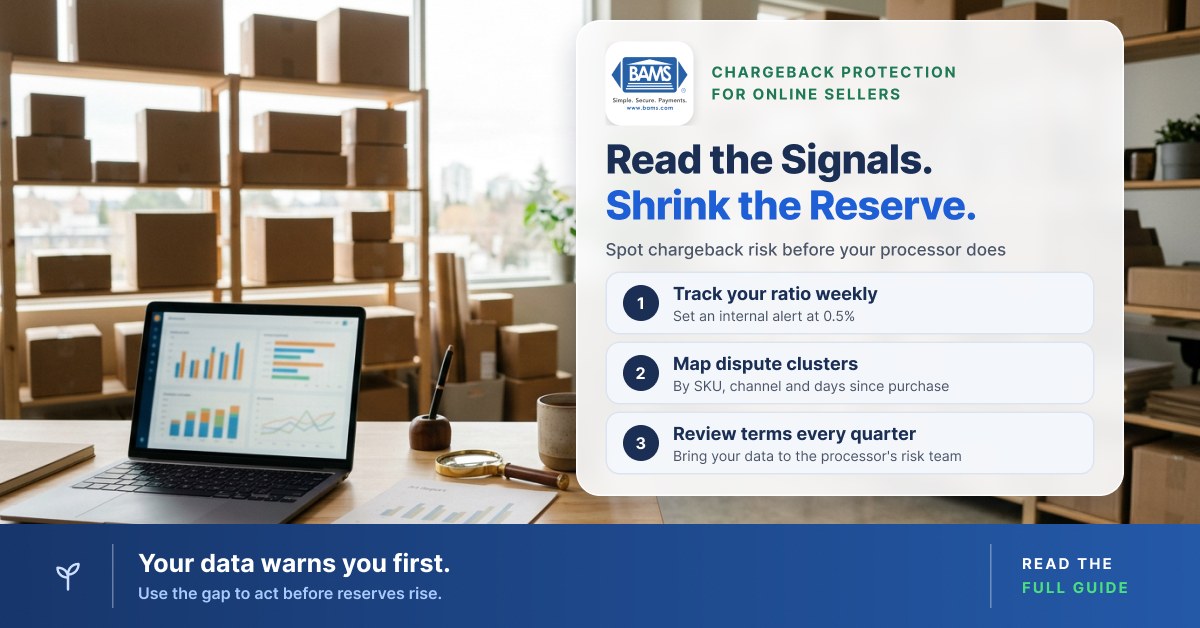
How to apply it: Build a monthly dispute map that tags each chargeback by SKU, acquisition channel and days-since-purchase. When clusters appear, address the root cause before your processor notices the pattern. If one product generates 40% of your disputes, consider pulling it, improving its description, or adding a confirmation step at checkout. For guidance on post-peak chargeback surge patterns, track your weekly chargeback ratio in the 30 to 60 days after high-volume periods.
3. Chargeback Ratio Approaching (Not Just Exceeding) Thresholds
Why it matters: Most merchants focus on the thresholds that trigger card network monitoring programs. Visa’s Acquirer Monitoring Program (VAMP), for example, counts fraud reports plus disputes against settled card-not-present transactions and its U.S. Excessive Merchant threshold dropped to 1.5% on April 1, 2026. But processors often adjust reserves well before that point. A ratio trending from 0.4% to 0.7% over three months tells a risk team that you are on a trajectory toward breach. They will act preemptively to protect themselves.
What it looks like today: Nearly half of surveyed merchants estimated that friendly fraud accounts for 50% or more of their chargebacks. This means your ratio is likely being inflated by disputes that are preventable with better documentation and communication, not by actual fraud.
How to apply it: Monitor your chargeback ratio weekly, not monthly. Set an internal alert at 0.5% so you have time to respond before your processor does. When you see the ratio rising, put prevention first. Resolving a dispute before it becomes a chargeback keeps it out of the count (Visa’s VAMP ratio excludes disputes resolved through pre-dispute solutions). Winning disputes with compelling evidence still matters, because it recovers revenue and raises the win rate risk teams review. Even so, chargebacks generally count toward network ratios whether you win or lose them. A step-by-step approach to reducing processor reserves through chargeback protection can guide your evidence-building process.
4. Average Transaction Value Shifting Without Explanation
Why it matters: A sudden increase in your average transaction value (ATV) is a fraud signal to processors. That holds even when it reflects legitimate business changes like launching a premium product line or bundling offers. Higher ATVs mean higher per-dispute exposure, which directly increases the financial risk a processor carries on your behalf.
What it looks like today: Many processors use automated risk scoring that weighs ATV changes against your historical baseline. If your ATV jumps 30% in a month without prior communication to your processor, their automated systems may flag your account for review. That can trigger a reserve increase before a human even looks at the context.
How to apply it: Notify your processor before launching products or promotions that will materially change your ATV. Provide context: “We are introducing a $500 product line that will increase our ATV by approximately 25% over the next quarter.” This proactive communication reframes the change as planned growth rather than a risk indicator. Keep records of these communications for future reserve negotiations.
5. Refund Monitoring Gaps That Let Friendly Fraud Compound
Why it matters: In Ethoca’s 2024 merchant survey, 67% of surveyed merchants routinely analyzed non-fraud chargebacks and 65% reviewed unusual patterns in customer order histories. Merchants who skip this work are more exposed to friendly fraud compounding into reserve increases. Without refund monitoring, repeat offenders exploit your return policy and each undetected instance adds to your dispute exposure.
What it looks like today: Nearly three-quarters of surveyed merchants reported an 18% average increase in friendly-fraud cases over the previous three years. This is not a stable baseline; it is an accelerating trend that directly affects your reserve terms.
How to apply it: Flag customers with more than two refund requests in 90 days for manual review. Cross-reference refund requests against delivery confirmation data. When you identify repeat offenders, document the pattern and share it with your processor as evidence that you are actively managing risk. Tools like BAMS’ Dispute Responder send immediate chargeback notifications and a clear action plan, giving your team time to respond and document the pattern.
6. Inconsistent or Missing Transaction Documentation
Why it matters: When a dispute arrives and you cannot produce delivery confirmation, customer communication records, or signed authorization, you lose the dispute by default. Every chargeback counts toward your ratio and a lost one also costs you the sale, the fee and a weaker win rate in reserve reviews. Poor documentation does not just cost you the disputed amount; it costs you cash flow for months through increased reserves.
What it looks like today: Declining too many good orders is one problem, but under-documentation of approved orders is equally damaging. Many mid-market teams have strong fraud screening at checkout but weak evidence collection post-purchase.
How to apply it: Audit your documentation chain for every order above your ATV. Ensure you capture: IP address at checkout, AVS and CVV match results, delivery confirmation with signature (for orders above $250) and any post-purchase customer communication. Store this data in a format that can be submitted as compelling evidence within 24 hours of a dispute notification. For broader eCommerce transaction security practices, review your PCI compliance and monitoring routines quarterly.
7. No Proactive Relationship with Your Processor’s Risk Team
Why it matters: Reserve decisions are not purely algorithmic. A risk analyst who knows your business model, seasonal patterns and growth plans reads your data differently. One seeing your account for the first time has less context. Merchants who communicate proactively with their processor earn more favorable reserve terms. It is not special treatment; they simply reduce the uncertainty that drives conservative risk decisions.
What it looks like today: Most eCommerce managers interact with their processor only when something goes wrong: a held payout, a reserve increase notification, a compliance warning. By that point, the reserve decision is already made. The merchants who successfully reduce reserves over time initiate quarterly reviews and share their dispute reduction metrics. They also request specific reserve adjustments tied to documented improvements.
How to apply it: Schedule a quarterly call with your processor’s risk or account management team. Bring data: your chargeback ratio trend, dispute win rate, refund rate by category and any operational changes you have made. Request a specific reserve adjustment (“We have maintained a 0.3% ratio for six months; can we move from 10% to 5%?”). If your processor does not offer this level of engagement, that itself is a signal to evaluate alternatives. BAMS, for example, provides dedicated account representatives, which makes it easier to keep reserve conversations proactive rather than reactive.

Watch these seven signals before your processor raises your reserve. Start with your weekly ratio, dispute clusters and quarterly reviews.
The Pattern Behind These Signals
Every chargeback protection signal on this list shares a common thread: it is visible in your data before it is visible to your processor’s risk team. The gap between when you can see a problem forming and when your processor acts on it is your window to intervene. Merchants who use that window effectively treat reserve management as an ongoing operational discipline, not a one-time negotiation.
The second pattern is that documentation and communication are force multipliers. A declining chargeback ratio is good. A declining chargeback ratio with a documented explanation of the operational changes that caused it is significantly more persuasive in a reserve review. Processors are not adversaries; they are counterparties managing their own risk. When you reduce their uncertainty, you reduce your reserves.
The tradeoff is time. Building these monitoring systems, maintaining documentation and conducting processor reviews requires consistent effort. But the alternative is having 5% to 10% of your revenue locked in a rolling reserve. That is a direct and ongoing cost that compounds as you grow.
Where to Start
You do not need to act on all seven chargeback protection signals at once. Start with the three that have the most immediate impact on your reserve terms:
- Weekly chargeback ratio tracking (Signal 3) gives you the earliest warning of trajectory changes.
- Dispute clustering analysis (Signal 2) identifies your highest-leverage fix by isolating the products or periods generating disproportionate disputes.
- Quarterly processor reviews (Signal 7) convert your operational improvements into actual reserve reductions.
Once these three chargeback protection signals are tracked, layer in refund velocity monitoring and documentation audits. The goal is not perfection across every metric. It is building a visible, documented track record that gives your processor confidence to release your funds faster. For a deeper look at processing cost triggers after peak season, review your pricing and reserve terms before your next high-volume period.
Frequently Asked Questions
What is reserve and hold management in merchant services?
Reserve management refers to how payment processors withhold a percentage of your transaction volume as a financial buffer against potential chargebacks and refunds. A rolling reserve typically holds 5% to 10% of each batch settlement for a set period (often 6 months), then releases the oldest funds on a rolling basis. Hold management involves monitoring these withheld amounts and understanding the terms that govern them. It also means working to reduce or eliminate them through improved dispute metrics and processor negotiation.
Why do payment processors withhold reserves from merchants?
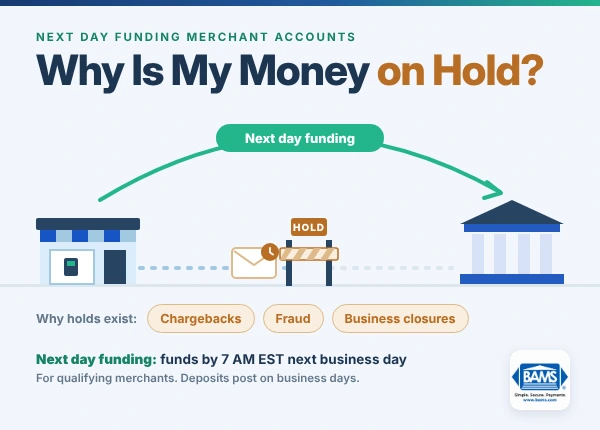
Processors carry financial liability when a merchant cannot cover chargebacks or refunds. If your business closes or cannot pay, the processor is responsible for those losses. Reserves act as collateral. The amount withheld is proportional to the processor’s perceived risk. That risk is driven by your chargeback ratio, refund rate, industry category, processing history and average transaction value. Higher perceived risk means higher reserves.
How do rolling reserves work in payment processing?
A rolling reserve withholds a fixed percentage of each day’s or week’s transaction settlements. It holds that money for a defined period, typically 90 to 180 days. After the holding period expires, the oldest funds are released back to you while new funds continue to be held. This creates a constantly replenishing pool. For example, with a 10% rolling reserve and a 180-day hold, funds from January settlements would be released in July. July settlements would then be held until January of the following year.
When can a merchant expect to have their reserves released?
Release timing depends on your reserve type and processor agreement. Rolling reserves release automatically after the holding period (typically 90 to 180 days). Fixed reserves (a lump sum held indefinitely) require a formal review and renegotiation. Most processors will review reserve terms after 6 to 12 months of consistent, low-risk processing. To accelerate release, maintain a chargeback ratio below 0.5%, document your dispute prevention improvements and request a formal reserve review with your processor’s risk team.
Which factors influence the percentage of reserves withheld by payment processors?
The primary factors are your chargeback ratio, refund rate, industry risk category, processing volume, average transaction value, time in business and processing history. Sudden changes in any of these (a spike in ATV, a new product category, rapid volume growth) can trigger reserve increases. Processors also consider your documentation practices, dispute win rate and how proactively you communicate about business changes.
How can merchants reduce their reserve requirements over time?
Watch the chargeback protection signals above and build a documented track record of low dispute rates, strong refund monitoring and proactive communication with your processor. Track your chargeback ratio weekly and keep it below 0.5%. Analyze dispute clusters to fix root causes. Maintain complete transaction documentation for compelling evidence submissions. Schedule quarterly reviews with your processor’s risk team and present your improvement data with specific reserve reduction requests. Consistent performance over 6 to 12 months gives you the strongest negotiating position.
Sources
- National Retail Federation: NRF and Happy Returns Report, 2024 Retail Returns to Total $890 Billion
- Visa: Visa Acquirer Monitoring Program Fact Sheet 2025
- Merchant Risk Council: 2024 Chargeback Field Report, Latest Trends and Impacts of Friendly Fraud
- Rivero: 2024 Chargeback Trends, Insights from Ethoca’s 2024 Outlook