
How to Evaluate Merchant Service Providers Brooklyn
Last Updated on October 1, 2026 by Dimitri Akhrin
A post-signing accountability framework for eCommerce operators tired of chasing lower rates
Learn how to evaluate merchant service providers based on responsiveness, error ownership, and operational transparency — not rate sheets. This guide gives eCommerce operators a structured framework for choosing payment partners who show up when funding stalls.
TL;DR
- Rates aren’t the real problem – Most eCommerce operators who switch processors discover that support quality, funding speed, and error resolution matter far more than a 10-basis-point rate difference.
- Test accountability before signing – Call the support line, present specific failure scenarios, and ask who your dedicated contact will be. The sales experience is not the support experience.
- Use the five-dimension framework – Evaluate processors on response architecture, error ownership, funding transparency, chargeback partnership, and contract integrity, not just pricing.
- Read the contract beyond the rate sheet – SLAs, termination clauses, rate adjustment provisions, and reserve policies define your actual recourse when things go wrong.
- Start with one action today – Call your current processor’s support line with a real question and time the experience. That single test will tell you whether you have a partner or just a vendor.
Guide Orientation: What This Covers and Who It’s For
This guide helps eCommerce managers evaluate merchant service providers based on what happens after you sign the contract, not before. If you’ve already switched payment processors once (or you’re considering it now), you know the pitch: lower rates, better technology, seamless integration. What you may not know is how to evaluate the thing that actually determines your day-to-day experience: accountability.
This is written for operators at established online businesses with 10 to 50 employees who process enough volume that a funding delay, an unresolved chargeback, or a silent support queue creates real financial pain. By the end, you’ll have a structured framework for evaluating payment partners on responsiveness, error ownership, and operational transparency.
While this guide focuses on provider accountability rather than payment security, merchants should still familiarize themselves with the resources available from the PCI Security Standards Council to understand their ongoing responsibilities for protecting payment data.
Why Choosing the Right Merchant Service Providers in Brooklyn (and Everywhere Else) Matters More Than Rates
The merchant services industry continues to evolve as businesses place greater emphasis on operational support, payment security, and long-term payment partnerships rather than pricing alone. That growth means more options for merchants, but also more noise. Every new entrant leads with the same promise: we’ll save you money on processing. And many of them will, at least on paper.
The problem surfaces after signing. When a batch fails to settle on a Friday afternoon, when a chargeback notification arrives with a 24-hour response window, or when your deposit simply doesn’t show up, the rate you negotiated becomes irrelevant. What matters is whether someone picks up the phone.
eCommerce operators lose revenue not because their processing rate is 15 basis points too high, but because their processor’s support model treats them like a ticket number. Delayed funding disrupts payroll. Unresolved chargebacks erode margins. Integration issues during peak season cost sales that never come back.
The cost of choosing a processor based solely on rate comparison is invisible until something breaks. And in payments, something always breaks eventually. The question isn’t whether you’ll need help. It’s whether help will be available, competent, and invested in your outcome when you do.
Core Concepts: Accountability vs. Service
What “Accountability” Actually Means in Payments
Service is answering the phone. Accountability is owning the outcome. A processor with good service will acknowledge your problem. An accountable partner will track it to resolution, communicate proactively during the process, and take responsibility when the error is on their side.
Most eCommerce operators have experienced service without accountability: a polite support agent who creates a ticket, escalates it to an unnamed team, and offers no timeline. That’s service. Accountability looks different: a named account manager who knows your integration, understands your transaction volume patterns, and can intervene directly with the acquiring bank or card network when something goes wrong.
The Rate Trap
Rate shopping is the default evaluation method for payment processors, and it’s not wrong. But it’s incomplete. Two processors can quote identical interchange-plus pricing and deliver wildly different experiences. One funds next day. The other holds deposits for 48 to 72 hours. One assigns a dedicated account manager. The other routes you to a general support queue. The rate is the same. The operational reality is not.
Local vs. National: A Framework, Not a Geography Lesson
When this guide contrasts “local” and “national” processor models, it’s describing a relationship structure, not just a zip code. A local-model provider, such as a Brooklyn merchant services provider, operates with direct relationships, named contacts and a business model built on retention through performance. A national-model provider operates at scale, prioritizing volume acquisition over individual merchant outcomes. Both can work. But only one is built for accountability.
The Accountability Framework: Five Dimensions That Matter After Signing

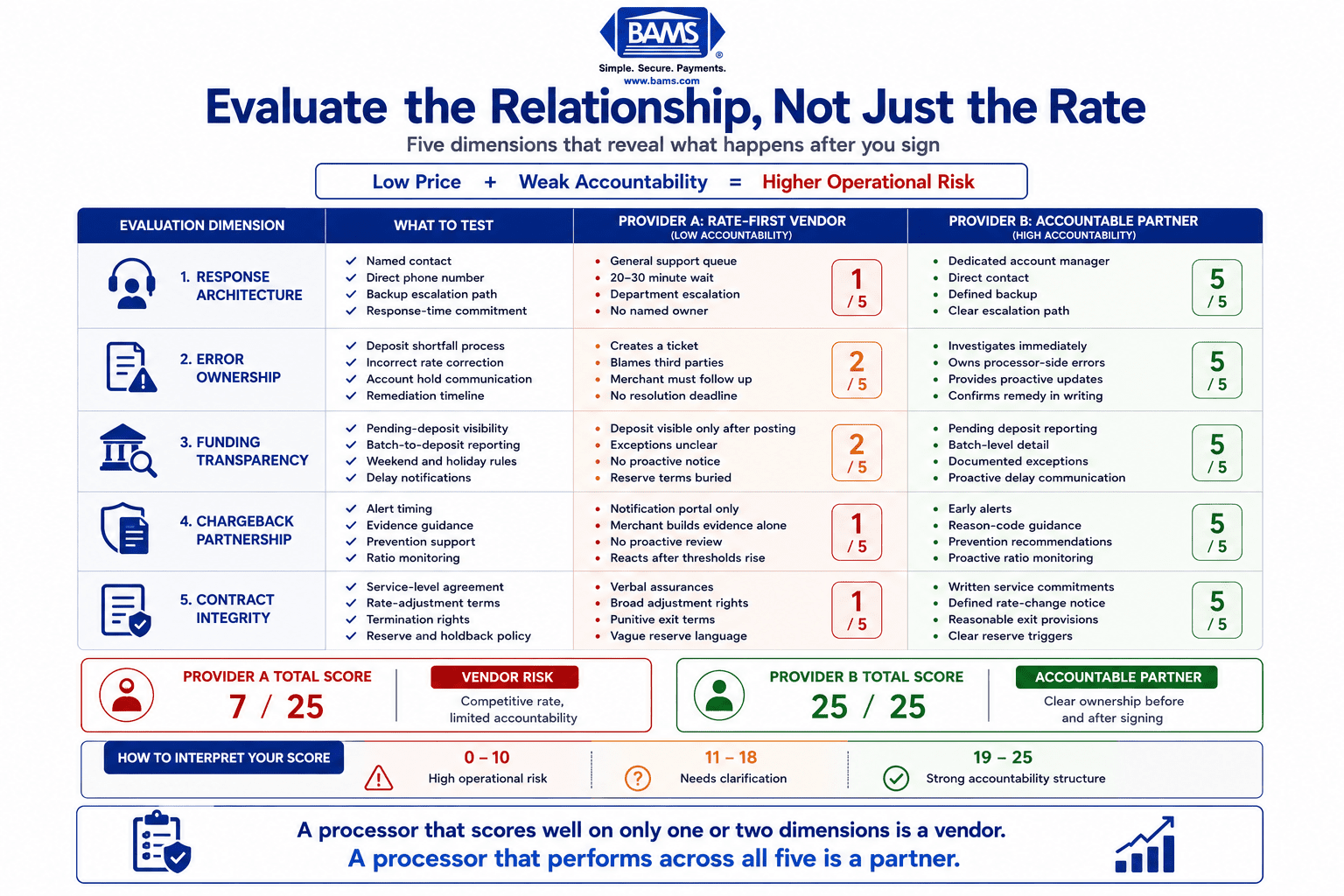
The right merchant service provider should be evaluated by how it responds when funding stalls, errors occur, or disputes require immediate action.
Instead of evaluating processors on features and rates alone, this guide uses a five-dimension framework designed to surface what your post-signing experience will actually look like. Each dimension corresponds to a step in the breakdown below.
- Response Architecture — How support is structured and who you actually reach
- Error Ownership — What happens when the processor makes a mistake
- Funding Transparency — How money moves and when you know about it
- Chargeback Partnership — Whether disputes are your problem or a shared one
- Contract Integrity — What the agreement actually commits the processor to do
These five dimensions are sequential in evaluation but simultaneous in practice. A processor that scores well on all five is a partner. A processor that scores well on one or two is a vendor. The distinction shapes everything.
Step-by-Step: How to Evaluate Payment Processor Changes Through the Accountability Lens
Step 1: Map the Response Architecture Before You Need It
Objective: Understand exactly who you’ll reach, how fast, and through what channels when something goes wrong.
Before signing with any processor, ask for the support structure in writing. Not the marketing version (“24/7 support!”) but the operational version. Who is your primary contact? What’s their direct number? If they’re unavailable, who is the backup? What’s the average response time for funding issues versus technical issues versus billing disputes?
Request a trial interaction. Call the support number during business hours and after hours. Note whether you reach a human or an IVR system. Time how long it takes. Ask a moderately technical question about batch settlement timing and evaluate whether the person who answers can address it or needs to escalate.
The distinction between dedicated account management and general support queues is not a luxury differentiator. It’s the difference between resolving a funding issue in hours versus days. Processors that assign named account managers are structurally more accountable because a specific person’s performance is tied to your satisfaction.
Anti-patterns: Accepting “we have great support” without testing it. Signing based on a sales rep’s responsiveness (sales and support are different teams with different incentives). Assuming chat-based support is equivalent to phone-based support for urgent financial issues.
Success indicators: You have a named contact with a direct line. You’ve tested the support channel and received a substantive answer within a reasonable window. The processor can describe their escalation path clearly.
Step 2: Stress-Test Error Ownership With Specific Scenarios
Testing realistic failure scenarios before signing reveals more about a payment provider than its rate sheet or sales presentation.
Objective: Determine whether the processor takes responsibility for their own mistakes or deflects to third parties.
Every processor makes errors. Batches fail. Deposits land in wrong amounts. Rate schedules get applied incorrectly. The question isn’t whether errors happen but what the processor does when they do. During your evaluation, present three specific scenarios and ask how each would be handled:
- A deposit is $2,000 short of what your transaction records show. What’s the investigation process and timeline?
- Your account is flagged for review and deposits are held without notice. Who initiates communication, you or them?
- A rate increase is applied that wasn’t in your original agreement. What’s the dispute process?
Listen for specifics. An accountable processor will describe a defined process with timelines. A non-accountable one will offer vague reassurances. Pay particular attention to whether the processor distinguishes between errors on their side (which they should remediate proactively) and errors on the network or issuing bank side (which they should still help you navigate).
Anti-patterns: Accepting “that rarely happens” as an answer. Failing to ask about error resolution because the sales conversation is going well. Confusing a processor’s willingness to discuss errors with their actual track record of resolving them.
Success indicators: The processor can describe specific remediation steps for each scenario. They acknowledge that errors occur and explain their internal accountability process. They provide references from current merchants who have experienced and resolved issues.
Step 3: Demand Funding Transparency, Not Just Speed
Objective: Verify that you’ll know where your money is at every stage of the settlement process, and that you’ll receive it on a predictable schedule.
Visa also publishes merchant resources explaining payment acceptance, transaction processing, and the movement of funds throughout the payment lifecycle, helping businesses better understand what happens between authorization and settlement. Learn more through Visa’s payment processing resources.
Funding speed matters. Next-day funding versus the traditional two-to-three-day hold can make a meaningful difference in cash flow, especially for eCommerce businesses with thin margins or seasonal inventory cycles. But speed without transparency is just a faster version of the same problem.
Ask your prospective processor these questions: Can you see pending deposits before they land? Will you receive notification if a deposit is delayed, and will that notification include a reason? Is there a dashboard or reporting tool that reconciles transactions to deposits in real time?
The best processors provide deposit-level detail that maps individual transactions to specific settlement amounts. This eliminates the guessing game that many eCommerce operators play every morning when they log into their bank account and try to figure out which batch just landed. Tools like BAMS, for example, pair next-day funding with dedicated account management so that when a deposit doesn’t match expectations, there’s a specific person to call who already has context on your account.
Anti-patterns: Evaluating funding speed without asking about funding visibility. Assuming all “next-day” programs are identical (some exclude weekends, holidays, or transactions above certain thresholds). Ignoring the processor’s reserve or holdback policies, which can silently reduce your effective funding speed.
Success indicators: You have access to real-time or near-real-time deposit reporting. The processor’s funding terms are documented with clear exceptions. You understand exactly when weekend and holiday transactions will settle.
Step 4: Evaluate Chargeback Partnership, Not Just Chargeback Tools
Objective: Assess whether the processor actively helps you fight and prevent chargebacks, or simply passes along notifications.
Chargebacks are one of the highest-friction areas in eCommerce payments. A single chargeback involves the card network, the issuing bank, the acquiring bank, and your processor. The process has strict deadlines, specific evidence requirements, and consequences (including account termination) for excessive chargeback ratios.
Most national-scale processors handle chargebacks by forwarding the notification to you and providing a portal where you can upload evidence. That’s the minimum. An accountable partner does more: they alert you before the deadline becomes urgent, advise on what evidence is most effective for the specific reason code, and in some cases, prepare the representment on your behalf.
Ask prospective processors: What’s your chargeback notification method and timeline? Do you provide guidance on evidence submission, or just a portal? Do you offer any proactive chargeback prevention (alerts, fraud screening, descriptor optimization)? What happens if my chargeback ratio approaches the card network threshold?
The difference between a processor that treats chargebacks as your problem and one that treats them as a shared problem is significant. The former costs you time, revenue, and potentially your processing account. The latter functions as financial consulting for merchants, helping you build defenses rather than just absorbing losses.
Anti-patterns: Evaluating chargeback support based on the existence of a portal rather than the quality of guidance. Ignoring chargeback prevention in favor of chargeback response. Failing to ask about the processor’s own chargeback ratio thresholds and what happens if you exceed them.
Success indicators: The processor provides proactive alerts with actionable guidance. They can describe specific strategies for reducing chargebacks in your business category. They have a defined process for helping you respond to disputes, not just a self-service portal.
Step 5: Read the Contract for Accountability Clauses, Not Just Pricing
Objective: Identify what the processor is contractually obligated to deliver beyond rates, and what recourse you have if they don’t deliver it.
Most merchants read the pricing section of their processing agreement carefully and skim everything else. This is understandable but costly. The sections that determine your post-signing experience are the ones most merchants skip: service level commitments, termination clauses, fee adjustment provisions, and dispute resolution procedures.
For a broader understanding of merchant processing relationships, settlement responsibilities, and operational risk management, the Office of the Comptroller of the Currency’s Merchant Processing Handbook provides guidance on how merchant acquiring relationships are managed within the banking system.
Look for these specific elements in any processing agreement:
- Service Level Agreement (SLA): Does the contract specify response times for support inquiries? Uptime guarantees for the gateway? Funding timelines with penalties for non-compliance?
- Rate Lock or Adjustment Terms: Can the processor raise your rates with 30 days’ notice? 60 days? No notice? Is there a cap on annual increases?
- Termination Provisions: What’s the early termination fee? Is there a liquidated damages clause? Can you leave without penalty if the processor fails to meet SLA commitments?
- Reserve and Holdback Rights: Under what conditions can the processor hold your funds? For how long? What triggers a reserve, and what releases it?
A processor confident in their service will offer clear SLAs with defined remedies. A processor that avoids service commitments in the contract is telling you something important: they don’t want to be held accountable.
Anti-patterns: Signing a contract without reading the termination clause. Assuming verbal promises from the sales rep are enforceable. Ignoring the reserve policy because “it probably won’t apply to me.”
Success indicators: The contract includes specific, measurable service commitments. Termination terms are reciprocal (you can leave if they underperform, not just if you choose to). Rate adjustment provisions include notice periods and caps.
Practical Examples: Two Scenarios, Two Outcomes
Scenario A: The Friday Afternoon Funding Failure
An eCommerce brand processing $400,000 per month notices at 3 PM on Friday that their Thursday batch (approximately $18,000) hasn’t settled. They need those funds to cover a supplier payment due Monday morning.
With a national-model processor: The merchant calls the 1-800 number, navigates an IVR menu, waits 22 minutes, and reaches a generalist agent who creates a ticket. The agent explains that the “funding team” will investigate, but they don’t work weekends. The merchant receives an email Monday afternoon confirming the deposit will arrive Tuesday. The supplier payment is late. A 2% late fee applies. Total cost: $360 in late fees plus the operational stress and supplier relationship damage.
With a relationship-model processor: The merchant texts their dedicated account manager directly. The manager checks the batch status within 15 minutes, identifies a flagged transaction that paused the entire batch, removes the flag, and confirms the deposit will land Saturday morning. The supplier payment goes out on time. Total cost: zero.
Same processing rate. Same interchange. Entirely different outcome.
Scenario B: The Chargeback Surge
A seasonal eCommerce business experiences a spike in chargebacks after a holiday promotion. Their chargeback ratio climbs from 0.4% to 0.9%, approaching the 1% threshold that triggers card network monitoring programs.
With a notification-only processor: The merchant receives automated chargeback alerts via email. Each alert contains a deadline and a link to a portal. No guidance on evidence strategy. No analysis of why chargebacks spiked. The merchant loses seven of nine disputes because the evidence submitted didn’t match the reason code requirements. Their ratio hits 1.1%. The processor issues a warning letter.
With an accountable partner: The account manager notices the ratio trend before the merchant does and calls proactively. They analyze the reason codes, identify that most are “product not as described” disputes tied to a specific SKU from the promotion, and recommend descriptor changes plus enhanced product photography. They help prepare representment packages for the existing disputes, winning five of nine. The ratio stabilizes at 0.7%. No monitoring program. No warning letter.
Common Mistakes and Pitfalls When Evaluating Payment Processor Changes
Chasing the lowest rate without testing support. A rate that’s 10 basis points lower saves you $1,000 on $1 million in volume. A single unresolved funding delay can cost more than that in a week. Evaluate the full cost of the relationship, not just the line item.
Confusing technology with accountability. A sleek dashboard doesn’t mean someone is watching it on your behalf. Self-service tools are valuable, but they’re not a substitute for a human who knows your business and intervenes when patterns shift.
Ignoring the transition itself. Switching processors is operationally complex. Gateway migrations, recurring billing updates, and PCI re-validation all carry risk. Ask your prospective processor how they manage the transition, not just what life looks like after it.
Assuming all “dedicated support” is equal. Some processors assign “dedicated” account managers who handle 500 accounts. Others assign managers who handle 50. The word is the same. The experience is not. Ask how many accounts your manager handles.
Evaluating based on the sales experience. The sales team’s job is to close you. The support team’s job is to keep you. These are different teams with different skills and different incentives. Test the support experience independently before signing.
What to Do Next
Start with one action: call your current processor’s support line with a real question and time the experience. Note who answers, how long it takes, and whether they resolve your issue or escalate it. That single data point will tell you more about your current relationship than any rate comparison.
If the experience confirms what you already suspect, use the five-dimension framework from this guide to evaluate alternatives. Request specific answers to the scenarios outlined in Step 2. Test the support channel as described in Step 1. Read the contract provisions outlined in Step 5 before you sign anything.
You don’t need to switch processors today. But you do need to know whether your current partner is one you can hold accountable. If they’re not, the cost of staying is accumulating quietly, in delayed deposits, lost disputes, and hours spent navigating support queues instead of growing your business. The right time to evaluate is before the next crisis, not during it.
Frequently Asked Questions
How do I know if my current payment processor is actually accountable?
Test it. Call your support line with a real issue and note three things: how long it takes to reach a human, whether that person can address your question directly, and whether they follow up without you chasing them. If you can’t name your account manager or reach them directly, that’s a clear signal. Accountability isn’t a feature on a website. It’s a pattern of behavior you can observe.
Are lower processing rates ever worth switching for?
Yes, but only when the rate difference is significant enough to offset the operational risk and cost of switching. A 10 to 15 basis point reduction on moderate volume may save a few thousand dollars annually. If the new processor has weaker support, slower funding, or less chargeback assistance, those savings can evaporate in a single bad month. Evaluate rates as one factor within the full accountability framework, not as the deciding factor.
What should I look for in a processing contract beyond pricing?
Focus on four areas: service level agreements (response times and uptime guarantees), rate adjustment provisions (how and when they can raise your rates), termination clauses (early termination fees and conditions for penalty-free exit), and reserve or holdback rights (when they can hold your funds and for how long). These clauses define your recourse if the relationship underperforms. Avoiding common contract mistakes can save you from expensive surprises later.
Is a local merchant services provider always better than a national one?
Not always, but the structural advantages are real. A local-model provider typically offers direct relationships with named contacts, faster escalation paths, and a business model built on retention rather than volume acquisition. The key distinction isn’t geography but relationship density. Ask whether you’ll have a dedicated account manager, how many accounts they handle, and whether you can reach them directly. Those answers matter more than the provider’s mailing address.
How long does it typically take to switch payment processors?
A well-managed transition takes two to four weeks for most eCommerce businesses, depending on integration complexity. This includes gateway migration, recurring billing updates, PCI re-validation, and testing. The risk isn’t the timeline itself but the support you receive during it. Ask your prospective processor to describe their onboarding and migration process in detail, including who manages it and what happens if something breaks during the cutover.
What’s the real cost of delayed funding for an eCommerce business?
Beyond the obvious cash flow impact, delayed funding creates secondary costs: late fees on supplier payments, missed inventory purchasing windows, payroll stress, and the operational time spent investigating the delay. For a business processing $300,000 to $500,000 monthly, even a two-day funding delay can tie up $20,000 to $30,000 at any given time. Next-day funding eliminates this drag and makes cash flow predictable rather than reactive.
Sources
- https://finance.yahoo.com/news/merchant-providers-market-report-2025-161600775.html
- https://www.bams.com/about-us/
- https://www.bams.com/blog/the-importance-of-great-customer-service-in-the-merchant-industry/
- https://www.bams.com/blog/why-merchants-need-a-payment-processor-offering-next-day-funding/
- https://www.bams.com
- https://www.bams.com/blog/mistakes-to-avoid-when-choosing-a-payment-processor/


