

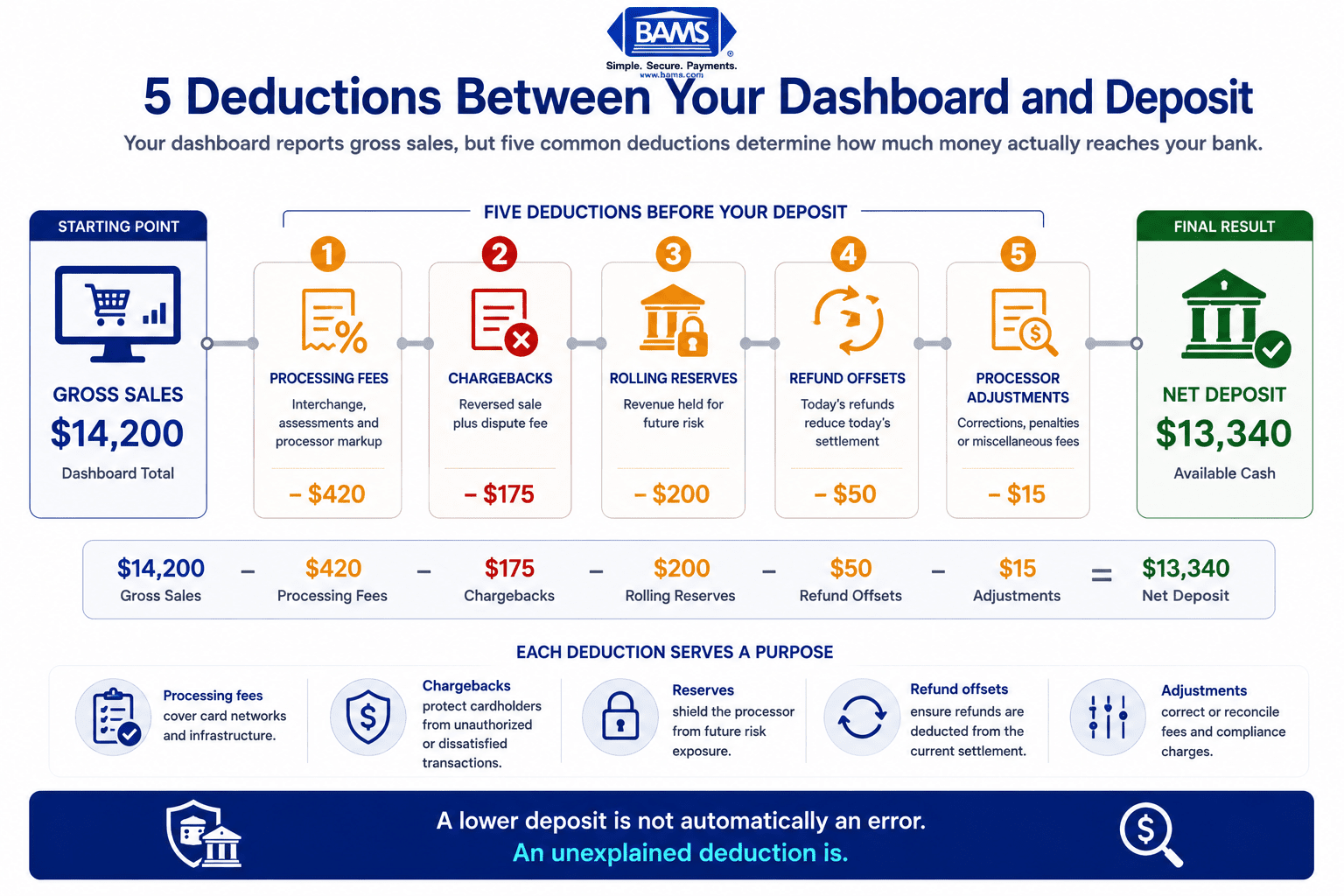
5 Deductions Between Your Dashboard and Your Deposit
Last Updated on October 1, 2026 by Dimitri Akhrin
The line items processors subtract before your money lands — and the silent losses most operators never question
Learn the five specific deduction categories that create the gap between your gross sales and net bank deposits. This breakdown turns each line item into a diagnostic signal so you can spot silent losses in your payment reconciliation process.
TL;DR
- Five deductions create the gap – Processing fees, chargebacks, rolling reserves, refund offsets, and processor adjustments are all subtracted before your deposit posts, and each one behaves differently in timing and visibility.
- Your dashboard shows gross; your bank shows net – The translation layer between the two is where silent revenue leakage hides, potentially 1 to 2% of net revenue for businesses that don’t actively reconcile.
- Chargebacks cost you twice – You lose the sale amount and pay a per-dispute fee, often deducted months later with no dashboard notification. Track them in a separate log, not just your order system.
- Every deduction is negotiable – Processing rates, reserve percentages, and chargeback fees are merchant agreement terms, not fixed costs. Improved performance gives you leverage to renegotiate.
- Start with two checks this week – Calculate your effective processing rate versus your contracted rate, and total your chargeback fees (not just reversed amounts). These two numbers reveal whether your deposits are leaking.
Why Your Bank Balance Never Matches Your Dashboard
You check your eCommerce dashboard at the end of the day. It says you processed $14,200 in sales. The next morning, your bank deposit shows $13,340. That $860 gap isn’t a glitch. It’s the result of a payment reconciliation process most operators never fully decode.
The disconnect between gross sales and net deposits is one of the most persistent sources of cash flow anxiety for online businesses. It creates planning paralysis: you can’t confidently reinvest in inventory or ads when you don’t know how much money will actually land. And the problem compounds over time, because each deduction category behaves differently, with different timing, different visibility, and different recoverability.
Yet most reconciliation guides treat this as a single accounting task. It isn’t. The gap between your dashboard and your bank is made up of discrete, diagnosable line items, each one a signal worth reading on its own.
What This Breakdown Covers (and What It Doesn’t)
This piece is for eCommerce managers at established businesses (roughly 10 to 50 employees) who process enough volume that even small per-transaction deductions create meaningful cash flow distortion. If you’ve ever wondered why your deposit was “short” but couldn’t pinpoint the cause without calling your processor, this is for you.
We’re not covering multi-entity consolidation, ERP integration, or enterprise treasury operations. We’re focused on the five specific deduction categories that processors subtract before your deposit posts, why each one matters as a diagnostic signal, and where small-to-midsize operators are most likely to absorb silent losses without realizing it.
How We Selected These Five Deductions
We evaluated each category based on three criteria: how frequently it creates deposit discrepancies for mid-market eCommerce operators, how often it goes unquestioned (accepted as “normal” without verification), and how recoverable the lost revenue is once identified. These aren’t the only things processors deduct. They’re the five most likely to silently erode your margins.
The 5 Deductions Between Your Dashboard and Your Deposit

Your dashboard reports gross sales, but five common deductions determine how much money actually reaches your bank.
1. Processing Fees: The Tax You Never Itemize
Why it matters: Every transaction carries a processing fee, but the structure of that fee is where operators lose visibility. Interchange, assessment, and processor markup are typically bundled into a single line on your statement. When they’re not broken out, you can’t tell whether your effective rate has drifted upward. Payment reconciliation is essential for identifying unexpected deductions, validating processor fees, and maintaining accurate cash flow reporting as transaction volume grows.
What it looks like today: Most processors deduct fees from your gross settlement before depositing. Some batch them monthly, others daily. The inconsistency makes it harder to match a specific day’s sales to a specific day’s deposit. Your dashboard shows gross volume; your bank reflects net, and the delta changes day to day based on card mix (rewards cards cost more), transaction size, and whether you ran any international cards with cross-border surcharges.
Settlement timing is influenced by the U.S. payment infrastructure, including bank processing schedules and settlement systems. The Federal Reserve provides information on how funds move through the U.S. payment system.
How to apply it: Pull your last three monthly statements and calculate your effective rate (total fees divided by total volume). Compare it to your contracted rate. If there’s a gap greater than 0.15%, request a line-by-line fee breakdown from your processor. Track your card-type mix monthly, because a shift toward more rewards or corporate cards will raise your costs without any rate change on paper.
2. Chargebacks: The Deduction That Costs You Twice
Why it matters: A chargeback doesn’t just reverse the sale. It also triggers a chargeback fee (typically $15 to $100 per dispute), and in many cases, the processor deducts both the transaction amount and the fee from your next deposit without a separate notification. For chargeback management, the real problem isn’t the occasional dispute. It’s the operators who never track the cumulative impact because the deductions are buried in settlement math.
What it looks like today: Chargebacks arrive on a delay, sometimes 30 to 120 days after the original transaction. This means a deduction hitting your deposit today might relate to a sale from two months ago. Your dashboard won’t flag it because the original order shows as “completed.” Meanwhile, your bank balance is short, and without a clear audit trail, the cause is invisible. If your chargeback ratio climbs above card network thresholds, you face monitoring programs, higher fees, or frozen accounts and potential blacklisting.
How to apply it: Build a chargeback log separate from your order management system. Record the dispute date, original transaction date, amount, fee, and reason code. Review it weekly. If you see patterns (specific products, shipping methods, or customer segments), address the root cause. Selecting a merchant services provider with built-in chargeback defense can help you detect and respond to disputes before they become deductions. BAMS, for example, offers proactive chargeback defense and a Dispute Assistant Manager that surfaces disputes early, giving you time to respond rather than absorb the loss.
3. Rolling Reserves: The Money That’s Yours but Not Available
Why it matters: Some processors hold a percentage of each deposit in a rolling reserve, typically 5 to 10% of daily volume, released after a set period (often 90 to 180 days). This is common for newer merchants, high-risk categories, or businesses with elevated chargeback histories. The deduction appears nowhere on your dashboard. Your sales look healthy, but your available cash is structurally lower than it should be, and many operators don’t realize reserves exist until they audit their deposits against gross sales.
What it looks like today: Reserves are outlined in your merchant agreement, often in fine print. They’re deducted silently from each settlement. If you’re a seasonal business, this creates a compounding problem: your highest-volume months generate the largest reserve holds, restricting cash flow precisely when you need it most for inventory replenishment and ad spend.
How to apply it: Review your merchant agreement for reserve terms. Calculate the total amount currently held. If your chargeback ratio has improved or your business has matured, request a reserve reduction or release schedule renegotiation. Track reserve holds as a separate line in your cash flow forecast so you’re planning against available funds, not gross deposits. If your processor won’t budge, this is a strong signal to evaluate alternatives that offer more transparent settlement terms.
4. Refund Offsets: When Yesterday’s Returns Shrink Today’s Deposit
Why it matters: Refunds processed today are typically deducted from today’s (or tomorrow’s) settlement, not matched back to the original transaction date. This creates a timing variance that makes daily deposit matching nearly impossible without a reconciliation system. The dashboard shows the refund as a separate event; the bank sees a smaller deposit. For businesses with liberal return policies or high return rates, this single category can account for the majority of deposit discrepancies.
What it looks like today:Payment reconciliation workflows must handle fee and deduction identification as a distinct step, and refund offsets are among the most common deductions that distort gross-to-net settlement. Most eCommerce platforms show refunds in their own reporting tab, disconnected from deposit reporting. This means you need to cross-reference two data sources daily to understand why your deposit is lower than expected.
How to apply it: Export your refund report and your deposit report for the same period. Match refund totals against deposit shortfalls. If your platform allows it, tag refunds with the original order date so you can see the lag. For businesses processing more than 100 refunds per month, consider automating this match. Automating reconciliation helps merchants process larger transaction volumes more consistently while reducing manual effort and improving visibility into settlement activity.
5. Processor Adjustments: The Catch-All You Should Never Ignore
Why it matters: Adjustments are the miscellaneous category that processors use for corrections, assessment fee true-ups, PCI non-compliance penalties, and other one-off deductions. They’re small individually (often under $50) but accumulate over months. Because they don’t correspond to any specific transaction, they’re the hardest to catch and the easiest to overlook. This is where exception management becomes critical: if you’re not reviewing adjustments line by line, you’re accepting charges you may not owe.
What it looks like today: Adjustments appear on your monthly statement, sometimes labeled vaguely (“misc adjustment,” “assessment fee,” “regulatory recovery”). Unexplained processor adjustments deserve individual review because recurring small deductions can accumulate into meaningful costs over time. For eCommerce operators without a dedicated finance team, these charges simply go unquestioned.
Merchants accepting payment cards should also review guidance from the PCI Security Standards Council to understand their responsibilities for maintaining PCI compliance and avoiding unnecessary compliance-related fees.
How to apply it: Flag any adjustment over $25 for investigation. Call your processor and ask for a plain-language explanation and the contractual basis for the charge. If you’re seeing PCI non-compliance fees, verify whether you’ve completed your annual Self-Assessment Questionnaire, because many merchants pay these penalties simply because they forgot to submit the form, not because they’re actually non-compliant. Keep a running log of adjustments by category so you can spot trends (quarterly assessment true-ups, for example, are normal; unexplained monthly deductions are not).
The Pattern Across All Five Deductions
Each deposit difference leaves a different trail, and the right diagnostic question reveals where the missing amount went.
Three themes connect these deduction categories. First, visibility is the core problem. Every deduction exists for a contractual reason, but processors rarely surface them in a way that matches how operators think about their money. Your dashboard speaks in gross sales. Your bank speaks in net deposits. The translation layer between them is where losses hide.
Second, timing creates false signals. Chargebacks lag by months. Refunds offset against future deposits. Reserves hold cash for quarters. If you reconcile only on a monthly basis, you’re averaging out the very spikes and gaps that reveal problems. Daily reconciliation, even a quick 10-minute check, catches discrepancies while they’re still actionable.
Third, each deduction is a negotiation surface. Processing fees, reserve percentages, and chargeback fees are all terms in your merchant agreement. They’re not fixed laws of nature. If you can demonstrate improved performance (lower chargeback ratios, higher volume, longer processing history), you have leverage to renegotiate. Operators who treat these as immovable costs leave money on the table every month.
Visa also publishes merchant resources explaining payment processing, settlement, and the movement of funds from authorization through final settlement. See Visa’s payment processing overview for additional information.
Where to Start Without Overhauling Everything
You don’t need to build a reconciliation infrastructure overnight. Start with two actions this week. First, calculate your effective processing rate from last month’s statement and compare it to your contracted rate. If the gap surprises you, that’s your first diagnostic signal. Second, pull your chargeback log (or start one) and total the fees, not just the reversed transactions, but the per-dispute penalties.
If you’re spending more than a few hours per month chasing deposit discrepancies, that’s a sign your processor isn’t giving you the transparency you need. Predictable deposits, clear fee breakdowns, and proactive dispute alerts aren’t premium features. They’re baseline requirements for any business trying to plan with confidence. Prioritize the deduction category that represents your largest unexplained gap, fix that one first, and use the pattern to work through the rest.
Frequently Asked Questions
What is deposit reconciliation in merchant services?
Deposit reconciliation is the process of matching your gross sales (what your eCommerce dashboard reports) to the net amount that actually lands in your bank account. The difference is made up of processing fees, chargebacks, refund offsets, reserves, and processor adjustments. Reconciliation identifies each deduction so you can verify the deposit is accurate and catch errors or unexpected charges.
Why does my bank deposit never match my sales dashboard total?
Your dashboard shows gross transaction volume. Your processor subtracts fees, chargebacks, refund offsets, reserves, and adjustments before depositing the net amount. Each deduction category has different timing (some are daily, some lag by weeks or months), which makes the gap inconsistent from day to day. Without tracking each category separately, the shortfall appears random.
How often should I reconcile my merchant deposits?
Daily reconciliation is ideal, even if it’s just a quick 10-minute comparison of expected versus actual deposits. Monthly reconciliation averages out the daily variances and can mask problems like creeping fee increases or unnoticed chargeback fees. A daily habit catches discrepancies while they’re still small enough to investigate and resolve.
What are common challenges in the payment reconciliation process?
The most common challenges include timing mismatches (refunds and chargebacks deducted from deposits days or months after the original transaction), vague line items on processor statements, bundled fees that obscure your true processing cost, and the sheer volume of transactions that makes manual matching impractical. Chargebacks in particular create delayed deductions that are hard to trace back to specific orders without a dedicated tracking system.
What are pre-arbitration fees, and how do they affect my deposits?
Pre-arbitration fees are charges assessed by card networks (Visa, Mastercard) when a chargeback dispute escalates beyond the initial representment stage. These fees can range from $100 to $500 or more and are deducted from your settlement. For small transactions, the fee often exceeds the disputed amount, making it financially better to accept the chargeback. Understanding when to accept versus contest a dispute is a key part of managing your net deposit amounts.
Which factors affect the timing of merchant service deposits?
Several factors influence when your money arrives: your processor’s settlement schedule (next-day versus two-day versus weekly), weekends and bank holidays (which pause ACH transfers), your batch close time, your risk profile (which may trigger reserve holds), and whether any chargebacks or adjustments are being netted against your deposit. Processors that offer next-day funding eliminate much of the timing uncertainty that makes cash flow planning difficult.


