Payment Processor Compliance: Reduce Payout Holds
Last Updated on October 6, 2026 by Dimitri Akhrin
A systematic guide to anticipating reserve triggers and negotiating lower hold percentages as you scale
Learn why payment processors increase payout holds during growth phases and how to reduce rolling reserves quarter over quarter. This guide covers specific compliance triggers, cash flow forecasting around held funds, and negotiation strategies for processor conversations.
TL;DR
- Reserves are negotiable, not permanent — Your initial reserve terms are based on limited onboarding data. As your processing history grows and risk metrics improve, you can and should request reductions.
- Your fraud and dispute trend is a major lever — Build several months of stable or improving performance before requesting a reserve reduction, then support your request with documented processing data.
- Communicate volume changes before they happen — Unexplained processing spikes trigger holds and reserve increases. A brief email to your account manager before a promotion or seasonal peak converts a risk signal into a documented business event.
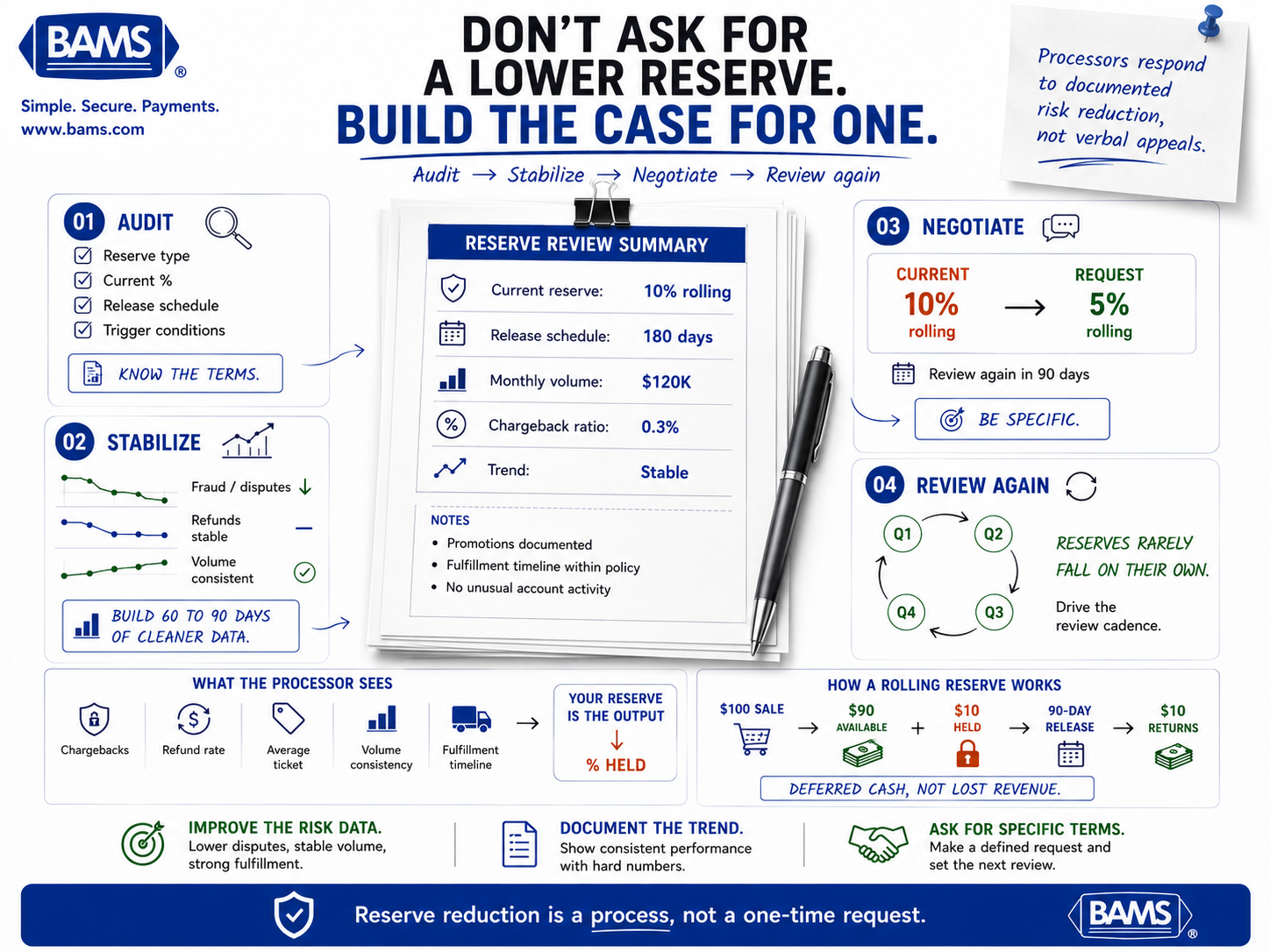
- Build your case with data, not requests — Prepare a one-page summary with trailing performance metrics and a specific reduction target. Processors respond to documented evidence, not verbal appeals.
- Set a quarterly review cycle — Processors rarely reduce reserves proactively. You need to drive the cadence, document each review, and treat reserve optimization as an ongoing operational process tied to your cash flow planning.
Guide Orientation: What This Covers and Who It’s For
This guide explains how payout holds and reserve requirements work after your merchant account is live, why they increase during growth phases, and how to systematically reduce them over time. It is written for eCommerce managers at established online businesses who have already been approved for processing but are encountering unexpected fund holds, rolling reserves, or delayed deposits as transaction volume scales.
By the end, you’ll understand the specific triggers that cause processors to withhold your revenue, how to forecast around held funds, and what concrete actions reduce reserve percentages quarter over quarter. You’ll also learn how to approach processor conversations as negotiations rather than compliance formalities.
This guide does not cover initial merchant account approval criteria, high-risk industry classification, or choosing between processors. It assumes you’re already processing transactions and want to keep more of your money moving.
Why Reducing Reserve Requirements Matters for Growing eCommerce
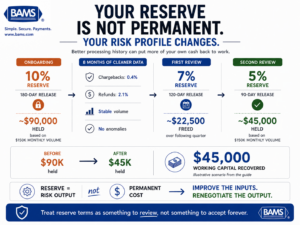
Reserve requirements should evolve as your processing history improves. Better risk data can support lower hold percentages and faster release schedules.
Most eCommerce operators treat reserves as a fixed cost set at onboarding. That assumption becomes expensive fast. As your monthly volume grows from $50,000 to $200,000, a 10% rolling reserve means the difference between $5,000 and $20,000 locked away from your operating cash at any given time. That’s payroll, inventory, or ad spend you can’t deploy.
The problem compounds because growth itself often triggers higher reserves. Processors interpret volume spikes, new product categories, and shifting average ticket sizes as risk signals. Google notes that unusual activity can trigger merchant verification, blocking future payouts until the account is cleared. This isn’t a high-risk merchant problem. It happens to mainstream businesses scaling through a successful quarter.
Meanwhile, payment processor compliance and risk controls can directly affect how much of your revenue remains accessible. OCC guidance recognizes merchant holdback reserves as a way for acquiring banks to manage exposure from chargebacks and other merchant-related risks. If you don’t understand what variables influence those controls, your cash flow can become unpredictable exactly when predictability matters most.
The cost of inaction isn’t just inconvenience. It’s missed growth opportunities, strained vendor relationships, and the compounding drag of capital sitting in someone else’s account instead of yours.
Core Concepts: Reserves, Holds, and the Risk Model Behind Them
What Reserves Actually Are
A reserve is a percentage of your processed volume that the payment processor withholds as a financial buffer against chargebacks, refunds, or fraud losses. It is not a fee. The money is still yours, but you can’t access it until the processor releases it according to a defined schedule or risk reassessment.
Three Types of Reserves
- Rolling reserve: A fixed percentage (typically 5-10%) of each transaction is held and released on a delayed schedule, often 90 to 180 days after the original transaction date. New holds are created daily while old ones release, creating a perpetual float.
- Capped reserve: The processor withholds funds until a set dollar amount is reached (for example, $25,000), then stops withholding. The cap stays in place as a buffer but no new deductions occur.
- Up-front reserve: A lump sum is required before processing begins. This is less common for established merchants but may appear during onboarding for newer businesses.
Holds vs. Reserves
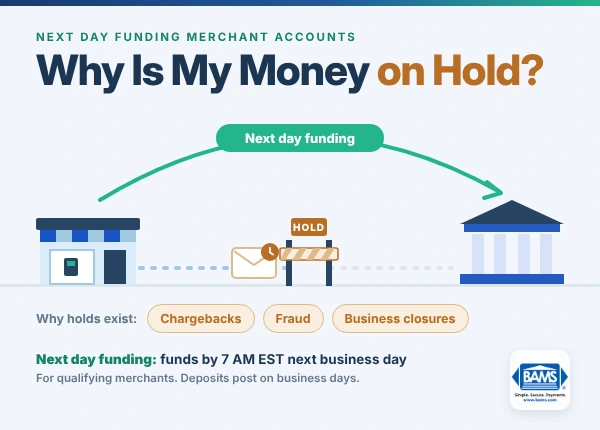
A payout hold is different from a reserve. Holds freeze all disbursements, usually triggered by a compliance flag, verification request, or sudden activity change. Google says payouts can be held for up to 35 days during account review. Reserves reduce your payout by a percentage. Holds stop it entirely. Both affect cash flow, but they require different responses.
The Risk Model You’re Operating Inside
Processors assign risk scores based on chargeback ratios, refund rates, average ticket size, industry category, processing history, and volume consistency. Every one of these variables is something you can measure, document, and influence. The conceptual shift this guide asks you to make: treat reserve requirements as a dynamic risk score output, not a static contract term.
The Framework: A Four-Phase System for Reducing Reserves
Processors reduce reserves when the risk data supports it. The strongest request combines clean trailing metrics with a specific target and documented review history.
Reducing reserves is not a single conversation. It’s a system with four interconnected phases that repeat as your business evolves:
- Phase 1: Audit — Understand your current reserve structure, what triggered it, and what metrics your processor is tracking.
- Phase 2: Stabilize — Bring the key risk signals (chargebacks, refund rates, volume patterns) into ranges that support a reduction request.
- Phase 3: Negotiate — Present your case to your processor with documentation, not just a request.
- Phase 4: Monitor and Repeat — Track the variables that influence reserves continuously, and renegotiate at defined intervals.
These phases are sequential the first time through, then cyclical. Each growth milestone (new product line, new geography, volume threshold) resets portions of the risk calculation and gives you a new opportunity to negotiate.
Step-by-Step: How to Reduce Your Reserve Requirements
Step 1: Audit Your Current Reserve Terms and Triggers
Objective: Know exactly what’s being held, why, and under what conditions it gets released.
Start by pulling your merchant processing agreement and finding the reserve clause. Identify the reserve type (rolling, capped, or up-front), the percentage or dollar amount, and the release schedule. Many eCommerce managers sign agreements without fully parsing these terms, then discover the impact months later when a large batch settles at 90% of expected value.
Next, contact your processor’s account management team and ask three specific questions: What risk factors determined my current reserve level? What metrics would need to change for a reduction? Is there a formal review schedule, or do I need to initiate one? Document the answers. If your processor can’t give you clear answers, that’s a signal about the relationship, not just the reserve.
Also review your recent payout statements for any holds that occurred outside the standard reserve. Some platforms can pause payouts while merchant verification or account review is underway. Google, for example, states that merchant payouts may remain on hold until its account review or required verification is completed. These types of holds are separate from a standard rolling reserve, so knowing the difference prevents you from solving the wrong problem.
Anti-patterns: Assuming your reserve terms haven’t changed since onboarding. Processors can adjust reserves based on performance, and some do so without proactive notification. Also avoid treating your reserve as a single number. Break it into components: percentage, schedule, and trigger conditions.
Success indicators: You can state your exact reserve percentage, the dollar amount currently held, the release timeline, and the specific metrics your processor uses to evaluate your risk level.
Step 2: Map Your Risk Profile from the Processor’s Perspective
Objective: See your business the way your processor’s risk engine sees it, so you can address the right variables.
Processors evaluate risk across several dimensions. The most influential for reserve calculations are your chargeback ratio, refund rate, average transaction size, monthly volume consistency, and delivery timeline (the gap between payment and fulfillment). Pull 6-12 months of data on each of these from your processor dashboard and your internal systems.
Chargeback and fraud activity are important parts of your processor’s risk assessment, but network monitoring should not be reduced to a single universal chargeback percentage. Visa’s current Visa Acquirer Monitoring Program evaluates fraud and disputes together at both the merchant and acquirer levels. Track those trends alongside refund rates, average ticket size and volume consistency. For a deeper look at how chargeback ratios directly influence your reserve and deposit speed, that relationship is worth understanding in detail.
Volume consistency matters more than most operators realize. A business processing $80,000/month for six months that suddenly processes $200,000 in month seven looks like a risk event, even if it’s just a successful product launch. Processors interpret variance as unpredictability, and unpredictability increases reserves.
Anti-patterns: Focusing only on chargebacks while ignoring refund rates or volume spikes. Also avoid comparing your metrics to industry benchmarks without knowing which benchmarks your specific processor uses internally.
Success indicators: You have a dashboard or spreadsheet tracking chargeback ratio, refund rate, average ticket size, and monthly volume trend over at least six months. You can identify which metrics are strongest and which need improvement before a negotiation.
Step 3: Stabilize the Variables That Drive Reserve Calculations
Objective: Bring your risk metrics into ranges that support a reserve reduction before you ask for one.
This is where operational work pays financial dividends. Start with chargebacks, since they carry the most weight. Implement or improve three layers of defense: pre-transaction (clear product descriptions, transparent shipping timelines, visible refund policies), mid-transaction (fraud screening, AVS and CVV matching, 3D Secure for high-ticket items), and post-transaction (proactive customer communication, rapid response to disputes, and chargeback alerts that let you refund before a dispute escalates to a chargeback).
For refund management, track refund reasons by category. If a specific product or SKU drives disproportionate refunds, address it at the product level rather than absorbing the financial signal it sends to your processor. A 2% refund rate with clear, documented reasons is a different risk profile than a 2% rate with no categorization.
For volume consistency, communicate planned increases to your processor before they happen. If you’re running a major promotion or entering a seasonal peak, send a brief email to your account manager with projected volume, the reason for the increase, and the expected duration. This converts a risk signal into a documented business event. Processors treat communicated spikes differently than unexplained ones.
If your business has grown significantly since onboarding, make sure your declared processing volume matches reality. Mismatches between declared and actual volume are one of the most common triggers for holds and reserve increases, and they’re entirely preventable with proactive communication.
Anti-patterns: Trying to negotiate a reserve reduction before your metrics support it. Processors respond to data trends, not promises. Also avoid making operational changes and requesting a review the same month. Give your improvements 60-90 days to show up in the data.
Success indicators: Fraud and dispute activity is stable or declining over several consecutive months. Refund rate is categorized and trending downward. There are no unexplained volume spikes in the trailing quarter, and declared volume remains aligned with actual processing.
Step 4: Build Your Negotiation Case with Documentation
Objective: Present a structured, data-backed request that makes the reserve reduction decision easy for your processor.
Processors don’t reduce reserves because you ask. They reduce them because the risk data supports it and you’ve made the case clearly. Prepare a one-page summary that includes: your current reserve terms, your trailing 6-month performance on chargeback ratio, refund rate, and volume consistency, and your specific request (percentage reduction, schedule change, or conversion from rolling to capped reserve).
Frame the request around the processor’s interests, not just yours. A merchant with a 0.3% chargeback ratio and consistent volume is a low-risk, high-margin account for the processor. Remind them of that. If you’ve implemented fraud prevention tools, document them. If you’ve resolved a previous issue that triggered the reserve, reference the resolution and the months of clean data since.
Ask for specific terms. “Can you reduce my reserve?” is weaker than “Based on my trailing six-month chargeback ratio of 0.3% and consistent monthly volume of $120,000, I’m requesting a reduction from 10% rolling reserve to 5%, with a review in 90 days.” Specificity signals competence and makes the processor’s decision binary rather than open-ended.
Partners like BAMS assign dedicated account managers who can walk through this process with you, translating your operational data into the language processors use internally. That kind of support turns a negotiation into a guided conversation rather than a cold request.
Anti-patterns: Making emotional appeals about cash flow pressure without data. Threatening to switch processors as a negotiation tactic (this often backfires, since a new processor may impose higher reserves during onboarding). Accepting a verbal agreement without getting updated terms in writing.
Success indicators: You have a written summary ready to send. Your request includes specific numbers, a defined timeline, and references to your trailing performance data. You’ve identified the right contact at your processor for this conversation.
Step 5: Forecast Cash Flow Around Your Reserve Schedule
Objective: Eliminate cash flow surprises by building reserve timing into your financial planning.
Even as you work to reduce reserves, you need to operate within the current structure without disruption. Build a simple cash flow model that accounts for the reserve float. If you’re on a 10% rolling reserve with a 90-day release, your available cash from any given day’s sales is 90% on payout day, with the remaining 10% arriving three months later.
Map this against your fixed obligations: payroll dates, inventory purchase cycles, ad spend commitments, and vendor payment terms. Identify months where the reserve float creates a gap between revenue recognition and cash availability. This is where many growing eCommerce businesses get caught. Revenue is up, but accessible cash is down because the reserve percentage applies to a larger base.
Use the release schedule as a planning tool, not just a constraint. If you know $15,000 in reserves releases on the 15th of each month, you can time inventory purchases or vendor payments to align with that inflow. This doesn’t solve the underlying problem, but it prevents the cash flow volatility that leads to reactive decisions.
For businesses processing through multiple channels, consolidate your reserve exposure across all processors. You may have a 5% reserve with one processor and a 10% reserve with another. Understanding the aggregate number gives you a clearer picture of your true working capital position.
Anti-patterns: Treating reserved funds as lost revenue in your mental model (they’re deferred, not gone). Ignoring the compounding effect of reserves on growing volume. Failing to update your cash flow forecast when reserve terms change.
Success indicators: You have a rolling cash flow forecast that includes reserve holds and releases by date. You can identify, at least 30 days in advance, any periods where reserve timing creates a cash gap.
Step 6: Establish a Recurring Review Cycle
Objective: Make reserve reduction an ongoing process, not a one-time event.
Set a quarterly calendar reminder to review your reserve terms against your current performance metrics. Each review should answer three questions: Have my risk metrics improved since the last review? Has my volume changed enough to warrant updated terms? Are there new operational changes (fraud tools, fulfillment improvements, product mix shifts) that strengthen my position?
If the answer to any of these is yes, initiate a conversation with your processor. Don’t wait for them to offer a review. Most processors will not proactively reduce reserves. The incentive structure doesn’t reward it. You need to drive the cadence.
Document every review, whether it results in a change or not. A record of consistent, low-risk performance across multiple review cycles builds a cumulative case that’s harder to deny. It also protects you if there’s turnover on your processor’s account management team. New contacts can see the history without you rebuilding the relationship from scratch.
This is also where the broader configuration of your merchant account matters. Batch timing, fraud filter settings, PCI compliance status, and interchange qualification all feed into the risk model. A quarterly review is an opportunity to check all of these, not just the reserve line item.
Anti-patterns: Reviewing reserves only when cash flow is tight (this puts you in a reactive posture). Assuming that once reduced, reserves stay reduced permanently (volume changes or chargeback spikes can trigger increases). Skipping documentation because the review didn’t result in a change.
Success indicators: You have a documented review history with dates, metrics submitted, and outcomes. Your reserve terms have been updated at least once in the trailing 12 months. You have a named contact at your processor for reserve discussions.
Practical Example: A Growing DTC Brand Reduces Its Rolling Reserve
Consider a direct-to-consumer skincare brand processing $150,000/month. At onboarding, the processor set a 10% rolling reserve with a 180-day release, creating a perpetual float of roughly $90,000 in held funds. The brand’s founder accepted this as standard.
After eight months of clean processing (chargeback ratio at 0.4%, refund rate at 2.1%, no volume anomalies), the operations manager audited the reserve terms and discovered the release schedule was longer than industry norms for their risk profile. They compiled a six-month performance summary and requested a meeting with their processor’s risk team.
The first request was partially successful: the processor reduced the reserve from 10% to 7% and shortened the release from 180 days to 120 days. That freed up approximately $22,500 in working capital over the following quarter. Six months later, with continued clean metrics and a documented history of proactive communication, the second review brought the reserve down to 5% with a 90-day release.
The total impact: the brand went from $90,000 perpetually held to approximately $45,000, recovering $45,000 in working capital without changing anything about their sales volume. The key was treating the reserve as a negotiable output of measurable inputs, not a fixed cost.
Common Mistakes and Pitfalls
- Treating reserves as permanent. Many merchants never revisit their initial terms. Reserves are set based on limited data at onboarding and should evolve as your processing history grows.
- Confusing holds with reserves. A compliance hold freezes everything. A reserve reduces payouts by a percentage. Solving one doesn’t address the other, and the response to each is different.
- Negotiating without data. Asking for a reduction without a documented performance history puts the burden on your processor to do the analysis. They won’t.
- Ignoring volume declarations. If your actual processing exceeds your declared volume by a significant margin, your processor may interpret this as undisclosed risk and increase reserves or trigger a hold.
- Switching processors to escape reserves. A new processor will run their own risk assessment. Without a track record, you may face equal or higher reserves during the new onboarding period. Build history where you are before moving.
These mistakes are common because the information asymmetry between merchants and processors is real. Processors understand their risk models intimately. Most merchants don’t. Closing that gap is the single highest-leverage action you can take for your cash flow.
What to Do Next
Start with Step 1. Pull your merchant processing agreement and identify your current reserve type, percentage, and release schedule. If you can’t find those terms in your agreement, call your processor and ask. That single action gives you the baseline for everything else in this guide.
You don’t need to complete all six steps this week. Stabilizing your risk metrics (Step 3) takes 60-90 days of consistent performance. Use that time to build your cash flow forecast (Step 5) and prepare your negotiation documentation (Step 4). Set a calendar reminder for your first quarterly review.
This guide is designed as a reference you return to at each review cycle, not a checklist you complete once. Your reserve terms should improve incrementally as your processing history lengthens and your risk profile strengthens. Treat each reduction as evidence that the system works, and use it to build momentum for the next one.
Frequently Asked Questions
What is reserve and hold management in merchant services?
Reserve management is the process of understanding, forecasting, and actively reducing the percentage of your processed revenue that your payment processor withholds as a risk buffer. Hold management refers to preventing and resolving full payout freezes triggered by compliance flags, verification requests, or unusual account activity. Both directly affect how much of your revenue you can access and when.
Why do payment processors withhold reserves from merchants?
Processors withhold reserves to protect themselves against financial exposure from chargebacks, refunds, and fraud. If a merchant goes out of business or generates excessive disputes, the processor is liable to the card networks for those losses. The reserve acts as collateral. The percentage and structure are determined by the processor’s risk assessment of your business based on factors like chargeback ratio, industry category, processing history, and volume patterns.
How do rolling reserves work in payment processing?
A rolling reserve withholds a fixed percentage (commonly 5-10%) of each day’s processed transactions and releases those funds on a delayed schedule, typically 90 to 180 days later. Because new holds are created daily while old ones release, there is always a pool of your money held by the processor. The size of that pool grows proportionally with your sales volume, which is why reserves become more impactful as your business scales.
When can a merchant expect to have their reserves released?
Release timing depends on your reserve type and processor. Rolling reserves release on their defined schedule (90-180 days per transaction batch). Capped reserves remain in place indefinitely as a buffer but stop collecting once the cap is reached. Compliance-triggered holds have no fixed timeline and depend on how quickly you provide requested documentation. Some processors hold payouts for up to 35 days during account reviews.
Which factors most influence the percentage of reserves withheld?
The most influential factors are your chargeback ratio (the single most weighted metric), refund rate, average transaction size, monthly volume consistency, delivery timeline (how long between payment and fulfillment), and your industry’s overall risk classification. Processing history length also matters. Newer accounts with less data typically face higher reserves because the processor has less evidence to assess risk.
How can merchants reduce their reserve requirements over time?
Reduce reserves by building a documented track record of stable or declining fraud and dispute activity, manageable refund rates, consistent volume and proactive communication with your processor. Prepare a data-backed request that includes trailing performance metrics and a specific reduction target. Establish a quarterly review cycle so reserve terms evolve with your risk profile rather than remaining fixed at onboarding levels.