7 Cash Advance Items That Break Funeral Pricing Transparency
Last Updated on September 25, 2026 by Dimitri Akhrin
anWhere FTC itemization rules, surcharging laws, and merchant services collide on your price list
Learn which cash advance item categories create compliance gaps when payment-method surcharges meet FTC disclosure rules. This guide helps funeral home operators align itemization, pricing transparency, and merchant services to protect margins.
TL;DR
- Itemize every cash advance item individually – The FTC requires separate line items for each third-party charge (crematory fees, death certificates, flowers, clergy). Bundling them into one line violates the Funeral Rule and weakens your position in payment disputes.
- Disclose markups or retained rebates in writing – If you charge more than your actual cost on any cash advance item, your statement must say so. Silence on markups is a compliance violation, not a gray area.
- Configure surcharging to exclude pass-through costs – Applying a flat surcharge to the entire invoice, including cash advance items you claim are “at cost,” creates both a regulatory problem and a trust problem. Separate surcharge-eligible and non-eligible line items in your payment system.
- Fix deposit timing to stop floating vendor payments – If your processor holds funds for two to three days while crematories and cemeteries expect immediate payment, you are funding the gap out of operating cash. Next-day funding eliminates this structural cash flow leak.
- Treat your price list and payment processing as one system – The operators who avoid cash flow gaps connect their General Price List, disclosure language, and merchant services configuration into a single workflow instead of managing them separately.
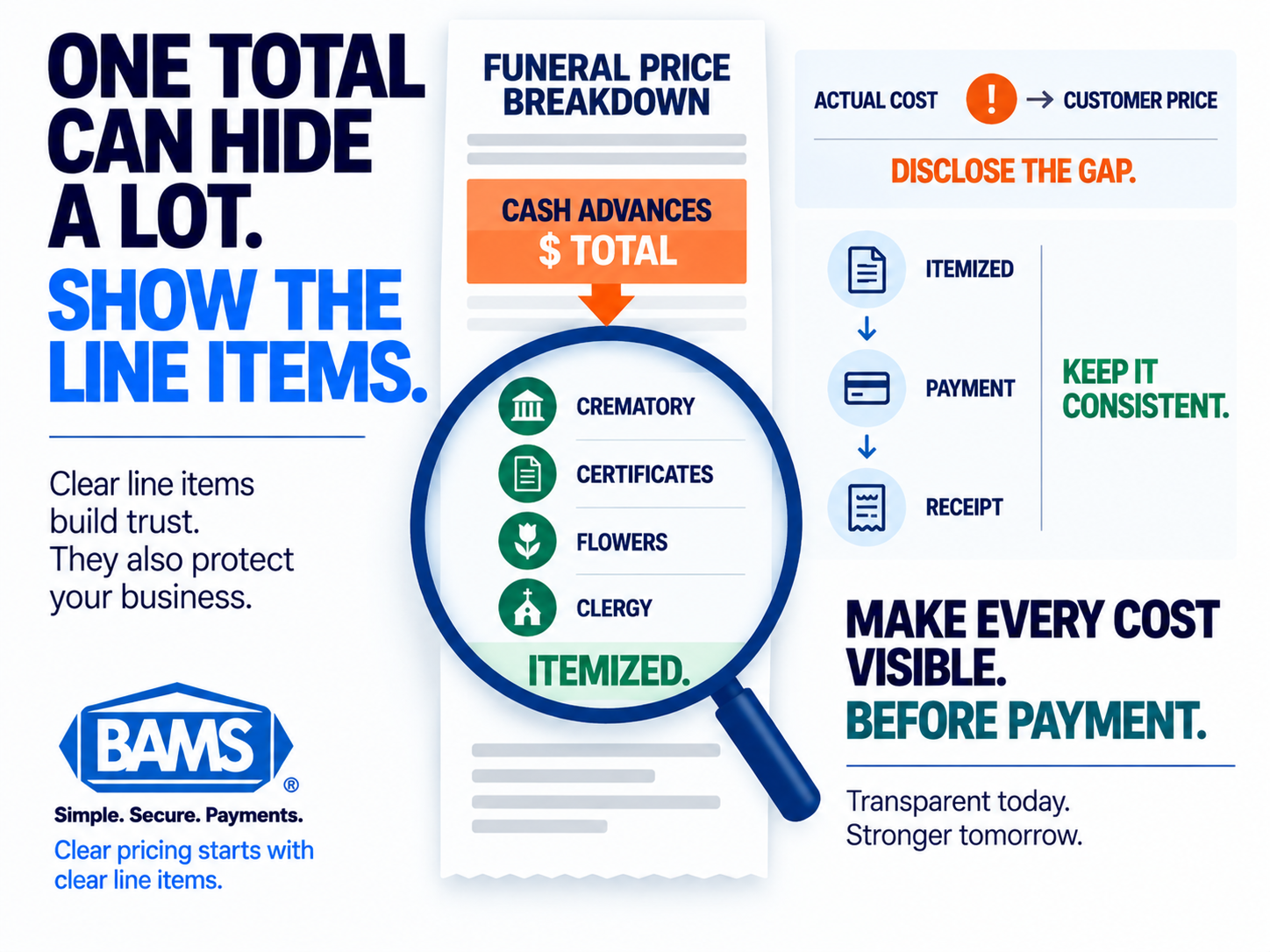
Pricing transparency breaks down when third-party funeral costs disappear inside a bundled total. Clear individual line items make the payment structure easier to understand and manage.
Why Cash Advance Items Create the Biggest Pricing Blind Spot in Funeral Service
Cash advance items sit at the intersection of three regulatory and operational forces that most funeral home operators never think about at the same time: FTC itemization rules, payment method surcharging laws, and deposit timing from your merchant services provider. When those forces collide on a single statement of funeral goods and services, the result is often a cash flow gap that has nothing to do with revenue and everything to do with how you structured the transaction.
The problem is compounding. FTC staff found that at least 33% of funeral homes offered package pricing by phone without providing itemized price information. That means a third of operators are already on shaky compliance ground before a family even walks through the door, and their payment processing setup is almost certainly not configured to handle the disclosure requirements that follow.
This guide addresses the specific line-item categories where funeral home pricing transparency breaks down under payment-method pressure, and what to do about it.
Who This Is For and What It Covers
This is for family-owned funeral service operators managing one to ten locations who handle high-ticket transactions (often exceeding $15,000) and need their cash advance items, funeral service itemization, and payment acceptance to work together without margin erosion or regulatory exposure.
This is not a general overview of the Funeral Rule. It does not cover casket or outer burial container pricing in depth. Instead, it focuses on the operational gap between what the FTC requires you to disclose on cash advance items and how your merchant services setup either supports or undermines that disclosure. You will walk away with a concrete framework for connecting your General Price List to your payment processing configuration.
How These Items Were Selected
Each item below targets a specific failure point where FTC disclosure requirements and payment processing mechanics interact. The selection criteria: Does this issue create a cash flow gap, a compliance risk, or a margin leak that operators routinely miss? If it does all three, it made the list.
7 Cash Advance Itemization Failures That Create Cash Flow Gaps
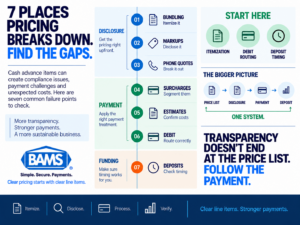
Cash advance pricing problems can appear at disclosure, payment and settlement. These seven checks help funeral home operators identify where transparency and payment operations can fall out of alignment.
1. Bundling Third-Party Charges into a Single “Cash Advance” Line
Why it matters: The FTC requires funeral providers to list each cash advance item separately on the statement and disclose any markup, commission, rebate, or discount retained. When you lump cemetery fees, death certificates, clergy honoraria, and flowers into one line, you violate itemization rules and obscure the actual cost structure from families. This also makes it impossible to apply payment-method-specific pricing accurately.
What it looks like today: Many operators still use a single “Cash Advances” line on their statement of goods and services, with a handwritten or typed total. Some software platforms default to a summary view that requires manual override to show individual items. Neither approach survives an FTC audit or a chargeback dispute where the cardholder questions what they paid for.
How to apply it: Break every third-party charge into its own line item in your arrangement software. Map each line to a corresponding category in your payment system so that when a family pays by credit card, the merchant descriptor and receipt reflect the itemized structure. This creates a documentation trail that protects you on both the compliance and dispute-resolution sides.
2. Failing to Disclose Markups on Items You Don’t Pass Through at Cost
Why it matters: The FTC is explicit: if you mark up a cash advance item or keep a supplier rebate, you cannot tell consumers the charged price equals the provider’s cost. Many operators add a handling fee or margin to items like obituary notices or crematory services without adjusting their disclosure language. This creates a transparency gap that erodes trust and, in a dispute, leaves you without a defensible paper trail.
What it looks like today: Some funeral homes add a flat percentage to all cash advance items without disclosing it. Others receive volume rebates from crematories or vault companies and treat the rebate as margin without updating the statement. Both practices violate the Funeral Rule’s markup disclosure requirement.
How to apply it: Audit every cash advance item on your General Price List. For any item where your charge exceeds your cost (including retained rebates), add a written disclosure statement. Use language like: “We charge for our services in arranging for the following items. These charges may be higher than the actual cost to us.” This is the FTC’s own suggested phrasing.
3. Quoting Package Prices by Phone Without Itemizing Cash Advances
Why it matters: The FTC’s 2024 undercover phone sweep confirmed that funeral providers must disclose itemized price information over the telephone. Cash advance items are frequently discussed during the first call, before a family sees the full price list. If you quote a package that includes third-party charges without breaking them out, you are already non-compliant.
What it looks like today: A family calls and asks about a direct cremation. The funeral director quotes $2,800, which includes the crematory fee, death certificates, and transportation. None of those cash advance items are mentioned individually. The family hears one number. When the itemized statement arrives later, the total looks different because surcharges, taxes, or actual third-party costs shifted.
How to apply it: Create a phone script that mirrors your General Price List structure. When quoting any arrangement that includes cash advance items, name each item and its price. Train staff to say: “The crematory fee is $350, death certificates are $25 each, and our transportation charge is $275.” This aligns your verbal disclosure with your written itemized price list and reduces disputes at the point of payment.
4. Ignoring How Surcharging Rules Apply to High-Ticket Cash Advance Payments
Why it matters: Many funeral homes have started surcharging credit card transactions to offset processing costs. But surcharging rules vary by state, apply differently to debit versus credit cards, and interact with your itemized pricing in ways most operators haven’t considered. If your cash advance items total $4,000 on a $15,000 funeral and you add a flat surcharge to the entire transaction, you may be surcharging third-party pass-through costs, which creates both a compliance issue and a customer experience problem.
What it looks like today: Operators apply a 3% surcharge to the full invoice total, including cash advance items they claim to pass through at cost. Families see the surcharge and question whether the “at cost” claim is accurate. In states where surcharging is restricted or banned, this practice creates additional legal exposure.
How to apply it: Work with your merchant services provider to configure surcharging only on the service and merchandise portions of the invoice, not on cash advance items disclosed as pass-through costs. If your processor cannot separate line items for surcharge calculation, that is a sign your payment setup needs restructuring. Understanding how cost-plus pricing models work can help you evaluate whether your current processing fees justify the surcharge approach at all.
5. Accepting Payment Before Third-Party Costs Are Confirmed
Why it matters: Cash advance items are estimates until the third-party provider invoices you. If you collect payment from a family based on estimated costs, then the actual crematory fee, cemetery charge, or death certificate cost comes in higher, you absorb the difference or issue an awkward follow-up invoice. Either outcome creates a cash flow gap. The first erodes margin. The second erodes trust.
What it looks like today: A funeral home collects $12,000 at arrangement, including estimated cash advance items. The cemetery invoice arrives two weeks later at $800 more than estimated. The operator either eats the $800 or sends a supplemental bill to a grieving family. Meanwhile, the credit card transaction settled days ago, and the deposit is already allocated to payroll and overhead.
How to apply it: Structure your payment collection in two phases. Collect for your services and merchandise at arrangement. Collect for cash advance items once third-party costs are confirmed, or clearly disclose the estimated nature of those charges and build a documented adjustment process. This approach requires a payment processor that supports split or staged transactions without penalizing you on interchange rates. Providers like BAMS offer next-day funding and transparent fee structures that make staged collection practical, so you are not waiting days for each deposit to clear before you can pay your vendors.
6. Misclassifying Debit Transactions and Losing the Interchange Difference
Why it matters: On a $15,000 funeral transaction, the difference between debit interchange and credit interchange can be $200 or more. Many funeral home terminals and point-of-sale systems default to processing all card transactions as credit, even when the family uses a debit card and enters a PIN. This means you pay higher interchange on every debit transaction, and on high-ticket cash advance items, that cost adds up fast.
What it looks like today: Operators rarely check their monthly processing statements to see how transactions are classified. They see a blended rate and assume it is fixed. In reality, debit transactions routed as credit cost significantly more, and the operator never recovers that margin. Understanding your effective processing rate and interchange tiers is the first step toward fixing this.
How to apply it: Enable PIN debit acceptance on all terminals. Train staff to ask families whether they prefer debit or credit when presenting a card. Review your monthly processing statement and look for debit transactions routed through credit networks. If your processor does not break this out clearly, request a line-item audit or switch to a provider that offers interchange-plus pricing with full transaction visibility.
7. Slow Deposit Timing That Forces You to Float Vendor Payments
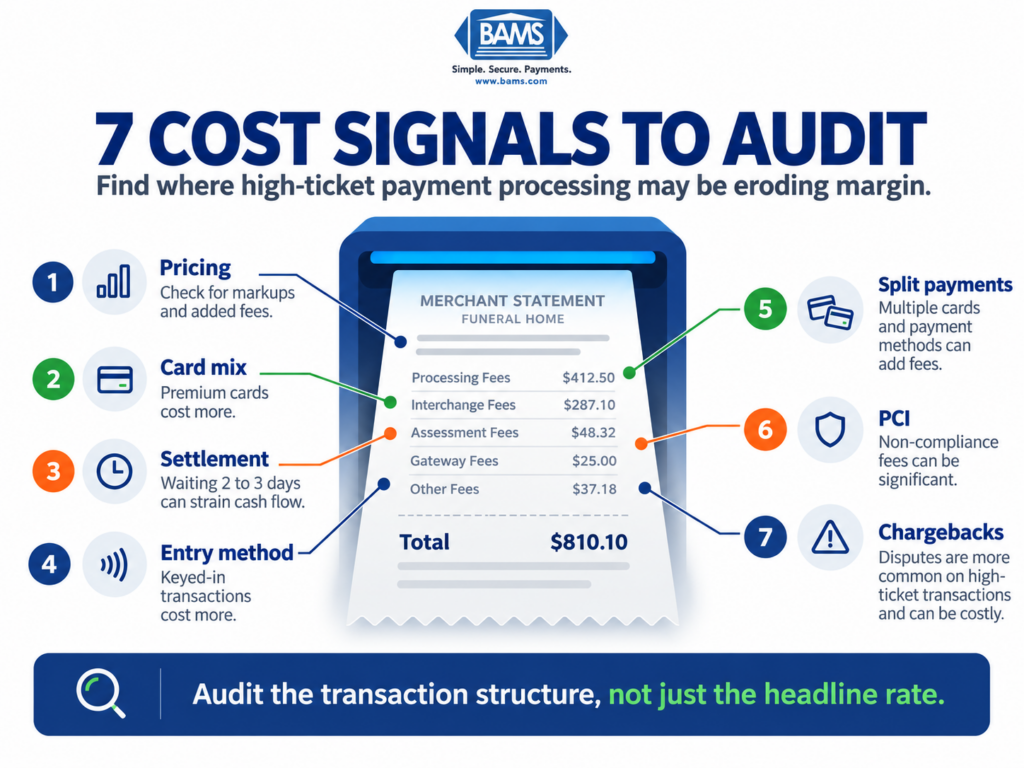
Why it matters: Cash advance items require you to pay third-party vendors (crematories, cemeteries, florists, clergy) on their timeline, not yours. If your payment processor holds your deposits for two to three business days, you are floating those vendor payments out of operating cash. On a busy month with multiple services, this timing mismatch can create a cash gap that looks like a revenue problem but is actually a deposit timing problem.
What it looks like today: A funeral home processes $60,000 in card payments over a weekend. The processor batches and holds funds until Wednesday. Meanwhile, the crematory expects payment Monday, the florist invoices Tuesday, and the cemetery charges post immediately. The operator dips into a line of credit or delays vendor payments, damaging relationships and incurring interest.
How to apply it: Negotiate next-day or same-day funding with your merchant services provider. Calculate how much you spend annually on float costs (interest on credit lines, late payment penalties, lost early-pay discounts from vendors). Compare that number to the cost difference between your current processor and one that offers faster settlement. In most cases, faster funding pays for itself within the first quarter.
The Pattern Behind These Failures
Every item on this list shares a common root: operators treat FTC compliance and payment processing as separate concerns. They build their General Price List in one system, configure their merchant terminal in another, and never connect the two. The result is a funeral service itemization process that satisfies neither regulatory requirements nor financial efficiency.
The second pattern is timing. Cash advance items are inherently asynchronous. You collect from families before you pay vendors, you estimate before you confirm and you process a card today but receive the deposit days later. Each timing gap compounds the next. When you layer surcharging rules and interchange classification on top, the margin leakage becomes structural, not incidental.
The operators who avoid these gaps treat their price list, their disclosure language, and their payment processing configuration as a single integrated system. That is the shift.
Where to Start Without Overhauling Everything
You do not need to fix all seven issues at once. Start with three moves. First, audit your General Price List against your statement of goods and services to confirm every cash advance item is individually listed with accurate markup disclosure. Second, review your last three months of processing statements to identify debit-as-credit misrouting and calculate the interchange you overpaid. Third, check your deposit timing and compare the cost of float against faster settlement options.
These three steps address compliance, margin, and cash flow simultaneously. They require no new software, no staff restructuring, and no capital investment. They require attention, a calculator, and a willingness to look at your payment processing as part of your pricing strategy rather than separate from it.
Frequently Asked Questions
What is the FTC Funeral Rule and why does it matter for cash advance items?
The FTC Funeral Rule requires funeral providers to give consumers itemized pricing for all goods and services, including cash advance items like crematory fees, death certificates, flowers, and clergy honoraria. Each cash advance item must be listed separately, and any markup or retained rebate must be disclosed. Violations can result in warning letters, fines, and reputational damage.
How does the FTC Funeral Rule affect pricing transparency for funeral services?
The Rule mandates that funeral homes provide a General Price List, a Casket Price List, and an Outer Burial Container Price List to consumers. For cash advance items specifically, the Rule requires individual line-item disclosure and prohibits claiming a charge equals the provider’s cost if the funeral home retains any markup, commission, or rebate. This level of funeral home pricing transparency extends to telephone inquiries as well.
When must funeral homes provide itemized price disclosures to consumers?
Itemized pricing must be provided at the earliest point of contact. For in-person visits, the General Price List must be offered before discussing arrangements. For telephone inquiries, the FTC confirmed in its 2024 enforcement actions that itemized price information must be disclosed over the phone when consumers ask about prices, terms, or conditions of funeral goods and services.
Which payment methods are affected by surcharging regulations in the funeral industry?
Surcharging rules apply to credit card transactions but generally prohibit surcharges on debit card (PIN-based) transactions. Rules vary by state, with some states banning credit card surcharges entirely. Funeral homes must also consider how surcharges interact with cash advance items disclosed as pass-through costs, since adding a surcharge to items you claim are “at cost” undermines that disclosure.
How can funeral homes optimize merchant services to stay compliant with the Funeral Rule?
Configure your payment system to mirror your itemized price list structure. Ensure surcharges apply only to appropriate line items. Enable PIN debit to reduce interchange costs. Use a processor that supports staged or split transactions so you can collect for services and cash advance items separately. Prioritize next-day funding to avoid floating vendor payments out of operating cash.
What are the most common cash advance items funeral homes must itemize?
The FTC identifies common cash advance items as cemetery or crematory services, pallbearers, transportation, clergy honoraria, flowers, musicians, nurses, obituary notices, gratuities, and death certificates. Each must appear as a separate line item on the statement of funeral goods and services, with disclosure language if the funeral home’s charge exceeds its actual cost.
Sources
- https://www.ftc.gov/news-events/news/press-releases/2024/11/ftc-staff-issues-report-undercover-funeral-rule-phone-sweep
- https://www.ftc.gov/business-guidance/resources/complying-funeral-rule
- https://www.ftc.gov/news-events/news/press-releases/2024/01/ftc-sends-warning-letters-funeral-homes-after-first-undercover-phone-sweep