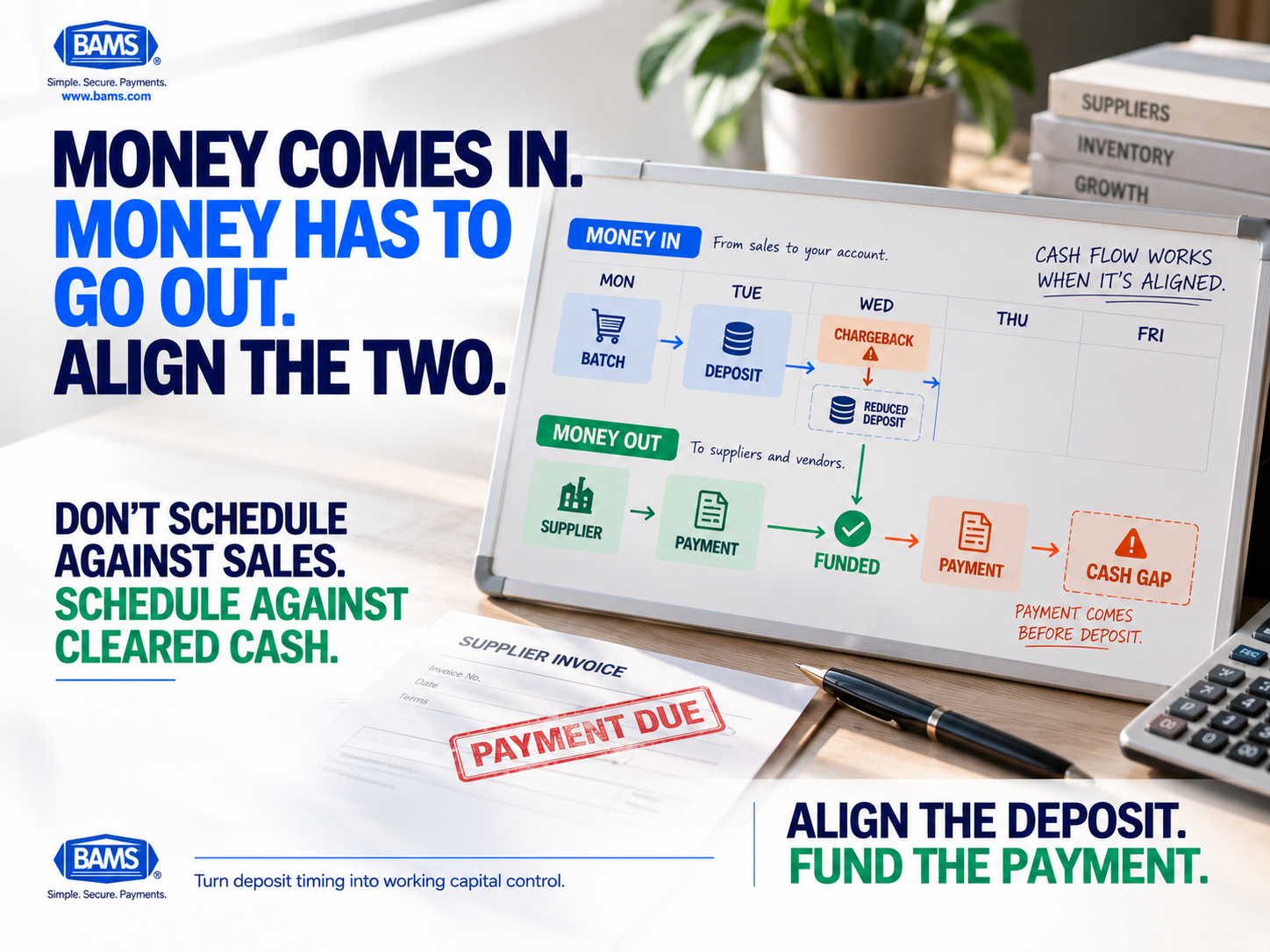
Predictable Cash Flow: Align Batch Timing to Payments
Last Updated on September 24, 2026 by Dimitri Akhrin
Turn transaction batching into a working capital lever that captures early-pay supplier discounts
Learn how to map your batch close windows to supplier payment terms so deposits land exactly when you need them. This guide helps eCommerce operators stop guessing at deposit timing and start capturing early-pay discounts most brands miss.
TL;DR
- Batch timing is an operational lever, not just a setting — Controlling when your transaction batches close determines when deposits land, which directly controls when you can pay suppliers and capture early-pay discounts.
- Chargebacks erode deposit predictability, not just revenue — The real cost of chargebacks is the variance they introduce into your expected deposit amounts, which disrupts your entire outgoing payment schedule.
- Schedule payments against confirmed deposits, not projections — Map every supplier payment to a specific batch deposit. No payment run should execute until the funding deposit has cleared.
- Early-pay discounts are the hidden payoff — Aligning batch timing with supplier terms can unlock $10,000 to $15,000+ in annual savings that most eCommerce brands leave on the table because they can’t predict when cash will be available.
- Start by mapping 30 days of actual settlement data — Compare your processor’s stated timeline to real bank deposits, identify variance, and use that baseline to restructure both batch timing and payment scheduling.
Guide Orientation: What This Covers and Who It’s For
This guide shows eCoommerce operators how to protect predictable cash flow from chargeback disruptions by treating transaction batching as a strategic lever, not just a backend setting. You’ll learn how batch timing connects directly to supplier payments, early-pay discounts, and working capital stability.
It’s written for eCommerce managers at established online businesses (roughly 10 to 50 employees) who already process meaningful transaction volume but haven’t yet aligned their deposit timing with their outgoing payment schedules. If you’re still guessing when funds will land in your account, this is for you.
By the end, you’ll be able to map your batch close windows to your supplier payment terms, identify how chargebacks erode deposit predictability, and build a payment cadence that captures discounts most brands leave on the table. This guide does not cover chargeback dispute mechanics in detail or payment gateway selection criteria.

Predictable cash flow comes from coordinating money coming in with money going out. Mapping deposits to supplier payment dates can turn batch timing into a practical working capital tool.
Why Predictable Cash Flow Depends on Batch Timing, Not Just Faster Deposits
Most eCommerce operators focus on getting deposits faster. That’s a reasonable instinct. But speed alone doesn’t solve the real problem: knowing exactly which dollars will land, in which batch, on which day. Without that visibility, your outgoing payments are built on assumptions, and assumptions create gaps.
Those gaps have a real cost. When you can’t confirm that Tuesday’s deposit will clear before Wednesday’s supplier payment run, you either delay the payment, losing early-pay discounts, or send it anyway and risk a shortfall. Neither outcome helps your margins. The Federal Reserve has noted that faster access to customer payments can reduce small businesses’ need for short-term financing when working capital is tied up in inventory and other goods.
Chargebacks make this worse. A single disputed transaction can pull funds from a batch you were counting on, turning a predictable deposit into a smaller, delayed one. When chargebacks cluster (around promotions, product launches, or seasonal spikes), the disruption compounds. Your deposit schedule becomes unreliable precisely when you need it most.
The shift in thinking is straightforward: treat batch timing as an operational lever that controls when revenue becomes usable cash. When you control that lever, you can schedule supplier payments with confidence, negotiate from a position of strength, and stop relying on short-term credit to bridge avoidable gaps.
Core Concepts: Batching, Deposit Windows, and the Chargeback Drag
Transaction Batching
Every card transaction your store processes doesn’t move money immediately. Transactions accumulate in a batch, and that batch closes at a scheduled time (often set by your processor or gateway). Once the batch closes, settlement begins, and funds move toward your bank account. The timing of that close is the single biggest variable in when you actually get paid.
Deposit Windows
A deposit window is the predictable interval between batch close and funds arriving in your account. With standard processing, this might be two to three business days. With next-day funding, it compresses to one business day. The key insight: the deposit window only becomes useful for planning when you know exactly when your batch closes.
The Chargeback Drag
Chargebacks don’t just cost you the disputed amount plus fees. They create what we’ll call “chargeback drag” on your cash flow predictability. When a chargeback hits, your processor deducts the disputed amount from a future batch settlement. You expected $12,000 in Tuesday’s deposit; you received $11,400. That $600 gap cascades into every payment you scheduled against that expected amount.
Early-Pay Discounts
Many suppliers offer terms like 2/10 net 30: pay within 10 days and save 2%. On a $50,000 monthly supplier spend, that’s $12,000 per year in savings. But capturing those discounts requires certainty about when your cash is available. Guesswork means missed windows and forfeited savings.
The Framework: Batch-to-Payment Alignment
The method here is a five-stage process that connects your transaction batching schedule to your supplier payment calendar. Think of it as building a bridge between money coming in and money going out, with chargeback protection as the guardrails.
The stages are:
- Stage 1: Map Your Current Batch Timing — Understand exactly when batches close and deposits land.
- Stage 2: Quantify Chargeback Drag — Measure how disputes erode your deposit predictability.
- Stage 3: Restructure Batch Close Windows — Adjust timing to align with your operational calendar.
- Stage 4: Build a Deposit-Linked Payment Schedule — Schedule outgoing payments against confirmed deposits, not projected ones.
- Stage 5: Defend the Schedule — Implement chargeback prevention to protect the predictability you’ve built.
Each stage builds on the previous one. Skipping ahead (scheduling payments before understanding your batch timing, for example) recreates the guesswork problem this guide solves.
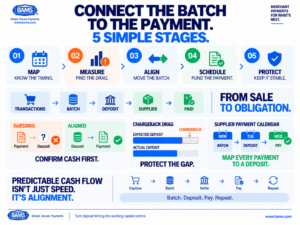
Batch-to-payment alignment connects transaction settlement with supplier payment timing so outgoing payments are based on cleared cash rather than assumptions.
Step-by-Step: Aligning Batch Timing With Supplier Payments
Step 1: Map Your Current Batch Timing
Objective: Know the exact time your batches close each day and when the corresponding deposits arrive in your bank account.
Start by pulling your processor’s batch settlement reports for the last 30 days. For each batch, record three data points: the batch close time, the number of transactions included, and the timestamp when funds appeared in your bank account. Most processors close batches automatically at a default time (often between 5 PM and 7 PM local time), but this varies.
Calculate the average settlement lag: the hours between batch close and deposit. Then look for variance. Are some batches settling in 18 hours while others take 40? That variance is the enemy of planning. Common causes include weekend cutoffs, holiday schedules, and transactions flagged for review.
What to avoid: Don’t rely on your processor’s stated funding timeline without verifying it against actual bank deposits. Marketing materials say “next-day funding.” Your bank statements tell you what actually happens. Also avoid averaging across weekdays and weekends together, as these have fundamentally different settlement patterns.
How to verify progress: You should be able to state, with confidence: “Batches that close by [time] on weekdays land in our account by [time] the following business day.” If you can’t make that statement precisely, keep refining your data. This baseline is the foundation for everything that follows.
Step 2: Quantify Chargeback Drag on Your Deposits
Objective: Measure the dollar impact and timing disruption that chargebacks create in your deposit schedule.
Pull your chargeback history alongside your batch settlement data. For each chargeback, identify which batch settlement was reduced (or which future batch absorbed the deduction). Calculate two metrics: the average monthly chargeback deduction as a percentage of total deposits, and the standard deviation of daily deposit amounts with and without chargeback deductions.
The second metric matters more than the first. A 1.5% monthly chargeback rate might sound manageable. But if those chargebacks cluster around the 8th and 22nd of each month (common for subscription businesses with billing cycles), they create predictable holes in specific deposits you may be planning around.
Understanding how chargeback ratios affect your funding speed is also critical here. Elevated dispute rates can trigger processor risk flags that slow settlement across all your batches, not just the disputed transactions. This is the hidden multiplier most eCommerce operators miss.
What to avoid: Don’t treat chargebacks as a flat monthly cost. The timing of the deduction matters as much as the amount. A $600 chargeback deducted from a $15,000 deposit is noise. The same $600 deducted from a $3,000 deposit on the day you need to pay a supplier is a crisis.
How to verify progress: You should have a clear picture of which days and which deposit amounts are most vulnerable to chargeback disruption. Ideally, plot this on a calendar alongside your supplier payment dates.
Step 3: Restructure Your Batch Close Windows
Objective: Adjust when your batches close so that deposits land before your largest outgoing payment obligations.
This is where batching shifts from a technical setting to an operational lever. If your payment gateway or processor supports configurable batch close times, adjusting that schedule gives you more control over when settlement begins. Confirm the available cutoff settings directly with your provider before making changes.
Here’s the decision framework: if your largest supplier payment runs on Wednesdays, you need Tuesday’s deposit to be fully settled before that payment executes. Work backward from the payment time to determine the latest batch close that still guarantees settled funds. If your processor offers next-day funding with a 9 PM cutoff, a Monday batch closing at 8:30 PM gives you Tuesday afternoon funds to cover Wednesday morning payments.
For businesses with multiple supplier payment dates, consider splitting your batch strategy. Some processors allow multiple batch close times per day. A morning close captures overnight international orders; an evening close captures the domestic business day. Each batch becomes its own predictable deposit.
What to avoid: Don’t set your batch close time right at the processor’s cutoff. Leave a buffer. Transactions that arrive in the final minutes before cutoff sometimes roll into the next batch, creating exactly the kind of unpredictability you’re eliminating. Also avoid changing batch timing without informing your accounting team, as reconciliation depends on consistent patterns.
How to verify progress: After adjusting batch close times, monitor deposits for two full weeks. Confirm that the new timing produces consistent, predictable deposit amounts on the days you need them. Adjust if variance remains above your tolerance.
Step 4: Build a Deposit-Linked Supplier Payment Schedule
Objective: Schedule all outgoing supplier payments against confirmed deposit arrivals, not projected revenue.
With your batch timing optimized, you can now build a payment calendar that runs on confirmed cash, not forecasts. The principle is simple: no payment run executes until the deposit it depends on has cleared. Nacha notes that ACH batches allow businesses to send one file containing multiple payments rather than processing each payment individually and that recurring payment patterns can improve forecasting and day-to-day cash flow management.
Start by listing every recurring supplier payment with its due date, early-pay discount terms, and minimum payment amount. Then map each payment to the specific batch deposit that will fund it. For example: “Supplier A’s $8,200 invoice (2/10 net 30, due the 15th, early-pay deadline the 5th) is funded by the deposit from Monday the 3rd’s batch close.”
This mapping also improves reconciliation. Modern Treasury allows expected payments, including invoices and outgoing payments, to be represented and reconciled against transactions from the financial institution. Connecting expected supplier payments to actual bank activity gives you a clearer record of which deposits funded which obligations and where exceptions still need review.
What to avoid: Don’t schedule payments based on average daily deposits. Use the lower bound of your recent deposit range (after accounting for chargeback drag) as your planning number. This builds in a margin of safety without requiring you to hold excessive reserves.
How to verify progress: Track how many early-pay discounts you capture per month compared to your baseline. Also track whether any payment run has been delayed due to insufficient funds. Zero delayed runs means your alignment is working.
Step 5: Defend the Schedule With Chargeback Prevention
Objective: Reduce chargeback frequency and clustering to protect the deposit predictability you’ve built.
Your batch-to-payment alignment is only as reliable as your deposits. Chargebacks are the primary threat to that reliability. Prevention here isn’t about eliminating all disputes (that’s unrealistic). It’s about reducing the variance chargebacks introduce into your deposit amounts.
Focus on three high-impact areas. First, implement clear billing descriptors so customers recognize charges and don’t file “friendly fraud” disputes. Second, use automated alerts (Visa’s CDRN or Mastercard’s Ethoca) to resolve disputes before they become formal chargebacks. Third, review your refund policy: a fast, generous refund policy costs less than the chargeback fee plus the lost deposit predictability.
This is where a proactive merchant services partner makes a meaningful difference. BAMS, for instance, pairs next-day funding with proactive chargeback defense, which means your deposits stay predictable and your payment schedule stays intact. That combination of faster settlement and fewer disruptions is what turns payment processing from a cost center into a working capital advantage.
For a deeper look at faster deposit strategies that reduce settlement delays, including reconciliation automation and chargeback prevention tactics, that resource covers seven specific approaches you can layer onto this framework.
What to avoid: Don’t treat chargeback prevention as a one-time project. Dispute patterns shift with product mix, promotional calendars, and customer demographics. Review your chargeback data monthly and adjust prevention measures accordingly. Also avoid ignoring small chargebacks: they accumulate and can trigger processor risk thresholds that slow your funding across the board.
How to verify progress: Track two metrics monthly: chargeback rate (as a percentage of transactions) and deposit variance (the standard deviation of daily deposit amounts). Both should trend downward as your prevention measures take hold.
Practical Example: How Batch Timing Unlocks $14,400 in Annual Savings
Consider an eCommerce brand doing $120,000 per month in revenue across three primary suppliers. Supplier A offers 2/10 net 30 terms on $40,000 monthly. Supplier B offers 1.5/10 net 30 on $30,000. Supplier C has flat net-30 terms on $50,000.
Before optimizing, this brand’s batches close at the processor’s default (6 PM), deposits land inconsistently between one and three business days later, and the team schedules supplier payments on the 25th of each month to be safe. They never capture early-pay discounts because they can’t confirm cash availability within the 10-day window.
After mapping batch timing and switching to a processor with next-day funding and a 9 PM cutoff, deposits become predictable: batches closing by 8:30 PM settle by the following afternoon. The team restructures supplier payments to run on the 8th (funded by deposits from the 5th through 7th) and captures both early-pay discounts.
The math: 2% of $40,000 ($800/month from Supplier A) plus 1.5% of $30,000 ($450/month from Supplier B) equals $1,250 per month, or $15,000 per year. Subtract a modest buffer cost for the tighter cash management, and the net savings land around $14,400 annually. That’s money that was always available but inaccessible because deposit timing was unpredictable.
Now add chargeback drag to the scenario. If this brand experiences $2,400/month in chargebacks (a 2% rate), and those chargebacks cluster around the 6th through 8th, they directly threaten the deposits funding the early-pay window. By implementing chargeback alerts and improving billing descriptors, the brand reduces disputes by 40%, cutting monthly chargeback drag to $1,440 and stabilizing the deposits that fund their discount-capturing payment runs.
Common Mistakes and Pitfalls
Treating batch timing as “set and forget.” Your transaction volume shifts seasonally. A batch close time that works in Q1 may not work during holiday surges when higher volume means longer processing queues. Review quarterly.
Ignoring the compounding effect of small chargebacks. A $45 chargeback feels irrelevant. Twenty of them in a week creates a $900 hole in a deposit you were counting on, and potentially flags your account for slower settlement.
Scheduling payments against gross deposits. Your deposit amount is net of processing fees and chargeback deductions. Always plan against net deposits, not the gross transaction total you see in your eCommerce dashboard.
Optimizing inflows without coordinating outflows. Faster deposits don’t help if your payment runs still execute on arbitrary dates. The value is in the alignment between the two, not in either one alone.
Assuming your processor’s stated timeline is guaranteed. Verify with bank data. Stated timelines are targets, not contracts. Build your payment schedule around observed performance, not marketing promises.
What to Do Next
Start with Step 1. Pull 30 days of batch settlement data and map your actual deposit timing. This takes an hour and gives you the foundation for every decision that follows. You don’t need to restructure your entire payment operation today.
Once you have that baseline, compare it to your supplier payment calendar. Look for the gaps: deposits that land after payments execute, early-pay windows you’re missing, days where chargeback deductions create shortfalls. Those gaps are your highest-value optimization targets.
Revisit this framework as your business scales. Transaction volume changes, supplier relationships evolve, and chargeback patterns shift. The alignment between batch timing and faster deposit strategies isn’t a one-time fix. It’s an ongoing operational discipline that compounds in value over time.
Frequently Asked Questions
What is next-day funding in merchant services?
Next-day funding means your processor deposits the funds from a completed batch into your bank account by the following business day. The key variable is the batch close cutoff time. If your batch closes before the cutoff (often 9 PM), settlement begins that night and funds typically arrive by the next afternoon. This compresses the gap between making a sale and having usable cash.
How does next-day funding improve cash flow planning for online retailers?
It reduces the settlement window from two to three days down to one business day, which makes your deposit timing predictable enough to schedule outgoing payments against. Instead of holding extra cash reserves to cover the uncertainty of when deposits arrive, you can plan supplier payments, payroll, and inventory purchases against known deposit dates.
How can I optimize my batch timing for faster funding?
Check your payment gateway or processor settings for the batch close time. Set it as close to (but not at) your processor’s cutoff as possible to capture the maximum number of transactions in each batch while still qualifying for next-day settlement. Leave a 15 to 30 minute buffer before the cutoff to avoid transactions rolling into the next batch. Then verify actual deposit timing against your bank statements for two weeks.
How do chargebacks affect my deposit predictability?
When a chargeback is filed, your processor deducts the disputed amount (plus fees) from a future batch settlement. This means the deposit you expected is smaller than planned. If chargebacks cluster around specific dates, they can create predictable shortfalls in the deposits you’ve scheduled payments against. High chargeback rates can also trigger slower settlement speeds across all your transactions.
When should a business consider switching to next-day funding?
Consider switching when you’re regularly bridging cash flow gaps with credit lines, missing early-pay supplier discounts because you can’t confirm fund availability, or when your monthly transaction volume is high enough that even one extra day of float represents meaningful working capital. If delayed deposits are forcing you to hold larger cash reserves than necessary, next-day funding likely pays for itself.
Can batch payments really help reduce supplier payment costs?
Yes. Grouping multiple supplier invoices into a single batch payment reduces the number of individual transfers (and their associated fees) while simplifying reconciliation. More importantly, when you combine batch payments with predictable deposit timing, you can consistently hit early-pay discount windows that save 1.5% to 2% on supplier invoices, which adds up to thousands of dollars annually for most mid-size eCommerce operations.