7 Fraud Patterns Hiding in Your Apple Pay Disputes
Last Updated on July 27, 2026 by Dimitri Akhrin
The diagnostic signals eCommerce managers need to separate friendly fraud from genuine chargebacks
Learn to spot the fraud patterns unique to Apple Pay chargebacks that standard processor dashboards obscure. This guide walks eCommerce managers through actionable signals for identifying friendly fraud in tokenized mobile wallet transactions.
TL;DR
- Apple Pay’s security doesn’t eliminate chargebacks – Tokenization and biometric authentication reduce fraud at checkout, but they don’t prevent friendly fraud, non-delivery disputes, or buyer’s remorse claims after the sale.
- Your processor dashboard hides critical signals – Authentication methods, DAN-to-FPAN mappings, and velocity spikes are often averaged away or absent from standard reporting, leaving you without the evidence you need to win disputes.
- Merchants who fight Apple Pay chargebacks win far more often – Apple Pay disputes have a 7x higher win rate when challenged with proper documentation, but only 5% of merchants report success because most don’t collect the right evidence.
- Start with three actions – Flag Apple Pay transactions at purchase, store both token and card number mappings, and require tracked shipping on orders above your average value. These cover the most common evidence gaps.
- Friendly fraud is the real threat – 40% of merchants report rising friendly fraud on mobile wallet transactions. Repeat-customer purchase history and biometric authentication evidence are your strongest tools for representment.
Mobile Wallets Are Growing. So Are the Disputes You Can’t Explain.
Apple Pay now processes billions of transactions annually, and your customers love it. Faster checkout, fewer abandoned carts, and the perception of airtight security. But here’s the disconnect: as mobile wallet adoption grows, eCommerce managers are seeing fraud patterns they weren’t trained to recognize.
The chargeback that arrives from an Apple Pay transaction looks different from a stolen-card dispute. Your processor dashboard may show a tokenized Device Account Number (DAN) instead of a card number, a liability shift notation you didn’t expect, or a reason code that doesn’t match the customer’s actual complaint. The signals are thinner. The context is harder to reconstruct. And the revenue loss is just as real.
Most content about Apple Pay security stops at “tokenization makes things safer.” That’s true at the network level. But it doesn’t help you when a legitimate-looking Apple Pay order turns into a friendly fraud chargeback 60 days later, and you’re left trying to piece together evidence from incomplete transaction records.
What This Guide Covers (and What It Doesn’t)
This guide is for eCommerce managers at small-to-midsize businesses who accept Apple Pay and have started noticing dispute patterns they can’t fully explain. You don’t need to be a fraud engineer or a payments architect to use it.
We’re not covering the technical plumbing of tokenization or how to integrate Apple Pay into your checkout. Instead, we’re focused on seven diagnostic signals that distinguish genuine Apple Pay disputes from friendly fraud, and what you can actually do about each one without rebuilding your fraud stack.
How We Selected These Signals
Each signal was chosen based on three criteria: it’s visible (or discoverable) without enterprise-grade tooling, it maps to a specific merchant action, and it addresses a gap between what your processor tells you and what you need to know to defend revenue. We prioritized signals that eCommerce operators can act on within their existing workflows.
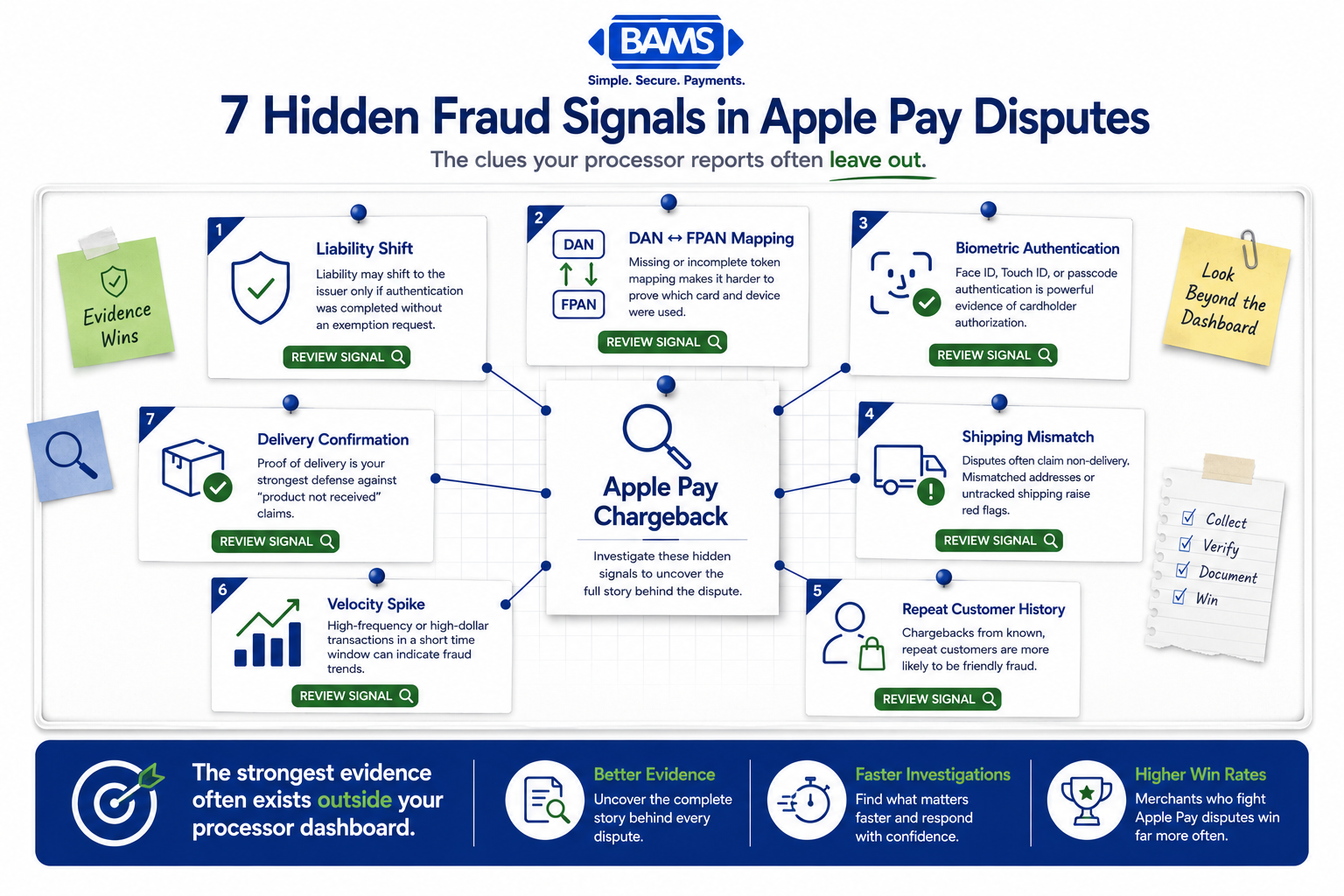
7 Fraud Patterns in Apple Pay Disputes That Your Processor Won’t Flag for You
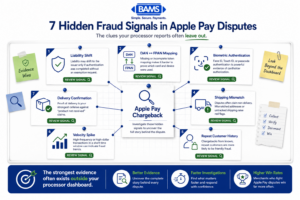
Most Apple Pay disputes aren’t caused by weak payment security. They’re caused by operational signals that standard processor dashboards fail to surface.
1. The Liability Shift Notation That Misleads You
Why it matters: Apple Pay transactions authenticated via FaceID, TouchID, or passcode typically shift chargeback liability to the card issuer, not you. But this liability shift only holds when the authentication was completed without an exemption request from the merchant. Many eCommerce managers assume they’re protected on every Apple Pay transaction. They’re not.
Apple’s official Apple Pay documentation explains how Face ID, Touch ID, and device passcodes authenticate Apple Pay transactions while protecting customer payment information.
What it looks like today: Your processor may show a generic “authenticated” flag without distinguishing between full SCA compliance and an exemption-based approval. If you requested a low-risk exemption (common in frictionless checkout flows) and the issuer granted it, liability reverted to you silently.
How to apply it: Pull your Apple Pay dispute records from the last 90 days. Check whether the transactions that resulted in chargebacks carried an exemption flag. If you see a pattern, review your checkout configuration to confirm when your platform requests exemptions versus full authentication. Disabling automatic exemption requests for orders above a certain threshold is a fast fix.
2. The DAN-to-FPAN Matching Gap
Why it matters: When a customer pays with Apple Pay, the network tokenizes their card into a Device Account Number. Your processor stores the DAN, but the cardholder’s bank references the Funding Primary Account Number (FPAN). When a dispute arrives, you may not be able to match the chargeback to the original order without manually cross-referencing both numbers.
Mastercard Developers documents how Device Primary Account Numbers (DPANs), Funding Primary Account Numbers (FPANs), and network tokenization work together during digital wallet transactions.
What it looks like today: You receive a chargeback notification referencing a card number you don’t recognize. Your order management system shows a different (tokenized) number. The dispute deadline is ticking, and you can’t locate the transaction to build a response. This matching failure is one reason why around 40% of merchants report struggling to challenge mobile wallet chargebacks.
How to apply it: Ask your payment processor whether they provide FPAN-to-DAN mapping in their reporting API or dispute notifications. If they don’t, you need to store both identifiers at the point of transaction. Even a simple spreadsheet linking order IDs to both numbers gives you a lookup tool when disputes arrive.
3. The “Not Recognized” Reason Code on a Biometrically Authenticated Transaction
Why it matters: A cardholder claiming they don’t recognize a charge that was authenticated with their fingerprint or face is a strong signal of friendly fraud, not stolen-card fraud. But most processor dashboards don’t surface the authentication method alongside the reason code. You see “transaction not recognized” and assume it’s legitimate.
What it looks like today: The dispute arrives with a standard reason code (Visa 13.1 or Mastercard 4837, for example). Nothing in the notification tells you the original payment was biometrically verified. You accept the chargeback because the evidence seems thin. Meanwhile, merchants who do dispute Apple Pay chargebacks win at 7 times the rate compared to traditional card disputes.
How to apply it: Flag every Apple Pay transaction in your order system at the time of purchase (not retroactively). When a “not recognized” dispute arrives, cross-reference it against your Apple Pay flag. If the transaction was biometrically authenticated, include that evidence in your representment. The authentication data is your strongest rebuttal.
4. The Shipping Address That Doesn’t Match the Device Profile
Why it matters: Apple Pay autofills the billing address from the customer’s Wallet. But the shipping address is entered manually or selected from saved options. When a fraudster uses a compromised Apple Pay account (through social engineering, not technical exploit), they often change the shipping address while the billing address stays consistent. This mismatch is invisible in standard processor reports.
What it looks like today:Fraudsters increasingly use social engineering to target people rather than technology, bypassing biometric controls entirely by convincing account holders to authorize payments or by accessing devices during brief physical possession. The billing-shipping mismatch is one of the few signals that survives tokenization.
How to apply it: Add a rule in your order review workflow that flags Apple Pay transactions where the shipping address differs from the billing address by more than a reasonable threshold (different state, different country, or a known reshipping address). This doesn’t require AI. It requires a checklist.
5. The Repeat-Customer Dispute That Signals Buyer’s Remorse
Why it matters: Friendly fraud on Apple Pay often comes from real customers who made a real purchase and then filed a dispute instead of requesting a refund. Because Apple Pay’s frictionless checkout reduces purchase hesitation, it can also reduce the psychological barrier to disputing after the fact. The customer doesn’t feel like they “committed” to the purchase the way they would typing in a full card number.
PCI Security Standards Council guidance emphasizes protecting payment credentials throughout the payment lifecycle, but merchants remain responsible for maintaining the operational evidence needed to resolve disputes after a purchase has been completed.
What it looks like today: You see a chargeback from a customer who has ordered from you three times before, always with Apple Pay, always with successful delivery. Your processor shows it as a standard dispute. Nothing distinguishes it from a first-time fraudulent order. Tools like BAMS’ proactive chargeback defense can help surface these repeat-customer patterns before the dispute window closes, giving you time to respond with purchase history and delivery confirmation.
How to apply it: Build a simple customer dispute history. When a chargeback arrives, check whether the customer has previous successful orders. If they do, your representment package should include the full purchase history, delivery confirmations for prior orders, and evidence of the Apple Pay authentication. Repeat-customer disputes have the highest win rate when properly documented.
6. The Velocity Spike Your Processor Averages Away
Why it matters: When a compromised Apple Pay account is used for fraud, the transactions often come in clusters: multiple orders within a short window, sometimes to different shipping addresses. Your processor’s daily summary report smooths these into an average transaction count. The spike disappears into the aggregate.
What it looks like today:More than 50% of current fraud attempts leverage AI to automate these bursts, making them harder to catch with static rules. Your processor shows you “47 transactions today” without highlighting that 12 of them came from the same device token within 90 minutes.
How to apply it: If your platform supports it, set up alerts for multiple Apple Pay transactions from the same DAN within a defined time window. Even two orders from the same device token within an hour, shipping to different addresses, should trigger a manual review. This is a velocity check, not a fraud model, and most eCommerce platforms can support it with basic automation.
7. The Missing Delivery Confirmation That Voids Your Defense
Why it matters: Apple Pay’s security features protect you at the point of authentication. They do nothing for you after the product ships. If a customer disputes an Apple Pay transaction claiming non-delivery, your only defense is proof of delivery. And yet many eCommerce operators treat Apple Pay transactions as inherently lower-risk and skip signature confirmation or tracking on smaller orders.
What it looks like today: Although Apple Pay strengthens payment authentication, merchants should continue collecting delivery confirmation and shipment evidence because authentication alone does not resolve fulfillment-related disputes. The chargebacks that do occur are disproportionately non-delivery claims, precisely the type where authentication evidence is irrelevant and shipping evidence is everything.
How to apply it: Require tracked shipping with delivery confirmation on all Apple Pay orders above your average order value. For high-value items, require signature confirmation regardless of payment method. Store tracking numbers linked to order IDs in a format you can quickly retrieve during a dispute window. The 15 to 30 days you have to respond is not enough time to hunt for shipping records across disconnected systems.
What These Signals Have in Common
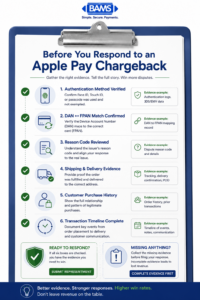
Winning Apple Pay chargebacks depends on collecting the right evidence before deadlines expire. A standardized checklist helps merchants respond faster and more consistently.
Every signal on this list shares one characteristic: it exists in the gap between what your processor reports and what you need to defend your revenue. Tokenization, biometric authentication, and liability shifts are network-level protections. They reduce fraud at the point of sale. But they don’t reduce disputes after the sale, and they don’t build your representment case for you.
The merchants who protect revenue as mobile wallet adoption grows are the ones who treat Apple Pay disputes as a distinct category with its own evidence requirements, its own timing constraints, and its own diagnostic signals. They don’t rely on their processor dashboard alone. They build a thin layer of operational intelligence (flags, cross-references, velocity checks) on top of their existing systems.
The tradeoff is real: each signal requires a small amount of manual process or system configuration. But the alternative is absorbing chargebacks you could have won, on transactions that were legitimately authenticated, from customers who were never actually defrauded.
Where to Start Without Overwhelming Your Team
You don’t need to implement all seven signals at once. Start with three: flag Apple Pay transactions at the point of purchase (Signal 3), store DAN-to-FPAN mappings (Signal 2), and enforce tracked shipping on orders above your average value (Signal 7). These three actions cover the most common evidence gaps in Apple Pay dispute responses.
If your current processor doesn’t give you visibility into authentication methods or token mappings, that’s a conversation worth having. Partners like BAMS provide dedicated account management and proactive chargeback defense that can fill exactly these gaps, especially for small-to-midsize merchants who don’t have a fraud team on staff.
The goal isn’t to build a fraud detection engine. It’s to stop losing disputes you should be winning, on payments your customers actually authorized.
Frequently Asked Questions
How does Apple Pay’s tokenization affect chargeback disputes?
Apple Pay replaces your customer’s actual card number with a Device Account Number (DAN). This makes the payment more secure at checkout, but it can make disputes harder to trace. When a chargeback arrives referencing the original card number (FPAN), you may not be able to match it to the tokenized transaction in your system without storing both identifiers at the time of purchase.
Does Apple Pay’s biometric authentication protect merchants from all chargebacks?
No. Biometric authentication (FaceID or TouchID) typically shifts liability to the card issuer for unauthorized-transaction claims. But it does not protect you from non-delivery disputes, item-not-as-described claims, or friendly fraud where the actual cardholder authorized the purchase and then disputed it later. You still need shipping evidence and order documentation for those cases.
Why are Apple Pay chargebacks harder to fight than traditional card chargebacks?
Three main reasons: the tokenized transaction data is harder to match to dispute notifications, processor dashboards often don’t surface the authentication method used, and many merchants assume Apple Pay’s security eliminates their need to collect dispute evidence. Merchants who do challenge Apple Pay chargebacks with proper documentation win at significantly higher rates than those who challenge traditional card disputes.
What is friendly fraud, and why is it common with mobile wallets?
Friendly fraud occurs when a real customer makes a legitimate purchase and then files a chargeback instead of requesting a refund. Mobile wallets like Apple Pay can increase this behavior because the frictionless checkout experience reduces the feeling of commitment to a purchase. About 40% of merchants report a rise in friendly fraud specifically tied to mobile wallet transactions.
When should merchants consider enabling Apple Pay as a payment option?
Apple Pay is worth enabling when your customer base skews mobile, your cart abandonment rate on mobile is high, or you want to reduce checkout friction. The security benefits are real: chargeback rates on Apple Pay run about 25% lower than traditional card payments. Just make sure you also build the operational processes to handle the disputes that do occur, since they require different evidence than standard card chargebacks.
Which fraud prevention strategies work for small-to-midsize merchants without a dedicated fraud team?
Start with operational basics: flag Apple Pay transactions at purchase, store token-to-card-number mappings, enforce tracked shipping on higher-value orders, and build a simple customer dispute history. These steps don’t require AI or enterprise tooling. For more proactive defense, work with a merchant services partner that offers chargeback defense support and can surface dispute patterns across your transaction data.