Merchant Services: Why “Fast Funding” Is a Lie
The settlement system gap costing eCommerce businesses 2-3 days of cash flow every single week
Learn why funding speed marketed as a checkbox feature hides the real cash flow problem. This piece exposes how weekend settlement delays create a preventable gap between promised payment processing speed and actual deposits.
TL;DR
- Funding speed isn’t a feature, it’s a system – Your actual deposit timing depends on batch cut-offs, settlement rails, banking relationships, and day-of-week patterns, not just your processor’s marketing label.
- Weekend sales expose the real gap – Friday-through-Sunday revenue often takes 2-3 extra days to land because traditional settlement infrastructure doesn’t operate on weekends, creating a predictable cash flow hole.
- Think “cash velocity,” not “funding tier” – Measure the actual elapsed time from customer purchase to usable cash in your account, broken down by day of week, then optimize the weakest links in your settlement stack.
- Processor selection is a systems question – The cheapest rate with unpredictable funding can cost more in working capital drag than a slightly higher rate with reliable, transparent deposit timing.
Your Payment Processor Promised Speed. Your Bank Account Tells a Different Story.
Every eCommerce operator has lived this moment: you run a strong weekend, sales spike, and then Monday arrives with an empty deposit. Tuesday, still nothing. By Wednesday, when the cash finally lands, you’ve already missed a restock window or delayed an ad spend decision. The frustrating part? Your processor technically offers “fast funding.” The problem isn’t the feature. It’s the system behind it.
The Industry Sold You Payment Processing Speed as a Checkbox
The merchant services industry has trained everyone to think about funding speed the way we think about shipping tiers. Standard is slow. Next-day is fast. Same-day is fastest. Pick one, pay accordingly, move on.
This framing made sense when the biggest concern was whether your processor batched once a day or twice. But eCommerce doesn’t operate in neat banking windows. As electronic payments continue to play a larger role in business operations, funding speed is no longer just a convenience feature. According to the ACH Network, businesses increasingly rely on electronic payment infrastructure to move funds efficiently, making settlement timing a critical part of day-to-day operations.
Yet most processors still market it like a static product attribute. You either have next-day funding or you don’t. That framing hides the real question: next-day from when, exactly?
Funding Speed Isn’t a Feature. It’s a System You Either Control or Don’t.
Here’s what we actually believe: the distinction between same-day and next-day funding is far less important than understanding the settlement mechanics that determine when your money actually moves. Treating funding speed as a binary checkbox is exactly why most eCommerce businesses keep absorbing a preventable 2-3 day cash flow gap every single week.
Where the Gap Actually Lives
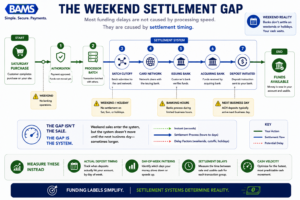
Most funding delays are not caused by processing speed. They are caused by settlement timing.
Let’s trace what happens after a customer taps “Buy Now” on a Saturday afternoon.
The payment gateway captures the authorization. Your processor batches the transaction. But here’s where it gets interesting: the batch doesn’t settle until the processor submits it to the card network, the network clears it with the issuing bank, and the acquiring bank initiates the deposit. Each of these steps has its own clock, its own cut-off time, and its own rules about weekends and holidays.
Most processors batch once per day, typically in the late afternoon or evening. If your Saturday sale gets captured after the batch cut-off, it rolls into Sunday’s batch. But Sunday isn’t a banking day. Neither is Saturday. So that transaction doesn’t even enter the settlement pipeline until Monday morning. If your processor’s “next-day funding” means one business day after settlement (not after the sale), your Saturday revenue doesn’t hit your account until Tuesday. Sometimes Wednesday.
This isn’t a bug. It’s how the rails work. Traditional ACH settlement operates on a next-business-day cycle. Newer payment infrastructure, including same-day ACH capabilities and the Federal Reserve’s FedNow Service, can help compress settlement timelines when supported by the processor, acquiring bank, and receiving bank.
Weekend Sales: The Concrete Case
For eCommerce businesses, weekends often represent peak revenue. Flash sales, social media campaigns, and general consumer browsing patterns push Friday-through-Sunday transactions to 30-40% of weekly volume for many online stores. That’s a massive chunk of revenue sitting in limbo during the exact window when settlement infrastructure slows to a crawl.
The cost isn’t abstract. When your weekend revenue takes three days to land, you’re making Monday’s inventory decisions with Thursday’s cash. You’re throttling ad spend because the budget hasn’t replenished. You’re paying suppliers late (or early from reserves you shouldn’t need to hold). Payment acceptance remains a significant operating expense for many businesses, making delays in accessing revenue even more costly when cash is tied up in the settlement pipeline.
The hidden surcharge is the time-value of money trapped in the settlement pipeline. According to the Federal Reserve’s 2025 Small Business Credit Survey, managing operating expenses remains a significant challenge for many small businesses, making delays in cash availability more impactful than many operators realize.
The Setup Matters More Than the Label
What actually determines your funding speed isn’t the marketing label. It’s the configuration: which gateway you use, what batch cut-off times your processor sets, whether your acquiring bank supports same-day ACH, and whether your business bank can receive faster payments. Change any one of those variables and the same “next-day funding” product delivers a materially different outcome.
This is where working with a merchant services partner that actually explains the pipeline matters. BAMS, for example, offers next-day funding but also walks merchants through the mechanics of their specific setup, so operators understand exactly when Saturday’s revenue will arrive and can plan accordingly. That transparency turns funding speed from a hope into a schedule.
Similarly, if you’re running on a platform with its own payment layer (Shopify Payments, for instance), your funding timeline is governed by that platform’s settlement rules, not just your processor’s. Understanding how eCommerce payments actually flow from checkout to deposit is the prerequisite for optimizing anything.
What Changes If You Stop Treating Funding as a Feature
If this framing is right, several things follow.
First, the “same-day vs. next-day” comparison becomes the wrong question. The right question is: what is the actual elapsed time between my customer’s purchase and the cash arriving in my operating account, broken down by day of week? That number is what your cash flow model should be built on.
Second, you can stop over-reserving. Many eCommerce operators hold 5-10 days of operating cash as a buffer against settlement delays. If you can compress and predict your funding timeline, that buffer shrinks, and that capital goes back to work. Your cash flow model is probably built on assumptions that no longer match reality.
Third, processor selection becomes a systems integration question, not a rate-shopping exercise. The cheapest processor with unpredictable three-day funding might cost you more in working capital drag than a slightly higher rate with reliable next-morning deposits.
A Better Way to Think About It
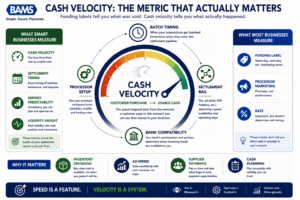
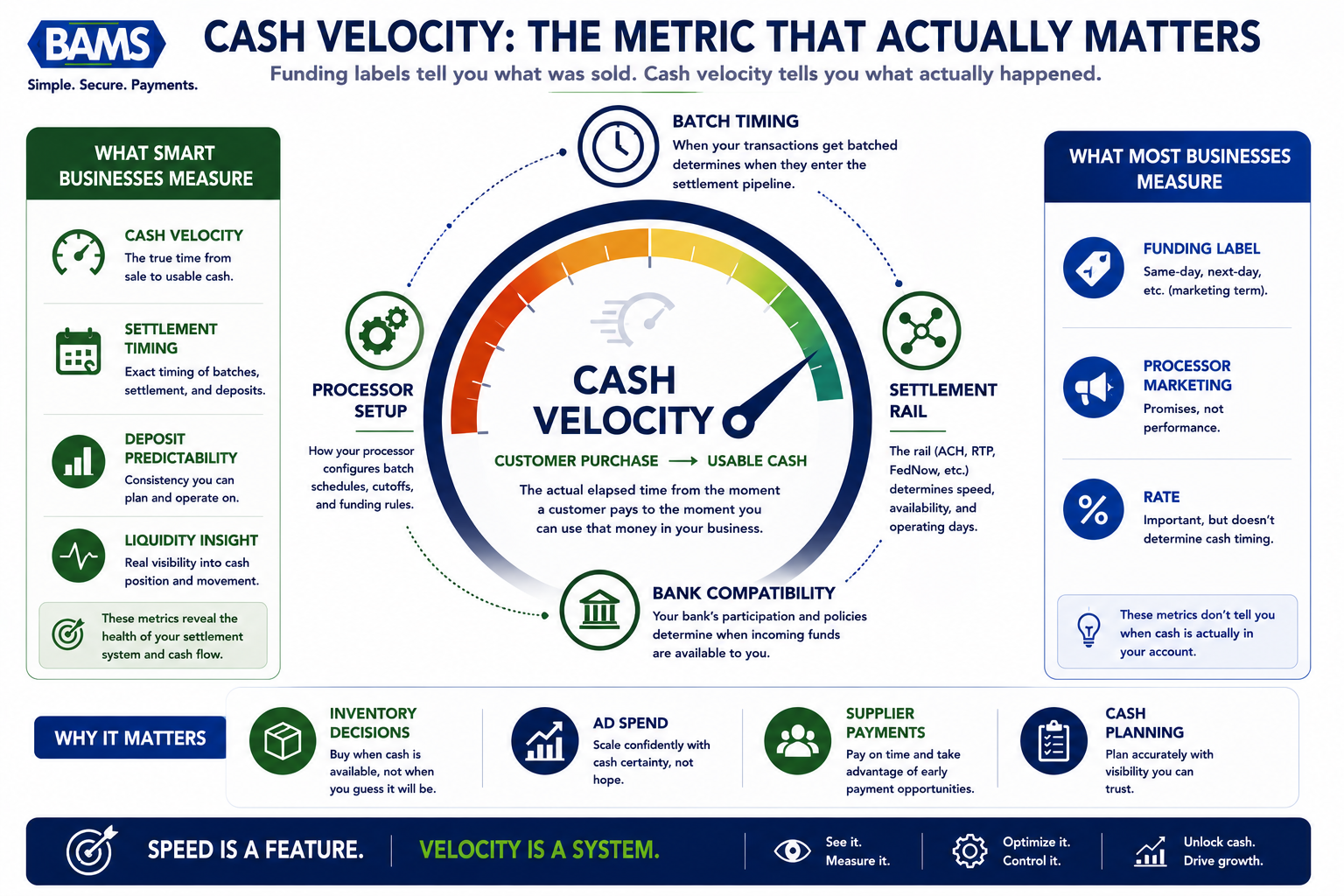
Funding labels tell you what was sold. Cash velocity tells you what actually happened.
Stop thinking of funding speed as a tier you purchase. Start thinking of it as cash velocity, the measurable, optimizable rate at which revenue converts to usable operating capital.
Cash velocity is a function of your entire settlement stack, not any single provider’s marketing claim. It accounts for batch timing, rail selection, banking relationships, and day-of-week patterns. When you measure it, you manage it. When you manage it, you stop leaving days of float on the table every week.
The merchants who gain an edge here aren’t the ones who pay for the fastest funding label. They’re the ones who understand their pipeline well enough to make informed decisions about where speed actually matters and where it’s just a line item on an invoice.
The Real Advantage Is Knowing Your Own Pipeline
We don’t think the future of financial stability solutions for eCommerce is faster rails (though those help). It’s merchants who understand their settlement mechanics well enough to stop being surprised by their own cash position. That’s not a technology problem. It’s an education and partnership problem.
The processors who win long-term will be the ones who make the pipeline visible, not just fast. Because speed you can’t predict is just another version of slow.
Frequently Asked Questions
What is next-day funding in merchant services?
Next-day funding means your processor deposits settled transaction funds into your bank account by the next business day. The key detail most providers leave out: “next business day” is counted from when the batch settles, not from when the customer pays, which can add 1-3 days depending on weekends and cut-off times.
How can a business qualify for next-day funding?
Qualification typically depends on your processing volume, chargeback ratio, business type, and how long you’ve been with your processor. Your acquiring bank and business bank also need to support the settlement rails required for accelerated deposits.
When should a business consider same-day funding over next-day?
Same-day funding makes the most difference when your business has high weekend transaction volume or relies on rapid inventory turnover. If your cash flow model depends on daily revenue access to fund ads or restock, the compressed timeline can eliminate costly delays.
Sources