

8 Ways Apple Pay Cuts Hidden Chargeback Costs
Last Updated on October 15, 2026 by Dimitri Akhrin
A full-lifecycle diagnostic that surfaces where dispute fees, lost merchandise, and interchange penalties quietly drain margin
Learn where chargeback costs actually accumulate across your payment processing stack and how Apple Pay mechanisms reduce losses at each stage. Built for eCommerce managers already feeling the drag of disputes on cash flow and margin.
TL;DR
- Chargebacks cost far more than the dispute fee – Mastercard reports average internal and third-party costs of $128 per chargeback, excluding the cost of lost goods or services.
- Apple Pay’s biometric authentication prevents disputes at the source – Tokenized, device-authenticated transactions make “I didn’t authorize this” claims nearly impossible, reducing friendly fraud before it starts.
- Data quality pays off twice – Submitting complete transaction data (Level 2 and Level 3 fields) both lowers your interchange rates and strengthens your evidence when you do need to fight a dispute.
- Speed is a cost lever – Next-day funding, real-time ratio monitoring, and rapid dispute response all shrink the window in which chargebacks drain your working capital and operations.
- Start with diagnostics, not tools – Segment your chargebacks by type and monitor your ratio weekly. Those two steps reveal where your losses actually concentrate and which fixes will deliver the fastest ROI.
The Chargeback Costs You’re Not Tracking

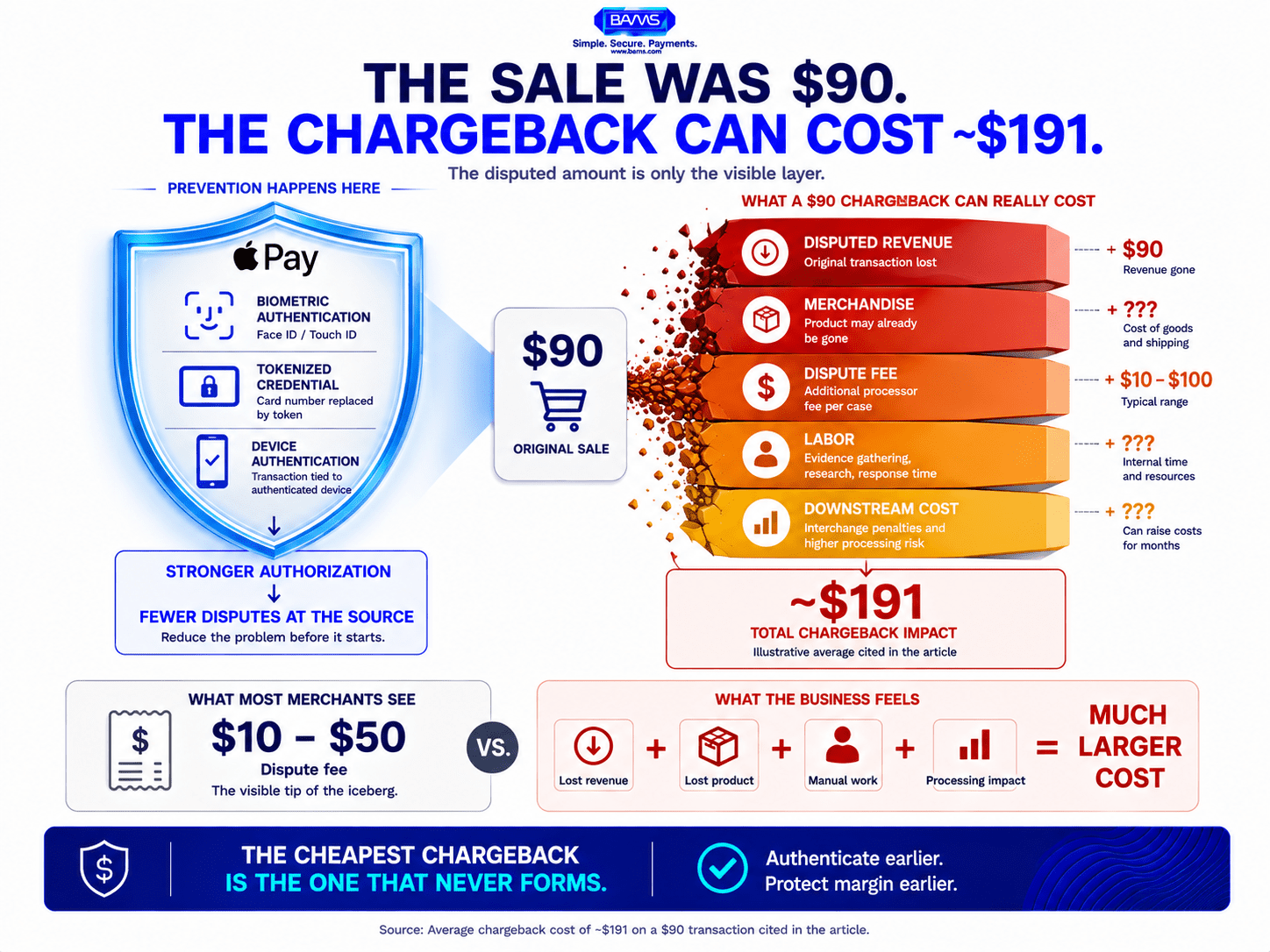
The disputed sale is only one layer of chargeback cost. Lost merchandise, fees, operational work and downstream processing effects can push the total impact much higher.
Most eCommerce managers know chargebacks hurt. What they underestimate is where the damage actually lands. The dispute fee itself (typically $10 to $50 per case, sometimes reaching $100) is only the visible layer. Underneath it sit lost merchandise you’ll never recover, labor hours spent assembling evidence, and interchange penalties that quietly inflate your processing rates for months after a dispute spike.
When you factor in all of those layers, the cost extends well beyond the original transaction. Mastercard reports that merchants average $82 in internal costs and $46 in third-party fees per chargeback, excluding the cost of lost goods or services. Because chargeback costs compound across your payment processing stack, even a modest reduction in disputes can unlock savings that ripple through your entire P&L.
This isn’t a guide about toggling a single fraud filter. It’s a diagnostic across your full transaction lifecycle, surfacing the specific mechanisms (including Apple Pay) that cut losses at each stage.
Who This Is For and What It Covers
This list is built for eCommerce managers at established online businesses who are already processing meaningful volume and feel the drag of disputes on cash flow, staffing, and margin. If you’re running a team of 10 to 50 and your chargeback rate has become a recurring line item rather than an occasional nuisance, these are the levers to pull.
We’re not covering basic fraud-filter setup or how to file a dispute response for the first time. Instead, this focuses on systemic cost reduction: the operational, technical, and payment-method decisions that prevent chargebacks from forming and shrink the financial impact of the ones that still get through.
How We Selected These Approaches
Each item was evaluated on three criteria: does it reduce chargeback frequency, does it lower the per-dispute cost when one occurs, and does it protect interchange qualification so your baseline processing fees don’t creep upward? Approaches that only address one of these three were excluded. The goal is compounding savings, not isolated fixes.
7 Ways to Turn Fewer Chargebacks Into Real Savings
1. Authenticate at the Point of Sale With Biometric Payment Methods
Why it matters: Strong authentication and tokenization can reduce fraud before a transaction becomes a dispute. Visa Token Service replaces sensitive card numbers with tokens and supports digital wallets including Apple Pay to enable more secure digital payment experiences. For merchants, reducing fraud at the transaction stage can prevent some disputes before they ever enter the chargeback process.
What it looks like today: Apple Pay uses Face ID or Touch ID to authenticate every transaction, generating a device-specific token (MPAN) instead of transmitting the actual card number. This shifts liability away from you and toward the issuer in most dispute scenarios.
How to apply it: Promote Apple Pay as a checkout option, especially on mobile where conversion rates and fraud risk are both elevated. Track your chargeback rate segmented by payment method. Within a few months, you’ll have data showing the dispute-rate gap between tokenized and non-tokenized transactions.
2. Close the Interchange Qualification Gap
Why it matters: Every chargeback doesn’t just cost you the dispute fee. It can trigger interchange downgrades on future transactions, meaning you pay a higher rate on sales that have nothing to do with the original dispute. This is the compounding effect most managers miss.
What it looks like today: Apple Pay transactions tend to qualify for lower interchange tiers because tokenized, authenticated payments meet card network criteria for reduced risk. But qualification also depends on submitting the right transaction data (Level 2 and Level 3 fields like tax amount, shipping address, and line-item detail). If your gateway isn’t passing that data, you’re leaving savings on the table.
How to apply it: Audit your interchange qualification rates on Apple Pay transactions versus traditional card payments. Look for downgrades caused by missing data fields, and work with your payment processor to ensure Level 3 data is captured automatically at checkout.
3. Shorten Your Dispute Resolution Timeline
Why it matters: Disputes can tie up funds while your team assembles documentation and waits for resolution. The cost isn’t just the fee. It’s the operational drag and the capital you can’t deploy.
What it looks like today: Merchants who invest in proactive chargeback defense (automated alerts, rapid-response evidence submission, and pre-dispute resolution through network programs like Visa’s CDRN or Mastercard’s Ethoca) cut resolution time and win rates simultaneously.
How to apply it: If you’re currently handling disputes manually, calculate the labor cost per case. Then compare it against the cost of automated dispute management. For many mid-size merchants, a partner like BAMS that offers proactive chargeback defense and dedicated account management can reduce both the time-to-resolution and the internal staffing burden.
4. Separate Friendly Fraud From True Fraud in Your Data
Why it matters: Treating all chargebacks as a single category leads to blunt-instrument responses. Tightening fraud filters to stop true fraud will increase false declines on legitimate customers. Ignoring friendly fraud means you’re absorbing losses you could contest and win.
What it looks like today: The 2024 Chargeback Field Report from the Merchant Risk Council found that many merchants believe a significant portion of their disputes stem from first-party (friendly) fraud. Yet most don’t segment their dispute data well enough to act on that insight.
How to apply it: Tag each chargeback by reason code and cross-reference it with your order data (delivery confirmation, customer communication history, IP and device fingerprint). Build a simple dashboard that separates true fraud, friendly fraud, and merchant error. This segmentation tells you where to invest: better authentication, better dispute responses, or better fulfillment processes.
5. Use Contactless Payment Data to Strengthen Dispute Evidence
Why it matters: When you do need to fight a dispute, the quality of your evidence determines whether you recover the funds. Tokenized payment methods like Apple Pay generate richer transaction metadata (device authentication, geolocation signals, unique transaction identifiers) that strengthens your representment case.
What it looks like today: Merchants who include device-level authentication proof in their dispute responses win at higher rates than those submitting only basic order details. The token-based transaction trail provides a clear chain of authorization that issuers find persuasive.
How to apply it: Update your dispute response templates to include Apple Pay-specific evidence fields: device authentication method, MPAN token reference, and any available device or session data. If your payment gateway doesn’t surface this data in an accessible format, that’s a conversation to have with your processor. Understanding the true cost of chargebacks versus interchange fees can help you prioritize which disputes are worth contesting.
6. Align Funding Speed With Dispute Cycles
Why it matters: When deposits take 3 to 5 business days and disputes freeze funds for 46, your working capital takes a double hit. Faster funding doesn’t prevent chargebacks, but it changes the math on how much each dispute disrupts your operations.
What it looks like today: Most traditional processors batch-settle and fund on a 2-to-5-day cycle. Next-day funding (available through processors like BAMS) means the revenue from non-disputed transactions reaches your account faster, giving you a cash-flow buffer to absorb the occasional dispute freeze without scrambling.
How to apply it: Calculate your average daily revenue and multiply it by the difference between your current funding delay and next-day funding. That number represents the working capital you’re lending your processor interest-free. If it’s material (and for most mid-size eCommerce operations, it is), switching to next-day funding is one of the fastest ROI moves available.
7. Monitor Your Chargeback Ratio as a Leading Indicator, Not a Lagging Report
Why it matters: Card networks impose monitoring programs when your chargeback ratio crosses specific thresholds (typically 0.9% to 1% of transactions). Once you’re in a monitoring program, you face additional fees, mandatory audits, and potential account termination. By the time you see it in a monthly report, you’ve already crossed the line.
What it looks like today: The merchants who avoid monitoring programs track their ratio weekly (or even daily), broken down by payment method, product category, and customer segment. They spot spikes early and intervene before the ratio breaches the threshold.
How to apply it: Set up automated alerts when your chargeback ratio exceeds 0.65% in any rolling 30-day window. That gives you a buffer before you hit network thresholds. Segment the data by payment method. You’ll likely find that Apple Pay transactions carry a lower dispute rate than traditional card-not-present payments, which can inform how aggressively you promote tokenized checkout options.
The Pattern Underneath These Savings

Chargeback reduction works best as a system. Stronger authentication, better transaction data, stronger evidence and faster payment operations protect margin at different stages.
Three themes connect every item on this list. First, authentication at the front end (biometrics, tokenization) prevents more disputes than any back-end filter. Second, data quality determines both your interchange rates and your dispute win rates, so investments in better data capture pay off twice. Third, speed matters: faster funding, faster dispute response, and faster ratio monitoring all reduce the window in which chargebacks drain your resources.
These aren’t independent tactics. They form a feedback loop. Better authentication lowers your dispute rate, which protects your interchange qualification, which lowers your per-transaction cost, which improves the margin you’re defending in the first place. The merchants who see the largest savings treat chargeback reduction as a system, not a checklist.
Where to Start
You don’t need to implement all seven approaches at once. Start with the diagnostic work: segment your chargebacks by type (item 4) and monitor your ratio in real time (item 7). Those two steps will tell you exactly where your losses concentrate. From there, prioritize based on your biggest cost driver. If friendly fraud dominates, invest in authentication and evidence quality. If interchange downgrades are bleeding margin, focus on data capture and qualification audits.
Resource constraints are real. Pick one or two items that address your most expensive problem, measure the impact over 60 to 90 days, and expand from there. Even a small reduction in chargeback volume, when compounded across dispute fees, lost merchandise, labor, and interchange penalties, translates into savings that grow every month.
Frequently Asked Questions
What fees do merchants incur when accepting Apple Pay?
Apple doesn’t charge merchants a fee for accepting Apple Pay. Your costs come from the same interchange fees, network assessments, and processor markups you’d pay on any card transaction. The difference is that Apple Pay’s tokenized, authenticated transactions often qualify for lower interchange tiers, which can reduce your effective rate compared to traditional card-not-present payments.
How does Apple Pay help reduce fraud and chargeback costs?
Apple Pay requires biometric authentication (Face ID or Touch ID) for every transaction and replaces the actual card number with a device-specific token. This makes it extremely difficult for someone to use a stolen card number and nearly eliminates “unauthorized transaction” disputes. The authentication data also strengthens your evidence if you need to contest a chargeback.
How much does a single chargeback actually cost?
The dispute fee itself ranges from $10 to $50 (sometimes $100), but the total cost is much higher. When you include lost merchandise, labor for evidence gathering, and potential interchange downgrades on future transactions, the average chargeback costs roughly $191 on a $90 disputed transaction. That’s why prevention is far more cost-effective than response.
How long does a chargeback dispute take to resolve?
Chargeback resolution time varies depending on the dispute, card network, issuer, and response process. While a dispute remains unresolved, it can create additional administrative work and reduce cash flow predictability. This is why faster funding on non-disputed transactions and efficient dispute management can make a material difference to operations.
When should businesses actively promote Apple Pay to customers?
Promote Apple Pay most aggressively on mobile checkout flows, where both fraud risk and cart abandonment are highest. Also consider promoting it for high-value orders where the chargeback cost would be significant, and for repeat customers where faster checkout can improve lifetime value. Track your dispute rate by payment method to quantify the benefit.
What’s the difference between chargeback fees and interchange fees, and which should I reduce first?
Interchange fees apply to every transaction and are set by card networks. Chargeback fees are penalty charges per dispute. For most mid-size eCommerce businesses, interchange fees represent a larger total dollar amount, but chargebacks have a compounding effect because they can trigger interchange downgrades. If your dispute rate is above 0.5%, prioritize chargeback reduction first since it will also protect your interchange rates.


