
Apple Pay Fraud: A Merchant Guide to Dispute Triage
Last Updated on August 18, 2026 by Dimitri Akhrin
How to read tokenized transaction signals, separate true fraud from friendly fraud, and win more chargebacks
Learn how to triage Apple Pay disputes by reading transaction-level signals that distinguish genuine fraud from friendly fraud. This guide gives eCommerce operators a practical framework for filing stronger responses and recovering lost revenue.
TL;DR
- Most Apple Pay chargebacks aren’t true fraud — Apple Pay’s biometric authentication and tokenization make genuine unauthorized use rare, which means a large share of disputes are friendly fraud from legitimate cardholders. These are winnable if you respond correctly.
- Classify before you respond — Read the authentication signals, shipping data, customer history, and reason code to determine whether a dispute is true fraud or friendly fraud. This single step changes your entire evidence strategy.
- Build fraud-type-specific evidence packages — Generic dispute templates lose cases. For friendly fraud, lead with Apple Pay’s biometric authentication proof, delivery confirmation, and post-purchase engagement. For true fraud indicators, consider accepting the loss and tightening filters.
- Watch for provisioning fraud patterns — The main Apple Pay vulnerability is stolen cards added to a fraudster’s wallet. Look for clusters of high-value first-time orders with mismatched addresses, which require different handling than friendly fraud.
- Track outcomes and refine — Log every dispute result by reason code, fraud classification, and evidence submitted. This data reveals which cases you win, which you lose, and where to focus your prevention and response efforts for the biggest revenue impact.
Guide Orientation: What This Covers and Who It’s For
This guide walks eCommerce managers through a practical framework for identifying, triaging, and responding to Apple Pay fraud disputes before they erode revenue. The focus is on separating true fraud from friendly fraud at the transaction level, so you file stronger responses and recover more chargebacks.
It’s built for established online businesses (roughly 10 to 50 employees) that already accept Apple Pay and are seeing chargeback volume that doesn’t match their actual fraud exposure. If you’re an eCommerce operator who manages disputes directly or oversees the team that does, this is for you.
By the end, you’ll understand how Apple Pay’s tokenized transaction data differs from standard card data, how to read the signals that distinguish genuine unauthorized use from buyer’s remorse, and how to build a triage process that protects your dispute win rate. This guide does not cover Apple Pay’s technical integration or setup. It assumes you’re already processing these transactions and need to defend the revenue they generate.
Why Protecting Revenue From Apple Pay Disputes Matters Now
Mobile wallet adoption is no longer an early-adopter trend. Apple Pay’s footprint continues to expand, and with it, the volume of transactions flowing through tokenized channels. That growth is broadly positive for merchants. Apple Pay uses tokenization and device-based authentication to help reduce payment fraud while protecting card credentials during every transaction.
But here’s the problem: lower fraud rates don’t mean lower chargeback rates. Apple Pay’s security architecture (biometric authentication, device-bound credentials, tokenization) makes true unauthorized fraud genuinely difficult. What it doesn’t prevent is a legitimate cardholder completing a purchase with Face ID, receiving the product, and then filing a dispute claiming the charge was unauthorized.
This is friendly fraud, and it’s the fastest-growing category of chargebacks across eCommerce. When you treat every Apple Pay dispute as if a stolen card was involved, you accept losses you could have contested and won. The cost compounds: lost merchandise, forfeited revenue, increased chargeback ratios that threaten your processing account, and higher processing fees triggered by elevated dispute rates.
The merchants who protect their margins aren’t the ones with the most sophisticated fraud-prevention software. They’re the ones who can read a transaction and make a fast, informed decision about whether to fight or accept a dispute. That’s a skill, and this guide teaches it.
Core Concepts: Tokenization, Fraud Types, and What Apple Pay Actually Changes
How Tokenization Reshapes the Dispute Landscape
When a customer pays with Apple Pay, their actual card number never touches your system. Instead, Apple generates a Device Account Number (DAN), a token unique to that device. Each transaction also includes a one-time dynamic security code. This means traditional card-not-present fraud (where stolen card numbers are used online) is nearly eliminated for Apple Pay transactions.
For you as a merchant, this is critical context. If someone disputes an Apple Pay transaction claiming their card was stolen and used without authorization, the claim faces a high bar of implausibility. The fraudster would need the physical device and the cardholder’s biometric data (Face ID or Touch ID) to complete the purchase. That scenario isn’t impossible, but it’s rare.
True Fraud vs. Friendly Fraud: The Distinction That Saves Revenue
True fraud means an unauthorized party genuinely used a payment method without the cardholder’s knowledge or consent. In the Apple Pay context, this typically involves compromised device access or social engineering during card provisioning.
Friendly fraud (also called first-party fraud) means the actual cardholder authorized the transaction but later disputes it. Reasons range from forgetfulness and family members making purchases to deliberate abuse of the chargeback system. Because Apple Pay uses strong customer authentication through biometrics and tokenization, merchants should carefully distinguish genuine unauthorized use from first-party disputes before deciding how to respond.
Why This Matters for Your Response Strategy
The evidence you gather and the narrative you build in a dispute response should differ completely depending on which type of fraud you’re facing. Treating all disputes identically, with a generic response template, is the single most common reason merchants lose winnable cases.
The Triage Framework: Four Phases of Apple Pay Dispute Defense

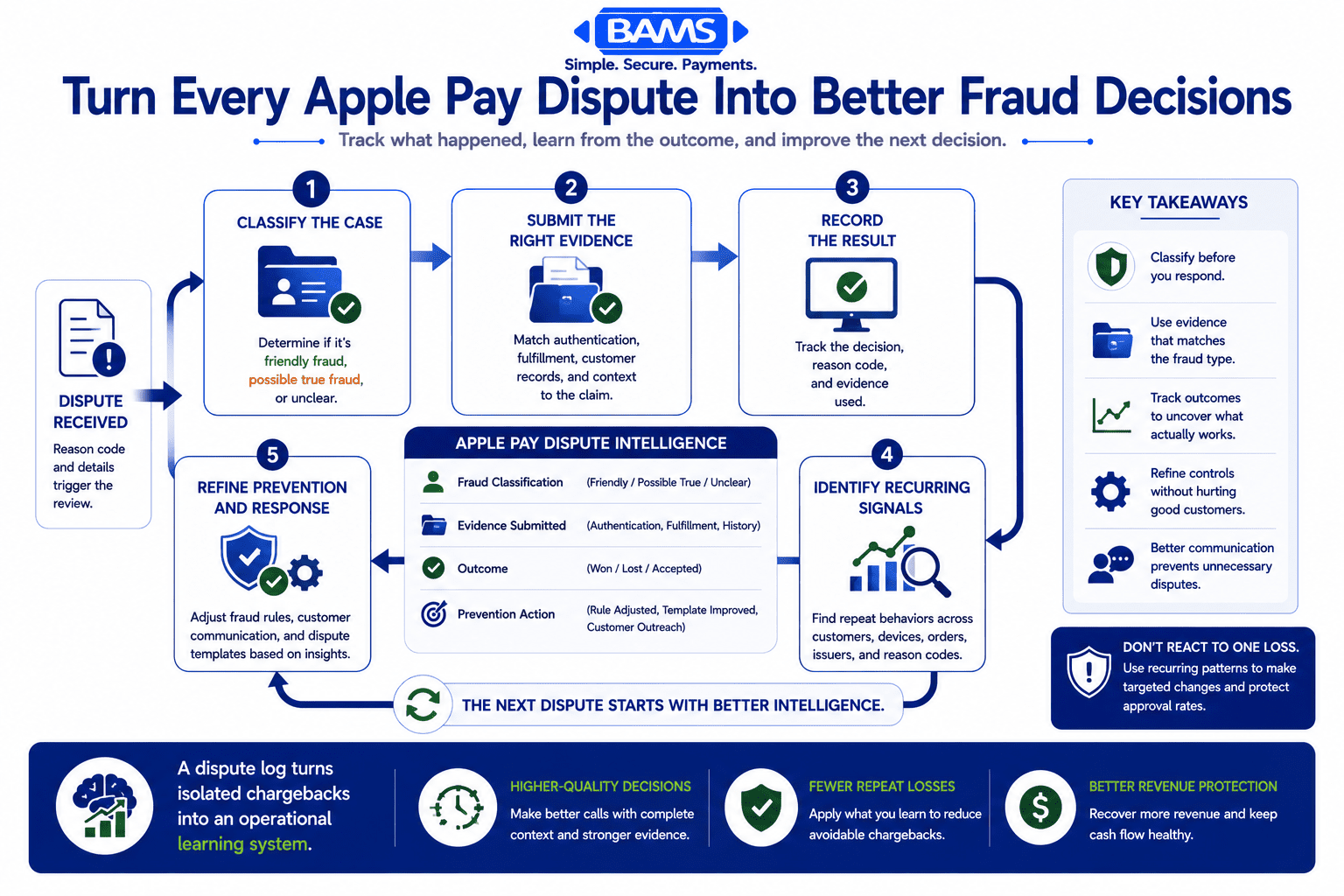
Apple Pay disputes should be classified before they are answered. Authentication, purchase history, fulfillment data, and customer behavior reveal whether a merchant should build representment, investigate further, or accept the loss.
Protecting revenue from Apple Pay chargebacks follows a four-phase process. Each phase builds on the previous one, and skipping steps is where most merchants lose cases they should win.
- Phase 1: Signal Collection — Gather transaction-level data that reveals how the purchase was authenticated and fulfilled.
- Phase 2: Fraud Classification — Use those signals to categorize the dispute as likely true fraud or likely friendly fraud.
- Phase 3: Evidence Assembly — Build a response package tailored to the specific fraud classification, not a generic template.
- Phase 4: Response and Follow-Through — File the representment with proper documentation and track outcomes to refine your process.
These phases form a repeatable system. The goal isn’t perfection on every case. It’s a consistently higher win rate that compounds into meaningful revenue recovery over quarters and years.
Step-by-Step Breakdown: How to Triage and Respond to Apple Pay Chargebacks
Step 1: Pull the Full Transaction Record Within 24 Hours
Objective: Assemble every available data point about the disputed transaction before memory fades and logs rotate.
When a chargeback notification arrives, your first move is to pull the complete transaction record from your payment gateway and your order management system. For Apple Pay transactions specifically, look for the tokenized payment indicator. Most gateways flag whether a transaction was authenticated via a mobile wallet, and many will show the authentication method (biometric vs. passcode).
Collect the following: the Device Account Number (the token, not the underlying card number), the transaction timestamp, the IP address and device fingerprint, the shipping address and delivery confirmation, any customer service interactions before or after the purchase, and the specific reason code on the chargeback. Reason codes are your roadmap. A code indicating “unauthorized transaction” requires a fundamentally different response than one indicating “product not received” or “not as described.”
Anti-pattern: Waiting more than 48 hours to begin evidence collection. Delivery tracking links expire, customer service chat logs get archived, and gateway data retention windows vary. Urgency matters here.
Success indicator: You have a single document or case file containing every data point listed above within one business day of the chargeback notification.
Step 2: Read the Authentication Signals to Classify the Dispute
Objective: Determine whether the transaction’s authentication profile is consistent with true unauthorized fraud or points toward friendly fraud.
This is the step most merchants skip entirely, and it’s where the real revenue protection happens. Apple Pay transactions carry authentication signals that traditional card transactions don’t. When a customer authenticates with Face ID or Touch ID on their personal device, that biometric verification is logged by the card network as a strong customer authentication event.
Ask yourself a series of diagnostic questions. Was the transaction authenticated biometrically? Did the shipping address match the billing address on file? Has this customer purchased from you before? Did the customer contact support before filing the dispute, or did the chargeback arrive without warning? Was the product digital (immediately delivered) or physical (with a tracking number)?
A biometrically authenticated Apple Pay transaction, shipped to a known address, from a repeat customer who never contacted support, is a textbook friendly fraud profile. Conversely, a first-time customer with mismatched addresses and an unusual device fingerprint warrants more caution. Apple’s own data shows fraud reduction of 60% to 90% compared to traditional cards, which means the baseline probability of true unauthorized fraud on a properly authenticated Apple Pay transaction is genuinely low.
Anti-pattern: Assuming every “unauthorized” reason code means actual unauthorized use. The reason code reflects what the cardholder claimed, not what actually happened.
Success indicator: You can articulate in one sentence whether this dispute is more likely true fraud or friendly fraud, and you can point to specific data points supporting that classification.
Step 3: Build a Fraud-Type-Specific Evidence Package
Objective: Assemble documentation that directly addresses the cardholder’s specific claim, using evidence that matches your fraud classification.
If you’ve classified the dispute as likely friendly fraud, your evidence package should emphasize the authentication strength of Apple Pay. Explain (briefly, in plain language the bank analyst can follow) that the transaction required biometric verification on the cardholder’s personal device. Include the delivery confirmation showing the item arrived at the cardholder’s address. Include any post-purchase engagement: emails opened, loyalty points earned, return requests initiated and then abandoned, or product reviews left.
For disputes you’ve classified as potentially legitimate true fraud, your calculus changes. Consider whether the cost of fighting exceeds the recovery. In some cases, accepting the chargeback and tightening your fraud filters is the smarter business decision. Not every dispute is worth contesting, and recognizing that distinction is a sign of mature transaction analysis, not weakness.
For friendly fraud cases, structure your response letter around three pillars: (1) the transaction was strongly authenticated via Apple Pay’s biometric and tokenized system, (2) the product or service was delivered as described, and (3) the cardholder’s post-purchase behavior is inconsistent with someone who was genuinely defrauded. Tools like BAMS’ proactive chargeback defense can help you organize this evidence systematically and flag disputes that match friendly fraud profiles before response deadlines pass.
Anti-pattern: Submitting the same generic evidence template for every dispute regardless of reason code or fraud type. Bank analysts review hundreds of cases. A targeted, specific response stands out.
Success indicator: Your evidence package directly addresses the cardholder’s stated reason for the dispute and includes at least three distinct pieces of supporting documentation.
Step 4: Understand the Fraud Patterns Unique to Mobile Wallets
Objective: Recognize the specific fraud patterns that affect Apple Pay transactions so you can spot emerging risks before they become chargeback clusters.
While Apple Pay’s tokenization eliminates most traditional card-not-present fraud, it introduces a different risk surface. The most common pattern isn’t stolen credentials used at checkout. It’s compromised card provisioning: a fraudster adds a stolen card number to their own Apple Wallet, passes the bank’s verification (often a simple SMS code sent to a number they’ve already compromised), and then makes purchases that are technically “authenticated” by Apple Pay’s biometric system on the fraudster’s device.
At least 502 reports of unauthorized card transactions in Singapore in early 2025 involved cards linked to Apple Pay through exactly this provisioning vulnerability. For eCommerce merchants, this means that even biometrically authenticated Apple Pay transactions aren’t a guarantee of legitimacy if the card was fraudulently provisioned.
Watch for clusters: multiple orders from new accounts shipping to the same address, unusually high average order values from first-time Apple Pay users, or a sudden spike in disputes from a specific card-issuing bank. These patterns suggest provisioning fraud rather than friendly fraud, and your response strategy should shift accordingly.
Anti-pattern: Assuming that because Apple Pay uses biometrics, every authenticated transaction is safe. The biometric verifies the device holder, not necessarily the legitimate cardholder.
Success indicator: You maintain a simple log or dashboard tracking dispute frequency by payment method, customer type, and reason code, and you review it at least monthly.
Step 5: File the Representment With Precision and Track Outcomes
Objective: Submit your dispute response within the deadline, formatted for the reviewing analyst, and capture the outcome for process improvement.
Timing is non-negotiable. Most card networks give you 30 days to respond to a chargeback, but the effective window is shorter because your acquirer may need processing time. Aim to submit your representment within 14 days of notification. Late responses are automatic losses regardless of evidence quality.
Format your response for the person reading it: a bank analyst who may review dozens of cases per day. Lead with your strongest evidence. Use clear headers. Attach documents in the order they’re referenced. A well-organized response signals competence and increases the likelihood of a favorable review.
After filing, track the outcome. Record whether you won or lost, the reason code, the fraud classification you assigned, and the evidence you submitted. Over time, this data reveals which types of disputes you win consistently and which you don’t. That feedback loop is how you refine your triage process and improve your win rate quarter over quarter. Merchants working with partners like BAMS benefit from dedicated account managers who can help analyze these patterns and adjust dispute strategy based on actual outcomes rather than guesswork.
Anti-pattern: Filing and forgetting. If you don’t track outcomes, you can’t improve your process, and you’ll keep losing the same types of disputes.
Success indicator: You have a running record of dispute outcomes and can calculate your win rate by fraud classification type.
Step 6: Tighten Pre-Transaction Controls Based on Dispute Data
A chargeback should produce more than a win or loss. Tracking classifications, evidence, and outcomes helps merchants improve future dispute responses and refine fraud controls without creating unnecessary false declines.
Objective: Use your dispute outcome data to adjust front-end fraud filters and reduce future chargeback volume without blocking legitimate sales.
Dispute defense is reactive by nature. The highest-leverage move is preventing the chargeback from happening in the first place. Use the patterns you’ve identified in Steps 4 and 5 to calibrate your fraud detection rules. If you’re seeing provisioning fraud from specific geographies or card issuers, add velocity checks or additional verification steps for those segments.
For friendly fraud prevention, the most effective tool is often better communication, not better technology. Clear order confirmation emails, prominent billing descriptors that customers recognize on their statements, proactive shipping notifications, and easy-to-find return policies all reduce the “I don’t recognize this charge” disputes that account for a significant share of friendly fraud. If you sell on platforms like BigCommerce or WooCommerce, make sure your Apple Pay integration includes post-purchase communication flows that reinforce the purchase in the customer’s mind.
Balance is essential here. Overly aggressive fraud filters block legitimate customers and cost you more in lost sales than chargebacks ever would. Use your dispute data to make surgical adjustments, not sweeping changes.
Anti-pattern: Reacting to a single high-value chargeback by tightening all fraud filters across the board. This creates false declines that silently destroy revenue.
Success indicator: Your chargeback ratio trends downward over three to six months while your approval rate remains stable or improves.
Practical Examples: Friendly Fraud vs. True Fraud in Action
Scenario A: The Repeat Customer Who “Didn’t Authorize” a Purchase
A customer who has made four previous purchases from your store buys a $180 item using Apple Pay. The transaction is biometrically authenticated. The item ships to the same address as all prior orders and is confirmed delivered. Three weeks later, you receive a chargeback with reason code 10.4 (“Other Fraud — Card-Absent Environment”).
Your triage: This is a textbook friendly fraud profile. The biometric authentication, repeat purchase history, consistent shipping address, and confirmed delivery all point to a legitimate cardholder who authorized the transaction. Your evidence package should lead with the Apple Pay authentication data, followed by the purchase history, delivery confirmation, and any post-purchase email engagement. Win probability: high.
Scenario B: The New Customer With a High-Value Order
A first-time customer places a $650 order using Apple Pay. The shipping address doesn’t match the billing address. The order is placed at 3 AM in the cardholder’s time zone. You receive a chargeback within 10 days of delivery, and the cardholder’s issuing bank notes that the customer reported their card information compromised across multiple merchants.
Your triage: This profile is consistent with provisioning fraud, where a stolen card was added to someone else’s Apple Wallet. The mismatched addresses, unusual timing, first-time purchase, high value, and multi-merchant compromise pattern all support the cardholder’s claim. Contesting this dispute is likely a losing proposition. Accept the loss, flag the signals, and update your fraud filters to add friction for similar transaction profiles going forward.
Common Mistakes and Pitfalls
Treating all Apple Pay chargebacks as unwinnable. Because Apple Pay is associated with strong payment security, some merchants assume that any dispute must reflect genuine fraud. The opposite is often true: the very strength of Apple Pay’s authentication makes friendly fraud more likely as a proportion of total disputes.
Ignoring reason codes. The reason code tells you exactly what the cardholder claimed. Your response must address that specific claim. A response about delivery confirmation is irrelevant if the dispute code is “unauthorized transaction.”
Over-investing in prevention tools while under-investing in response quality. Fraud prevention is important, but the disputes that reach you still need skilled, timely responses. Many merchants spend heavily on fraud screening and then submit weak representments that lose winnable cases.
Not tracking outcomes. Without data on which disputes you win and lose (and why), you’re operating blind. Even a simple spreadsheet tracking reason codes, fraud classifications, and outcomes will reveal actionable patterns within a few months.
What to Do Next
Start with one change: the next time an Apple Pay chargeback arrives, spend 15 minutes running through the diagnostic questions in Step 2 before you decide whether to fight or accept it. That single habit, classifying before responding, will shift your win rate more than any tool or template.
If you’re seeing more than a handful of Apple Pay disputes per month, build the simple tracking log described in Step 5. Review it monthly. The patterns will emerge faster than you expect, and each pattern you identify is a decision you won’t have to make from scratch next time.
This guide is a reference, not a checklist. Revisit the triage framework as your dispute volume evolves, as Apple Pay’s market share grows, and as your own data reveals which response strategies work best for your specific product category and customer base. Revenue protection isn’t a one-time project. It’s an ongoing operational skill that gets sharper with practice.
Frequently Asked Questions
What is Apple Pay and how does it work for online transactions?
Apple Pay is a mobile wallet that lets customers pay using their iPhone, iPad, or Mac. Instead of transmitting the actual card number, Apple Pay creates a Device Account Number (a unique token) for each card added to the wallet. Online purchases require biometric authentication (Face ID or Touch ID) or a device passcode. This tokenized, biometrically verified process means the merchant never receives the real card number, which significantly reduces traditional card-not-present fraud.
Why am I getting chargebacks on Apple Pay transactions if it’s so secure?
Apple Pay’s security dramatically reduces true unauthorized fraud, but it doesn’t prevent friendly fraud. A legitimate cardholder can authenticate a purchase with their own face or fingerprint, receive the product, and still file a dispute claiming the charge was unauthorized. Because Apple Pay makes genuine unauthorized use so difficult, a higher proportion of Apple Pay chargebacks tend to be friendly fraud rather than true fraud. That’s actually an advantage for merchants who know how to build the right evidence package.
How does tokenization affect my ability to fight chargebacks?
Tokenization works in your favor during disputes. Because Apple Pay transactions require a device-bound token and biometric authentication, you can argue that the transaction was strongly verified by the actual cardholder. This authentication data becomes a key piece of evidence in your representment. Your payment gateway should provide indicators showing the transaction was processed through a mobile wallet with biometric verification.
Which fraud patterns should I watch for with Apple Pay specifically?
The primary risk unique to Apple Pay is provisioning fraud, where a fraudster adds a stolen card to their own Apple Wallet by intercepting the bank’s verification step (often an SMS code). Once provisioned, they can make biometrically authenticated purchases on their own device. Watch for clusters of first-time buyers with high order values, mismatched billing and shipping addresses, and reports of card compromise across multiple merchants. These signals suggest provisioning fraud rather than friendly fraud.
What evidence do I need to win an Apple Pay chargeback dispute?
For friendly fraud cases, lead with the Apple Pay authentication data (showing biometric verification), delivery confirmation to the cardholder’s address, any prior purchase history, and post-purchase engagement (emails opened, support interactions, product reviews). For each dispute, your evidence should directly address the specific reason code. A response about strong authentication is most effective against “unauthorized transaction” claims, while delivery proof is critical for “product not received” codes.
When should I accept an Apple Pay chargeback instead of fighting it?
Accept the loss when the transaction signals genuinely point to true fraud: first-time customer, mismatched addresses, multi-merchant compromise reported by the issuing bank, or provisioning fraud indicators. Also consider the economics. If the disputed amount is small and the evidence is ambiguous, the time spent building a representment may exceed the potential recovery. Use your triage framework to make this decision based on data, not emotion.


