

Brooklyn Merchant Services: A Face-to-Face Guide
Last Updated on October 1, 2026 by Dimitri Akhrin
How local payment partnerships turn fee disputes into resolved conversations instead of ignored tickets
Learn how to evaluate Brooklyn merchant services partners based on accountability, not just features. This guide walks eCommerce operators through face-to-face cost reviews and shows how geographic proximity transforms fee dispute resolution.
TL;DR
- Accountability beats availability – 24/7 support lines don’t help if no one on the other end knows your account or has authority to act. Choose a partner where a named person owns your outcomes.
- Insist on a face-to-face cost review before committing – A real cost review analyzes your actual statements line by line, covering effective rate, interchange qualification, and hidden fees. This takes 45 to 90 minutes and can’t be replicated in a quick screen share.
- Structure accountability into the contract – Get quarterly reviews, rate-lock provisions, reasonable exit terms, and a named escalation contact in writing. Verbal promises disappear after onboarding.
- Monitor your effective rate monthly – If it moves more than 0.05% without explanation, flag it immediately. Small deviations caught early are easy to fix. Large ones discovered late become disputes you may abandon.
- Geographic proximity is operational infrastructure – A local merchant services partner operates within reputational networks where poor service has real consequences, creating natural accountability that remote processors simply don’t face.
Guide Orientation: What This Covers and Who It’s For
This guide is for eCommerce operators who are tired of fighting fee disputes through ticket queues and hold music. If you manage payments for an established online business (roughly 10 to 50 employees) and you’ve ever tried to get a straight answer about a rate increase from a faceless processor, this is written for you.
We’re going to walk through what it actually looks like to choose a Brooklyn merchant services partner you can hold accountable, specifically one who can sit across a table from you and review your statements line by line. This isn’t a listicle of processors or a feature comparison chart.
By the end, you’ll understand how to evaluate payment partners based on accountability infrastructure, what a face-to-face cost review involves, and how to structure a relationship where disputes get resolved instead of ignored. We’re excluding enterprise payment orchestration platforms and global acquiring strategies. This is about the operational reality of working with a partner who picks up the phone, and who you can visit when they don’t.
Why Choosing an Accountable Payment Partner Matters Now
The payment processing industry has spent the last decade consolidating. Smaller processors get acquired by larger ones. Your dedicated rep leaves, and suddenly you’re routed to a general support line. Rate structures change with a PDF attachment you didn’t read. For eCommerce operators, this isn’t a minor inconvenience. It’s a structural vulnerability.
Consider the local context. Brooklyn’s private sector employment grew 47.5% from 2010 to 2019, outpacing NYC’s 28.7% growth over the same period. That growth produced a dense ecosystem of small and midsize businesses, many of them running eCommerce operations alongside physical storefronts. These businesses need cost reduction services that match their scale, not enterprise solutions designed for companies processing $50 million a month.
When something goes wrong with your payment processing (a funding delay during a peak sales week, an unexpected chargeback cluster, a rate hike buried in an amendment), the cost of not having an accountable partner isn’t theoretical. It’s a cash flow gap you have to cover out of pocket, and it’s a dispute you abandon because the effort exceeds the recovery. It’s margin erosion you accept because you can’t prove what changed.
The businesses that avoid these outcomes aren’t necessarily paying less per transaction. They have a relationship where someone is answerable. That’s the distinction this guide makes concrete.
Core Concepts: Accountability vs. Availability

Availability means someone answers. Accountability means a named person owns the outcome and follows the issue through resolution.
What Accountability Actually Means in Payments
Most processors advertise “24/7 support.” That’s availability, not accountability. Availability means someone answers. Accountability means someone owns the outcome. The difference shows up when you need a rate reviewed, a funding delay explained, or a chargeback defended with urgency.
An accountable partner has a named person (or small team) who knows your business, your processing volume, your seasonal patterns, and your margin structure. When you call, they don’t ask you to re-explain your setup. When something breaks, they don’t route you to a department that doesn’t know your account exists.
The Local Partner Distinction
Geographic proximity isn’t about convenience. It’s about operational infrastructure. A local partner, someone you can meet in person, creates a dynamic where disputes carry weight. Walking into an office with a stack of statements and asking “explain this line item” produces a fundamentally different interaction than emailing a support alias and waiting 72 hours for a templated response.
This is especially relevant in markets like Brooklyn, where 1,913 M/WBE-certified businesses operate within a tight commercial geography. The density of businesses creates natural accountability loops: reputation travels, referrals matter, and a processor who mistreats a client risks losing an entire network.
The Cost Review vs. The Rate Quote
A rate quote tells you what you’ll pay. A cost review tells you what you’re actually paying and why. Most eCommerce operators have never had a proper cost review because their processor has no incentive to conduct one. Understanding this distinction is essential before evaluating any partner.
The Framework: Four Pillars of Payment Partner Accountability
Choosing an accountable payment partner isn’t a single decision. It’s an evaluation across four interconnected pillars. Each one reinforces the others, and weakness in any single pillar undermines the whole relationship.
- Access — Can you reach a decision-maker, not just a support agent, within hours?
- Transparency — Can your partner explain every line on your statement without deflecting to “industry standard” language?
- Proximity — Can you sit down face-to-face for a cost review, dispute resolution, or strategic conversation?
- Continuity — Will the same person or team manage your account over years, not months?
These four pillars form the evaluation spine for the step-by-step breakdown that follows. Each step maps to one or more of these pillars and gives you a concrete way to test whether a prospective (or current) partner meets the standard.
Step-by-Step: How to Evaluate and Choose a Payment Partner You Can Hold Accountable
Step 1: Audit Your Current Dispute Resolution Experience
Objective: Establish a baseline for how your current processor handles problems so you can identify specific gaps an accountable partner must fill.
Before you evaluate anyone new, document how your current processor handles exceptions. Pull the last three to five instances where you needed help: a chargeback, a funding delay, a rate question, an integration issue. For each one, record how long it took to reach a human, whether that human had authority to act, and whether the issue was resolved or simply closed.
Most eCommerce operators discover a pattern here. Tier-one support responds quickly but can’t do anything. Escalation takes days. Resolution (if it happens) comes with no explanation of root cause. This pattern isn’t a bug in the system. It’s the system working as designed for processors who manage thousands of accounts remotely.
Anti-patterns to avoid: Don’t rationalize poor support as “normal for the industry.” Don’t skip this step because you think your current processor is “fine.” Fine is not a standard. Measurable resolution time and outcome quality are standards.
Success indicators: You have a written log of 3 to 5 support interactions with timestamps, escalation paths, and outcomes. You can articulate exactly where your current processor fails you.
Step 2: Define What “Accountable” Means for Your Business
Objective: Translate the abstract concept of accountability into specific, testable requirements tied to your operations.
Accountability looks different for a DTC brand doing $200K/month than for a B2B eCommerce operation with net-30 invoicing. Your requirements should reflect your actual pain points, not a generic wishlist. Start with three questions:
- What’s the most expensive payment problem you’ve had in the last 12 months, and how was it handled?
- If your funding was delayed for 48 hours during your busiest week, what would the downstream impact be?
- When was the last time someone proactively reviewed your processing costs and recommended changes?
Your answers define your accountability requirements. If funding speed is critical, you need a partner who offers next-day funding and can explain exactly what happens when it doesn’t arrive on time. If chargebacks are your main exposure, you need a partner with proactive defense capabilities, not just a portal where you upload evidence and hope.
Anti-patterns to avoid: Don’t create a requirements list based on marketing materials. “Dedicated account manager” means nothing if that person manages 500 accounts. Test claims with specific scenarios.
Success indicators: You have 3 to 5 concrete, scenario-based requirements (e.g., “I need a named contact who can explain a rate change within 4 business hours”) that you can use to evaluate any prospective partner.
Step 3: Evaluate Business Advisor Partnerships, Not Just Vendor Contracts
Objective: Distinguish between processors who sell you a service and partners who advise you on cost structure, risk, and optimization over time.
The difference between a vendor and a business advisor partnership is what happens after you sign. A vendor activates your account and moves on. An advisor reviews your statements quarterly, flags interchange overcharges, and tells you when your processing pattern has shifted enough to warrant a pricing adjustment.
When evaluating prospective partners, ask for a sample cost review. Not a quote, not a proposal. A review of your actual current statements. A partner worth working with will walk through your statements and show you where you’re overpaying, even before you’ve committed to switching. This is the clearest signal of advisory intent versus sales intent.
In Brooklyn’s dense business ecosystem, advisory relationships carry reputational weight. A local merchant services provider who conducts thorough cost reviews builds referral networks organically. A provider who obscures fees loses clients to the next advisor who doesn’t. This competitive dynamic works in your favor, but only if you’re evaluating partners on advisory depth rather than headline rates.
Anti-patterns to avoid: Don’t accept a “savings estimate” based on industry averages. Insist on analysis of your actual statements. Don’t confuse a sales call with a cost review. A real review takes time and produces specific, line-item findings.
Success indicators: Your prospective partner has reviewed your actual statements and identified specific areas of overpayment with dollar amounts attached. They can explain interchange categories relevant to your transaction mix.
Step 4: Test the In-Person Cost Review Process
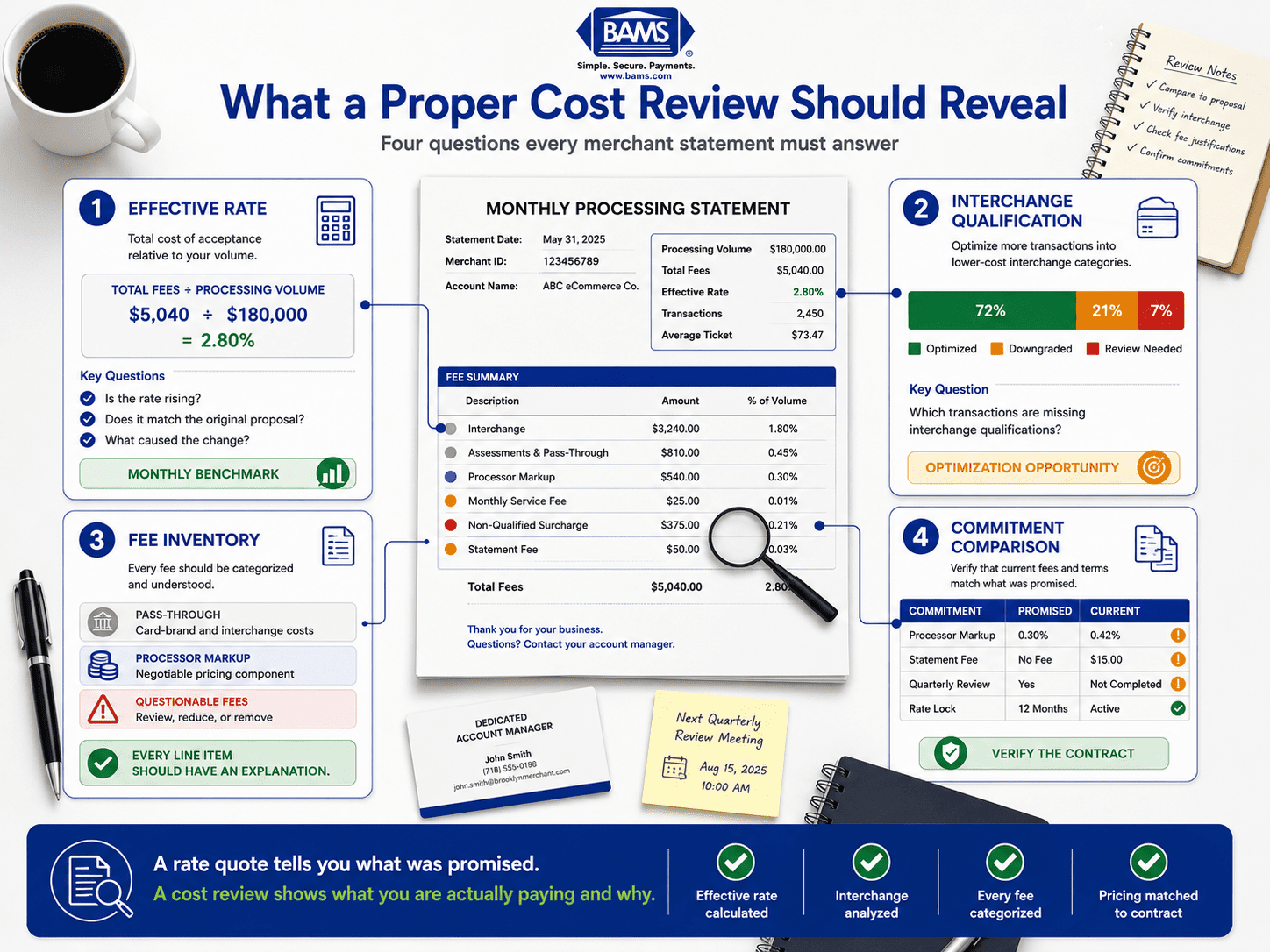
A detailed visual of the four areas an accountable merchant services partner should examine during an in-person processing cost review.
Objective: Experience what a face-to-face cost review actually involves so you can compare it against remote alternatives and make an informed decision.
This is where geographic proximity proves its value. A proper in-person cost review involves sitting down with your statements (typically 3 to 6 months), your processing partner, and sometimes your bookkeeper or CFO. The review covers:
- Effective rate calculation — Total fees divided by total volume, giving you a single number to benchmark against.
- Interchange qualification analysis — Are your transactions qualifying at the lowest possible interchange tier? If not, why?
- Fee inventory — Every line item identified and categorized as pass-through (non-negotiable), processor markup (negotiable), or junk fee (eliminable).
- Comparison to commitment — Does your current pricing match what you were quoted or contracted for?
This process takes 45 to 90 minutes when done properly. It cannot be replicated in a 15-minute screen share. The physical act of pointing at a line item and asking “what is this?” while someone who manages your account is sitting across from you creates a dynamic where vague answers don’t survive. Providers like BAMS build their merchant relationships around this kind of transparent, face-to-face statement review, pairing it with dedicated account management so the person across the table actually knows your business.
Merchants can also review payment ecosystem resources published by Visa to better understand how transaction processing, settlement, and merchant reporting work across the card payment lifecycle.
Anti-patterns to avoid: Don’t let a prospective partner skip the review and jump straight to quoting you a lower rate. A lower rate without a review is a guess, and it may not account for the fees that are actually costing you the most. Don’t accept a review that only covers the processor’s markup and ignores interchange optimization.
Success indicators: You leave the review knowing your effective rate, your interchange qualification rate, and at least two specific actions that would reduce your costs. You have a document you can reference later.
Step 5: Structure the Relationship for Ongoing Accountability
Objective: Build contractual and operational structures that maintain accountability over time, not just during the sales process.
The sales process is when every processor is at their most attentive. Accountability is tested at month 7, month 18, month 36. Structure your relationship to maintain leverage throughout:
- Quarterly reviews — Agree in writing to quarterly statement reviews. This is the single most effective accountability mechanism. A partner who commits to reviewing your costs every 90 days has a recurring obligation to justify their pricing.
- Rate-lock provisions — Understand exactly what can and cannot change in your pricing, and under what conditions. Get this in writing, not in a verbal assurance.
- Exit terms — Know your cancellation terms before you sign. Punitive early termination fees are the hallmark of a processor who expects you to want to leave. An accountable partner doesn’t need a financial penalty to retain you.
- Escalation path — Document who you contact when your primary rep can’t resolve an issue. This should be a named individual, not a department.
The importance of dedicated customer service in merchant services isn’t about friendliness. It’s about having a structural commitment to resolution that survives personnel changes and corporate priorities.
Businesses that accept card payments should also stay familiar with guidance from the PCI Security Standards Council, which publishes security standards and best practices for protecting payment data and maintaining a healthy payment environment.
Anti-patterns to avoid: Don’t sign a contract without reading the amendment clause. Many processors reserve the right to change pricing with 30 days’ notice via a statement message you’ll never read. Don’t assume goodwill replaces structure. Even the best relationships need documented commitments.
Success indicators: You have a signed agreement that includes quarterly review commitments, clear rate-lock terms, reasonable exit provisions, and a named escalation contact.
Step 6: Monitor and Enforce Accountability After Onboarding
Objective: Maintain the accountability standards you established during the selection process through active, ongoing verification.
Accountability degrades without maintenance. After onboarding, implement a simple monitoring rhythm:
- Monthly: Check your effective rate. If it moves more than 0.05% without explanation, flag it immediately.
- Quarterly: Attend your scheduled review. Bring questions. Compare current statements to the baseline established in your initial cost review.
- Annually: Conduct a full re-evaluation. Has your transaction volume changed? Has your average ticket size shifted? Has your chargeback ratio moved? Any of these changes may warrant a pricing adjustment, and an accountable partner will initiate that conversation before you do.
If your partner misses a quarterly review, that’s a signal, and If they can’t explain a rate change within 48 hours, that’s a stronger signal. If you find yourself back in a ticket queue with no named contact, you’ve lost accountability and it’s time to revisit Step 1.
For eCommerce operators who depend on consistent cash flow, monitoring funding speed is equally critical. If you were promised next-day funding and you’re consistently receiving funds on day two or three, document the pattern. Faster access to funds isn’t a perk. It’s an operational requirement that affects your ability to pay suppliers, run ads, and manage inventory.
Anti-patterns to avoid: Don’t set up monitoring and then ignore it. Don’t wait until a problem is severe to raise it. Small deviations, caught early, are easy to resolve. Large deviations, discovered late, become disputes.
Success indicators: You have a recurring calendar event for monthly rate checks and quarterly reviews. You’ve had at least one productive conversation with your partner about a change you noticed before it became a problem.
Practical Examples: What Accountability Looks Like (and Doesn’t)
Scenario A: The Rate Increase You Didn’t Agree To
An eCommerce operator notices their effective rate has climbed from 2.65% to 2.89% over six months. With a remote processor, they submit a ticket. Four days later, they receive a response citing “interchange adjustments” with no further detail. They reply asking for specifics. Another three days. The response references a card brand bulletin from months ago. The operator has no way to verify whether the increase is legitimate pass-through or processor markup inflation.
With a local, accountable partner, the same operator brings their last six statements to a scheduled quarterly review. The partner identifies that two interchange categories shifted due to a change in the operator’s average ticket size, accounting for about half the increase. The other half is a processor markup adjustment that was applied in error. It gets reversed that week. Total resolution time: one meeting.
Scenario B: The Chargeback Cluster During a Product Launch
A DTC brand launches a new product line and sees 15 chargebacks in 10 days, mostly “item not as described” disputes. With a remote processor, they receive automated chargeback notifications and a portal to upload evidence. There’s no guidance on response strategy, no analysis of whether the disputes share a pattern, and no proactive communication about the impact on their chargeback ratio.
With an accountable partner, the operator gets a call (not an email) on day three. The partner has already identified the pattern, flagged the product SKU, and drafted response templates tailored to the dispute reason code. They also recommend a fulfillment documentation change that reduces future exposure. The chargeback ratio stays below the card brand threshold. The operator keeps their account in good standing.
Common Mistakes and Pitfalls
Choosing on price alone. The lowest quoted rate means nothing if your effective rate creeps up unchecked. A partner who charges slightly more but conducts quarterly reviews and catches overcharges will save you more over 24 months than the cheapest quote you can find.
Confusing technology with accountability. A sleek dashboard doesn’t replace a human who knows your business. Self-service tools are valuable, but they don’t negotiate on your behalf or catch errors proactively.
Assuming local means small. Geographic proximity doesn’t imply limited capability. Many local merchant services providers offer the same processing infrastructure as national players, with the added layer of personal accountability. Quality merchant account providers can deliver competitive pricing without sacrificing service depth.
Not documenting commitments. Verbal promises during the sales process evaporate after onboarding. If a partner commits to quarterly reviews, rate locks, or named contacts, get it in writing.
Waiting too long to switch. Sunk cost fallacy keeps businesses with bad processors for years. If your current partner can’t meet the accountability standards outlined in this guide, the cost of staying exceeds the cost of switching.
What to Do Next
Start with Step 1. Pull your last three support interactions with your current processor and write down what happened. How long did resolution take? Did you speak to someone who knew your account? Was the outcome satisfactory?
If the answers are discouraging, that’s useful information, not a crisis. It means you now have a concrete baseline against which to evaluate alternatives. Use the four-pillar framework (Access, Transparency, Proximity, Continuity) to score any prospective partner, and insist on a face-to-face cost review before making a commitment.
This guide is a reference, not a checklist. Revisit it when your contract comes up for renewal, when your processing volume shifts significantly, or when you notice your effective rate moving in the wrong direction. Accountability isn’t a one-time selection criterion. It’s an ongoing standard you maintain by paying attention and asking questions.
Frequently Asked Questions
What’s the difference between a payment vendor and a business advisor partnership?
A vendor activates your account and provides transactional support. A business advisor partnership involves ongoing cost reviews, proactive optimization recommendations, and a named contact who understands your processing patterns and margin structure. The distinction shows up after onboarding, when you need someone to catch interchange overcharges or explain a rate change without being asked.
How often should I review my payment processing statements?
Check your effective rate monthly (total fees divided by total volume). Conduct a detailed review quarterly, ideally with your processing partner present. Do a full re-evaluation annually, especially if your transaction volume, average ticket size, or chargeback ratio has changed. Small deviations caught early are far easier to resolve than large ones discovered late.
What should a proper cost review include?
A thorough cost review covers your effective rate calculation, interchange qualification analysis (whether your transactions are hitting the lowest possible tier), a full inventory of every fee categorized as pass-through, processor markup, or junk fee, and a comparison of your current pricing to your original contract terms. This typically takes 45 to 90 minutes with 3 to 6 months of statements.
Why does geographic proximity matter when choosing a payment processor?
Proximity creates accountability infrastructure. A face-to-face cost review produces different outcomes than a remote screen share because vague answers don’t survive in-person scrutiny. Local partners also operate within reputational networks where poor service has visible consequences, which creates a natural incentive to resolve issues thoroughly and quickly.
What are the warning signs that my current payment processor isn’t accountable?
Key warning signs include: support interactions that require re-explaining your business setup every time, rate changes communicated only through statement messages, no proactive outreach about cost optimization, escalation paths that lead to departments rather than named individuals, and punitive early termination fees designed to trap you rather than retain you through service quality.
When should a business consider switching merchant service providers?
Consider switching when your effective rate has increased without clear explanation, when support interactions consistently fail to produce resolution, when you’ve never received a proactive cost review, or when your contract includes terms (like automatic rate adjustment clauses) that remove your leverage. The cost of switching is almost always lower than the cost of staying with an unaccountable partner over multiple years.


