

Mobile Payment Security: A Guide for Ecommerce
Last Updated on October 1, 2026 by Dimitri Akhrin
How biometric authentication protects consumers but leaves merchants exposed to chargebacks and fraud
Learn why Apple Pay’s device-level security doesn’t eliminate your dispute risk. This guide maps the gap between biometric authentication and merchant liability, giving ecommerce operators a framework to defend revenue against mobile payment fraud.
TL;DR
- Biometrics protect the device, not your revenue — Apple Pay’s Face ID confirms who is holding the phone, but it can’t tell you whether the card in that wallet was legitimately enrolled. Chargebacks from enrollment fraud look identical to clean transactions.
- Tokenization reduces data theft, not disputes — The Device Account Number system prevents stolen transaction data from being reused, but it does nothing to prevent friendly fraud or account takeover scenarios that drive merchant chargebacks.
- Layer your defenses beyond what Apple provides — Effective protection requires transaction-level fraud signals (geolocation, velocity checks, device fingerprinting), proactive evidence collection, and a chargeback response infrastructure that your payment processor actively supports.
- Track mobile wallet disputes separately — If you can’t segment your chargeback data by payment method, you can’t identify whether Apple Pay transactions carry disproportionate risk. This visibility is the foundation of every other defense.
- Don’t disable mobile wallets; optimize around them — Apple Pay improves conversion and reduces cart abandonment. The goal is risk-adjusted acceptance with layered fraud screening, not avoidance of the payment method entirely.
Guide Orientation: What This Guide Covers and Who It’s For
This guide addresses a specific, growing problem: mobile payment security feels airtight at the consumer level, but it leaves eCommerce merchants exposed to disputes, chargebacks, and revenue loss they didn’t see coming. If you run an online store and accept Apple Pay or other mobile wallets, this is for you.
We’ll walk through exactly how biometric authentication and tokenization work at the device level, then map the fraud scenarios and dispute risks that still land squarely on your business. By the end, you’ll understand the gap between device-level security and merchant-level liability, and you’ll have a concrete framework for defending your revenue as mobile wallet adoption accelerates.
This guide does not cover in-store NFC terminal setup or enterprise-scale payment orchestration. It focuses on the operational realities facing eCommerce businesses with 10 to 50 employees that process a meaningful volume of digital wallet transactions.
Why Mobile Payment Security Still Demands Your Attention
Mobile wallets like Apple Pay have reshaped consumer expectations. Checkout is faster. Friction is lower. And the biometric layer (Face ID, Touch ID) creates a strong impression that every transaction is verified and safe. For consumers, that’s largely true. For merchants, the picture is more complicated.
Mobile wallets continue to become a larger share of eCommerce payments, giving merchants faster checkout experiences and stronger payment security. Statista highlights the continued growth of digital payment methods, making it increasingly important for merchants to understand the operational risks that remain after a payment is successfully authorized.
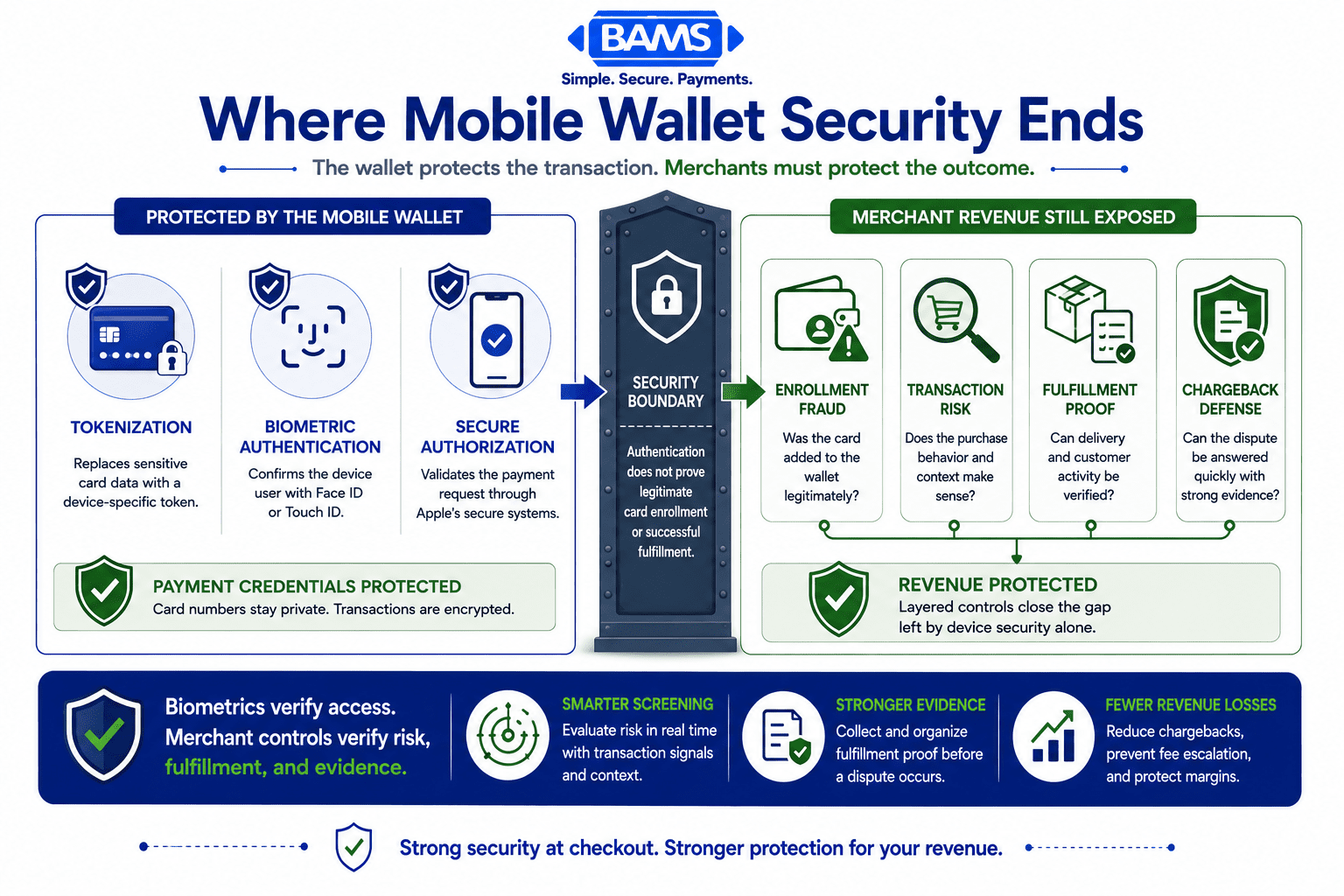
Here’s the core tension: biometric authentication protects the device holder. It confirms that the person tapping “Pay” is the person enrolled on that phone. But it tells you nothing about whether the cardholder authorized adding that card to the wallet in the first place. It tells you nothing about whether the purchase will result in a chargeback filed weeks later. The security that Apple Pay provides ends at the point of transaction. The liability that follows lives with you.
Ignoring this gap has a compounding cost. Chargebacks carry fees. Elevated dispute ratios trigger monitoring programs from card networks. And the operational drag of investigating and responding to disputes pulls your team away from growth work. The cost of inaction isn’t a single lost transaction. It’s a slow erosion of margin, cash flow predictability, and processing stability.
Core Concepts: What You Need to Understand Before Building Defenses

Biometric authentication and tokenization protect the payment process, but merchants still need fraud screening, fulfillment records, and dispute infrastructure to protect revenue.
Tokenization and the Device Account Number (DAN)
When a customer adds a card to Apple Pay, the actual card number is never stored on the device. Instead, Apple and the card network generate a Device Account Number (DAN), a token that substitutes for the real card number. Every transaction uses this token alongside a one-time dynamic security code. This means that even if transaction data were intercepted, the token would be useless for future fraud.
For merchants, this is genuinely good news. Mastercard Developers explains how Device Primary Account Numbers (DPANs) and network tokenization replace sensitive card numbers during wallet transactions. While tokenization significantly improves payment security, it does not verify whether the card was legitimately enrolled into the wallet.
Biometric Authentication: Strong but Bounded
Apple’s official Apple Pay documentation explains that Face ID, Touch ID, and device passcodes authenticate the user before releasing payment credentials. These protections greatly reduce unauthorized device use but do not prevent enrollment fraud or post-purchase disputes.
The Merchant Liability Gap
This is the concept most content about Apple Pay security ignores. In a card-not-present environment (which includes all eCommerce), the merchant bears liability for unauthorized transactions unless specific conditions shift that liability. Apple Pay’s tokenization can improve your interchange qualification and reduce certain fraud vectors, but it does not transfer chargeback liability away from you. The dispute still arrives at your door, and you still need evidence to fight it.
Friendly Fraud vs. True Fraud
True fraud involves a stolen card used without the cardholder’s knowledge. Friendly fraud (also called first-party fraud) involves a legitimate cardholder who makes a purchase and then disputes it, claiming they didn’t authorize it or didn’t receive the goods. Both types generate chargebacks. Both cost you money. And both occur with Apple Pay transactions, regardless of biometric verification.
The Framework: A Four-Layer Revenue Protection Model for Mobile Wallet Transactions
Defending your revenue against mobile wallet disputes requires a layered approach. No single tool or policy eliminates risk. Instead, you need four interconnected layers working together:
- Layer 1: Enrollment Fraud Detection — Catching transactions where stolen cards were added to legitimate devices.
- Layer 2: Transaction-Level Signals — Using behavioral and contextual data to flag anomalies at the moment of purchase.
- Layer 3: Post-Purchase Evidence Collection — Building a documentation trail that supports dispute responses before a chargeback arrives.
- Layer 4: Dispute Response Infrastructure — Having systems, partners, and processes ready to respond to chargebacks quickly and with compelling evidence.
Each layer reduces the probability and impact of the next failure mode. Skip a layer, and the ones below it carry disproportionate weight. The steps below walk through each layer in operational detail.
Step-by-Step: Building Your Mobile Payment Security Defenses
Step 1: Understand Where Enrollment Fraud Bypasses Biometrics
Objective: Recognize that the fraud you need to defend against often happens before the transaction reaches your checkout.
One of the most difficult fraud scenarios involves stolen payment credentials being enrolled into a fraudster’s own mobile wallet. Because the transaction is authenticated on the fraudster’s device, it can appear completely legitimate from the merchant’s perspective despite ultimately resulting in a chargeback.
From your perspective as a merchant, this transaction looks clean. The token is valid. The biometric check passed. The dynamic security code is correct. There is no technical signal in the transaction data that distinguishes it from a legitimate purchase. The chargeback arrives weeks later when the actual cardholder notices the charge.
What to avoid: Don’t assume that seeing “Apple Pay” or a tokenized transaction in your payment dashboard means the transaction is low-risk. This assumption is the single most common source of preventable losses for eCommerce operators accepting mobile wallets.
How to verify progress: Review your chargeback data and tag disputes that originated from mobile wallet transactions. If you can’t currently distinguish these, that’s your first operational gap to close.
Step 2: Layer Transaction-Level Fraud Signals Into Your Checkout Flow
Objective: Add contextual and behavioral checks that catch what tokenization and biometrics miss.
Since the token itself won’t reveal enrollment fraud, you need to rely on signals surrounding the transaction. Effective signals include device fingerprinting (is this device associated with previous fraud?), velocity checks (how many transactions has this device or account attempted in a short window?), geolocation analysis (does the shipping address match the device’s location?), and order pattern analysis (is this a high-value first-time order with expedited shipping to a freight forwarder?).
Industry analysts identify AI-driven fraud detection as the primary use of artificial intelligence in payments, complementing biometric layers to address threats like account takeover. You don’t need to build this from scratch. Most modern fraud screening tools can be integrated into your checkout flow and configured to flag or hold orders that match high-risk patterns.
What to avoid: Don’t set fraud filters so aggressively that you block legitimate customers. False declines cost more than fraud in many eCommerce verticals. Calibrate your rules based on your actual chargeback data, not generic thresholds.
How to verify progress: Track your false decline rate alongside your fraud rate. A healthy system reduces chargebacks without meaningfully increasing declined legitimate orders. If you see a spike in customer complaints about payment failures after implementing new rules, recalibrate.
Step 3: Build a Post-Purchase Evidence Trail Before You Need It
Objective: Collect and organize the documentation you’ll need to win disputes, starting at the moment of purchase.
When a chargeback arrives, you typically have 7 to 30 days to respond with compelling evidence. Merchants who scramble to assemble documentation after receiving a dispute notification win far fewer cases than those who collect evidence proactively. For mobile wallet transactions, your evidence package should include the transaction ID and token reference, delivery confirmation with signature or photo proof, IP address and device data from the checkout session, customer communication logs (order confirmations, shipping notifications, support interactions), and any AVS (Address Verification Service) or CVV match data available.
One nuance specific to Apple Pay: because the DAN replaces the actual card number, your records may not immediately match the card number the issuing bank references in a dispute. Make sure your payment processor maps DANs to the underlying card references so you can connect the dots during a dispute response.
What to avoid: Don’t rely on your payment gateway’s default transaction records alone. They rarely contain enough contextual detail to win a dispute. Supplement with your own order management and shipping data.
How to verify progress: Run a mock dispute drill. Pick a random Apple Pay transaction from last month and attempt to assemble a complete evidence package within 30 minutes. If you can’t, your documentation process has gaps.
Step 4: Establish Proactive Chargeback Defense Infrastructure
Objective: Reduce chargeback volume through prevention alerts and improve win rates on disputes that do occur.
Chargeback defense has two components: preventing disputes from escalating to formal chargebacks, and winning the ones that do. On the prevention side, services like Verifi and Ethoca provide real-time alerts when a cardholder initiates a dispute with their bank. These alerts give you a window (often 24 to 72 hours) to issue a refund before the dispute becomes a formal chargeback, avoiding the chargeback fee and the hit to your dispute ratio.
On the response side, your win rate depends on the quality and speed of your evidence submission. This is where your payment processor relationship matters significantly. A processor that provides proactive chargeback defense support, helps you interpret reason codes, and assists with evidence formatting gives you a structural advantage over one that simply forwards dispute notifications.
BAMS offers proactive chargeback defense as part of its merchant services, helping small-to-midsize eCommerce businesses respond to disputes with the right evidence and within the right timeframes. If your current processor treats chargebacks as your problem to solve alone, that’s a gap worth evaluating.
What to avoid: Don’t ignore low-value chargebacks because they seem insignificant individually. Card networks monitor your dispute ratio (chargebacks divided by total transactions), not your dollar amount. A pattern of small uncontested chargebacks can push you into a monitoring program with real financial consequences.
How to verify progress: Track three metrics monthly: total chargeback count, chargeback ratio (aim to stay well below 1%), and dispute win rate. Improvement in any of these three directly protects your revenue.
Step 5: Align Your Apple Pay Acceptance Strategy With Your Risk Profile
Merchants do not need to disable mobile wallets to reduce risk. A risk-adjusted acceptance model preserves checkout convenience while adding stronger controls around suspicious transactions.
Objective: Make informed decisions about how you accept mobile wallet payments based on your specific product category, average order value, and customer base.
Not all eCommerce businesses face the same risk from mobile wallet fraud. A store selling $20 consumable products has a very different risk profile than one selling $500 electronics with high resale value. Your Apple Pay acceptance strategy should reflect this reality. Consider implementing tiered verification for high-value orders (requiring additional confirmation for orders above a threshold), adjusting your fraud screening rules for mobile wallet transactions specifically, and reviewing whether your processing fees and interchange qualification are optimized for tokenized transactions.
If you’re running on BigCommerce, Shopify, or another major platform, accepting Apple Pay in your eCommerce store is straightforward from a technical standpoint. The strategic question is how you layer risk controls on top of that acceptance.
What to avoid: Don’t disable Apple Pay entirely because of fraud concerns. Mobile wallets reduce cart abandonment and improve conversion rates, especially on mobile devices. The goal is risk-adjusted acceptance, not avoidance.
How to verify progress: Compare your chargeback rate on Apple Pay transactions versus traditional card-not-present transactions. If Apple Pay chargebacks are disproportionately high, your fraud screening rules likely need mobile-wallet-specific adjustments.
Step 6: Monitor for Social Engineering and Phishing Escalation
Objective: Recognize that the fastest-growing fraud vectors targeting mobile wallets are human-based, not technical.
Merchant Risk Council notes that merchants increasingly face fraud driven by social engineering, first-party misuse, and evolving attack techniques. Strong customer communication and operational controls remain important even when payments are protected by tokenization and biometric authentication.
As a merchant, you can’t prevent phishing attacks against your customers. But you can reduce your exposure to the downstream consequences. Implement clear, consistent communication branding so customers can distinguish your legitimate emails from phishing attempts. Use order confirmation and shipping notification workflows that give customers easy ways to verify purchases. Provide a visible, accessible customer support channel so customers contact you before filing a dispute with their bank.
What to avoid: Don’t assume that Apple Pay’s biometric security eliminates the need for customer communication best practices. The strongest technical security in the world doesn’t help if a customer doesn’t recognize your charge on their statement and files a dispute instead of calling you.
How to verify progress: Review your dispute reason codes. If a significant percentage fall under “transaction not recognized” or “unauthorized transaction” categories, your customer communication and billing descriptor clarity need attention.
Practical Examples: How This Plays Out in Real eCommerce Scenarios
Scenario A: The Clean-Looking Fraudulent Order
A customer places a $380 order for premium skincare products using Apple Pay on your Shopify store. The transaction passes tokenization checks, biometric authentication succeeds on their device, and no fraud flags trigger. Three weeks later, the actual cardholder sees the charge, doesn’t recognize it, and files a chargeback. You lose the merchandise, the revenue, and pay a $25 chargeback fee.
What went wrong: The card was added to the fraudster’s device using stolen credentials and a compromised phone number for verification. No transaction-level signals were configured to catch the mismatch between shipping address and device geolocation.
What would have helped: A geolocation check comparing the device’s IP location to the shipping address, combined with a velocity check on the shipping address (it had received four orders from different Apple Pay wallets in the same week), would have flagged this order for manual review.
Scenario B: Friendly Fraud on a Subscription Product
A legitimate customer signs up for a monthly supplement subscription using Apple Pay. After three months, they file a dispute claiming they “didn’t authorize recurring charges.” The biometric authentication on each renewal is irrelevant to the dispute because the customer is arguing they didn’t consent to the subscription terms, not that someone else used their device.
What would have helped: Clear subscription terms displayed and agreed to during checkout, confirmation emails for each renewal with easy cancellation links, and a proactive evidence collection system that logs the customer’s consent at signup. This evidence package wins the dispute.
Common Mistakes and Pitfalls in Mobile Payment Security
Treating tokenization as a complete fraud solution. Tokenization protects card data. It does not verify the legitimacy of the person who enrolled the card. These are different problems requiring different defenses.
Failing to distinguish mobile wallet chargebacks from traditional ones. If you can’t segment your dispute data by payment method, you can’t identify whether mobile wallets are a disproportionate source of losses. This blind spot prevents targeted intervention.
Ignoring billing descriptor clarity. A surprising number of “unauthorized transaction” disputes are actually customers who don’t recognize the charge on their statement. Check what your business name looks like on a bank statement. If it’s cryptic or truncated, fix it.
Contesting every chargeback without strategy. Some disputes aren’t worth fighting. Others are critical to contest. Prioritize based on dollar amount, evidence strength, and your current dispute ratio. A strategic approach protects your ratio better than a blanket policy.
Assuming your payment processor handles this for you. Many processors forward dispute notifications and leave you to figure out the rest. If you’re not getting proactive guidance on evidence requirements, reason code interpretation, and deadline management, you’re leaving winnable disputes on the table.
What to Do Next
Start with one action: pull your chargeback data from the last 90 days and tag every dispute that originated from a mobile wallet transaction. If your processor doesn’t make this easy, that’s a signal worth paying attention to.
From there, run the mock dispute drill described in Step 3. Pick a real Apple Pay transaction and try to build a complete evidence package. The gaps you discover will tell you exactly where to focus next.
This guide is designed as a reference you return to as your mobile wallet volume grows. Revisit your fraud screening rules quarterly. Review your chargeback metrics monthly. And treat your payment processor relationship as a strategic partnership, not a utility. The merchants who protect their revenue as mobile wallet adoption grows are the ones who build these defenses incrementally, not the ones who wait for a chargeback spike to force their hand.
Frequently Asked Questions
What is Apple Pay and how does it work for eCommerce transactions?
Apple Pay is a digital wallet that stores tokenized versions of credit and debit cards on Apple devices. When a customer pays on your eCommerce site, Apple Pay uses a Device Account Number (DAN) instead of the actual card number, combined with a one-time dynamic security code. The customer authenticates with Face ID or Touch ID on their device. For merchants, the transaction arrives through your payment gateway like any other card-not-present transaction, but with tokenized credentials instead of raw card data.
If Apple Pay uses biometric authentication, why do I still get chargebacks?
Biometric authentication confirms that the person holding the device is the person enrolled on that device. It does not confirm that the card stored in the wallet was added by its rightful owner. Fraudsters who add stolen card credentials to their own devices pass every biometric check. Additionally, friendly fraud (legitimate cardholders disputing charges they actually made) is unaffected by biometrics entirely. Both scenarios result in chargebacks that land on your business.
How does tokenization enhance the security of Apple Pay transactions?
Tokenization replaces the actual card number with a Device Account Number that is useless outside the specific device and transaction context. This means intercepted transaction data can’t be reused for future fraud, and your systems never store the real card number. Tokenization replaces the actual card number with a device-specific payment token that is used during transactions. This greatly reduces the usefulness of stolen payment credentials but does not eliminate merchant exposure to enrollment fraud, friendly fraud, or fulfillment-related chargebacks.
Which fraud patterns are most common with Apple Pay transactions?
The three most common patterns are enrollment fraud (stolen cards added to a fraudster’s own device), friendly fraud (legitimate customers disputing valid purchases), and social engineering-driven fraud (consumers tricked into revealing credentials that are then used to provision wallets). Enrollment fraud is particularly dangerous because the resulting transactions appear fully authenticated and technically clean from the merchant’s perspective.
Should I stop accepting Apple Pay to reduce fraud risk?
No. Disabling Apple Pay would increase cart abandonment and reduce conversion rates, especially on mobile. Mobile wallets improve the checkout experience and can qualify for favorable interchange rates. The correct approach is risk-adjusted acceptance: layer fraud screening, evidence collection, and chargeback defense on top of your Apple Pay integration rather than removing it.
What metrics should I track to monitor mobile wallet dispute risk?
Track three core metrics monthly: total chargeback count segmented by payment method (so you can see mobile wallet disputes separately), your overall chargeback ratio (chargebacks divided by total transactions, aiming to stay well below 1%), and your dispute win rate. If your mobile wallet chargeback rate is significantly higher than your traditional card-not-present rate, your fraud screening rules need mobile-wallet-specific adjustments.


