Cash Flow Planning: Sequence Deposits to Unlock Discounts
Last Updated on October 27, 2026 by Dimitri Akhrin
What You’ll Build: A Chargeback-Proof Cash Flow Sequence
By the end of this tutorial, you will have a working system that protects your cash flow planning from chargeback disruptions. Specifically, you’ll connect your transaction batching schedule to your supplier payment calendar so that chargebacks stop derailing your ability to capture early-pay discounts.
Your success criteria are simple. First, you can predict within a narrow window exactly when each day’s deposits will land. Second, your supplier payments fire on schedule regardless of chargeback activity. Third, you capture at least one early-pay discount that was previously unreachable because of deposit timing uncertainty.
In this approach, cash flow planning is a sequencing problem, not a budgeting problem. You are not forecasting revenue. You are controlling the order in which money moves so that every link in the chain (batch close, deposit, invoice approval, supplier payment) fires in the right sequence.
TL;DR
- Cash flow is a sequencing problem – Control when deposits land and when payments go out, rather than trying to forecast unpredictable revenue.
- Transaction batching drives everything downstream – Your batch cutoff time determines when deposits arrive, which determines whether you can hit supplier discount deadlines. Set it 60 to 90 minutes before your processor’s submission deadline.
- Chargebacks need a dedicated buffer – Calculate your worst-case daily chargeback deduction, multiply by 1.5 and earmark that amount to absorb volatility without disrupting supplier payments.
- Early-pay discounts are high-return and underused – 61% of suppliers are interested in taking early payments at least some of the time, but only 3% report being paid early. Predictable deposits give you the leverage to negotiate 2% to 3% discounts.
- A 10-minute daily routine keeps it all running – Verify deposits, check for chargeback deductions, confirm your buffer and approve invoices. This small habit protects thousands of dollars in annual savings.
Prerequisites and Setup Checklist
Before you start, confirm the following items are in place. Missing even one will create a bottleneck mid-process.
- Payment processor access: You need admin-level access to your processor dashboard where you can view and adjust batch cutoff times.
- eCommerce platform admin: Access to your Shopify, WooCommerce, BigCommerce, or equivalent store backend to verify order and settlement data.
- Supplier terms documentation: A list of your top 5 suppliers with their current payment terms (e.g., Net 30, 2/10 Net 30). If you don’t have these written down, request them now.
- Bank account with transaction-level reporting: You need to see individual deposit amounts and timestamps, not just daily balances.
- Spreadsheet or cash flow tool: Google Sheets works. You’ll build a simple timing map.
- Chargeback history: Pull 90 days of chargeback data from your processor, including dispute dates, resolution dates and deducted amounts.
Time estimate: 3 to 4 hours for initial setup. 15 minutes per day for ongoing management. Expect the first full cycle to take 2 to 3 weeks before you see measurable results.
Why Sequencing Beats Budgeting for Cash Flow Planning
Most eCommerce brands approach cash flow planning as a forecasting exercise: estimate revenue, subtract expenses, hope the timing works. The problem is that chargebacks introduce unpredictable deductions that blow up even accurate forecasts.
The sequencing approach is different. Instead of predicting how much money you’ll have, you control when money arrives and when it leaves. BCG research from 2024 notes that paying suppliers early could earn a 2% to 3% discount on the original price, while paying down debt early may save 1% to 2% based on the weighted average cost of capital. But you can only capture those discounts if your deposits land predictably enough to trigger payments within the discount window.
This tutorial treats your transaction batching schedule as the first domino. Get that right and everything downstream (deposit timing, invoice approval, supplier payment) falls into place.

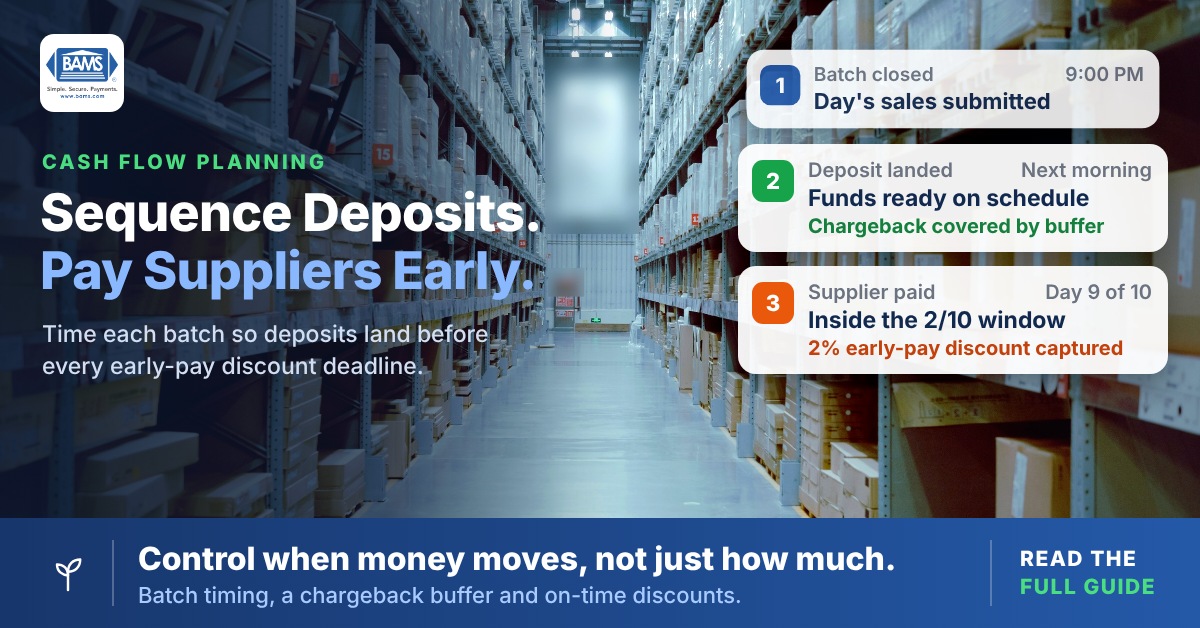
Batch closes, deposit lands, invoice is approved, supplier is paid. A chargeback buffer keeps the last step on time. The annualized figure is illustrative.
Step 1: Map Your Current Batch-to-Deposit Timeline
Action: Log into your payment processor dashboard. Find your current batch cutoff time and your processor’s stated settlement window. Write both down.
Open your bank’s transaction history and pull the last 30 days of deposits from your processor. For each deposit, record the date and amount. Now match each deposit to the batch it came from. Most processors label deposits with the batch date or provide a reference ID.
Expected result: A table showing batch close date/time in column A, deposit date in column B and the gap (in hours or days) in column C. You should see a consistent pattern, such as “batch closes at 10 PM EST, deposit lands by 2 PM EST next business day.”
Common failure: If your gaps vary by more than one business day, your batch cutoff may be too close to your processor’s daily submission deadline. Batches that miss the cutoff by even minutes get pushed to the next cycle, adding a full day of delay.
Step 2: Identify Chargeback Deduction Patterns
Action: Pull your 90-day chargeback report. For each chargeback, record three dates: the original transaction date, the date the chargeback was filed and the date the deduction hit your deposit.
Sort by deduction date. You are looking for clustering. Do chargebacks tend to hit on specific days of the week? Do they coincide with your largest deposit days? Calculate the average deduction amount and the standard deviation.
Expected result: A clear picture of how much money chargebacks remove from your deposits and when those deductions typically appear. Even a small chargeback rate removes money from deposits, but the timing is what causes the real damage.
Checkpoint: If your average chargeback deduction exceeds 2% of daily deposits, flag this. That is well above the levels card networks expect, so it also deserves a conversation with your processor. You’ll need a larger buffer in Step 5. If you’re seeing signs that deposit timing is costing you money, this step will quantify exactly how much.
Step 3: Build Your Supplier Payment Calendar
Action: Create a new spreadsheet tab. List your top 5 suppliers by annual spend. For each supplier, record their payment terms, the discount terms (if any) and your typical invoice receipt date.
Calculate the discount deadline for each supplier. For example, if Supplier A offers 2/10 Net 30 and you typically receive invoices on the 1st of the month, your discount deadline is the 11th. Mark these deadlines on a calendar.
Expected result: A visual calendar showing exactly which days you need available cash to capture discounts. Research shows that 61% of suppliers are interested in taking early payments at least some of the time, yet only 3% report being paid early. This means your suppliers are likely open to discount arrangements you haven’t explored yet.
Common failure: Many eCommerce managers only track due dates, not discount deadlines. If you don’t have discount terms with your suppliers, skip to Step 4 and come back to negotiate them once your deposit timing is predictable.
Step 4: Align Your Batch Cutoff to Your Payment Windows
Action: Compare your batch-to-deposit timeline (Step 1) with your supplier payment calendar (Step 3). You are looking for alignment gaps: days where you need cash for a supplier payment but your deposit hasn’t landed yet.
Adjust your batch cutoff time so that deposits consistently land one business day before your earliest supplier payment deadline. If a supplier’s discount deadline is the 11th, the deposit you plan to use needs to land by the 10th.
In your processor dashboard, change your batch cutoff timing to hit well before your processor’s daily submission deadline. A safe buffer is 60 to 90 minutes before the deadline.
Expected result: A new batch schedule where deposits land predictably enough to fund supplier payments within discount windows. This is where transaction batching stops being an operational detail and becomes a working capital lever.
Checkpoint: Run a 5-day test. Track whether deposits land within your predicted window each day. If they don’t, your cutoff time needs further adjustment.
Step 5: Create a Chargeback Buffer to Protect Supplier Payments
Action: Using your chargeback deduction data from Step 2, calculate your “worst-case daily deduction.” Take the highest single-day chargeback deduction from the past 90 days and multiply it by 1.5. This is your buffer amount.
Set up a separate holding balance (a sub-account or a clearly earmarked portion of your operating account) equal to this buffer. This money exists solely to cover the gap when a chargeback deduction reduces your deposit below the amount needed for a supplier payment.
Expected result: A dedicated buffer that absorbs chargeback volatility without disrupting your supplier payments schedule. You are decoupling chargeback risk from payment execution.
Merchants who respond to disputes quickly and keep chargebacks low can often reduce this buffer over time. BAMS, for instance, combines next-day funding for qualifying merchants with Dispute Responder, which sends immediate chargeback notifications and a clear action plan so you can respond quickly and reduce losses.
Common failure: Setting the buffer too low. If you use the average deduction instead of the worst-case, you’ll still miss payments during high-chargeback periods (post-holiday season, after a product recall, etc.).
Step 6: Automate Invoice Approval Triggers
Action: Set up a daily process (automated or manual) that checks two conditions before approving a supplier invoice for payment: (1) today’s deposit has landed and matches or exceeds the expected amount minus the buffer threshold and (2) the supplier’s discount deadline is within 3 business days.
If both conditions are true, approve the invoice for payment. If the deposit is short (due to a chargeback deduction), draw from the buffer and approve anyway. When the discount deadline is more than 3 days out, hold the invoice.
Expected result: A rules-based approval flow that removes guesswork. You never miss a discount because you were waiting to “see how the week goes.” You also never release funds earlier than you need to.
Checkpoint: After 2 weeks, review how many invoices were approved on time, how many required buffer draws and how many discounts you captured. Your target is 90% or higher on-time approval without buffer draws.
Step 7: Negotiate Early-Pay Terms With Your Top Suppliers
Action: With your deposit timing now predictable, contact your top 3 suppliers and propose early-payment terms. A standard opening offer is 2/10 Net 30 (2% discount for payment within 10 days). If they already offer this, ask about deeper discounts for payment within 5 days.
Frame the conversation around reliability: “We’ve restructured our deposit timing so we can pay within [X] days consistently. Can we formalize a discount for early payment?” Research indicates that 51% of suppliers are paid late by customers on average, so offering reliable early payment gives you significant negotiating leverage.
Expected result: At least one supplier agrees to a discount arrangement. Even a 1.5% discount on your largest supplier relationship can translate to thousands of dollars annually.
Common failure: Approaching the negotiation before your deposit timing is actually stable. Suppliers will withdraw discount terms quickly if you miss early-payment windows. Complete Steps 1 through 6 first.
Step 8: Build a Daily Verification Routine
Action: Create a 10-minute daily checklist that runs every morning after deposits post:
- Verify deposit amount against expected batch total. Flag any variance over 2%.
- Check for chargeback deductions in today’s deposit. Log the amount and update your 90-day rolling average.
- Confirm buffer balance is at or above your threshold. Replenish if a draw occurred yesterday.
- Review invoice queue for any payments due within 3 business days. Approve or hold per Step 6 rules.
- Update your timing map with today’s actual batch-to-deposit gap.
Expected result: A living system that self-corrects. Your timing map gets more accurate each day, your buffer calibration improves and you catch problems before they cascade into missed payments. For more detail on building this routine, see the guide on aligning batch timing to payments.
Configuration and Customization
Variables You Should Adjust
Batch cutoff time: The default your processor sets is rarely optimal. Test different cutoff times in 30-minute increments over a 2-week period. Track the impact on deposit arrival time.
Buffer multiplier: The 1.5x worst-case multiplier is a safe default. If your chargeback rate is below 0.5%, you can reduce this to 1.2x. If your chargeback rate exceeds 1.5%, increase to 2x.
Invoice approval window: The 3-business-day trigger is a starting point. If your deposits are extremely consistent (within a 2-hour window daily), you can tighten this to 2 days, which gives you more flexibility in cash deployment.
Settings You Must Change
Processor notification preferences: Enable real-time alerts for chargeback filings and deposit postings. Without these, your daily verification routine depends on manual checking, which introduces delay.
Bank account alert thresholds: Set a low-balance alert at your buffer amount plus one day’s average supplier payment. This gives you a 24-hour warning before a cash shortfall.
Verification and Testing
Test procedure: Run your complete system for 3 full weeks before evaluating. During this period, track four metrics daily: deposit arrival time variance (target: under 2 hours), chargeback deduction as a percentage of deposits, buffer draw frequency and early-pay discounts captured.
Success definition: Your system is working when deposit arrival time variance stays under 2 hours for 15 of 15 business days, your buffer absorbs all chargeback deductions without disrupting supplier payments and you capture at least one early-pay discount you would have missed under your old process.
Edge cases to verify: Test a weekend/holiday scenario (Friday batch settling on Monday). Then simulate a high-chargeback day by temporarily reducing your buffer. Finally, test a supplier invoice arriving earlier than expected.
Common Errors and Fixes
Error: Deposits Arrive a Day Later Than Expected
Symptom: Your timing map shows a consistent 1-day gap between predicted and actual deposit dates. Cause: Your batch cutoff is too close to or past your processor’s submission deadline. Fix: Move your batch cutoff 90 minutes earlier and retest for 5 business days.
Error: Buffer Depletes Faster Than Expected
Symptom: You draw from the buffer more than twice per week. Cause: Your chargeback rate is higher than your 90-day average suggested, or a seasonal spike has begun. Fix: Increase the buffer multiplier to 2x and investigate the root cause of chargebacks. Fast dispute response tools, such as BAMS Dispute Responder, help you contest chargebacks sooner and reduce losses, which helps stabilize your buffer.
Error: Supplier Rejects Your Early-Pay Proposal
Symptom: Supplier says they don’t offer early-pay discounts. Cause: Many suppliers have discount programs but only for buyers who ask. Others genuinely don’t. Fix: Ask specifically: “If we paid within 7 days consistently, would you consider a 1.5% discount?” In Taulia’s supplier survey, 61% of suppliers express interest in early payments at least some of the time.
Error: Batch Totals Don’t Match Deposit Amounts
Symptom: Deposit is consistently lower than batch total by a small, variable amount. Cause: Processing fees, chargeback deductions, or rolling reserve requirements are being netted from your deposit. Fix: Request a gross-vs-net deposit breakdown from your processor. Adjust your expected deposit calculation to account for the net amount.
Error: Invoice Approval Bottleneck on Mondays
Symptom: Friday and weekend batches create a backlog of approvals on Monday morning. Cause: Weekend batches settle on Monday, but supplier discount deadlines don’t pause for weekends. Fix: Shift your Friday batch cutoff 2 hours earlier to ensure Monday deposits arrive as early as possible. Prioritize discount-deadline invoices in your Monday queue.
Next Steps and Extensions
Once your cash flow planning system is running smoothly, consider these extensions. First, expand early-pay negotiations to all suppliers, not just your top 3. According to the Hackett Group, best-in-class accounts payable teams capture seven times more early-pay discounts than their peers, largely through automation.
Second, ask your processor whether you can run separate merchant IDs or batch schedules for different sales channels. This can let you prioritize high-value batches for faster settlement.
Third, use your improved predictable cash flow to reduce or eliminate short-term credit lines. Every dollar of interest you stop paying on bridge financing drops straight to your margin. Review your transaction batching schedule quarterly to ensure your cutoff times still align with your evolving supplier calendar.
Frequently Asked Questions
What is next-day funding in merchant services?
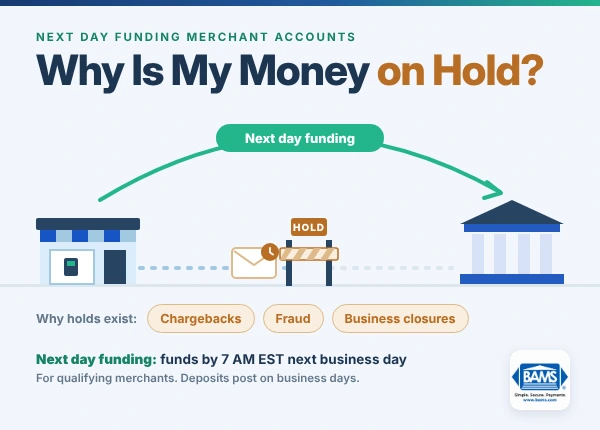
Next-day funding means your processor deposits the previous day’s credit card transactions into your bank account by the next business day. This is faster than the 2 to 3 business day settlement some processors use. At BAMS, qualifying merchants can access funds in as little as ten hours after transactions are batched. The speed depends on your batch cutoff time, your processor’s submission schedule and your bank’s posting policies.
How does next-day funding improve cash flow planning for online retailers?
When deposits arrive on a predictable daily schedule, cash flow planning gets simpler because you can time outgoing payments with confidence. Instead of guessing whether funds will be available, you know exactly when money lands. This lets you approve supplier invoices, capture early-pay discounts and avoid drawing on credit lines to cover timing gaps.
How can I optimize my batch timing for faster funding?
Set your batch cutoff time at least 60 to 90 minutes before your processor’s daily submission deadline. Batches that miss the deadline by even a few minutes get pushed to the next cycle, adding a full business day of delay. Test different cutoff times in 30-minute increments over 2 weeks and track when deposits actually post to find your optimal window.
How do chargebacks affect deposit predictability?
Chargebacks create variable deductions from your daily deposits. When a chargeback is filed, your processor deducts the disputed amount (and sometimes a fee) from a future deposit. This makes your actual deposit amount unpredictable, which can cause you to miss supplier payment windows. Building a dedicated chargeback buffer and using proactive dispute prevention tools are the most effective countermeasures.
When should a business consider switching to next-day funding?
Consider switching when you notice that deposit delays are causing you to miss supplier discount deadlines, draw on credit lines for short-term cash needs, or hold excess cash reserves “just in case.” If any of these apply, the cost of slower funding likely exceeds the cost of a processor that offers next-day settlement.
What are early-pay supplier discounts and are they worth pursuing?
Early-pay discounts (such as 2/10 Net 30) give you a percentage off the invoice total if you pay within a shorter window. A 2% discount for paying 20 days early translates to an annualized return of roughly 37% (2/98 × 365/20). BCG notes that early supplier payment could earn 2% to 3% off the original price, while paying down debt early may save 1% to 2%, which makes discounts one of the highest-return uses of available cash.