Digital Wallet Payments eCommerce: Reduce Abandonment
Last Updated on June 11, 2026 by Dimitri Akhrin
A data-driven comparison of checkout options to help eCommerce managers capture more sales
Compare traditional payment methods against digital wallets across mobile performance, checkout friction, and deposit timing. Learn which approach best reduces your cart abandonment rate.
TL;DR
- Offer both payment types – Restricting to traditional-only costs you sales; digital wallets reduce the 80% mobile abandonment rate through one-tap checkout
- Digital wallets win on mobile – If mobile traffic exceeds 50% of sessions, wallet implementation should be your top payment priority
- Deposit timing depends on your processor – Neither payment method determines when you get paid; next-day funding requires choosing the right merchant services partner
- Implementation is simpler than expected – Major platforms like Shopify and BigCommerce enable digital wallets through settings, not custom development
- Security perception matters – Tokenization and biometric authentication in digital wallets build customer confidence that manual card entry cannot match
The Payment Options Showdown: What eCommerce Managers Need to Know
You’re watching revenue slip away at checkout. Cart abandonment remains a persistent challenge across online retail, and the payment options you offer directly affect whether customers complete purchases or bounce. This comparison breaks down traditional payment methods versus digital wallet payments to help you reduce cart abandonment and capture more sales.
This analysis focuses on mid-size eCommerce operations processing significant monthly volume. We’ll examine checkout friction, mobile performance, deposit timing, and implementation complexity. If delayed deposits and abandoned carts are eating into your margins, this comparison will clarify which payment approach fits your business.
Quick Verdict: Which Payment Approach Wins?
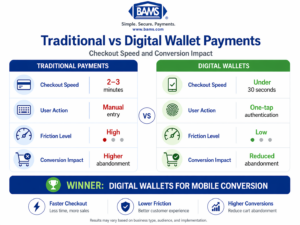
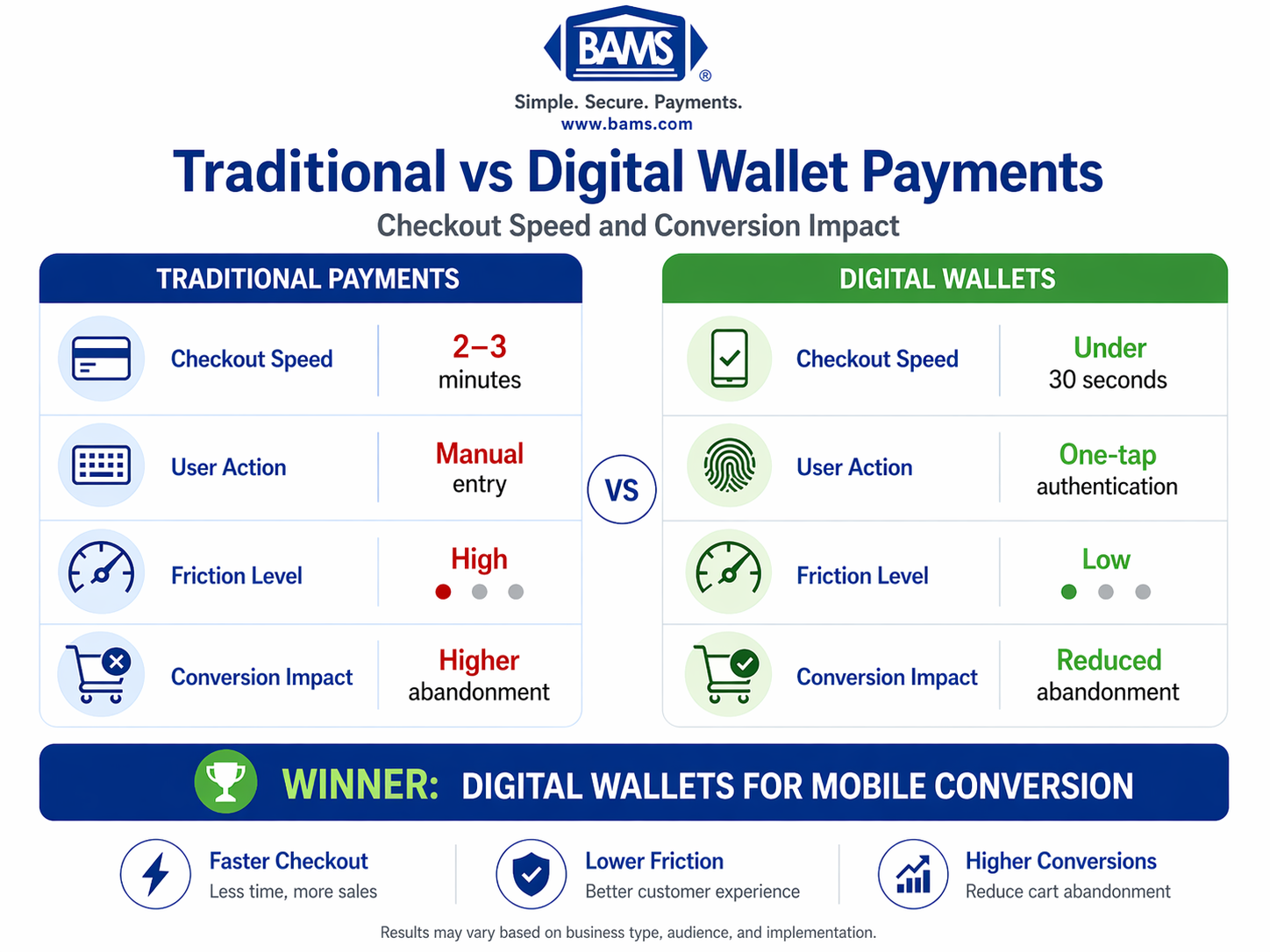
Digital wallets significantly reduce checkout friction and cart abandonment compared to traditional payment methods, especially on mobile devices.
Choose digital wallet payments if your mobile traffic exceeds 50%, you sell in high-abandonment categories like fashion or beauty, or your customers expect one-tap checkout experiences.
Choose traditional payment methods if your customer base skews older, you operate in B2B with invoice-heavy workflows, or you need maximum control over payment data.
For most eCommerce managers reading this, expanding to include digital wallets alongside traditional options delivers the best results. The data strongly supports payment option expansion rather than replacement.
|
Criterion |
Traditional Payments |
Digital Wallets |
Winner |
|---|---|---|---|
|
Mobile Checkout Speed |
Manual entry required |
One-tap authentication |
Digital Wallets |
|
Cart Abandonment Impact |
Higher friction at checkout |
Reduces drop-off significantly |
Digital Wallets |
|
Deposit Timing |
2-3 business days typical |
Varies by processor |
Depends on Processor |
|
Customer Trust Signals |
Familiar but concerns persist |
Tokenization builds confidence |
Digital Wallets |
|
Implementation Complexity |
Standard integration |
Platform-dependent |
Traditional Payments |
|
Regional Coverage |
Universal acceptance |
Strong in NA/EU, growing elsewhere |
Traditional Payments |
|
Processing Costs |
Established fee structures |
Competitive, sometimes lower |
Tie |
Evaluation Criteria: What Actually Matters for Your Bottom Line
We’re comparing these payment approaches across seven dimensions that directly affect your revenue and operations. Mobile checkout speed matters most because checkout friction compounds quickly on smaller screens, where manual entry feels slower and more error-prone.
Cart abandonment impact measures how each approach affects completion rates. Deposit timing determines your cash flow predictability. Customer trust signals influence purchase confidence. Implementation complexity affects your team’s bandwidth. Regional coverage matters if you sell internationally. Processing costs hit your margins directly.
For eCommerce managers at established businesses, deposit timing and cart abandonment impact typically carry the most weight. You need funds flowing predictably while maximizing the orders that actually complete.
Mobile Checkout Speed: The Real Friction Point
Traditional Payment Methods
Credit and debit card payments require customers to manually enter 16-digit card numbers, expiration dates, CVV codes, and billing addresses. On mobile devices, this process can take several minutes. Typing errors force restarts. Small screens and auto-correct create friction.
The strength here is universality. Every customer knows how to use a credit card. No app downloads are required. No separate wallet setup is needed beyond your checkout flow.
Digital Wallet Payments
Apple Pay, Google Pay, and similar wallets reduce checkout to a single tap plus biometric authentication. Payment credentials are pre-stored. Shipping addresses auto-populate. The process is materially faster than manual card entry.
The limitation is adoption. Not every customer has a digital wallet configured. Older demographics may prefer familiar card entry. Some customers still distrust storing payment information on devices.
Verdict
Digital wallets win decisively for mobile checkout speed. If your analytics show high mobile traffic with poor mobile conversion, this single factor may justify payment option expansion.
Cart Abandonment Impact: Where Revenue Gets Rescued
Traditional Payment Methods
Traditional checkout creates multiple abandonment triggers. Customers leave when asked to create accounts. They abandon when card details fail validation. They exit when the process feels too long. Long, form-heavy checkout flows create more chances for hesitation.
Traditional methods also lack the psychological commitment advantage of stored credentials. Each purchase requires the buyer to re-enter sensitive details and recommit to completing the transaction.
Digital Wallet Payments
Digital wallets address the checkout-to-completion gap directly. One-tap payments compress the most vulnerable part of the funnel by reducing fields, steps, and opportunities for second thoughts.
Wallets also provide trust signals through tokenization. Customers know their actual card numbers are not being passed around in the same way as a manual entry flow. This security perception reduces hesitation at the payment step. If you already have a reliable payment gateway, adding digital wallet acceptance can strengthen checkout performance without forcing a full rebuild.
Verdict
Digital wallets reduce cart abandonment more effectively than traditional methods alone. The key word is alone. Offering both options captures customers who prefer either approach. Restricting to traditional-only leaves conversion on the table.
Deposit Timing: When You Actually Get Paid
Traditional Payment Methods
Standard merchant accounts typically deposit funds in 2-3 business days. Some processors hold funds longer for new accounts or flagged transactions. Weekend sales may not hit your account until later in the week.
This delay creates cash flow gaps. You’ve shipped inventory, paid suppliers, and covered labor costs before payment arrives. For businesses managing tight margins, these gaps compound.
Digital Wallet Payments
Digital wallet transactions process through your existing merchant account. The deposit timing depends on your payment processor, not the wallet itself. Apple Pay and Google Pay do not usually determine settlement speed on their own; they pass transactions through the acquiring and processing setup behind your checkout.
This means wallet payments can arrive as quickly as your processor allows. If your provider supports guaranteed next-day funding, wallet transactions can benefit as well. Payment method alone does not solve delayed deposits.
Verdict
Deposit timing depends on your processor, not your payment method. The real solution to delayed deposits is choosing a merchant services partner with faster funding strategies. Payment method alone does not determine when funds arrive.
Customer Trust and Security Perception
Traditional Payment Methods
Credit cards benefit from decades of consumer familiarity. Customers understand dispute processes and fraud protection. However, data breach headlines have eroded confidence in sharing card numbers online.
PCI compliance requirements help, but customers don’t see your security infrastructure. They only see a form asking for sensitive financial data
Digital Wallet Payments
Tokenization means actual card numbers are not exposed in the same way during checkout. Customers authenticate with biometrics, such as fingerprint or facial recognition, rather than typed passwords. These visible security measures build confidence.
According to Visa, digital payment flows are designed to streamline the transaction experience while supporting secure processing. That combination of speed and visible security makes wallet options especially appealing for mobile-first shoppers.
Verdict
Digital wallets win on security perception and actual security architecture. For customers concerned about online payment safety, wallet options provide reassurance that traditional card entry cannot match.
Implementation Complexity: What Your Team Faces
Traditional Payment Methods
Credit card processing integration is well-documented across every major eCommerce platform. Your development team has likely done this before. Payment gateways provide extensive documentation and support.
The tradeoff is ongoing PCI compliance maintenance. You’re responsible for secure card data handling, which requires regular audits and security updates.
Digital Wallet Payments
Wallet integration complexity varies by platform. Shopify, BigCommerce, and WooCommerce often allow relatively simple activation. Custom platforms require more development work, but the effort is usually smaller than many teams expect.
The advantage is reduced exposure to sensitive payment data. Since tokenized wallet flows can limit how payment credentials move through your environment, security management often becomes easier to maintain.
Verdict
Traditional payments win slightly on implementation familiarity, but wallet integration has become straightforward on major platforms. For many teams, adding digital wallets requires configuration and testing, not a large-scale rebuild.
Regional Coverage and Customer Expectations
Traditional Payment Methods
Credit and debit cards work everywhere. Visa and Mastercard have near-universal merchant acceptance. For international eCommerce, traditional cards provide reliable coverage across regions.
Digital Wallet Payments
Apple Pay and Google Pay dominate in North America and Europe. Adoption continues growing but remains uneven globally. Some regions prefer local alternatives like Alipay, WeChat Pay, or regional bank wallets.
The strategic approach is matching wallet options to your customer geography. If 80% of your customers are in the US, Apple Pay and Google Pay cover the digital wallet demand effectively.
Verdict
Traditional payments win on universal coverage. Digital wallets win in specific high-adoption regions. For US and European eCommerce, offering both approaches captures the widest customer base.
Use Case Mapping: Which Approach Fits Your Situation
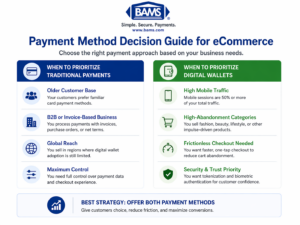
Use this guide to determine when to prioritize digital wallets or traditional payments based on your customer behavior and traffic mix.
If you sell fashion or beauty products, prioritize digital wallet expansion immediately. These categories see the highest abandonment rates (82-85%), and mobile shoppers dominate. One-tap checkout directly addresses your biggest conversion gap.
If your customer base skews 55+, maintain strong traditional payment options while gradually introducing wallets. Older demographics adopt digital wallets more slowly but increasingly use them. Don’t force the transition.
If you process high-volume B2B transactions, traditional methods with invoice options may better serve your workflow. Digital wallets suit consumer impulse purchases more than considered B2B procurement.
If mobile traffic exceeds 60% of sessions, digital wallet optimization should be your top payment priority. The mobile abandonment gap (80% vs 68% desktop) represents your largest revenue opportunity.
If you sell internationally across multiple regions, layer digital wallets on top of traditional methods rather than replacing them. Coverage gaps in some regions make traditional cards essential as fallback.
What Both Approaches Get Wrong
Neither traditional payments nor digital wallets solve the fundamental deposit timing problem. Both transaction types flow through your merchant account and arrive according to your processor’s schedule. If your processor holds funds for 3 days, faster checkout doesn’t mean faster cash.
Neither approach addresses chargeback prevention directly. Fraud protection measures require additional tools beyond payment method selection. Both traditional and wallet transactions can result in disputes that drain revenue and time.
The payment method itself doesn’t fix broken checkout flows, poor product pages, or shipping cost surprises. These abandonment drivers require separate optimization regardless of payment options offered.
Migration and Switching Considerations
Adding digital wallets to existing traditional payment infrastructure involves minimal switching cost. You’re expanding options, not replacing them. Most platforms enable wallet payments through existing payment gateway relationships.
The real switching consideration is your payment processor. If your current processor doesn’t support the wallets you need, or deposits funds too slowly, processor migration becomes necessary. This involves updating gateway integrations, potentially brief checkout disruptions, and merchant account setup time.
Data portability is straightforward for payment methods. Customer payment credentials stay with the wallet providers (Apple, Google) or card networks, not your systems. Switching processors doesn’t affect stored customer payment methods.
Consider switching processors when deposit timing consistently impacts operations, when processing fees erode margins unnecessarily, or when support responsiveness fails during disputes. The payment method question is secondary to processor quality.
Final Recommendation: Expand, Don’t Replace
For eCommerce managers at established businesses, the comparison verdict is clear: offer both traditional and digital wallet payments. Restricting options costs you sales. The goal is not to replace a familiar option with a trend. It is to remove unnecessary checkout friction for as many customers as possible.
Prioritize digital wallet implementation if mobile abandonment exceeds your desktop rate by more than 10 percentage points. The checkout speed advantage directly addresses mobile friction.
Address deposit timing separately by evaluating your payment processor. According to the Federal Reserve, payment economics and transaction routing play an important role in how card-based payments move through the system. Faster funding improves cash flow predictability regardless of which payment method customers choose, while broader payment acceptance helps you capture more of the orders already in your funnel.
Frequently Asked Questions
What are faster deposit strategies in merchant services?
Faster deposit strategies include next-day funding programs, same-day ACH transfers, and weekend deposit processing. The most effective approach is selecting a payment processor that offers next-day funding as a standard feature rather than a premium add-on. This applies to both traditional card payments and digital wallet transactions equally.
How can I improve my payment authorization rates?
Authorization rate improvement starts with offering multiple payment options so customers can use their preferred method. Digital wallets often see higher authorization rates because tokenized credentials stay current automatically. Additionally, ensure your payment gateway supports retry logic for soft declines and address verification matching.
When should I consider expanding my payment options?
Expand payment options when your mobile abandonment rate exceeds 75%, when customers contact support asking for specific payment methods, when you see high cart-to-checkout drop-off in analytics, or when entering new geographic markets with different payment preferences. The cost of adding options is typically lower than the revenue lost from limited choices.
Which payment processing fees can I reduce to optimize costs?
Focus on interchange optimization through proper transaction categorization, Level 2 and Level 3 data submission for B2B transactions, and cost-plus pricing models that pass through actual interchange rates. Digital wallet transactions sometimes qualify for lower interchange categories due to reduced fraud risk. Review your monthly statements for downgrades that inflate costs.
What role does fraud protection play in payment optimization?
Fraud protection directly impacts your effective processing costs through chargeback fees, lost merchandise, and potential processor penalties. Digital wallets provide built-in fraud reduction through tokenization and biometric authentication. For traditional payments, implement AVS matching, CVV verification, and velocity checks. Proactive chargeback defense saves more than reactive dispute management.
How do digital wallets affect recurring payments and subscriptions?
Digital wallets support recurring payments through tokenization that automatically updates when customers receive new cards. This reduces involuntary churn from expired card declines. Traditional card-on-file systems require customers to manually update payment details when cards expire, leading to failed renewals and subscription cancellations.
Sources