

Payment Processing Transparency for eCommerce
Last Updated on October 1, 2026 by Dimitri Akhrin
Why transparent transaction reporting is the key to reclaiming control over your cash flow
Discover how shifting from opaque payment processing to transparent transaction reporting gives you real visibility into fees, deposit timing, and cash flow optimization.
TL;DR
- Opaque payment processing is costing you – Bundled fees and unpredictable deposits make cash flow management reactive instead of strategic
- Transaction reporting is the unlock – Real-time visibility into fees, deposit timing, and transaction types lets you optimize costs and predict cash position
- Cost-plus pricing reveals hidden savings – Many e-commerce businesses overpay on debit transactions because flat-rate pricing hides the true cost structure
- Treat your processor as a data partner – The shift from utility to insights provider is the difference between tolerating payment costs and controlling them
Your Payment Processor Knows More About Your Cash Flow Than You Do
Here’s a frustrating reality: you run a successful e-commerce operation, move thousands of dollars in daily sales, and still find yourself checking your bank account wondering when that money will actually arrive. The deposit timeline feels arbitrary. The fees seem to shift. And when you ask for clarity, you get a spreadsheet that raises more questions than it answers.
This isn’t a technology problem. It’s an information problem. And it’s costing you more than delayed deposits.
The NACHA ACH Network governs how electronic payments settle, which directly impacts deposit timing and cash flow predictability.
The “Trust Us” Model of Payment Processing
For years, e-commerce businesses accepted a certain opacity in payment processing. You signed up with a gateway, agreed to a rate that sounded reasonable, and hoped the math worked out. Processors bundled fees into tidy percentages, batched your deposits on their timeline, and sent statements designed more for compliance than comprehension.
This model worked when e-commerce was simpler. When transaction volumes were lower and margins were fatter, a few days of float and some buried fees didn’t break the business.
But the economics have shifted. The old “trust us” model isn’t just outdated. It’s actively working against you.
The Shift That Changes Everything
Here’s what I believe: the moment your business gains access to transparent transaction reporting, you stop managing cash flow reactively and start controlling it proactively. This isn’t about switching processors or negotiating rates. It’s about demanding visibility into every transaction, every fee, and every deposit timeline.
What Transparency Actually Looks Like in Practice

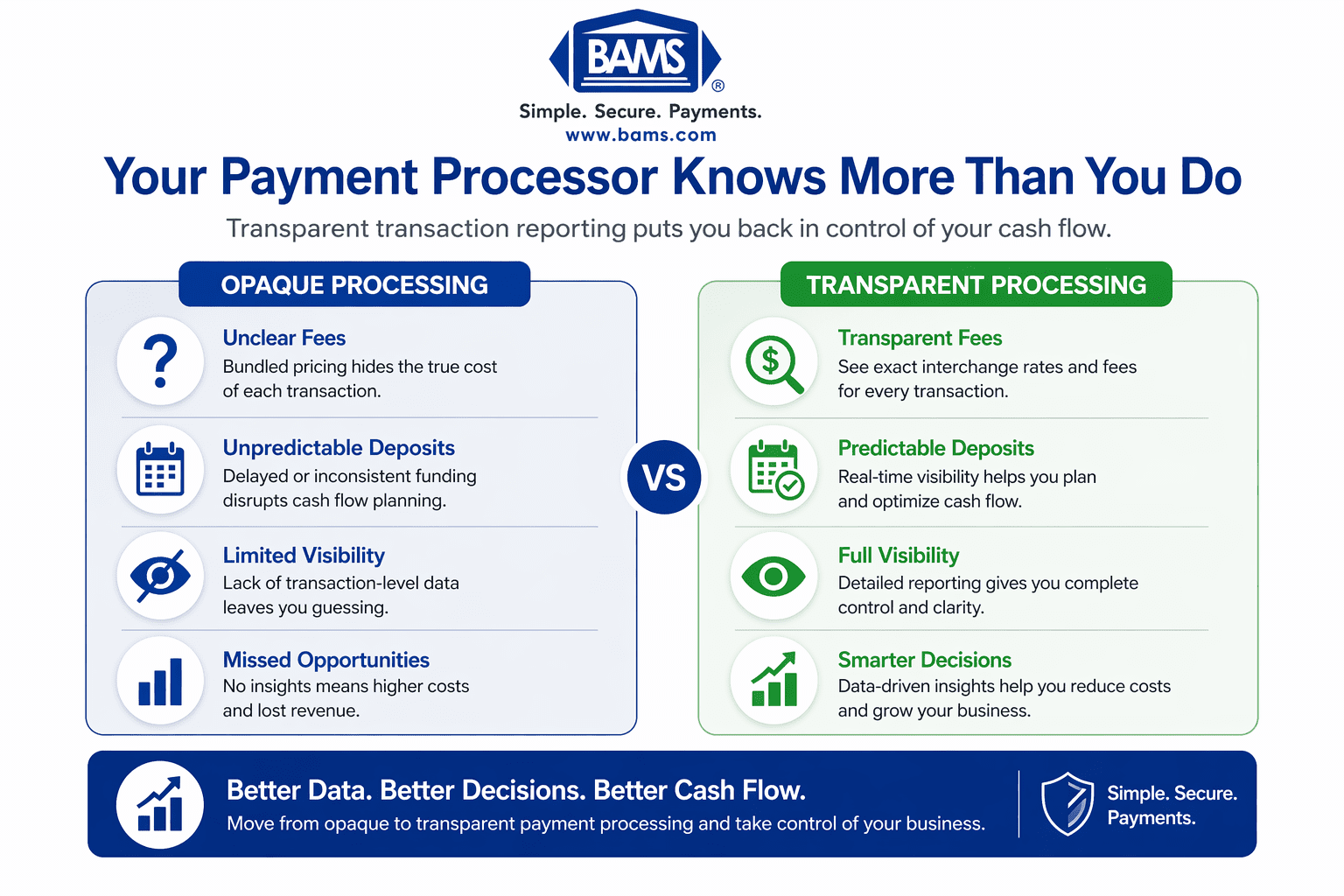
Transparent payment processing gives eCommerce businesses full visibility into fees, deposits, and transaction data, enabling better cash flow control.
Let me show you what changes when you move from opaque to transparent payment processing.
A mid-sized e-commerce brand I’ve observed was running $80,000 in monthly transactions through a flat-rate processor. Their deposits arrived in 3-5 business days. Their statements showed a clean 2.9% + $0.30 per transaction. Simple, right?
When they switched to a processor offering detailed transaction reporting with cost-plus pricing, they discovered something interesting. About 40% of their transactions were debit cards, which carry interchange rates significantly lower than credit. They’d been paying credit card rates on debit transactions for years.
More importantly, they could now see exactly when each batch settled, which card types drove their highest fees, and where authorization failures were costing them sales. The data existed all along. They just couldn’t access it.
Real-time payment gateway insights let you answer questions that used to require weeks of forensic accounting: Why did Tuesday’s deposit come up short? Which product category generates the most chargebacks? Are your international transactions actually profitable after fees?
According to the Federal Reserve, interchange rates vary significantly between debit and credit transactions, which is why pricing transparency matters.
BAMS approaches this through detailed transaction reporting and next-day funding, giving e-commerce managers the visibility to make same-week decisions rather than same-quarter discoveries. But the principle matters more than any single provider: you cannot optimize what you cannot see.
The Real Cost of Staying in the Dark
If transparent transaction reporting matters, what happens to businesses that ignore it? As explained by Modern Treasury, better transaction-level visibility allows businesses to make faster and more accurate financial decisions.
First, you’re making inventory decisions with incomplete information. When deposits arrive unpredictably, you either hold excess cash as a buffer (expensive) or risk stockouts during float periods (more expensive).
Second, you’re likely overpaying without knowing it. Bundled pricing hides the true cost of different transaction types. Without line-item visibility, you can’t negotiate effectively or route transactions optimally.
Third, and this is the one that keeps e-commerce managers up at night, you can’t spot problems until they become crises. A spike in authorization failures, an uptick in chargebacks, a change in customer payment preferences. These signals exist in your transaction data. But if your reporting is a monthly PDF, you’re always reacting to last month’s problems.
A New Mental Model for Payment Processing
Detailed transaction reporting helps businesses reduce costs, predict deposits, and make faster, data-driven financial decisions.
Stop thinking of your payment processor as a utility. Start thinking of it as a data partner.
The electricity company sends you a bill. A data partner sends you insights. The difference isn’t just information volume. It’s the shift from passive recipient to active decision-maker.
When you can see your transaction data in real time, with fees broken out by type and deposits tracked to the hour, payment processing stops being a cost center you tolerate and becomes a lever you control. That’s the reframe: payment gateway insights aren’t a nice-to-have feature. They’re the foundation of cash flow control.
The Question Worth Asking
Every e-commerce manager reading this can run a simple test tomorrow. Pull up your last three months of payment processing statements. Can you answer, without additional research, what your effective rate was on debit versus credit transactions? Can you identify your three highest-fee transaction types? Do you know, to the day, when each deposit will hit your account?
If the answer is no, your processor has information you’re paying for but not receiving. The fix isn’t complicated. It’s a conversation. But it starts with believing you deserve to see the data.
Frequently Asked Questions
What are faster deposit strategies in merchant services?
Next-day funding programs and real-time settlement options are the most direct strategies. These require processors that prioritize deposit speed and provide transparent batch timing so you can predict exactly when funds arrive.
How can transaction reporting help reduce payment processing costs?
Detailed reporting reveals which transaction types carry the highest fees, allowing you to optimize payment routing and negotiate more effectively. Many businesses discover they’re overpaying on low-cost transaction types like debit cards when using bundled pricing.
What role does cost-plus pricing play in payment optimization?
Cost-plus pricing separates interchange fees from processor markup, giving you visibility into the actual cost of each transaction. This transparency lets you identify savings opportunities that bundled or flat-rate pricing obscures.
Sources


