
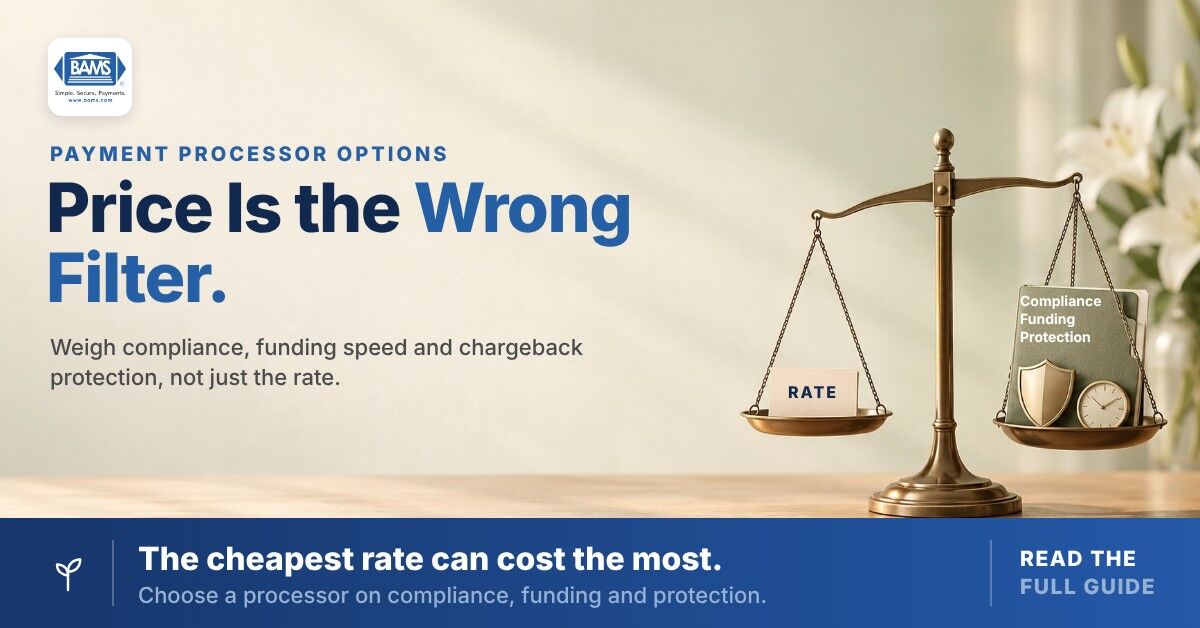
Payment Processor Options: Why Price Is the Wrong Filter
The Rate Sheet Trap Nobody Talks About
Picture a funeral home director who spends three months comparing payment processor options by rate and picks the cheapest one. Within a quarter, slower funding and a lost chargeback dispute cost more than the lower rate will save all year. It’s a common pattern for high-ticket businesses.
When you process transactions that routinely exceed $10,000 or $15,000, the math changes. The risks change. And the cost of choosing wrong compounds fast.
TL;DR
- Rate shopping is a trap for high-ticket businesses – Funeral homes processing $10,000+ transactions face compliance, cash flow and chargeback risks that a low rate can’t offset.
- Compliance extends beyond PCI – FTC Funeral Rule requirements, state regulations and trust account obligations mean your processor’s documentation and workflow capabilities matter as much as its pricing.
- Funding speed is a cash flow lever – The difference between next-day and three-day settlement compounds across multiple services and locations, creating unnecessary float that drains working capital.
- Treat your payment stack as infrastructure – Evaluate processors on total cost of doing business (compliance support, chargeback defense, funding predictability) rather than basis points alone.
Why Everyone Compares Payment Processing Fees First
It makes sense on the surface. According to the Nilson Report, U.S. merchants paid $187.2 billion in fees to accept $11.902 trillion in card payments in 2024. Small firms feel it too: in the Federal Reserve’s 2024 Report on Payments, fees topped the list of payment challenges. Fees are visible, growing and painful. Of course operators want to minimize them.
The industry reinforces this instinct. Most processor marketing leads with rate comparisons. Basis points become the primary differentiator. And for a retail shop running $40 average tickets, that approach works well enough.
But funeral service isn’t retail. Your average transaction is dramatically higher. Families come to you at an emotional time. Your regulatory environment includes the FTC Funeral Rule, state-specific requirements and trust account obligations. A rate sheet can’t tell you whether your processor will help you navigate any of that.
The Real Decision Isn’t About Cost. It’s About Exposure.
Here’s what we actually believe: for high-ticket, trust-dependent service businesses, processor selection is fundamentally a compliance and cash flow decision, not a cost comparison. The cheapest rate that introduces compliance gaps or unpredictable funding is the most expensive option you’ll ever choose.
Where Payment Processor Options Actually Diverge
Compliance Is More Than PCI
PCI compliance matters, obviously. But for funeral homes, the compliance picture extends well beyond protecting card data. The FTC Funeral Rule requires itemized price lists, accurate price information by phone and specific disclosures. Many states add their own requirements around deposits, preneed trust payments and documentation retention.
The Rule doesn’t regulate how families pay, but your payment system still touches all of this. When a family puts a $12,000 deposit on a preneed arrangement, your receipts, records and transaction categories should match your itemized prices and trust paperwork. Generic processor setups rarely account for these workflows.
If you’re unsure what you should actually be paying for PCI compliance services, this breakdown of PCI compliance fees is a good diagnostic starting point. Any fee you can’t tie to a specific service deserves scrutiny.
The Hidden Cost of Slow Funding
Many processors settle card payments in one to three business days. For many businesses, a day or two of float is a minor inconvenience.
For funeral homes, it’s not minor at all.
You have vendor obligations that don’t wait. Casket suppliers, florists, cemetery fees and third-party services all expect prompt payment. When a $15,000 transaction settles on day three instead of day one, you’re floating that gap for two extra days from reserves or delaying payments to partners.
Multiply that across multiple services per week, across multiple locations and the cash flow drag becomes substantial. Operators can end up carrying five figures in unnecessary float simply because their batch cutoff times don’t match their operational rhythm. Missing a cutoff by minutes can push a deposit back an entire business day.
This is where BAMS addresses a real pain point. Next-day funding for qualifying merchants, at no extra cost, can put funds in your account in as little as ten hours after batching. That shrinks the gap between service delivery and cash availability.
Chargebacks Hit Different at $15,000
Every chargeback can carry a dispute fee from your processor. That’s the direct cost. But on a $15,000 transaction, the indirect cost (lost revenue, staff time spent on documentation, potential reserve increases) dwarfs the fee itself.
Funeral services carry a unique chargeback risk profile. Transactions are emotionally charged. Family members who weren’t the primary decision-maker sometimes dispute charges after the fact. And the documentation required to defend a high-ticket dispute is extensive.
A processor without dispute tools leaves you assembling evidence packages from scratch under tight response windows. Mastercard notes acquirer deadlines average 10 to 35 days and your processor’s deadline is usually shorter. BAMS Dispute Responder sends immediate chargeback notifications with a clear action plan, which matters on high-ticket services.
The Markup You Can’t See
Across all U.S. card payments, the Nilson figures work out to fees of about 1.6% of volume, but that average hides wide variation. On top of interchange and assessment fees, processors add their own markup, often as a percentage plus a fixed per-transaction fee.
The lowest advertised rate often excludes material per-transaction fees, batch fees, statement fees and PCI non-compliance penalties. When you’re evaluating payment processor options, the only honest comparison happens at the level of effective cost: total fees divided by total volume. If you want to run that calculation yourself, this guide to calculating your merchant discount rate walks through the math step by step.
For operators processing eCommerce payment processing transactions (online preneed sales, memorial merchandise, or digital invoicing for at-need arrangements), the picture gets even murkier. Card-not-present transactions usually cost more to process, reflecting higher fraud and chargeback risk. And when an account is flagged as higher risk, a processor may hold a rolling reserve, a percentage of revenue held for months. Funeral services, with their high average tickets, sometimes trigger these holds unexpectedly.
What Changes If You Stop Shopping on Rate
If this perspective is right, the implications are significant. It means your processor evaluation checklist needs to start with questions most operators never ask: How does this processor handle documentation for regulatory compliance? What’s the actual funding timeline for my batch schedule? What chargeback defense resources exist for high-ticket disputes? Will the payment stack integrate with my management software and accounting tools?

Five questions to ask before you sign. Price is one filter, not the only one.
It means the “savings” from a cheaper rate can vanish. One delayed funding cycle, one lost chargeback dispute or one compliance gap found in an audit can wipe them out. For a family-owned operation managing multiple locations, these aren’t abstract risks. They’re Tuesday.
And it means the operators who treat processor selection as a strategic decision (not a commodity purchase) will run tighter, more resilient businesses.
A Better Way to Think About Your Payment Stack
Stop thinking of your processor as a toll booth that takes a percentage on the way through. Start thinking of it as infrastructure. Like plumbing.
Bad plumbing doesn’t just cost you in water bills. It floods the basement. It corrodes the foundation. You don’t notice the damage until it’s expensive to fix.
Your payment stack is operational infrastructure, not a line-item expense. The right processor doesn’t just move money. It protects your compliance posture, stabilizes your cash flow and defends your revenue on the transactions that matter most. When you evaluate it that way, the conversation shifts from “who charges the least” to “who reduces my total cost of doing business.”
Understanding how PCI compliance fees reveal your processor’s transparency is one practical place to start that evaluation.
The Families You Serve Deserve Better Than a Discount Processor
You built your reputation on trust, dignity and attention to detail. Your payment experience should reflect those same values. A declined transaction during an arrangement conference, an unexplained hold on a preneed deposit, a chargeback you couldn’t defend because your processor didn’t provide the tools: these aren’t just operational failures. They’re trust failures.
Choose your payment infrastructure the way you’d choose any partner who touches your families. Not on price. On fit.
Frequently Asked Questions
How can funeral homes ensure PCI compliance when integrating payment systems?
Start by confirming your processor provides PCI-compliant infrastructure, including encrypted payment gateways and secure data handling. Beyond PCI, make sure the payment workflow produces itemized receipts that match your price lists, along with trust-related transaction records.
Why does settlement timing matter more than rate for high-ticket service businesses?
On a $15,000 transaction, the difference between next-day and three-day funding means two extra days of float. Across several services a week, that can add up to tens of thousands of dollars you cover out of pocket. Predictable funding lets you meet vendor obligations on time without dipping into reserves or delaying payments to partners.
What should funeral home operators look for beyond payment processing fees when choosing a processor?
Compare payment processor options on chargeback defense, funding speed, software integration and PCI compliance support. Also ask whether the processor understands funeral service requirements. Total cost of doing business matters more than the advertised rate.


