7 Faster Deposit Strategies to Improve eCommerce Cash Flow
Last Updated on May 25, 2026 by Dimitri Akhrin
Practical methods to close the gap between sales and settlement, from recurring payments to digital wallet integration
Learn specific strategies to speed up when revenue hits your account. This guide covers payment processor selection, digital wallet payments, and recurring payments support to eliminate costly cash flow gaps.
TL;DR
- Switch to next-day funding as your first move. This single change often delivers more cash flow improvement than all other strategies combined.
- Enable digital wallet payments everywhere since Apple Pay and Google Pay transactions clear faster due to higher processor trust and lower fraud flags.
- Build recurring payments support to create predictable deposit schedules you can plan around instead of sporadic settlement batches.
- Prevent chargebacks proactively because disputed transactions trigger fund holds that extend well beyond the disputed amount.
- Consolidate payment gateways to eliminate fragmented settlement schedules and create a single, predictable deposit stream.
Why Delayed Deposits Cost More Than You Think
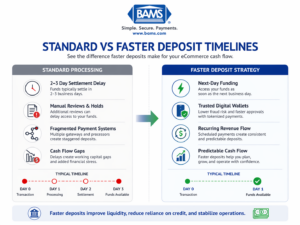
A side-by-side comparison of traditional settlement delays versus faster deposit strategies that help eCommerce businesses access funds sooner.
Your eCommerce store processed $47,000 in sales last week. The money sits in limbo while your supplier invoices come due, your ad spend renews, and payroll approaches. This gap between earning and accessing funds creates a silent tax on your operation.
In 2025, the payments landscape has shifted dramatically. Digital payments continue to grow as businesses shift toward faster, electronic settlement systems supported by modern payment infrastructure. Yet many eCommerce managers still operate with deposit timelines designed for a slower era. The result is borrowed money to cover gaps your own revenue should fill.
The strategies below address this structural problem. They move beyond generic advice about “improving cash flow” to specific mechanisms that accelerate when your money actually lands in your account.
What This List Delivers (And What It Doesn’t)
This guide targets eCommerce managers at established businesses who process consistent transaction volume but face frustrating delays between sale and settlement. You already have payment processing. The question is whether your current setup works for you or against you.
These faster deposit strategies focus on practical changes you can implement within your existing operations. We exclude enterprise-level treasury management systems and strategies requiring significant capital investment. Each method has been selected for its direct impact on deposit timing, not peripheral benefits.
Selection Criteria for These Strategies
Each strategy earned its place based on three factors: measurable impact on deposit speed, implementation feasibility for mid-size eCommerce operations, and compatibility with existing payment infrastructure. We prioritized approaches that compound over time rather than one-time fixes.
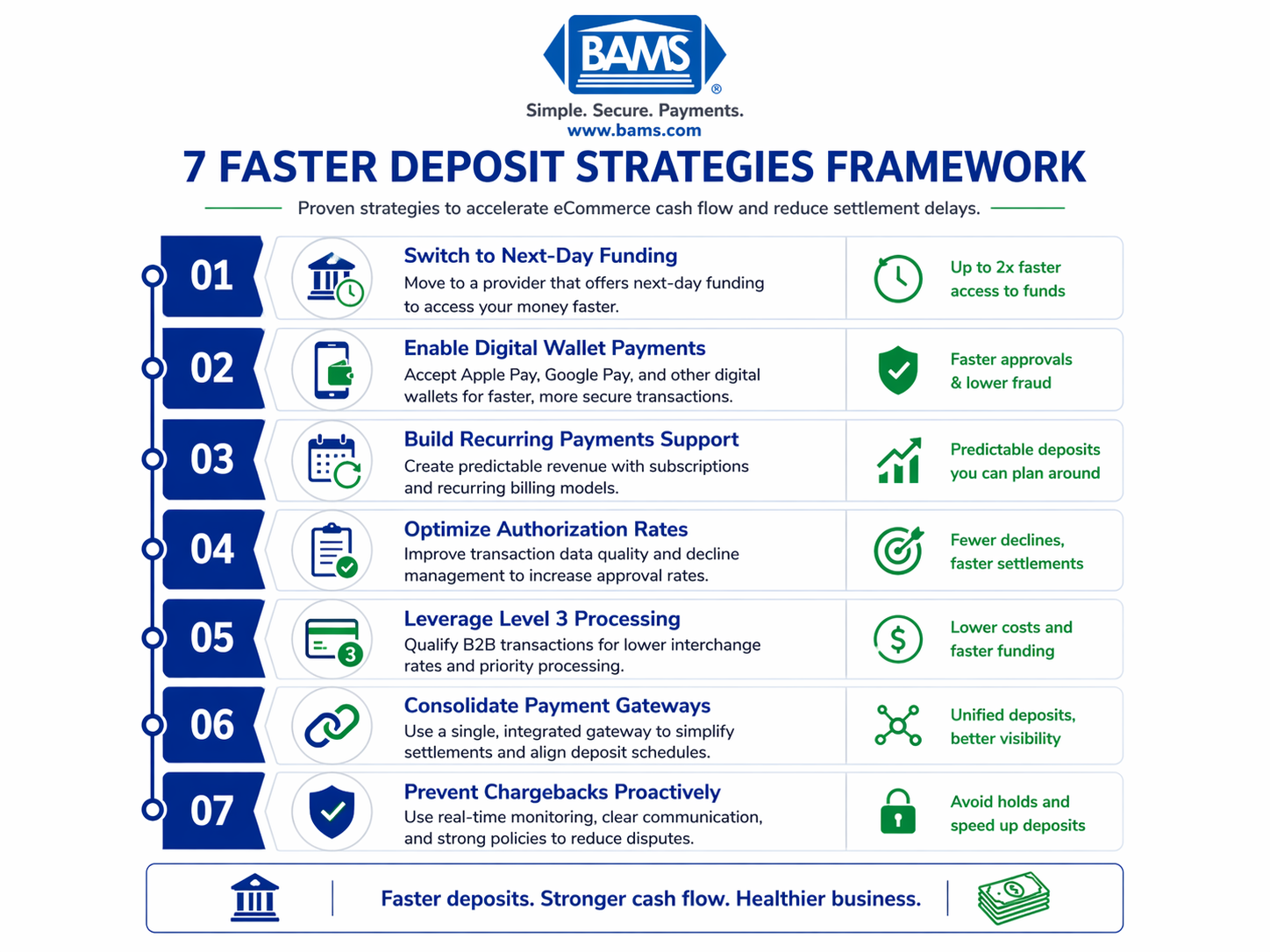
7 Faster Deposit Strategies That Transform Cash Flow

A structured framework of seven proven strategies that help eCommerce businesses accelerate deposits, improve cash flow predictability, and reduce settlement delays.
1. Switch to Next-Day Funding Providers
Why it matters: Standard merchant accounts often hold funds for 2-3 business days. That delay multiplies across hundreds of transactions weekly, creating a permanent float that benefits your processor, not you.
What it looks like today: Next-day deposits enable e-commerce businesses to stop waiting days for earnings access, steadying cash flow predictably. Modern payment systems now support faster settlement timelines, allowing businesses to access funds more quickly through optimized payment infrastructure, as explained by Modern Treasury. Modern processors offer this as a standard feature rather than a premium add-on. The technology exists to settle faster; the question is whether your current provider offers it.
How to apply it: Request your current processor’s funding timeline in writing. Compare against providers offering next-day funding as standard. Calculate the working capital value of those extra days across your monthly volume. The math often justifies switching even when other terms are similar.
2. Integrate Digital Wallet Payments Across All Channels
Why it matters: Digital wallet payments process with higher authorization rates and lower fraud flags, both of which accelerate settlement. Transactions flagged for review create deposit delays that ripple through your cash flow.
What it looks like today: Apple Pay, Google Pay, and similar services use biometric authentication and tokenization that processors trust more than manual card entry. This trust translates to faster clearing. Apple Pay for merchants provides both contactless convenience and fraud-deterring biometric security. Integrated payment gateway provides both contactless convenience and fraud-deterring biometric security.
Digital wallets leverage tokenization and secure authentication, reducing fraud risk and improving transaction efficiency, which contributes to smoother payment processing as outlined by Visa.
How to apply it: Audit your checkout flow for digital wallet options. If you accept them in-store but not online (or vice versa), you leave money on the table. Setting up Apple Pay acceptance involves specific terminal requirements for physical locations and platform integrations for eCommerce. Prioritize wallets your customer demographics actually use.
3. Implement Recurring Payments Support for Repeat Customers
Why it matters: Recurring payments support creates predictable deposit schedules you can plan around. Instead of sporadic transaction batches, you receive consistent settlement on known dates.
What it looks like today: Subscription billing, auto-replenishment programs, and membership models all generate recurring revenue with predictable settlement patterns. The recurring nature also reduces fraud review delays since the customer relationship is established.
How to apply it: Identify products with natural repurchase cycles. Offer subscription options with modest discounts (5-10%) to incentivize enrollment. Structure billing dates to align with your cash flow needs. Even converting 15% of repeat customers to recurring billing meaningfully smooths your deposit calendar.
4. Optimize Authorization Rates to Reduce Settlement Delays
Why it matters: Declined transactions that later succeed through retry logic often face extended settlement windows. Clean authorizations on the first attempt move through the system faster.
What it looks like today: Authorization rate improvement involves multiple factors: accurate billing descriptors, proper address verification setup, and retry logic that respects issuer preferences. Higher-quality transaction data and proper authorization processes improve approval rates and reduce delays, aligning with broader payment system efficiency insights from the Federal Reserve.
How to apply it: Pull your authorization rate report from your processor dashboard. Rates below 95% indicate optimization opportunities. Common fixes include updating your merchant category code, implementing network tokenization, and adjusting retry intervals. Each percentage point improvement reduces the transaction pool subject to extended review.
5. Leverage Level 3 Processing for B2B Transactions
Why it matters: If you sell to other businesses, Level 3 processing provides detailed transaction data that qualifies for lower interchange rates and faster settlement. Corporate and purchasing cards specifically benefit from this data depth.
What it looks like today: Level 3 processing transmits line-item details (product codes, quantities, tax amounts) with each transaction. This additional data satisfies card network requirements for preferred processing treatment, including expedited settlement for qualifying transactions.
How to apply it: Determine what percentage of your volume comes from corporate cards or business accounts. If it exceeds 20%, Level 3 processing likely benefits you. Your gateway must support the required data fields, and your checkout flow needs to capture the necessary information. Work with your processor to enable this capability.
6. Consolidate Payment Gateways to Single Settlement
Why it matters: Multiple payment gateways mean multiple settlement schedules, each with its own timing and fee structure. Consolidation creates a single, predictable deposit stream.
What it looks like today: eCommerce operations often accumulate payment methods over time: a primary gateway, a PayPal account, a separate solution for international transactions. Each settles independently, fragmenting your cash flow visibility and creating reconciliation overhead.
How to apply it: Map every payment method to its settlement timeline and fee structure. Identify a primary processor capable of handling your full payment mix. Migrate secondary methods to the primary gateway where possible. Accept that some payment diversity serves customer preference, but eliminate redundancy that exists only from historical accident.
7. Deploy Proactive Chargeback Prevention
Why it matters: Chargebacks trigger fund holds that extend well beyond the disputed amount. A single chargeback can freeze settlement on an entire batch while review processes complete. eCommerce fraud prevention directly impacts how quickly you access your legitimate earnings.
What it looks like today: Modern chargeback defense combines clear billing descriptors, proactive customer communication, and alert systems that resolve disputes before they escalate. Prevention costs less than response, both in fees and in settlement delays.
How to apply it: Review your chargeback rate monthly. Implement descriptor clarity so customers recognize charges. Use order confirmation and shipping notification emails that preempt “I don’t recognize this charge” disputes. Consider chargeback alert services that notify you of disputes before formal filing, giving you opportunity to refund proactively and avoid the hold process entirely.
The Pattern Across These Strategies
Three themes connect these approaches. First, processor trust accelerates settlement. Transactions that look legitimate to automated systems move faster than those requiring manual review. Digital wallets, clean authorizations, and established recurring relationships all signal trustworthiness.
Second, consolidation beats fragmentation. Multiple systems create multiple delays. Unified payment infrastructure means unified settlement timing you can actually plan around.
Third, prevention outperforms reaction. Chargebacks, authorization failures, and fraud flags all trigger delays. The cost of preventing these issues is lower than the cash flow impact of addressing them after they occur.
Where to Start Without Overwhelming Your Team
Implementing all seven strategies simultaneously would strain any operation. Begin with the highest-impact, lowest-effort changes: confirm your processor offers next-day funding, and switch if they don’t. This single change often delivers more cash flow improvement than all other strategies combined.
Next, audit your digital wallet acceptance. Getting started with Apple Pay and similar options requires modest setup but delivers ongoing authorization and settlement benefits.
Save the more complex changes (Level 3 processing, gateway consolidation) for after you’ve captured the quick wins. The goal is faster access to your money, not a perfect payment infrastructure. Start where the gap between effort and impact is widest.
Frequently Asked Questions
What are faster deposit strategies in merchant services?
Faster deposit strategies are specific changes to your payment processing setup that reduce the time between when a customer pays and when funds reach your bank account. These include switching to next-day funding providers, integrating digital wallet payments that clear faster, implementing recurring payments support for predictable settlement, and optimizing authorization rates to avoid review delays. The goal is eliminating the 2-5 day gap that standard processing creates.
How can I improve my payment authorization rates?
Authorization rate improvement starts with accurate billing descriptors that match your business name, proper address verification configuration, and retry logic that respects card issuer preferences. Pull your current authorization rate from your processor dashboard. Rates below 95% indicate room for improvement. Network tokenization, updated merchant category codes, and adjusted retry intervals typically yield measurable gains. Higher authorization rates mean fewer transactions stuck in extended review.
Why do digital wallet payments settle faster than traditional card transactions?
Digital wallet payments use biometric authentication (fingerprint, face recognition) and tokenization that processors trust more than manually entered card numbers. This trust translates to fewer fraud flags and manual reviews, both of which delay settlement. Apple Pay and Google Pay transactions also carry lower chargeback risk, which further accelerates the clearing process through payment networks.
What role does fraud protection play in deposit timing?
Fraud protection directly impacts deposit timing in two ways. First, transactions flagged for potential fraud enter manual review queues that delay settlement. Second, chargebacks trigger fund holds that can freeze entire batches while disputes resolve. Proactive fraud prevention (clear descriptors, customer communication, chargeback alerts) keeps transactions flowing through automated settlement rather than getting stuck in review processes.
When should I consider expanding my payment options?
Expand payment options when customer demand exists and the new method improves either conversion or settlement timing. Digital wallets merit priority because they offer both benefits. However, avoid adding payment methods that fragment your settlement into multiple streams. The ideal expansion adds customer convenience while consolidating (not fragmenting) your deposit schedule.
Which payment processing fees can I reduce while improving deposit speed?
Level 3 processing for B2B transactions qualifies for lower interchange rates and faster settlement simultaneously. Gateway consolidation eliminates redundant monthly fees while creating unified settlement. Next-day funding, once a premium feature, is now standard with many processors at no additional cost. The strategies that accelerate deposits often reduce fees as a secondary benefit, since both outcomes stem from cleaner, more trustworthy transaction patterns.
Sources