Streamline Payment Processing: Your Cash Flow Model Is Wrong
Last Updated on May 25, 2026 by Dimitri Akhrin
Why deposit timing — not revenue growth — is the most undervalued variable in eCommerce cash flow forecasting
Learn why standard cash flow forecasts fail eCommerce brands and how funding speed from your payment processor compounds into a real competitive advantage. Rethink your processor as a growth lever, not a utility.
TL;DR
- Deposit timing is the most undervalued variable in eCommerce cash flow forecasting – The 3-5 day funding delay most operators accept creates a permanent float that traps working capital and distorts forecasts.
- Daily or next-day funding simplifies forecasting and accelerates reinvestment – Each deposit maps to one day’s sales, making reconciliation cleaner and freeing cash for inventory, ads, and payroll faster.
- Your processor is a cash velocity engine, not a utility – Evaluating processors on funding speed and fee transparency (not just rate) compounds into a measurable operational advantage over time.
- The real cost isn’t the fee, it’s the delay – A slightly cheaper processor that holds your money for days costs more in missed opportunities than it saves in interchange.
Your Cash Flow Forecast Is Built on a Lie
Most eCommerce operators forecast cash flow using a model designed for businesses that invoice clients and wait 30 days. But you don’t invoice anyone. Your customers pay at checkout, and your processor holds the money for days before releasing it. That gap between “earned” and “available” is where forecasts break down. If you want to streamline payment processing into an actual growth lever, you need to start with a forecast that reflects how you actually get paid.
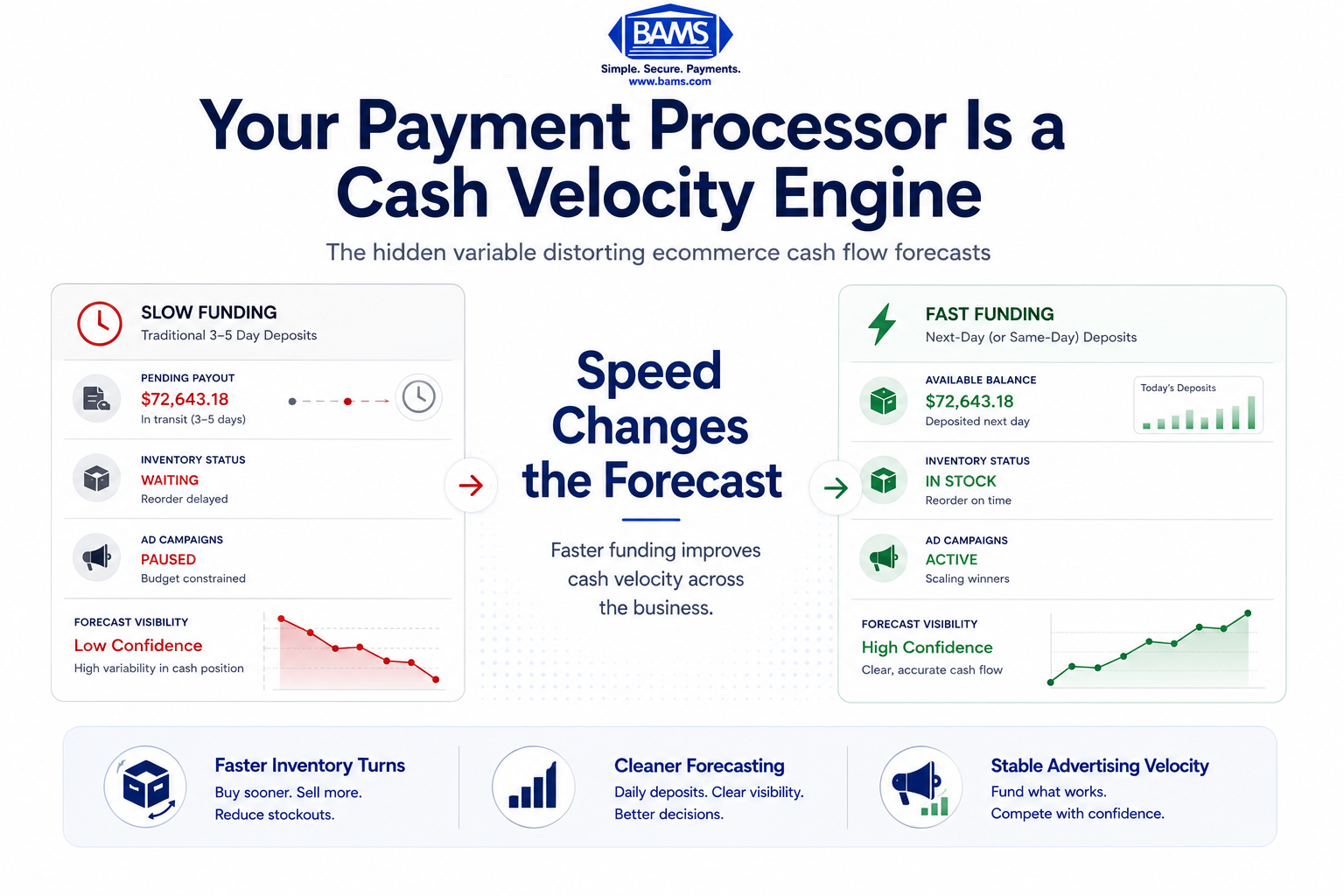
Why faster deposits improve eCommerce forecasting accuracy and accelerate working capital decisions.
The “Net 3-5” Default Nobody Questions
Here’s the assumption baked into most eCommerce cash flow planning: revenue hits your bank account within three to five business days. Operators build their inventory cycles, ad budgets, and payroll timelines around this rhythm. It works well enough that nobody questions it.
And to be fair, this used to be fine. When your store did $20K a month and you reordered inventory quarterly, a few days of float didn’t matter. But as digital commerce scales, Visa’s small business payment resources continue to emphasize the growing importance of faster and more efficient payment flows for modern eCommerce operations. Inventory windows are tighter. Ad spend decisions happen daily. And that three to five day deposit lag? It’s compounding into a structural disadvantage you’ve simply gotten used to.
Funding Speed Is Not a Feature. It’s a Strategy.
We believe the single most undervalued variable in eCommerce cash flow forecasting is deposit timing. Not revenue growth. Not margin optimization. The speed at which earned revenue becomes spendable cash.
When you shift from a 3-5 day funding cycle to next-day or same-day deposits, you don’t just “get paid faster.” You fundamentally change the math of your forecast.
How Daily Funding Rewrites the Cash Flow Equation
The Inventory Reinvestment Gap
Consider a mid-size eCommerce brand doing $500K in monthly revenue. On a standard 3-day rolling deposit, roughly $50,000 in earned revenue is perpetually in transit on any given day. That’s $50K you can’t use to restock a best-seller that’s about to go out of stock. It’s $50K you can’t deploy into a Facebook campaign that’s returning 4x ROAS right now, today.
Move to next-day funding, and that float shrinks dramatically. The cash you earned on Monday is available Tuesday morning. Your forecast stops being a guess about “when will I have the money” and becomes a clean daily ledger of what’s actually deployable.
Forecasting Gets Simpler, Not Harder
There’s a counterintuitive truth here: daily deposits make forecasting easier, not more complex. With weekly or bi-weekly lump deposits, you’re constantly reconciling which days’ sales are included in which deposit. With daily funding, each deposit maps to a specific day’s transactions. Your accounting team spends less time untangling batch deposits and more time on decisions that matter.
This is especially true when your processor provides real-time reporting alongside those deposits. When you can see yesterday’s sales, today’s deposit, and your effective processing rate in one place, the hidden cost of deposit delays becomes impossible to ignore.
Modern Treasury’s payment operations resources also emphasize how clearer settlement visibility and reconciliation workflows improve financial forecasting accuracy for growing businesses.
The Compounding Effect on Working Capital
We’ve seen a pattern across growing eCommerce brands: the ones that treat their processor relationship as an operational strategy decision (not just a cost line) tend to carry less debt. The logic is straightforward. When you access revenue faster, you rely less on credit lines to bridge gaps. You negotiate better terms with suppliers because you can pay sooner. You avoid the desperate “we need to float payroll” moments that erode both margins and morale.
NACHA ACH Network resources continue to highlight how settlement timing and ACH processing efficiency directly impact liquidity and working capital access for growing businesses. Delays of even one or two days compound operationally for eCommerce brands managing inventory and advertising cycles in real time. If major financial institutions struggle with settlement speed, imagine the compounding drag on a $2M eCommerce brand waiting on a processor that treats funding speed as an afterthought.
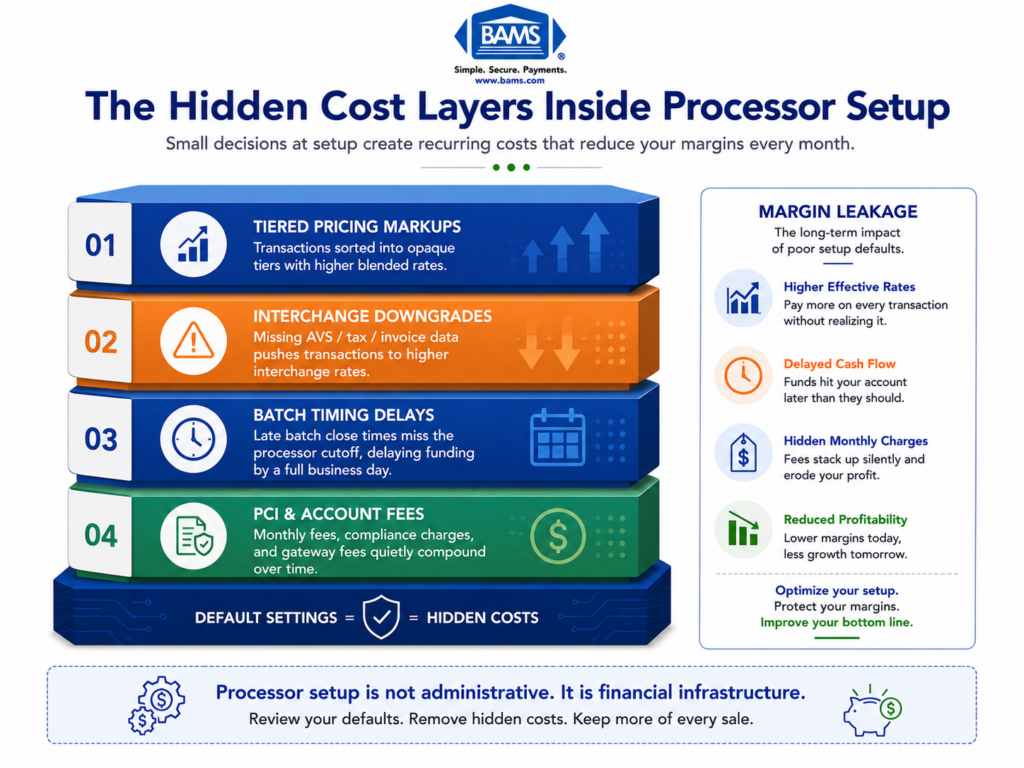
This is where choosing the right merchant services partner matters. BAMS, for example, offers next-day funding paired with transparent fee reporting, which means your daily cash flow forecast can be built on actual deposit data rather than estimates. When payment processing fees are clearly visible and deposits land predictably, your forecast becomes a tool you trust rather than a spreadsheet you dread.
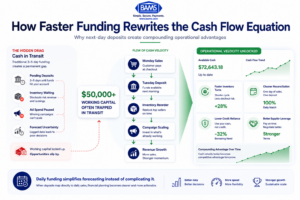
Why funding speed compounds into better forecasting accuracy and operational flexibility.
What Changes If You Take This Seriously
If funding speed really is a strategic lever (and we believe the evidence is clear), then several things follow. First, your processor evaluation criteria need to change. Stop leading with “what’s your rate?” and start asking “when do I get my money, and what does the reporting look like?” Understanding why funding takes so long is the first step toward demanding better.
Second, your cash flow forecast model needs a deposit timing variable. If you’re projecting weekly, switch to daily. Build your ad spend, inventory reorders, and payroll around actual available cash, not projected deposits. Third, recognize that payment processing fees matter, but they’re not the whole picture. A processor that saves you 0.1% on interchange but holds your money for four days is costing you far more in opportunity than you’re saving in fees.
Stop Thinking “Processor.” Start Thinking “Cash Velocity Engine.”
Here’s the reframe: your payment processor isn’t a utility, like electricity or WiFi. It’s the valve that controls how fast revenue converts to working capital. Every day of delay is a day your competitor (who chose a faster processor) is reinvesting while you’re waiting.
The brands pulling ahead aren’t the ones with the lowest processing rates. They’re the ones with the highest cash velocity.
When you see your processor through that lens, the conversation shifts entirely. You stop optimizing for familiarity and start optimizing for financial stability solutions that compound over time. You stop asking “is this good enough?” and start asking “what’s this costing me in speed?”
The Deposit That Lands Tomorrow Funds the Decision You Make Today
Ecommerce moves fast. Your cash should move faster. The operators who will win the next phase of growth aren’t waiting until Thursday to find out what Monday earned them. They’ve already reinvested it. The only question is whether you’ll keep forecasting around a delay you’ve accepted, or start building around the speed you deserve.
Frequently Asked Questions
What is a cash flow acceleration strategy for eCommerce?
It’s any approach that shortens the time between earning revenue and having spendable cash. For eCommerce, the highest-impact version is switching to a processor with next-day or same-day funding, which eliminates the 3-5 day deposit float that traps working capital.
How can businesses improve cash flow forecasting with real-time data?
Choose a payment processor that provides daily deposit reconciliation and transparent fee reporting. When each deposit maps cleanly to a single day’s transactions, your forecast becomes a reliable daily ledger instead of a batch-deposit guessing game.
Which payment solutions can help reduce processing fees?
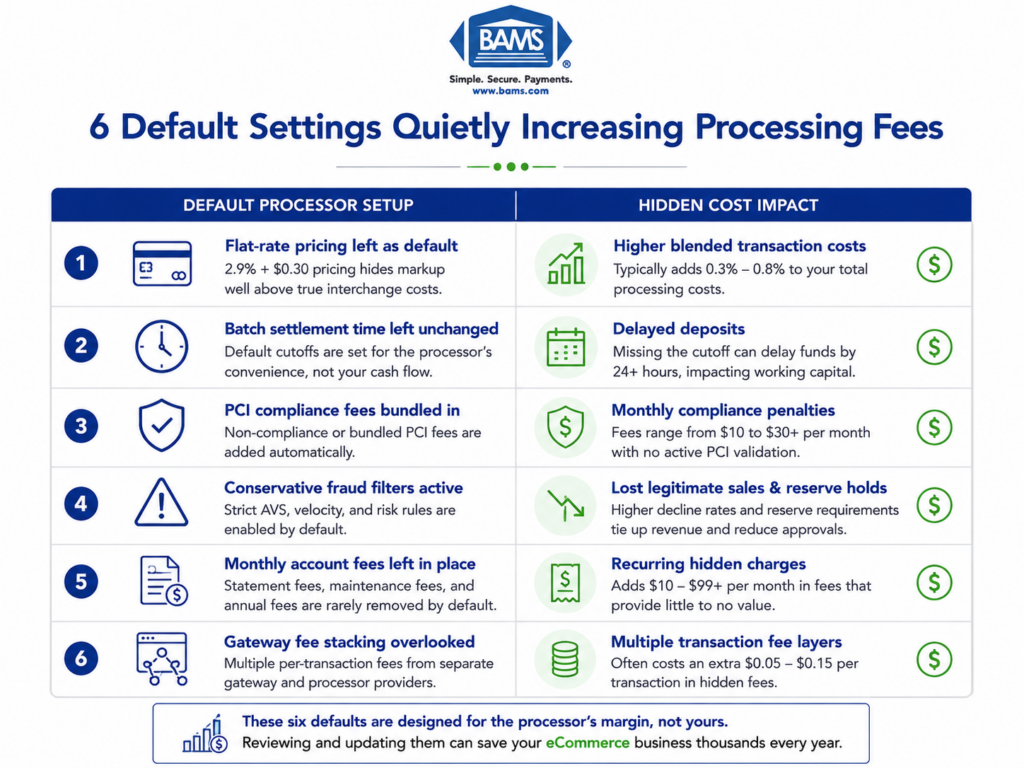
Look for processors that offer interchange-plus pricing with clear, itemized statements rather than bundled or tiered rates. Transparent pricing lets you see exactly what you’re paying per transaction, so you can identify and eliminate hidden markups. Comparing gateways on fee transparency is a good starting point.
Sources