Payment Processing Strategies: Why Your Best Month Triggers Holds
Last Updated on August 3, 2026 by Dimitri Akhrin
Processor holds aren’t bad luck — they’re the predictable result of letting your volume data stay invisible to risk teams.
Learn why eCommerce brands face funding holds during peak sales months and how proactive volume transparency prevents them. Discover the payment processing strategies that keep cash flowing when growth spikes catch underwriters off guard.
TL;DR
- Processor holds aren’t random – They’re triggered when your seasonal volume spike looks like a risk anomaly because your processor has no context for the increase.
- Proactive communication prevents cash flow disruptions – Sharing volume forecasts, ad spend plans, and launch calendars with your processor 60 to 90 days before peak season keeps your funds flowing on schedule.
- Your processor is a partner, not a pipe – Brands that treat payment processing as a relationship (with shared data and real-time analytics) consistently avoid the holds and delays that blindside their competitors.
- Next-day funding changes the math – When deposits arrive the next business day instead of sitting in limbo for 2 to 3 days, your busiest months become your most cash-efficient ones.
Your Biggest Sales Month Is Also Your Biggest Cash Flow Risk
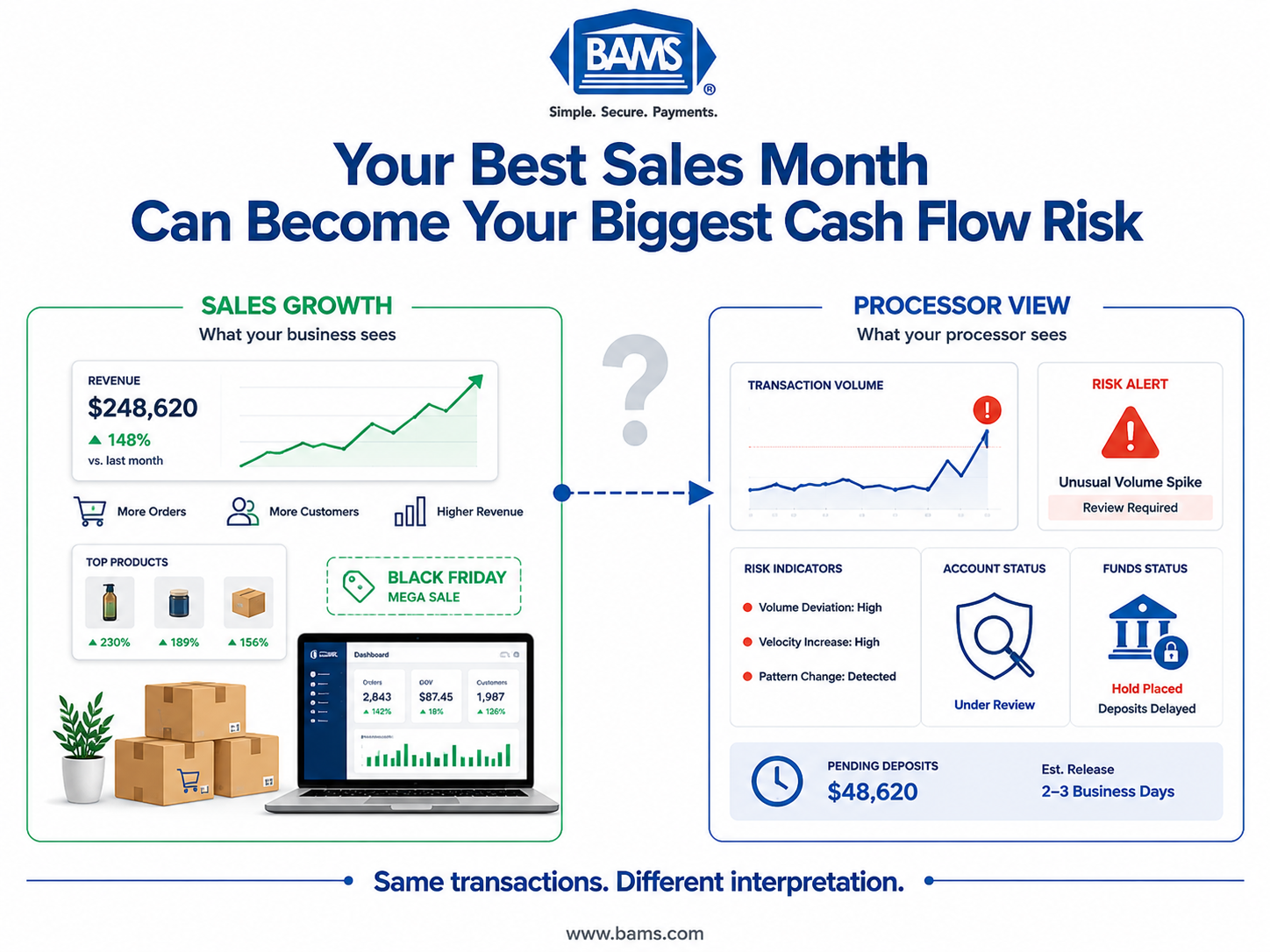
Here’s a pattern we see every year: an eCommerce brand has its best revenue week ever, then discovers its processor is holding a chunk of those funds. The owner scrambles. The team panics. And the money they need to fulfill orders, restock inventory, and keep ads running sits in limbo. Most brands chalk this up to bad luck or a glitchy system. It’s neither. It’s a predictable failure of communication between your business and the people underwriting your risk.
Unexpected growth isn’t the problem. Lack of visibility into that growth is.
The “Set It and Forget It” Approach to Payment Processing Strategies
Most eCommerce businesses negotiate their processing agreement once, usually during onboarding, and never revisit it. They lock in a rate, connect their gateway, and move on. When peak season arrives, they assume the system will simply absorb the spike.
This approach made sense when transaction volumes were steady and predictable. But eCommerce doesn’t work that way anymore. A viral product, a flash sale, or a strong Q4 push can double or triple your typical volume overnight. And the processor’s risk team, who approved you based on a very different transaction profile, sees that spike as a red flag.
The result? Reserve requirements. Funding delays. Holds. Not because you did anything wrong, but because your volume story changed and nobody told the underwriter.
The Real Problem Isn’t the Spike. It’s the Silence.
Processor holds during peak season aren’t bad luck. They’re the predictable result of letting your volume data stay invisible to the people making risk decisions on your account. The fix isn’t better luck. It’s better communication, powered by real-time analytics and proactive merchant engagement tools that keep your processor in the loop before the spike, not after.
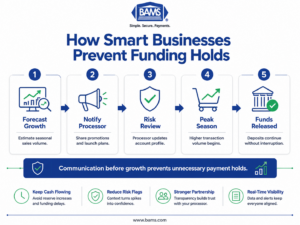
Sharing growth plans before peak season helps processors distinguish legitimate growth from unusual risk.
How Volume Blindness Costs You When It Matters Most
Think about how processor risk teams actually work. They approve your merchant account based on projected monthly volume, average ticket size, and chargeback ratios. These numbers form a baseline. When your actual transactions deviate sharply from that baseline, automated risk systems flag the account. A human reviewer then decides whether to hold funds, increase reserves, or freeze deposits entirely.
None of this is malicious. It’s how the system protects against fraud and merchant insolvency. But the system can’t distinguish between a fraudster laundering money through sudden volume spikes and a legitimate brand having its best Black Friday ever. Not unless you give it context.
This is where most eCommerce brands fail. They treat their processor like a utility (plug in and forget) rather than a partner who needs information to make good decisions on their behalf.
Consider the math. Global cashless payment volumes are projected to increase by more than 80% between 2020 and 2025, from about 1 trillion transactions to almost 1.9 trillion. Every processor in the world is managing more volume, more complexity, and more risk than ever before. Their systems are tuned for anomaly detection. Your seasonal spike, without context, looks exactly like an anomaly.
Now flip the scenario. Imagine you send your processor a heads-up in October: “We’re launching a new product line November 1. We expect 3x our normal volume through December 15. Here’s our ad spend plan, our fulfillment timeline, and our projected ticket size.” That email changes everything. The risk team adjusts your profile. The holds don’t happen. Your cash flows on schedule.
This isn’t theoretical. Brands that build this kind of transparency into their payment processing strategies consistently avoid the funding disruptions that blindside their competitors. The difference isn’t better technology. It’s better behavior.
That said, technology helps. Real-time payments systems are now available in more than 100 countries, with 575 billion RTP transactions expected by 2028. The infrastructure for faster, more transparent payment flows continues to expand globally, including initiatives like the Federal Reserve’s FedNow® Service, which enables instant payment capabilities in the United States. The question is whether your merchant services setup is designed to use it.
This is where a partner like BAMS changes the equation. Their dedicated account management model means you have a real person who knows your business, reviews your volume trends, and coordinates with underwriting before peak season hits. Combine that with next-day funding, and you’re not just avoiding holds. You’re turning your busiest months into your most cash-efficient ones.
What Happens When You Keep Treating Your Processor Like a Stranger
If this thesis is right, the implications are uncomfortable for a lot of growing brands. It means the holds and delays you’ve been experiencing aren’t operational hiccups. They’re symptoms of a relationship you’ve neglected.
It means your peak season planning needs a payments component, not just an inventory and marketing plan. You should be reviewing your credit card processing fee structure and volume thresholds 60 to 90 days before your anticipated spike, not scrambling to call support when funds don’t arrive.
It also means the cost of staying with a processor that doesn’t offer proactive account management isn’t just the rate on your statement. It’s the invisible cost of chargeback fees, reserve holds, and delayed deposits that hit hardest when revenue is highest. Those costs compound. And they don’t show up on any dashboard until it’s too late.
Stop Managing Payments. Start Managing the Relationship.
Here’s the reframe: your processor isn’t a pipe. It’s a partner with a risk appetite. And like any partner, it makes better decisions when it has better information.
The brands that thrive during seasonal volume spikes aren’t the ones with the lowest rates or the fanciest checkout flows. They’re the ones that treat transaction volume forecasting as a shared exercise, not a private spreadsheet. They use real-time analytics not just to monitor sales, but to build a shared language with the account teams that control their cash flow.
Think of it this way: you wouldn’t surprise your warehouse with 10x the orders. Don’t surprise your processor either.
The Brands That Win Peak Season Plan for Payments First
Seasonal volume doesn’t have to mean seasonal pain. The holds, the reserves, the funding delays: these are solvable problems, but only if you stop treating them as inevitable. Build the relationship. Share the data. Choose a partner who picks up the phone. Your cash flow will thank you.
Frequently Asked Questions
When should businesses review their payment processing setup before peak seasons?
Start 60 to 90 days before your anticipated volume spike. This gives your processor’s risk team time to adjust your account profile, update volume thresholds, and prevent automated holds from triggering during your busiest period.
How can businesses use data to forecast transaction volume for seasonal planning?
Pull your monthly transaction data from the past two years and overlay it with your planned marketing calendar, product launches, and promotional events. Share this forecast directly with your processor’s account team so they can align your risk profile with your expected growth.
What is a seasonal volume playbook in merchant services optimization?
It’s a proactive plan that coordinates your projected sales volume, average ticket size, and fulfillment timelines with your payment processor before peak season begins. The goal is to prevent funding delays and reserve holds by giving your processor the context it needs to treat your volume spike as legitimate growth, not a risk flag.
Sources