Financial Consulting for Merchants: The Support Test
Why the real measure of your payment processor reveals itself only when something breaks
Learn why payment processing support matters more than features when evaluating merchant partnerships. This piece reframes human-first access as an operational standard and exposes the hidden costs of settling for 1-800 support models.
TL;DR
- Support isn’t a feature, it’s a stress test – You only discover your payment processor’s true quality when something breaks, and by then, switching is expensive.
- Accountability beats automation – A named account manager who knows your business will save you more money than any dashboard or chatbot ever will.
- The hidden cost is what nobody flags – With U.S. merchants paying $187 billion in processing fees annually, even small overcharges compound into serious losses when no one’s proactively reviewing your rates.
- Evaluate partners at month 14, not day one – Ask who your account manager is, how you reach them directly, and when they last reviewed a client’s pricing. Those answers matter more than any rate sheet.
Nobody Shops for a Fire Extinguisher After the Kitchen Burns Down
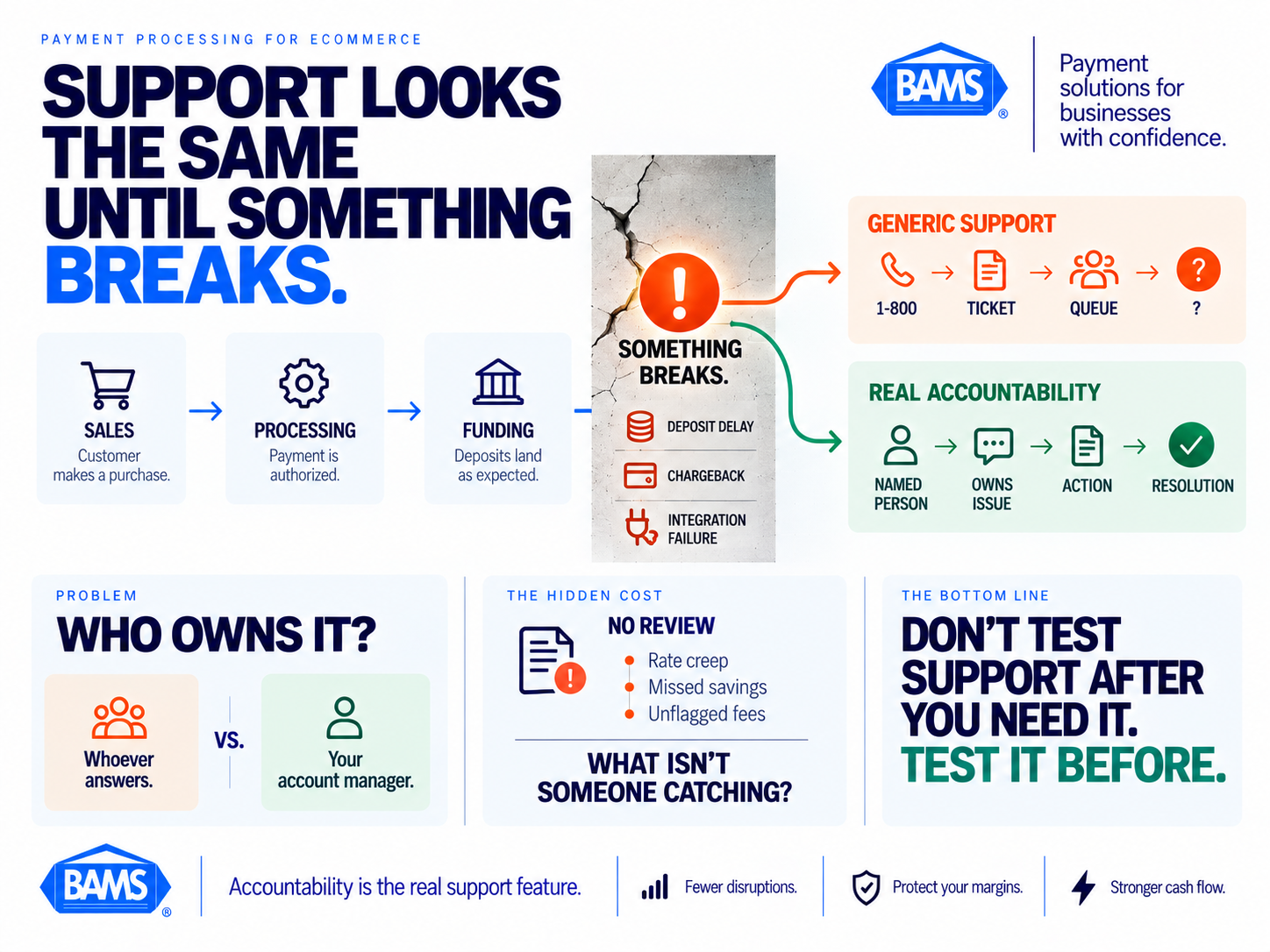
Your payment processor is invisible until it isn’t. When deposits land on time and chargebacks stay rare, you barely think about the company handling your transactions. But the moment something breaks (a funding delay during your biggest sales week, a chargeback dispute with no clear escalation path, an integration failure at 2 a.m.), you discover exactly what kind of partner you chose. And for most eCommerce operators, that discovery is brutal. Financial consulting for merchants has become a booming category, yet the most basic question still goes unasked: when things go sideways, can you actually reach a person who knows your name?
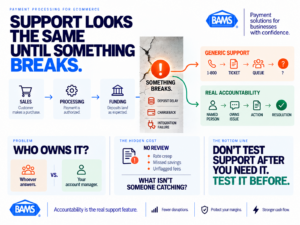
Payment support is easy to overlook when transactions are running normally. Its real value becomes visible when funding stops, a dispute escalates or a payment system fails.
The Support Model Everyone Settled For
The payment processing industry trained merchants to accept a certain standard. You sign up online. You get a confirmation email. You receive a generic support number. If you’re lucky, there’s a chat widget.
This model scaled beautifully for processors. It did not scale for merchants. But it became the norm because the industry optimized for acquisition speed, not relationship depth. And for a while, it worked well enough. Transactions cleared. Statements arrived. Problems were infrequent enough that the support gap stayed hidden.
The trouble is that “well enough” erodes quietly. Over half of merchants now rank payment cost as their top challenge, and their payments teams spend roughly 70% of their time wrestling with cost-related issues. That’s not a technology problem. That’s an accountability vacuum.
The Real Divide Isn’t Price. It’s Who Picks Up the Phone.
Here’s what we actually believe: the most important feature of any payment partner is whether you can hold them accountable when something goes wrong. Not in theory. In practice. On a Tuesday afternoon when $40,000 in deposits hasn’t arrived and your vendor payments are due tomorrow.
Credit card processing optimization matters. Transparent pricing matters. But none of it matters if the person responsible for your account is a rotating cast of tier-one agents reading from a script.
What Accountability Actually Looks Like in Payment Processing
Consider the math first. Nilson Report found that U.S. merchants paid $187.20 billion in fees to accept $11.902 trillion in card payments in 2024, equivalent to roughly $1.57 in fees for every $100 accepted. At that scale, even relatively small differences in pricing structure can translate into meaningful annual costs for individual merchants.
Now ask yourself: who at your processing company is actively working to bring that number down?
We’ve seen a pattern across eCommerce operators running established businesses with 10 to 50 employees. They chose their processor years ago based on a comparison chart or a recommendation. The onboarding was smooth. Then the relationship flatlined. No proactive outreach. No rate reviews. No one helping them understand which costs come from the payment network and which come from their processing relationship. Mastercard explains that interchange is only one component of the merchant discount rate and that merchant pricing is established by the acquirer. That separation is exactly why ongoing statement review and pricing transparency matter.
The gap becomes a chasm during disputes.
The average eCommerce merchant juggles multiple payment gateways and processors. When a chargeback hits, who owns the response? When a gateway integration breaks after a platform update, who coordinates the fix? In the 1-800 model, the answer is: whoever happens to answer the phone, assuming the hold time doesn’t outlast your patience.
Contrast that with a partner model built on dedicated account management. A named human who knows your business, your transaction volume, your seasonal patterns, and your tolerance for risk. Someone who doesn’t need a ticket number to remember your last conversation. This isn’t a luxury. It’s an operational standard that most processors have quietly abandoned because it doesn’t scale as cheaply.
BAMS operates on this model, pairing merchants with dedicated account managers who handle everything from proactive chargeback defense to regular rate reviews. It’s one approach among several, but it reflects a belief we share: that human-first access shouldn’t be a premium add-on. It should be the baseline.
The data supports this. When payments teams spend 70% of their time on cost-related firefighting, they’re not optimizing. They’re surviving. A partner who proactively surfaces savings (flagging a rate that crept up, recommending interchange-plus pricing, auditing for unnecessary fees) frees that time for actual growth work. The business cost savings aren’t hypothetical. They’re the direct result of someone paying attention on your behalf.
What You Lose When No One’s Watching
If this thesis is right, then the real cost of a faceless processor isn’t the fees on your statement. It’s the fees you never knew to question. It’s the chargeback you lost because no one built a defense in time. It’s the funding delay that forced you to tap a credit line during a cash-thin week. The Federal Reserve has noted that faster access to customer payments can help businesses manage working capital tied up in inventory and reduce their need for short-term financing.
These aren’t edge cases. They’re Tuesday. And they compound. A merchant who overpays by even 0.3% on processing fees across $2 million in annual volume leaves $6,000 on the table every year. Over five years, that’s $30,000 in business cost savings that never materialized because nobody was accountable enough to look.
The question isn’t whether your processor offers support. Every processor offers support. The question is whether your processor offers accountability. There’s a canyon between the two.
Reframe: Support Is a Test, Not a Feature
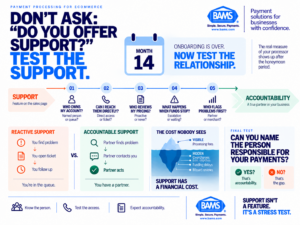
Strong payment support is more than a phone number. These questions reveal whether a processor provides real accountability when merchants need help.
Stop evaluating payment partners by what they promise during onboarding. Start evaluating them by what happens at month 14, when the honeymoon is over and a real problem surfaces.
Here’s a lens worth adopting: your payment processor’s support quality is a test you only grade when something goes wrong, and by then, switching costs make a failing grade expensive.
This reframe changes how you shop. Instead of comparing rate sheets, you start asking: who is my account manager? How do I reach them directly? When was the last time they proactively reviewed a client’s pricing? Can I visit their office? The answers tell you more than any feature comparison ever will. If you want a starting framework, this breakdown of common mistakes when choosing a processor covers the structural traps most merchants fall into.
The Partner You Can Name
We believe the future of financial consulting for merchants isn’t more dashboards, more automation, or more chatbots. It’s more humans with skin in the game. Partners who lose sleep when you lose revenue. Partners whose reputation is local, visible, and tied to yours.
If you can’t name the person responsible for your payments, that’s your answer.
Frequently Asked Questions
When should a business consider switching to a new payment processor?
If you can’t reach a named account manager when a problem arises, or if no one has proactively reviewed your rates in the past year, it’s time to evaluate alternatives. Funding delays and unresolved chargebacks are also clear signals that your current partner lacks accountability.
How does credit card processing optimization reduce costs for eCommerce businesses?
Optimization involves auditing your interchange rates, eliminating hidden fees, and ensuring you’re on the right pricing model (like interchange-plus). Even small percentage reductions compound into meaningful business cost savings across high transaction volumes.
Why does dedicated account management matter more than 24/7 chat support?
Chat support answers generic questions. A dedicated account manager knows your business patterns, anticipates seasonal risks, and proactively flags savings opportunities. The difference is reactive troubleshooting versus ongoing financial consulting for merchants.