
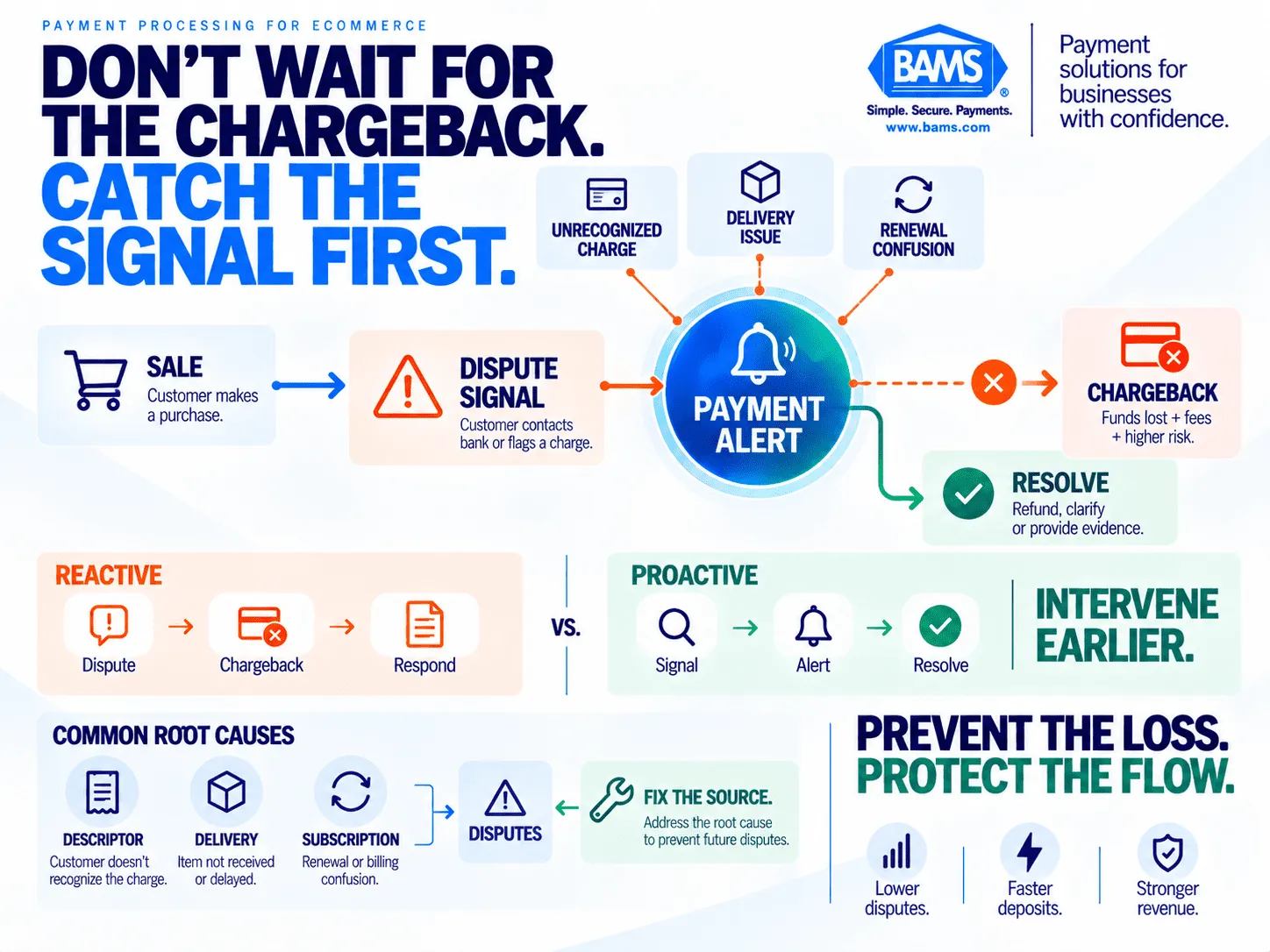
Chargeback Prevention: A Proactive Guide for eCommerce
How payment alerts intercept dispute signals before they drain your eCommerce revenue
Learn how chargebacks build from early warning signals most eCommerce operators miss. This guide shows you how to implement a payment alerts service and proactive monitoring workflows that stop disputes before they become revenue losses.
TL;DR
- Chargebacks are preventable, not inevitable – Most disputes stem from billing descriptor confusion, poor communication, and friendly fraud, not true card theft. Categorizing your disputes by root cause reveals the specific fixes your business needs.
- A payment alerts service is a high-impact intervention – Catching disputes before they become formal chargebacks gives you an opportunity to resolve the issue earlier, reduce additional chargeback costs and protect your dispute metrics.
- Your dispute ratio controls your deposit speed – Processors use your chargeback metrics to set settlement timelines and reserve requirements. Getting below 0.5% unlocks next-day funding and better processing rates, turning prevention into a direct cash flow advantage.
- Prevention beats response every time – Representment win rates sit below 20% for most merchants. Fixing descriptors, sending renewal reminders, and deploying alerts prevents far more revenue loss than fighting chargebacks after they post.
- Start with 90 days of dispute data – Pull your recent chargebacks, categorize them by reason code, and identify your top three root causes. Most eCommerce operators find that a small number of fixable issues drive the majority of their disputes.
Guide Orientation: What This Covers and Who It’s For
This guide shows eCommerce operators how to turn chargeback prevention into a proactive monitoring discipline that protects eCommerce revenue and accelerates deposit timelines. It is written for eCommerce managers at established online businesses (roughly 10 to 50 employees) who feel the operational weight of disputes, delayed funds, and rising processing costs.
By the end, you’ll understand how chargebacks build from early warning signals, how a payment alerts service intercepts disputes before they become revenue losses, and how reducing your dispute ratio directly unlocks faster deposits and better funding terms.
This guide does not cover enterprise-scale fraud orchestration, PCI compliance audits, or card-network arbitration procedures. It focuses on the practical decisions and workflows you can implement this week to stop bleeding margin to preventable disputes.

Chargeback prevention starts before the chargeback posts. Early payment alerts give merchants an opportunity to identify the issue and resolve eligible disputes before they become larger revenue and operational problems.
Why Chargeback Prevention Matters for eCommerce Revenue
Chargebacks are a compounding cost on growth. Beyond the disputed transaction itself, merchants may lose merchandise or services and incur additional operational expenses. Mastercard reports that merchants incur an average of $128 per chargeback in internal and third-party costs, excluding the potential loss of the merchandise or service itself. Preventing disputes from escalating into formal chargebacks can therefore reduce both direct and operational costs.
The trajectory is significant. Mastercard projects global chargeback volume to grow 37% from 2025 to 2029, reaching 359 million transactions annually. Not every dispute begins with stolen-card fraud. Purchase confusion, billing issues and first-party misuse can also push legitimate transactions into the dispute process.
Here’s the hidden cost most operators miss: your dispute ratio directly affects your deposit speed. Processors and acquirers treat high-dispute merchants as higher risk, which means longer reserve holds, delayed settlement windows, and reduced access to next-day funding. In other words, every chargeback you fail to prevent slows down the cash flow you need to reinvest in inventory, marketing, and operations. The cost of inaction is not just lost revenue. It’s slower growth.
Core Concepts: The Language of Dispute Prevention
Chargebacks vs. Refunds vs. Disputes
A refund is a merchant-initiated reversal. You control the timing and the cost. A dispute is a customer-initiated claim filed through their bank, which triggers a formal investigation. A chargeback is the result of a dispute the merchant loses (or doesn’t respond to). The critical distinction: refunds cost you the transaction. Chargebacks cost you the transaction plus fees, penalties, and reputational damage with your processor.
Friendly Fraud: The Dominant Threat
Most eCommerce operators picture chargebacks as stolen credit cards. The reality is different. Nearly half of merchants in a 2024 survey estimated friendly fraud accounted for 50% or more of their chargebacks. Friendly fraud means the legitimate cardholder made the purchase but disputes it anyway. They forgot, didn’t recognize the billing descriptor, or simply decided a dispute was easier than a return.
Dispute Ratio and Its Downstream Effects
Card networks and acquirers monitor fraud and dispute performance as part of their risk programs. Visa now uses the Visa Acquirer Monitoring Program to evaluate merchants and acquirers using combined fraud and dispute metrics and defined program thresholds. Merchants should monitor their own dispute trends closely and ask their processor which network and account-level thresholds apply to their specific portfolio.
Payment Alerts: The Interception Layer
A payment alerts service can notify you of a potential dispute before it becomes a formal chargeback. Mastercard notes that real-time alerts can give merchants an opportunity to stop fulfillment or issue a refund before a dispute escalates into a chargeback. The available response window depends on the network, alert program and issuer, so your workflow should prioritize these alerts as soon as they arrive.
The Framework: Signal, Intercept, Resolve, Strengthen
Effective chargeback prevention is a continuous cycle. Merchants identify dispute signals, intercept problems early, resolve them appropriately and use the resulting data to prevent similar disputes in the future.
Chargeback prevention is not a single tool or tactic. It’s a four-stage cycle that turns dispute data into operational improvements. Each stage feeds the next, creating a system that gets more effective over time.
- Signal: Identify the early indicators that a transaction is likely to generate a dispute. This happens before and during the sale.
- Intercept: Catch disputes in the pre-chargeback window using alerts, then resolve them before they become formal chargebacks.
- Resolve: For disputes that do escalate, respond with compelling evidence within the response deadline. Win what you can, learn from what you can’t.
- Strengthen: Feed dispute data back into your operations to fix root causes, improve descriptors, tighten policies, and reduce future dispute volume.
This guide walks through each stage with specific execution steps. The goal is not zero chargebacks (that’s unrealistic). The goal is a dispute ratio low enough to protect your deposit speed, your processing rates, and your margins.
Step-by-Step Breakdown: Building Your Chargeback Prevention System
Step 1: Map Your Dispute Signals Before They Become Chargebacks
Objective: Identify the transaction patterns, customer behaviors, and operational gaps that predict disputes before they’re filed.
Most chargebacks don’t appear without warning. They build from signals that eCommerce operators either can’t see or don’t know to look for. Start by pulling your last 90 days of dispute data and categorizing each chargeback by reason code. You’ll likely find that a small number of root causes drive the majority of disputes.
Common signal patterns include: orders where the billing descriptor doesn’t match your brand name (the customer sees “PYMT*XYZ LLC” on their statement and panics), high-value orders shipped without delivery confirmation, subscription renewals where the customer forgot they signed up, and orders placed with mismatched billing and shipping addresses.
Build a simple tracking sheet that maps each dispute to its root cause: descriptor confusion, delivery issue, product dissatisfaction, true fraud, or subscription billing. This becomes your prevention roadmap.
Anti-patterns: Don’t treat all chargebacks as fraud. Don’t ignore disputes under $50 because they “aren’t worth fighting.” Small disputes add up and they all count toward your ratio. Don’t rely solely on your processor’s monthly statement for dispute data; by the time you see it there, the window to act has closed.
Success indicators: You can categorize 80%+ of your disputes by root cause. You’ve identified your top three dispute drivers. You know your current dispute ratio to two decimal places.
Step 2: Fix Your Billing Descriptors and Communication Gaps
Objective: Eliminate the most common trigger for friendly fraud: customer confusion about what they purchased and who charged them.
Your billing descriptor is the text that appears on your customer’s bank or credit card statement. If it doesn’t clearly match your store name, you are generating disputes. This is the single highest-ROI fix most eCommerce operators can make. Contact your processor and confirm that your descriptor shows your customer-facing brand name, not your legal entity name or a parent company abbreviation.
Beyond descriptors, audit your post-purchase communication. Every order should trigger an immediate confirmation email with the exact amount charged, the descriptor that will appear on the customer’s statement, and a clear path to contact support. For subscription businesses, send renewal reminders 5 to 7 days before the charge, with a one-click cancellation option. It feels counterintuitive to make cancellation easy, but a voluntary cancellation costs you nothing compared to a chargeback that costs $169 and damages your dispute ratio.
Review your return and refund policy for clarity. If a customer can’t find your return policy within 10 seconds of looking, they’ll call their bank instead. Make the refund path easier than the dispute path.
Anti-patterns: Don’t hide your contact information behind login walls or chatbot mazes. Don’t use vague descriptors like “E-COMMERCE STORE” or your holding company name. Don’t assume customers read your terms at checkout.
Success indicators: Your billing descriptor matches your brand name. Confirmation emails include the descriptor text. You can measure a reduction in “unrecognized charge” reason codes within 60 days.
Step 3: Deploy a Payment Alerts Service to Intercept Disputes
Objective: Catch disputes during the pre-chargeback window and resolve them before they formally post, preserving both revenue and your dispute ratio.
This is the operational core of proactive chargeback prevention. A payment alerts service connects to the card networks’ early warning systems (Visa’s Verifi CDRN and Mastercard’s Ethoca) and notifies you the moment a cardholder contacts their bank about a transaction. You typically get 24 to 72 hours to act before the dispute becomes a formal chargeback.
When an alert fires, you have three options: issue a refund (which prevents the chargeback from posting to your ratio), provide transaction evidence to the issuing bank, or contact the customer directly to resolve the confusion. In most cases, the fastest path is issuing the refund. Yes, you lose the sale. But you avoid the chargeback fee, you protect your dispute ratio, and you keep your deposit speed intact. A $40 refund is always cheaper than a $169 chargeback.
For merchants working with BAMS, proactive chargeback defense is built into the merchant services relationship, with dedicated account managers who help you configure alert workflows and respond within the critical window. This is where having a payment partner with human-first support (rather than a self-service dashboard and a help article) makes a measurable difference in dispute outcomes.
Anti-patterns: Don’t set up alerts and then ignore them. Alerts without a response workflow are worse than useless because they create a record that you were notified and didn’t act. Don’t treat every alert as an automatic refund; some are worth investigating. Don’t rely on a single network’s alert system. Cover both Visa and Mastercard.
Success indicators: You’re receiving alerts for 80%+ of disputes before they post as chargebacks. Your average response time to alerts is under 24 hours. Your formal chargeback count drops relative to your alert volume.
Step 4: Strengthen Transaction-Level Fraud Filters
Objective: Block true fraud at the point of sale without over-declining legitimate customers.
While friendly fraud is the dominant chargeback driver, true fraud still accounts for a meaningful share of disputes. The challenge is filtering it without rejecting good orders. Two-thirds of surveyed merchants said they were already using or planning to use AI-powered fraud prevention tools, but for mid-size eCommerce operators, the priority should be getting the basics right before layering on AI.
Start with AVS (Address Verification Service) and CVV matching. Require both on every transaction. Set velocity filters: flag or block multiple orders from the same IP address, email, or card number within a short window. For high-value orders (define your own threshold based on your average order value), add manual review or require additional verification.
Watch your false positive rate carefully. Merchants reject about 6% of eCommerce orders due to fraud concerns, with false positives running between 2% and 10%. Every false decline is a lost customer and lost revenue. If you’re declining more than 3% of orders, your filters are likely too aggressive. Review declined orders weekly and look for patterns of legitimate customers being caught.
For a deeper walkthrough on layering these filters with your chargeback prevention system, see this guide on how to prevent chargebacks and unlock faster deposits.
Anti-patterns: Don’t block entire countries unless you have data showing consistent fraud from those regions. Don’t set fraud filters once and forget them; review and adjust monthly. Don’t assume AI tools eliminate the need for human review on edge cases.
Success indicators: Your true fraud chargeback rate decreases. Your order decline rate stays below 3%. You have a weekly review process for flagged and declined orders.
Step 5: Build a Dispute Response System That Wins Representments
Objective: For chargebacks that do post, respond with organized evidence within the deadline to recover revenue and demonstrate to your processor that you actively manage disputes.
Even with strong prevention, some chargebacks will get through. Your response system determines whether you recover that revenue or write it off. Currently, fraud-related dispute win rates sit below 20% for most merchants. That number is low partly because many merchants don’t respond at all, and partly because those who do respond submit incomplete or poorly organized evidence.
For every chargeback, assemble a response package that includes: the original order confirmation, proof of delivery (with tracking and signature if available), any customer communication (emails, chat transcripts, support tickets), your refund and return policy as shown at checkout, and AVS/CVV match results. Organize this evidence to directly address the specific reason code. A “product not received” dispute requires different evidence than an “unauthorized transaction” dispute.
Set a calendar reminder for response deadlines. Most networks give you 20 to 30 days, but the clock starts when the chargeback posts, not when you notice it. Missed deadlines mean automatic losses. If you’re managing more than 10 chargebacks a month, consider whether your current processor provides adequate support for representment or whether you need a partner with dedicated account management.
Anti-patterns: Don’t submit generic response templates without customizing them to the specific dispute. Don’t wait until the last day to respond, don’t fight every chargeback; if the evidence is weak, a strategic acceptance is sometimes the better use of your time. Don’t ignore the learning opportunity. Every lost representment tells you something about your prevention gaps.
Success indicators: You respond to 100% of chargebacks within 10 days of posting. Your win rate exceeds 30%. You track reason codes from lost representments and feed them back into Step 1.
Step 6: Connect Your Dispute Ratio to Deposit Speed and Funding Terms
Objective: Translate your improved dispute metrics into tangible cash flow benefits: faster deposits, lower reserves, and better processing rates.
This is where chargeback prevention becomes a growth lever, not just a cost-avoidance exercise. Your dispute ratio is one of the primary factors your processor uses to determine your risk profile, which directly affects how quickly you receive your funds.
Merchants with dispute ratios below 0.5% are in a strong position to negotiate for next-day funding, reduced rolling reserves, and lower per-transaction fees. If your ratio is above 0.9%, you’re likely facing longer settlement windows and possibly a reserve hold of 5% to 10% of your monthly volume. That’s cash you can’t use for inventory, advertising, or payroll.
Once your dispute ratio has been consistently below 0.5% for 90 days, approach your processor (or evaluate new ones) with the data. Show your trending dispute ratio, your alert response rate, and your representment win rate. These metrics demonstrate that you’re a low-risk merchant who deserves better terms. For a framework on evaluating processors based on deposit speed, see this guide on how to choose a payment processor for faster deposits.
Also review your batch submission timing.
Submitting your daily batch before your processor’s cutoff time (typically early afternoon) can shave a full business day off your deposit timeline. Combined with a low dispute ratio, this operational adjustment can mean the difference between receiving funds in one business day versus three. For more detail on batch timing and reserve optimization, see how to speed up payment deposits without raising costs.
Anti-patterns: Don’t assume your processor will proactively offer you better terms when your metrics improve. You have to ask. Don’t focus only on the dispute ratio and ignore related metrics like refund rate and authorization decline rate, which also affect your risk profile. Don’t switch processors solely for faster deposits without confirming the new processor’s chargeback support infrastructure.
Success indicators: Your dispute ratio is below 0.5% for three consecutive months. You’ve had a conversation with your processor about deposit speed and reserve terms. Your average deposit timeline has shortened by at least one business day.
Practical Examples: What This Looks Like in Operation
Scenario A: The Subscription Box Brand
A subscription eCommerce brand processing 3,000 orders per month was seeing 18 chargebacks monthly (0.6% dispute ratio). After categorizing disputes, they found 11 of the 18 were “unrecognized charge” reason codes. The fix: they updated their billing descriptor from “SBLX HOLDINGS” to “SNACKBOX MONTHLY,” added renewal reminder emails 5 days before each charge, and deployed a payment alerts service. Within 60 days, monthly chargebacks dropped to 6 (0.2% ratio). They used the improved ratio to negotiate next-day funding with their processor, freeing up roughly $15,000 in working capital that had been trapped in a rolling reserve.
Scenario B: The Fashion eCommerce Store
A mid-size apparel store was declining 7% of orders due to aggressive fraud filters. They were also losing about 12 chargebacks per month, with a representment win rate of 8%. After auditing their fraud filters, they loosened velocity rules for returning customers and added manual review for orders over $200 instead of auto-declining them. They also built a representment evidence template organized by reason code. Order declines dropped to 2.5%, chargebacks dropped to 9 per month, and their representment win rate climbed to 35%. The combined effect: higher revenue from recovered sales and lower chargeback costs.
The Cost Math
Consider a store processing 5,000 orders per month at an average order value of $75. At a 0.47% dispute rate, that’s roughly 24 chargebacks monthly. At $169 per chargeback (including fees, lost product, and operational time), that’s $4,056 per month or $48,672 annually. Cutting the dispute rate in half saves over $24,000 per year in direct costs, plus the indirect benefits of faster deposits and lower processing fees. One-third of merchants report that chargeback costs have directly affected the end price of their goods, meaning dispute reduction can also improve your competitive pricing position.
Common Mistakes and Pitfalls
Treating chargebacks as a finance problem instead of an operations problem. Chargebacks are symptoms of gaps in your communication, fulfillment, and customer service workflows. If you only track them in your accounting software, you’ll never fix the root causes.
Ignoring friendly fraud because it “feels” like a customer service issue.About three-quarters of merchants reported an average 18% increase in friendly fraud over the past three years. It’s not a minor nuisance. It’s the dominant dispute category, and it requires specific prevention tactics (descriptors, alerts, communication) that are different from fraud prevention.
Over-investing in fraud tools while under-investing in customer communication. The most expensive fraud detection system in the world won’t prevent a chargeback from a customer who didn’t recognize your billing descriptor or couldn’t find your return policy.
Failing to connect dispute metrics to processor negotiations. Your dispute ratio is leverage. If you improve it and don’t use it to negotiate better deposit terms, you’re leaving cash flow on the table.
What to Do Next
Start with Step 1. Pull your last 90 days of dispute data and categorize every chargeback by root cause. This single exercise will show you where your prevention system needs the most attention. Most operators find that two or three root causes drive the majority of their disputes, and the fixes are often straightforward (better descriptors, clearer emails, a payment alerts service).
Don’t try to build the entire system in a week. Implement one step, measure the impact for 30 days, then move to the next. The goal is a sustainable reduction in your dispute ratio that compounds over time into faster deposits, lower costs, and more predictable cash flow.
If you’re unsure where your dispute ratio stands or whether your current processor supports proactive chargeback defense, that’s a conversation worth having with your payment partner. For a broader view of how payment operations connect to growth, see this guide on payment orchestration for eCommerce.
Frequently Asked Questions
What are the most common payment challenges that lead to chargebacks for eCommerce merchants?
The most common triggers are billing descriptor confusion (customers don’t recognize the charge on their statement), lack of delivery confirmation, unclear return policies, and subscription renewals without adequate reminders. Friendly fraud, where the legitimate cardholder disputes a charge they actually made, accounts for 50% or more of chargebacks for nearly half of merchants surveyed.
How does a payment alerts service actually prevent chargebacks?
A payment alerts service connects to Visa’s and Mastercard’s early warning networks and notifies you within hours of a customer initiating a dispute with their bank. This gives you a 24-to-72-hour window to issue a refund or resolve the issue before the dispute formally posts as a chargeback. The refund costs less than the chargeback, and it doesn’t count against your dispute ratio.
When should an eCommerce business conduct a payment processing audit?
Conduct an audit whenever your dispute ratio rises above 0.3%, when you notice a spike in a specific chargeback reason code, or at least once per quarter. Also audit after major changes to your product catalog, pricing, subscription model, or fulfillment process, since these changes often introduce new dispute triggers.
Which factors affect the speed of payment deposits for eCommerce businesses?
Your dispute ratio is a primary factor. Processors also consider your refund rate, industry risk category, processing volume, and how long you’ve been with them. Operational factors like batch submission timing and authorization optimization also affect deposit speed. Merchants with dispute ratios below 0.5% are in the strongest position to access next-day funding.
How do false declines impact customer relationships and revenue?
False declines occur when legitimate orders are rejected by fraud filters. Merchants reject about 6% of eCommerce orders due to fraud concerns, with false positive rates between 2% and 10%. Each false decline is a lost sale and often a permanently lost customer, since most shoppers won’t retry after being declined. The revenue impact of over-aggressive fraud filters can exceed the cost of the chargebacks they’re trying to prevent.
Can reducing chargebacks actually lower my payment processing fees?
Yes. A lower dispute ratio reduces your risk profile with your processor, which can lead to lower per-transaction fees, reduced or eliminated rolling reserves, and access to faster funding programs. These savings compound over time. The key is to document your improved metrics and proactively negotiate with your processor rather than waiting for them to adjust your terms.


