7 Signs Your Cash Gaps Are a Timing Problem
Last Updated on May 26, 2026 by Dimitri Akhrin
A diagnostic framework for eCommerce operators whose revenue is growing but liquidity keeps stalling
Learn to identify whether recurring cash stress stems from deposit timing rather than weak margins or seasonal dips. This diagnostic list helps high-volume eCommerce operators pinpoint the hidden variable most cash flow advice ignores.
TL;DR
- Deposit timing is a hidden cash flow variable – Many eCommerce businesses mistake processor settlement delays for revenue or margin problems. If your monthly cash flow is positive but your weekly balance dips, timing is likely the cause.
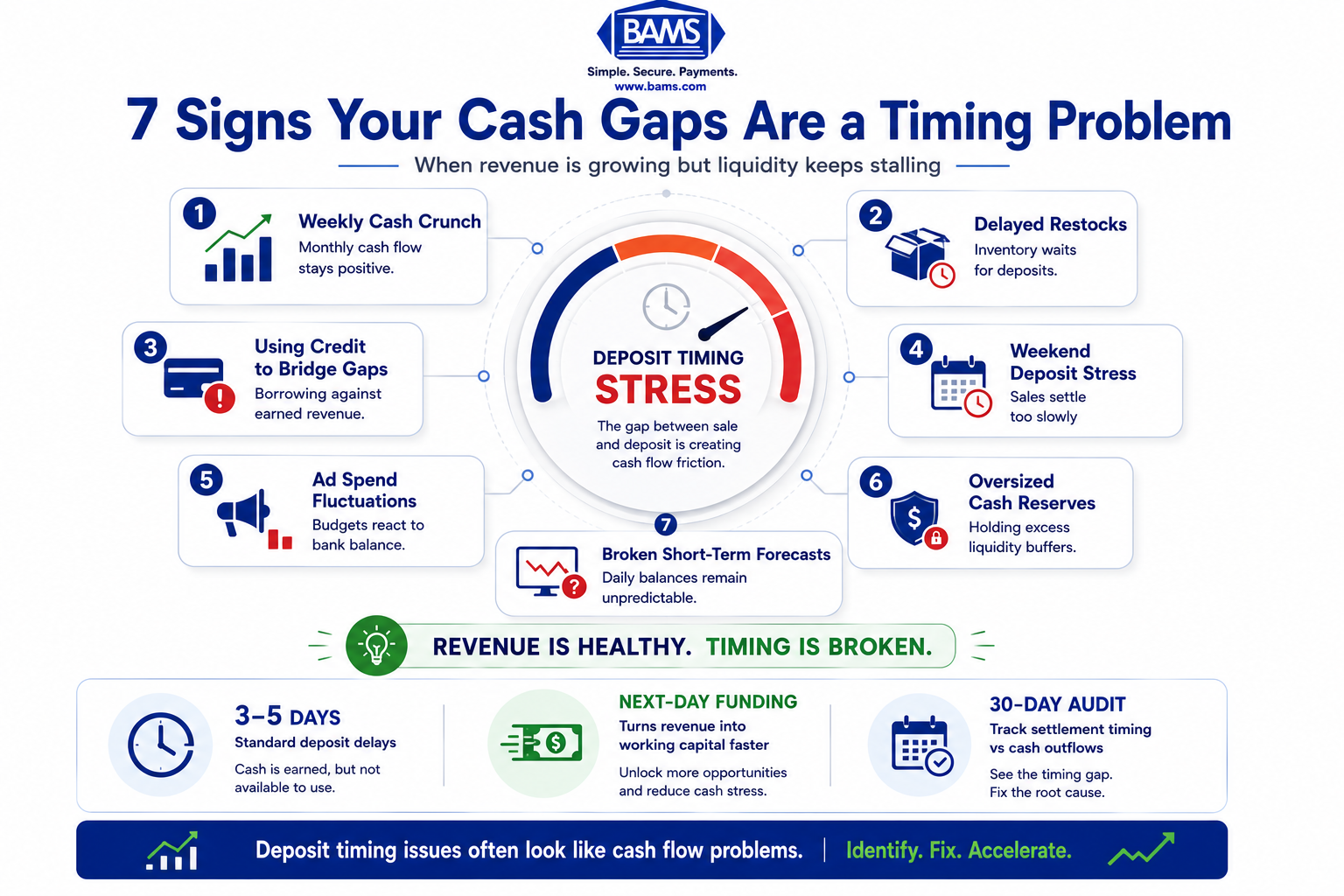
- Seven diagnostic signs point to timing gaps – Inconsistent weekly balances, delayed restocks, unnecessary credit lines, weekend stress, fluctuating ad spend, oversized reserves, and broken short-term forecasts all trace back to deposit lag.
- Borrowing to bridge deposit delays is expensive – Paying interest on revenue you’ve already earned costs more over time than switching to a processor with next-day funding.
- Start with a 30-day deposit audit – Track when deposits actually arrive versus when transactions occur, then overlay your outflow schedule. This tells you exactly how much of your cash stress is timing-driven.
- Faster deposits compound across operations – Solving the timing gap doesn’t just improve liquidity. It unlocks better inventory decisions, more consistent ad spend, and greater financial flexibility across the business.
The Cash Flow Problem That Has Nothing to Do With Revenue
Your sales dashboard looks healthy. Margins are holding. Demand is consistent, maybe even climbing. Yet every week, you’re scrambling to cover a supplier payment, delaying an ad spend increase, or watching a restock window close because the cash isn’t there yet. This is a challenge frequently discussed in Small Business Administration resources: growth and cash stress happening at the same time.
For high-volume eCommerce operators, effective cash flow management isn’t about chasing more revenue or slashing expenses. It’s about recognizing that deposit timing, the gap between when a customer pays and when that money lands in your bank account, is the hidden variable distorting your entire financial picture. And most cash flow advice ignores it completely.
A diagnostic framework for identifying whether eCommerce liquidity stress is caused by delayed deposits instead of poor business performance.
What This List Covers (and What It Doesn’t)
This is for eCommerce managers at established businesses processing hundreds or thousands of daily transactions. You already know how to read a P&L. You don’t need another article telling you to “invoice faster” or “negotiate better payment terms with clients.” You’re not sending invoices. You’re getting paid at checkout.
What you need is a diagnostic framework: a way to tell whether your recurring liquidity stress is caused by deposit timing, not by weak demand, thin margins, or seasonal dips. This list gives you seven specific signs that your cash gaps are a timing problem, and what to do about each one.
How We Selected These Signs
Each sign below was chosen because it meets two criteria. First, it’s a pattern that looks like a general cash flow failure but is actually caused by the lag between transaction and deposit. Second, it’s actionable through changes in payment processing, forecasting method, or operational sequencing rather than through financing or cost-cutting.
7 Signs Your Cash Gaps Are Caused by Deposit Timing
1. You Have Positive Monthly Cash Flow but Negative Weekly Cash Flow
Why it matters: When your monthly statements show a surplus but your weekly bank balance dips below operating minimums, the problem isn’t profitability. It’s the mismatch between when revenue clears and when obligations hit. Most eCommerce operators look at monthly aggregates and miss the intra-month crunch entirely.
What it looks like today: Your accounting software shows a healthy month-end balance. But every Tuesday or Wednesday, you’re watching your checking account hover near zero because weekend sales haven’t deposited yet. You might even move personal funds in temporarily, a habit that masks the real issue.
How to apply it: Build a rolling 7-day cash flow forecast instead of relying on monthly projections. Map your deposit schedule against your fixed outflow dates. If the gaps are consistent, the fix is faster deposits, not more sales.
2. Your Restock Decisions Are Based on Bank Balance, Not Demand Signals
Why it matters: When you delay a purchase order because the funds from last week’s sales haven’t landed yet, you’re letting your processor’s deposit schedule dictate your inventory strategy. That’s a timing problem wearing the mask of a budget problem. 51% of employer firms reported uneven cash flows as a challenge, and for eCommerce, uneven deposits are often the root cause.
What it looks like today: You know you need to reorder a top-selling SKU. The data says order now. But your available balance says wait three days. So you wait, and by the time the funds arrive, your supplier’s lead time pushes delivery back a full week. You lose sales to stockouts that were entirely preventable.
How to apply it: Track how often you delay purchase orders specifically because funds are in transit. If it happens more than twice a month, your deposit speed is constraining your inventory cycle. Switching to a processor that offers next-day funding can close this gap without requiring a credit line.
3. You’ve Considered a Line of Credit Solely to Cover Deposit Lag
Why it matters: There’s a meaningful difference between borrowing to fund growth and borrowing to bridge the gap your payment processor creates. If you’re applying for a credit line not because you need capital for expansion but because your own revenue takes 3 to 5 days to reach you, you’re paying interest on money you’ve already earned. That’s an expensive workaround for a solvable timing issue.
What it looks like today: You’ve researched short-term financing options or opened a business credit card with the sole purpose of covering operating expenses between deposit batches. You might even rationalize it as “standard practice.” It isn’t. It’s a sign your payment infrastructure is costing you more than the processing fee.
How to apply it: Calculate the annual cost of the credit you’re using to bridge deposit delays (interest, fees, opportunity cost). Compare that against the cost difference of switching to a processor with faster settlement. In many cases, the math favors the switch.
4. Weekend and Holiday Sales Create Predictable Monday Stress
Why it matters: eCommerce doesn’t pause on weekends. Your customers buy Saturday night. Your suppliers expect payment Monday morning. If your processor batches weekend transactions for Tuesday or Wednesday deposit, you have a structural gap that repeats every single week. This isn’t seasonality. It’s calendar mechanics.
What it looks like today: Friday through Sunday might represent 30% to 40% of your weekly volume. But that revenue doesn’t appear in your account until midweek. Meanwhile, Monday brings payroll, ad platform charges, and subscription renewals. The result is a predictable weekly cash valley that has nothing to do with how well your business is performing. NACHA ACH Network resources emphasize how ACH settlement timing and processing schedules directly affect business liquidity and cash availability.
How to apply it: Map your weekly deposit pattern against your weekly outflow schedule. If the stress concentrates around weekends and holidays, negotiate or switch to a processor with later batch cutoff times and weekend processing capability. Even shifting deposits by 24 hours can eliminate the weekly crunch.
5. Your Ad Spend Fluctuates Based on Available Funds, Not ROAS
Why it matters: Scaling paid acquisition requires consistent spend. When you pull back on ads not because performance declined but because today’s bank balance is low, you’re letting deposit timing control your growth rate. Algorithms on ad platforms penalize inconsistency, so the damage compounds: you spend less, performance drops, you spend less again.
What it looks like today: You know your Meta or Google campaigns are profitable at current spend levels. But twice a month, you reduce daily budgets because funds are in transit. When the deposit lands, you ramp back up, but the algorithm needs days to re-optimize. You’re paying a performance tax on a timing problem.
How to apply it: Separate your ad budget into a dedicated account funded by a predictable deposit schedule. If your current processor can’t deliver that predictability, this is one of the highest-ROI reasons to streamline payment processing by switching to a provider with consistent, next-day settlement. Tools like BAMS’ next-day funding can turn daily sales into next-day available capital, keeping your ad spend stable.
6. You Maintain a Larger Cash Reserve Than Your Risk Profile Requires
Why it matters: Holding excess cash as a buffer against deposit delays is a rational response to an irrational situation. But that cash has an opportunity cost. Every dollar sitting in reserve to cover a 3-day deposit lag is a dollar not invested in inventory, marketing, or operational improvements. 56% of firms cite paying operating expenses as a challenge, and oversized reserves are often a symptom of deposit uncertainty rather than genuine risk management.
What it looks like today: You keep two or three weeks of operating expenses liquid at all times, not because your business is volatile, but because you can’t predict exactly when deposits will clear. You’ve essentially built a self-funded float to compensate for your processor’s settlement schedule.
How to apply it: Calculate your actual risk-adjusted reserve need (typically 1 to 2 weeks for stable eCommerce). If you’re holding significantly more, quantify how much of that excess is deposit-timing insurance. Faster, more predictable deposits let you redeploy that capital into growth.
7. Your Cash Flow Forecast Breaks Down Below a 30-Day Horizon
Why it matters: If your quarterly and monthly forecasts are accurate but your weekly and daily forecasts are unreliable, the variable you’re failing to model is deposit timing. Most cash flow forecasting frameworks assume predictable inflow dates. For eCommerce operators receiving daily deposits with variable settlement windows, that assumption breaks the model at short time horizons.
What it looks like today: Your CFO or controller builds a monthly forecast that’s within 5% accuracy. But ask them to predict Thursday’s available balance and they’re guessing. The gap isn’t analytical skill. It’s that deposit timing introduces noise that standard forecasting tools don’t account for.
How to apply it: Add deposit settlement timing as an explicit variable in your cash flow forecasting model. Track actual deposit arrival times (not just amounts) for 30 days to establish your processor’s real-world pattern. Use that data to build a daily inflow model. If the variance is too high to forecast reliably, that’s your signal to find a processor with more consistent and transparent settlement.
The Pattern Underneath These Signs
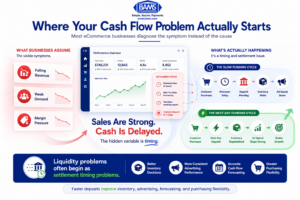
How to identify whether eCommerce cash stress is caused by slow deposits instead of declining sales.
All seven signs share a common structure: a business that performs well on paper but experiences real liquidity stress in practice. The gap between earned revenue and available cash creates a phantom problem that mimics deeper financial dysfunction. Operators respond with the tools designed for those deeper problems (credit lines, expense cuts, reserve hoarding) when the actual fix is mechanical and specific.
The second-order effect is subtler. When deposit timing constrains inventory, advertising, and vendor relationships, it doesn’t just cost money. It costs optionality. You can’t act on a flash sale from a supplier. You can’t capitalize on a trending product. You can’t test a new channel. Financial flexibility strategies start with eliminating the lag between earning and having.
The businesses that solve this don’t just improve cash flow. They accelerate cash inflows in a way that compounds across every operational decision.
Where to Start
You don’t need to address all seven signs at once. Start with the one that costs you the most. For most eCommerce operators, that’s sign 2 (inventory timing) or sign 5 (ad spend disruption), because those directly impact revenue generation.
The first practical step is a 30-day deposit audit: track every deposit’s arrival time against the transaction date, then overlay your outflow schedule. This exercise alone will tell you whether your cash stress is a timing problem or something else. Around 31% of small business owners name cash flow as their top concern, but the subset whose problem is deposit timing can fix it faster and cheaper than almost any other cash flow issue.
If the audit confirms a timing gap, prioritize processor evaluation over financing. The cost of switching is almost always lower than the cost of borrowing against your own revenue.
Frequently Asked Questions
What is a cash flow acceleration strategy?
A cash flow acceleration strategy is any operational change that shortens the time between earning revenue and having that cash available to spend. For eCommerce businesses, the most direct lever is deposit speed from your payment processor. Moving from 3-to-5-day settlement to next-day funding can eliminate recurring weekly cash gaps without requiring financing or expense reductions.
How can I tell if my cash gap is caused by deposit timing or a real revenue problem?
Run a simple test. Compare your monthly net cash flow to your weekly bank balance patterns. If monthly numbers are positive but weekly balances regularly dip below your operating minimum, the issue is timing. A revenue problem shows up as declining monthly totals, not as a repeating intra-week pattern.
Why is optimizing merchant services important for cash flow?
Your merchant services provider controls when you receive the money your customers have already paid. A processor with slow settlement effectively holds your working capital for days at a time. Optimizing for faster funding, lower fees, and transparent batch schedules directly improves your daily available cash without changing anything about your sales or expenses.
How can businesses improve cash flow forecasting with real-time data?
Start by tracking actual deposit arrival times, not just deposit amounts. Most forecasting models treat inflows as a single daily or weekly number. Adding the time dimension (when exactly deposits clear) lets you build a daily cash position forecast that accounts for weekends, holidays, and processor-specific settlement patterns. This turns an unreliable weekly guess into a usable daily projection.
Should I get a line of credit to cover deposit delays?
In most cases, no. If you’re borrowing solely to bridge the gap between earning revenue and receiving it, you’re paying interest on money that’s already yours. Calculate the annual cost of that bridge financing and compare it to the cost of switching to a processor with next-day funding. The processor switch is typically cheaper and eliminates the need for the credit line entirely.
Which payment solutions can help reduce processing fees while improving deposit speed?
Look for processors that offer interchange-plus pricing (for fee transparency) combined with next-day or same-day funding. Many processors bundle fast funding with higher rates, so evaluate the total cost: processing fees plus the implicit cost of delayed deposits. A provider like BAMS offers next-day funding alongside transparent pricing, which addresses both sides of the equation.
Sources