
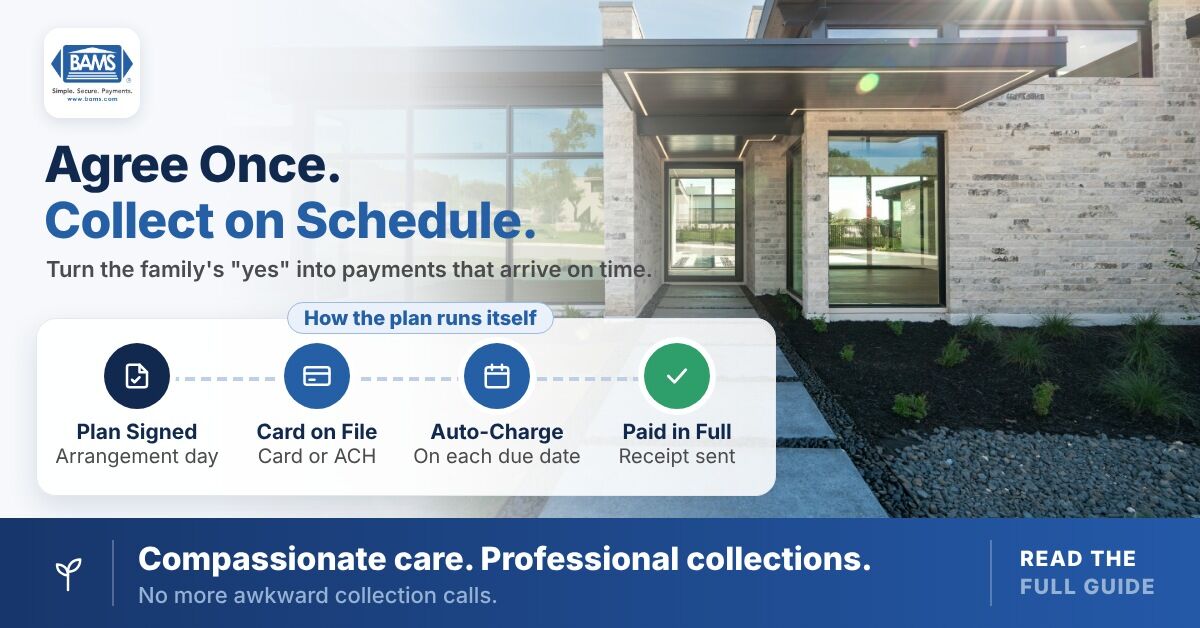
Installment Plans for Funeral Homes: A Systems Guide
Guide Orientation: What This Covers and Who It’s For
This guide addresses a specific, painful gap in funeral home operations: the period between when a family agrees to an installment plan and when your business actually collects every dollar owed. If you run a family-owned funeral home (one to ten locations) and you’ve watched installment plans quietly erode your cash flow because follow-up falls through the cracks, this is written for you.
We cover why informal payment arrangements fail, how to structure automated installment charging as an operational system and what compliance guardrails matter when collecting payments in death care. We do not cover insurance assignment processing in depth (that’s a separate workflow), nor do we address preneed trust fund regulations state by state.
By the end, you’ll understand how to replace awkward manual collection calls with a system that charges on schedule, how to offer flexible payment options without creating administrative chaos and where the real breakdowns happen between “family said yes” and “funds in your account.”
TL;DR
- Informal installment plans fail because of process, not people – Relying on staff to manually follow up with grieving families creates an emotional barrier that predictably leads to uncollected balances.
- Capture payment authorization at the arrangement conference – Getting a card on file or ACH authorization before the family leaves is the single most important step. Without it, every future installment requires uncomfortable manual outreach.
- Automate the charges, not just the reminders – Automated payment reminders still require the family to act. Automated charging (with prior authorization) removes the human bottleneck from collections entirely.
- Communication preserves the relationship – Pre-charge notifications, payment confirmations and a final thank-you message keep the process feeling personal and professional, preventing confusion and chargebacks.
- Plan for exceptions before they happen – Declined cards, method changes and hardship requests are inevitable. Documented protocols and retry logic keep these exceptions from collapsing your system back into manual follow-up.
Why Closing the Installment Gap Matters Now
Funeral service costs keep rising and many families owe more than an insurance assignment covers. The NFDA’s 2023 General Price List Study put the national median cost of a funeral with casket and burial at $8,300 and full-service arrangements with vaults and memorial events can cross $15,000. When insurance falls short, installment plans fill the gap.
Most funeral homes handle this gap with informal promises. A family reviews the general price list, signs the statement of goods and services selected, agrees to pay the balance in three or four installments and your front office writes a reminder on a calendar. Then the follow-up doesn’t happen. Not because your staff is lazy, but because calling a grieving family to ask for money feels wrong. It conflicts with the relational identity your business is built on.
The cost of inaction is real and compounding. Uncollected balances tie up working capital you need for vendor payments, facility maintenance and payroll. They create cash flow gaps that force you to dip into reserves or delay your own obligations. And every month an installment goes uncollected, the likelihood of ever collecting it drops. This isn’t a family relations problem. It’s a systems problem and it requires a systems solution.
Core Concepts: Understanding the Installment Collection Problem
The Three Payment Streams in Death Care
Funeral homes collect revenue through three distinct channels: at-need payments (card or check at the time of arrangement), insurance assignments (paid by carriers on their own timeline) and installment balances (the remaining amount families owe after partial payment or insurance shortfall). Each stream has different timing, different risk and different collection mechanics. This guide focuses on the third stream, installment plans, which is the most neglected.
Why “Informal” Fails
An informal installment plan is any arrangement where the funeral home relies on manual follow-up to collect future payments. This includes verbal agreements, handwritten schedules, sticky-note reminders and even spreadsheet trackers that depend on a staff member remembering to act. The failure mode isn’t dishonesty from families. It’s friction in your own process. When collection depends on a person initiating an uncomfortable conversation, collection rates decline predictably.
Automated Charging vs. Automated Reminders
There’s an important distinction between automated payment reminders (sending a family a notification that payment is due) and automated charging (actually processing a card or ACH debit on a scheduled date with prior authorization). Reminders still require the family to act. Automated charging requires them to have opted in once, then the system executes. Both have a role, but only automated charging removes the human bottleneck from collections.
Compliance Context
The FTC Funeral Rule governs price disclosure and prohibits requiring consumers to purchase unwanted goods or services. It does not prohibit structured payment collection, but it does require transparency. State regulations on preneed contracts, deposit trust requirements and consumer lending laws may also apply depending on how your installment plan is structured. Consult your state funeral board and legal counsel before implementing any new payment structure.
The Framework: From Handshake to Automated Collection
The method for closing the installment gap with automated installment plans follows five stages. Each stage addresses a specific breakdown point in the journey from “family agrees to pay” to “funds land in your account.”
- Stage 1: Structure the Agreement – Define terms, amounts and schedules before the family leaves your facility.
- Stage 2: Capture Payment Authorization – Secure card-on-file or ACH authorization at the point of arrangement.
- Stage 3: Automate the Charging Schedule – Set up recurring charges that execute without staff intervention.
- Stage 4: Build a Communication Layer – Send confirmations and receipts that maintain the human touch.
- Stage 5: Handle Exceptions Without Derailing the System – Create protocols for declined cards, changed methods and hardship requests.
These stages are sequential. Skipping Stage 2 (authorization capture) makes Stage 3 impossible. Skipping Stage 4 makes the system feel cold and transactional. The framework works as a chain and each link matters.

Skip a link and the chain breaks. Authorization at the arrangement table makes it all work.
Step-by-Step Breakdown: Building Your Installment Collection System
Step 1: Structure the Agreement at the Arrangement Table
Objective: Leave the arrangement conference with a written, signed installment schedule that specifies amounts, dates and payment method.
The arrangement conference is the only moment when the family’s attention, intent and emotional commitment align. If you leave this meeting without a documented payment structure, you’ve already introduced the gap that leads to uncollected balances. This doesn’t mean pressuring families. It means presenting payment options as a normal, expected part of the arrangement process, the same way you present casket options or service times.
Your installment agreement should include the total balance after any insurance assignment or initial deposit, the number of installments, the date each installment will be charged and the payment method on file. Keep it to one page. Use plain language. Avoid anything that resembles a loan agreement (which could trigger state lending regulations).
Anti-patterns: Telling the family “we’ll work something out later.” Leaving the payment schedule vague. Allowing the family to leave without signing anything because the conversation feels uncomfortable. These are the exact behaviors that create the collection gap.
Success indicators: Every at-need arrangement that involves an installment balance produces a signed, dated agreement before the family leaves. Your arrangement staff can present the installment option in under two minutes without awkwardness.
Step 2: Capture Payment Authorization at the Point of Arrangement
Objective: Obtain and securely store a valid payment method (credit card, debit card, or ACH details) with explicit recurring-charge authorization.
This is the step most funeral homes skip and it’s the step that makes everything else possible. Without a card on file or ACH authorization, every future installment requires someone on your staff to call the family, ask for payment information and process it manually. That’s the exact friction point where collections break down.
Capture the payment method during the arrangement conference, immediately after the family signs the installment agreement. Frame it as a convenience: “This way, the payments process automatically and you don’t have to remember to call us or write a check each month.” In a Mastercard survey of U.S. consumers, credit cards were the top method for recurring bills at 47%, so this isn’t an unfamiliar concept for most families.
Your authorization form must comply with card network rules for recurring transactions and stored credentials. This means clearly stating the amount or range of amounts to be charged, the frequency, the duration and how the cardholder can cancel. For ACH debits, Nacha rules require the account holder’s authorization for recurring debits and you should give the family a copy. Store payment data only through PCI-compliant systems. Never write card numbers on paper or store them in spreadsheets.
Anti-patterns: Asking for payment information over the phone days later (lower capture rate, higher friction). Storing card numbers in your funeral management software if it isn’t PCI-compliant. Failing to get explicit written authorization for recurring charges (this exposes you to chargebacks).
Success indicators: 90%+ of installment agreements include a captured payment method before the family leaves. Your authorization language has been reviewed by your payment processor for card-network compliance.
Step 3: Automate the Charging Schedule
Objective: Configure your payment system to process each installment automatically on the agreed date, with no staff action required.
This is where the system replaces the sticky note. Once you have a signed agreement and a payment method on file, the charging schedule should execute itself. Your payment processor or merchant services platform should allow you to set up a recurring charge series: specific amounts on specific dates, charged to the stored payment method.
The key operational shift here is that your staff’s role changes from “remember to collect” to “monitor for exceptions.” Instead of initiating collection, they review a dashboard or report that shows which charges processed successfully and which failed. This is a fundamentally different (and less emotionally taxing) workflow.
For funeral homes processing high-ticket transactions across multiple payment types, the charging platform matters. You need a processor that handles both card-on-file recurring charges and ACH debits, because families will use different methods. In the same Mastercard survey, only 51% of respondents felt they were frequently given the chance to choose their preferred payment method, so offering genuine flexibility is a differentiator, not a burden.
A merchant services partner like BAMS offers tokenized storage of customer payment information for recurring payments, plus next-day funding for qualifying merchants. Each installment that processes can then reach your account quickly instead of sitting in a settlement queue.
Anti-patterns: Setting up recurring charges through a generic eCommerce plugin not designed for high-ticket, low-volume businesses. Using a system that can’t handle mixed payment methods (card for one installment, ACH for the next). Failing to test the recurring charge setup before the first installment date.
Success indicators: Installments process on schedule without staff initiation. Failed charges generate automatic alerts. Your staff spends less than 15 minutes per week on installment collection administration.
Step 4: Build a Communication Layer That Preserves the Relationship
Objective: Send pre-charge notifications, payment confirmations and receipts that keep families informed without making them feel hounded.
Automation without communication feels cold. Automation with thoughtful communication feels professional and caring. This distinction matters enormously in funeral service, where your reputation depends on how families experience every touchpoint, including financial ones.
Build three automated messages into your installment workflow. First, a pre-charge notification sent 3 to 5 days before each installment processes. This gives the family time to ensure funds are available or contact you if they need to adjust. Second, a payment confirmation sent immediately after a successful charge. Third, a final receipt and thank-you message after the last installment, closing the financial relationship on a warm note.
These messages should come from your funeral home’s name and email, not from a generic payment processor. The tone should match your brand: respectful, clear and brief. Include the amount charged, the date and the remaining balance. Also include a simple way for families to update their payment method, such as a phone number or secure link.
Anti-patterns: Sending no communication and letting charges appear as surprises on bank statements. Using aggressive “payment due” language. Sending messages that look like mass marketing emails rather than personal correspondence.
Success indicators: Families rarely call to ask “what is this charge?” Your chargeback rate on installment transactions stays below 0.5%. Families occasionally reply to payment confirmations with positive feedback about the process.
Step 5: Handle Exceptions Without Derailing the System
Objective: Create clear protocols for declined charges, payment method changes and hardship situations so exceptions don’t collapse the entire installment workflow.
No system runs at 100%. Cards expire. Bank accounts change. Families hit unexpected financial difficulties. What matters is whether your team has a defined response for each type. Without exception protocols, a single declined charge can revert your entire process back to the informal, manual follow-up model you’re trying to escape.
For declined charges, set up automatic retry logic (most processors allow one or two retries within a defined window). If retries fail, trigger a staff notification with a script for reaching out to the family. The script should be empathetic and solution-oriented: “We noticed your scheduled payment didn’t process. Would you like to update your card on file, or would a different date work better this month?”
For payment method changes, make the process simple. Your system should accommodate method switches without requiring a new agreement or in-person visit, as long as the family authorizes the new method.
For genuine hardship, have a policy. Can you extend the schedule by one or two months? Can you reduce individual installment amounts and add additional payments? Document whatever you agree to and update the automated schedule accordingly. The goal is to keep the family in the system, not to push them out of it.
Anti-patterns: Having no retry logic and immediately calling the family after a single decline. Lacking a hardship policy, which forces staff to improvise during emotional conversations. Allowing exceptions to pile up in a “deal with later” folder.
Success indicators: Declined charges are resolved within 7 days in 90%+ of cases. Payment method updates happen without requiring a new signed agreement. Staff can handle exception calls using a documented script rather than improvising.
Practical Examples: How This Looks in Operation
Scenario A: The Insurance Shortfall
A family arranges a $12,500 service. The deceased’s life insurance policy has a $10,000 assignment. The family owes $2,500. At the arrangement conference, the director presents a three-installment plan: $833, $833 and $834, charged on the 15th of each of the next three months. The family provides a credit card, signs the authorization and the system is configured before they leave. Three charges process on schedule. No phone calls. No awkwardness. The family receives a brief confirmation email after each charge and a thank-you note after the final payment.
Scenario B: The Declined Card Recovery
A family on a four-installment plan has their second charge decline due to an expired card. The system retries once, fails again and triggers a staff alert. The office manager calls using the documented script, learns the family got a new card and updates the payment method in under five minutes. Then the charge processes the next day. Without the automated alert and script, this declined charge might have sat unaddressed for weeks.
Scenario C: The Hardship Adjustment
A family on a $3,000 balance contacts your office after paying the first $750 installment, explaining that an unexpected expense makes the next $750 payment difficult. Your staff, following the hardship protocol, spreads the remaining $2,250 over five payments of $450 instead of three and updates the automated schedule. The family stays in the system. The balance gets collected. And the relationship stays intact.
In each scenario, the system does the heavy lifting. Staff intervene only when exceptions arise and even then, they follow defined protocols rather than improvising under emotional pressure.
Common Mistakes and Pitfalls
Treating installment collection as a people problem instead of a process problem. If your staff consistently fails to follow up on balances, the issue isn’t motivation. It’s that you’re asking humans to do something emotionally difficult without giving them a system that handles the routine parts automatically.
Over-engineering the agreement. Multi-page contracts for installment plans with legal jargon intimidate families and slow down the arrangement conference. Keep it to one page with clear terms.
Ignoring payment method diversity. Insisting on credit card only (or check only) reduces your capture rate. Families have preferences. The Federal Reserve’s 2024 Diary of Consumer Payment Choice found credit cards (32%) and debit cards (30%) led consumer payments in 2023, while bank account (ACH) payments, used mostly for bills, made up 13%. Accommodate what families actually use.
Skipping the communication layer. Automated charges without automated communication generate confusion, disputes and chargebacks. Always notify before charging and confirm after.
Failing to audit your payment processing costs on recurring transactions. Some processors charge higher rates for card-on-file or recurring transactions. Know your effective rate on installment charges specifically, not just your blended average.
What to Do Next
Start with one change. If you currently have no written installment agreement template, create one this week. One page, plain language, with fields for total balance, installment amounts, dates and payment method authorization. Use it at your next arrangement conference and see how it changes the conversation.
If you already have installment plans but rely on manual follow-up, talk to your payment processor about recurring charge capabilities. Ask specifically about card-on-file storage, ACH debit scheduling, automatic retry logic and deposit timing for recurring transactions. If your current processor can’t support these features cleanly, that’s a signal worth paying attention to.
This guide is a reference, not a checklist you need to implement all at once. The families you serve deserve both compassionate care and professional financial processes. Those two things aren’t in tension. They’re complementary and the right system makes both easier.
Frequently Asked Questions
What are the benefits of automating installment plans for funeral homes?
Automated installment plans remove the need for staff to make uncomfortable collection calls, reduce uncollected balances and create predictable cash flow. They also improve the family’s experience by making payments seamless and expected rather than requiring repeated manual action from either side.
How can I improve authorization rates on recurring funeral home payments?
Capture the payment method at the arrangement conference (not days later by phone), use PCI-compliant card-on-file storage, send pre-charge notifications so families can ensure funds are available and set up automatic retry logic for initial declines. Offering multiple payment methods (card, ACH, debit) also increases the likelihood of successful authorization.
Does offering installment plans create compliance risk under the FTC Funeral Rule?
The FTC Funeral Rule governs price disclosure and prohibits tying purchases together, but it does not prohibit structured payment collection. However, if your installment agreement resembles a consumer loan (with interest, finance charges, or extended terms), state lending regulations may apply. Consult your state funeral board and legal counsel before implementing any plan that goes beyond simple payment scheduling.
What payment methods should funeral homes accept for installment plans?
Accept credit cards, debit cards and ACH/e-check at minimum. Consumers use all three, with cards leading overall and ACH common for bills. Limiting payment options for installment plans reduces your capture rate and increases the chance of declined charges.
How do I handle a family that can’t make an installment payment?
Have a documented hardship protocol before the situation arises. Common options include extending the payment schedule (adding one or two months), reducing individual installment amounts, or temporarily pausing charges with a defined restart date. Update the automated schedule to reflect any changes and document the new agreement in writing.
Which factors affect how quickly I receive funds from installment charges?
Settlement timing depends on your payment processor’s funding schedule, the payment method used (card transactions typically settle faster than ACH) and whether you qualify for next-day funding. Some processors batch recurring transactions differently than one-time charges, which can add delays. Ask your processor specifically about settlement timing for recurring card-on-file and ACH transactions.
Sources
- NFDA: 2023 NFDA General Price List Study Shows Inflation Increasing Faster than the Cost of a Funeral
- Federal Trade Commission: Complying with the Funeral Rule
- Mastercard: How Consumer Trends Are Transforming Bill Payments
- Federal Reserve Financial Services: 2024 Findings from the Diary of Consumer Payment Choice


