
Merchant Service Providers Brooklyn: Why Local Wins Disputes
Last Updated on October 22, 2026 by Dimitri Akhrin
A chargeback handled by someone who knows your business outperforms a 1-800 queue every single time
Learn why local merchant service providers deliver higher chargeback win rates than national processors. This piece examines how accountability and business-specific knowledge turn dispute resolution from a templated formality into a strategic advantage.
TL;DR
- Chargeback defense requires context, not templates – A dedicated partner who knows your business builds stronger cases and wins more disputes than a generic support queue ever will.
- The stakes are rising fast – U.S. chargeback volumes could hit $15 billion by 2026, and friendly fraud now accounts for half or more of disputes for many merchants. Winning these cases demands strategic judgment.
- Your merchant account health compounds – Every lost dispute pushes your chargeback ratio higher, risking monitoring programs, fines, and even account termination. The cost of bad support extends far beyond the individual dispute.
- Evaluate processors like partners, not vendors – The right question isn’t “what’s your rate?” It’s “who picks up the phone when a dispute hits, and do they already know my business?”
Your Chargeback Just Became Someone Else’s Problem
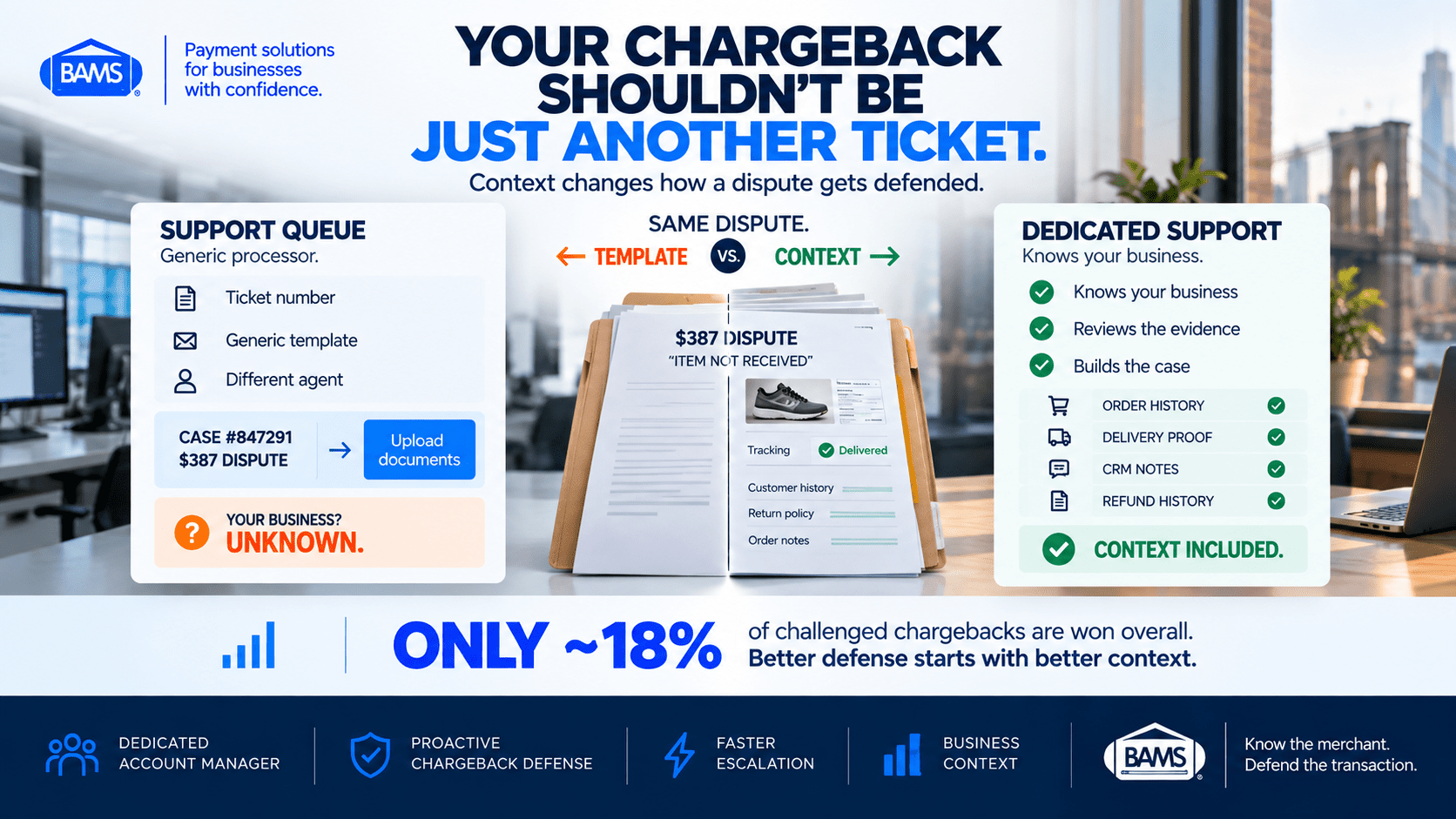
A $387 dispute hits your account on a Tuesday afternoon. You log into your processor’s portal, open a ticket, and wait. By Thursday, you get a templated email asking you to “upload supporting documentation.” No guidance on what evidence to prioritize, no context about this specific reason code. No one who knows that your average order value, your return policy, or your shipping workflow even exist.
You lose the dispute. And you lose a little more confidence that your merchant service providers are actually working for you.
The Support Model Everyone Settled For
Most eCommerce operators chose their payment processor the way they chose their first apartment: based on price, availability, and the assumption that everything would mostly work. And for a while, it did. The big processors scaled by standardizing everything, including support. Ticket queues, chatbots, knowledge bases. Efficient? Sure. Sufficient? As long as nothing went wrong.
The problem is that things go wrong constantly. U.S. merchants faced chargeback volumes between $8 billion and $11 billion in 2023, with projections pushing toward $15 billion by 2026. Friendly fraud alone surged 18% over the past three years for nearly three-quarters of surveyed merchants. The stakes are climbing, and the support model hasn’t kept pace.

Accountability Isn’t a Feature. It’s a Relationship.
Here’s what we actually believe: the single most undervalued variable in payment processing is whether the person defending your revenue knows your business by name. Not by ticket number. Not by merchant ID. By name, by model, by the specific operational details that determine whether a chargeback gets fought intelligently or gets a form letter.
That distinction is the difference between financial consulting for merchants and customer service theater.
Where Merchant Service Providers Actually Earn Their Fee
Consider what happens inside a chargeback dispute. You receive a reason code. That code determines your representment strategy, the evidence you need, and the deadline you’re working against. A fraud-coded chargeback requires different documentation than a “product not as described” claim. A subscription dispute demands different context than a one-time purchase.
Now consider who’s handling that for you.
In the standard model, your dispute enters a queue. An agent who processes hundreds of cases a day pulls yours. They don’t know your fulfillment timeline, your customer communication cadence, or whether you already issued a partial refund three weeks ago. They apply a template and they submit. But the quality of the evidence matters: Mastercard reports that merchants win more than 50% of representment cases overall and notes that success depends on the strength of the compelling evidence and the chargeback reason code.
Those aren’t just statistics. That’s revenue walking out the door because nobody in the process had the judgment to fight smarter.
Patrick Villanova, EVP of merchant services at Chargebacks911, put it plainly: merchants often treat chargebacks as an accounting issue, when they’re actually a customer-retention and risk-management issue. The context around each dispute matters enormously. And context is exactly what gets lost in a 1-800 queue.
Contrast that with a dedicated account manager who already knows your business.
They see the dispute come in and immediately recognize the pattern: this customer ordered twice in ten days, received both shipments (you have the tracking), and filed a “not received” claim on the second order. Your manager pulls the delivery confirmation, cross-references your CRM notes, drafts a representment package tailored to the issuing bank’s known preferences, and submits it before the deadline pressure even starts.
That’s not a marginal improvement. That’s a fundamentally different operation. Nearly half of merchants estimate that friendly fraud accounts for 50% or more of their chargebacks. These are winnable cases, but only if someone with strategic judgment is doing the fighting.
This is where business advisor partnerships reveal their real value. A partner like BAMS, which pairs dedicated account managers with proactive chargeback defense, treats each dispute as a strategic decision rather than a form to fill out. The difference shows up in win rates, and it shows up in your merchant account standing over time.

Chargeback defense is not just document submission. The quality of the evidence, understanding of the business and ability to respond strategically all matter.
What You’re Really Risking
If this thesis is right, then the cost of faceless payment support isn’t just the chargebacks you lose. It’s the compounding effect on your merchant account health. Excessive chargeback ratios trigger monitoring programs from card networks. Those programs come with fines, increased reserves, and in the worst cases, account termination.
For an eCommerce operation running on tight margins, a processor who can’t defend your disputes with precision is actively eroding your ability to operate. You’re not just losing the $387. You’re losing the right to process payments at favorable rates and you’re losing predictability in your cash flow. And you’re losing time you should be spending on getting your funds faster and reinvesting them, not chasing support tickets.
The eCommerce managers who treat processor selection as a pure cost optimization exercise are solving the wrong problem.
A Better Way to Think About Your Payment Partner
Stop evaluating processors like vendors. Start evaluating them like you’d evaluate a fractional CFO.
The question isn’t “what’s your rate?” The question is: “When a $2,000 friendly fraud dispute lands on my account next month, who picks up the phone, and do they already know my business well enough to win it?”
That reframe changes everything. It shifts the decision from a spreadsheet comparison to an operational risk assessment. It makes the common mistakes in choosing a payment processor painfully obvious. And it reveals why the cheapest option is often the most expensive one over twelve months.
The Processor You Can Walk Into a Room With
We believe the future of merchant services for growing eCommerce businesses isn’t more automation. It’s more accountability. Not less technology, but technology paired with a human who picks up when it matters, who knows your margin structure, and who treats your chargeback ratio like their own problem.
Because it is their problem. That’s what partnership means.
Frequently Asked Questions
Why does having a dedicated account manager improve chargeback win rates?
A dedicated manager already understands your business model, fulfillment process, and customer patterns. That context allows them to build stronger, tailored representment cases instead of submitting generic templates that card issuers routinely dismiss.
How do chargebacks affect my merchant account standing over time?
Excessive chargeback ratios trigger monitoring programs from Visa and Mastercard, which can result in fines, increased reserve requirements, or account termination. Winning more disputes and preventing unnecessary chargebacks keeps your ratio healthy and your processing terms favorable.
What should I prioritize when choosing merchant service providers for my eCommerce business?
Look beyond transaction rates. Prioritize the quality of dispute support, the availability of a dedicated contact who knows your business, funding speed, and transparent pricing. These operational factors compound over time and often matter more than a few basis points on your rate.


