

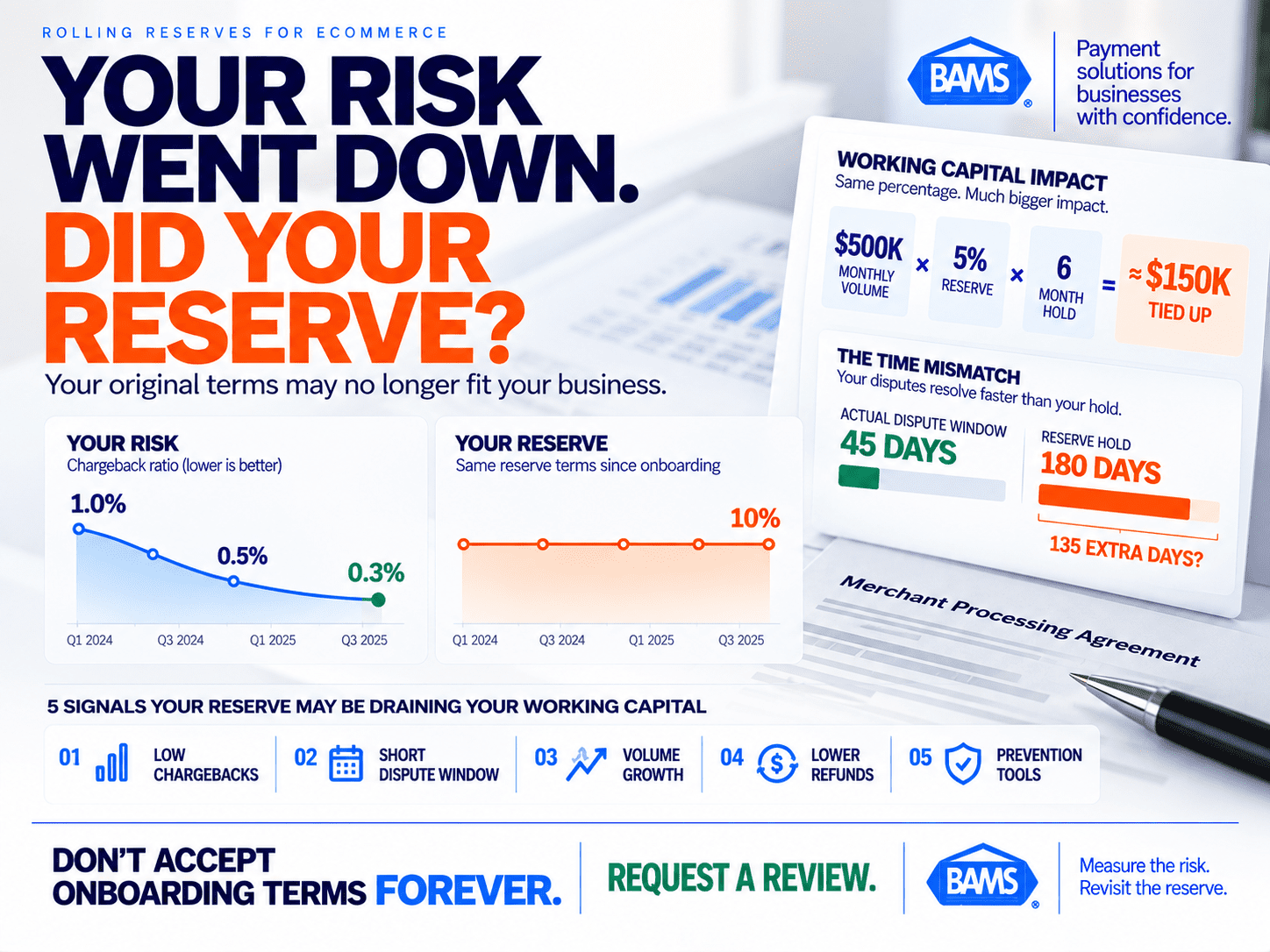
5 Signals Your Rolling Reserves Are Draining Working Capital
How to diagnose whether your processor’s reserve terms still match your actual chargeback risk profile
Learn five specific signals that your rolling reserves are compressing working capital beyond what your chargeback risk warrants. This diagnostic framework helps ecommerce managers benchmark their reserve exposure against real dispute data and take action.
TL;DR
- Reserve terms are set at onboarding and rarely updated – Your processor calibrated your reserve when they knew the least about your business. If your risk profile has improved, the terms probably haven’t kept pace.
- Your chargeback ratio is your strongest negotiation lever – If you’ve maintained a ratio below 0.5% for six or more consecutive months, your reserve is likely over-collateralized relative to your actual dispute exposure.
- Hold periods often exceed your real dispute window – Most ecommerce chargebacks surface within 30–60 days of delivery. A 180-day hold on a business with a 45-day dispute window ties up cash for no measurable risk reduction.
- Volume growth amplifies reserve impact – A 10% reserve at $50K/month is $5,000. At $500K/month, it’s $50,000. The percentage stays the same, but the cash flow compression multiplies.
- Start with two data points – Pull your chargeback ratio trend and your transaction-to-dispute timing. If both look strong, you have enough evidence to request a formal reserve review today.

Your risk profile can improve while your original reserve terms remain unchanged. That mismatch can leave significantly more working capital locked up than your current dispute exposure warrants.
Your Rolling Reserves Might Be Solving a Problem You No Longer Have
Rolling reserves exist for a reason. Processors use them to offset the financial exposure they carry when a merchant’s chargeback or refund activity could exceed what the business can cover. For genuinely high-risk accounts, that buffer makes sense.
But here’s the issue: reserve terms are typically set during onboarding, when a processor knows the least about your business. As you grow, your transaction history, dispute ratios, and refund patterns all improve. Yet the reserve percentage and hold period often stay frozen at their original settings. The result is a widening gap between your actual risk profile and the cash your processor is holding hostage.
For established ecommerce operations, that gap can quietly compress working capital by tens of thousands of dollars each month, funding a risk cushion that no longer reflects reality.
Who This Is For and What It Covers
This guide is for ecommerce managers at businesses doing consistent monthly volume who suspect their rolling reserves are disproportionate to their actual dispute risk. You’ve moved past the startup phase. You have processing history, stable fulfillment, and a chargeback ratio well below network thresholds.
This is not a guide to avoiding reserves entirely or gaming processor risk models. It’s a diagnostic framework: five specific signals that your current reserve terms are compressing your working capital more than your chargeback risk actually warrants, and what to do about each one.
How These Signals Were Selected
Each signal below maps to a specific metric or behavior that processors use internally to calibrate reserve exposure. If you can identify the gap between what the processor assumes and what your data shows, you have a negotiation lever. The signals are ordered from the most straightforward to diagnose to the most structurally embedded.
Reserve terms are often established before a processor has meaningful performance history. These five signals can help determine whether the original terms still reflect the merchant’s actual risk.
5 Signals Your Reserves Are Over-Compressing Working Capital
1. Your Chargeback Ratio Is Well Below the Threshold That Triggered Your Reserve
Why it matters: Processors set initial reserve percentages based on projected risk, often using industry-level benchmarks rather than your specific data. Industry guidance suggests merchants often need chargeback ratios below 0.5% to qualify for lower reserve percentages and shorter hold periods. If your ratio has been sitting at 0.2% or 0.3% for six or more consecutive months, the original reserve terms are pricing in a risk that hasn’t materialized.
What it looks like today: Card networks maintain formal fraud and dispute monitoring programs. Visa’s current Visa Acquirer Monitoring Program monitors fraud and dispute performance at both the acquirer and merchant level using defined program thresholds. If your own dispute performance has improved substantially, that gives you useful evidence for a reserve review.
How to apply it: Pull your chargeback ratio for the last six months from your processor dashboard or gateway reporting. Calculate the trend line. If it’s consistently declining or stable below 0.5%, document this in a formal reserve review request. Include the specific ratio figures, the number of transactions, and the dollar amounts involved. This is the single strongest data point in any reserve renegotiation.
2. Your Hold Period Exceeds Your Actual Delivery-to-Dispute Window
Why it matters: Reserve hold periods (often 90 to 180 days) are designed to cover the window during which a customer could file a dispute after a transaction. But most ecommerce chargebacks surface within 30 to 60 days of delivery. If your processor is holding funds for 180 days and your dispute data shows that 95% of chargebacks arrive within 45 days, the extra hold period is pure excess.
What it looks like today: The OCC notes that acquirers may establish merchant reserve or holdback accounts and fund them by withholding a portion of each day’s proceeds. For example, a merchant processing $500,000 monthly with a 5% reserve and a 180-day hold can have roughly $150,000 in cash tied up at any given time. That’s working capital you can’t deploy for inventory, marketing, or hiring.
How to apply it: Export your dispute data and calculate the median number of days between the original transaction date and the dispute filing date. If this window is significantly shorter than your reserve hold period, you have a data-backed case for compressing the hold. Even reducing a 180-day hold to 90 days can free up half the cash currently in reserve.
3. Your Volume Has Grown but Your Reserve Percentage Hasn’t Been Reviewed
Why it matters: Reserve terms set at $50,000 in monthly volume create a very different financial exposure at $500,000. A 10% reserve on $50K ties up $5,000 per month. The same percentage on $500K ties up $50,000 per month. The processor’s risk hasn’t scaled proportionally, but the cash impact on your business has multiplied tenfold.
What it looks like today: OCC guidance specifically addresses how merchant reserves are established and how frequently they are reviewed. As volume grows, even a modest percentage reduction (from 10% to 5%) can release significant working capital. Yet many processors don’t initiate reviews automatically. The merchant has to ask.
How to apply it: Calculate your current total reserve exposure: monthly volume × reserve percentage × hold period (in months). Compare this to your total chargeback losses over the same period. If the reserve is 10x or more your actual losses, you’re over-collateralized. Use this ratio as the centerpiece of a renegotiation conversation. A partner like BAMS, which assigns dedicated account managers to each merchant, can facilitate this kind of review as part of an ongoing relationship rather than forcing you to navigate an anonymous support queue.
4. Your Refund Rate Is Stable or Declining, but Nobody’s Tracking It as a Reserve Input
Why it matters: Processors don’t just watch chargebacks. Refund velocity is a leading indicator of potential disputes. A business with a high refund rate signals product or fulfillment issues that could escalate to formal disputes. But the inverse is also true: a stable or declining refund rate indicates that customers are getting what they expect, which reduces the processor’s actual chargeback risk management exposure.
What it looks like today: Most ecommerce platforms track refund rates, but few merchants present this data to their processor as part of a reserve conversation. It’s an underused lever because processors rarely ask for it proactively.
How to apply it: Pull your refund rate (refunds as a percentage of total transactions) for the last 6–12 months. If it’s trending downward or holding steady below 2–3%, package this alongside your chargeback ratio data. The combination of low disputes and low refunds tells a stronger story than either metric alone. This is the kind of evidence that shifts a reserve review from “we’d like lower terms” to “our data doesn’t support the current terms.”
5. You’re Paying for Risk Mitigation Twice: Reserves Plus Prevention Tools
Why it matters: Many growing ecommerce businesses invest in chargeback prevention tools, fraud filters, 3D Secure authentication, and order verification systems. These tools directly reduce the probability of the disputes that reserves are designed to cover. But processors rarely account for these investments when setting or reviewing reserve terms. You end up paying for risk reduction through your prevention stack and paying again through held funds.
What it looks like today: Mastercard’s merchant monitoring technology uses transaction intelligence and risk scoring to help acquirers, payment service providers and payment facilitators identify potentially risky merchant behavior. If your fraud controls, dispute processes and transaction performance have improved since your reserve was established, those changes are worth documenting as part of a reserve review.
How to apply it: Document every prevention measure currently in place: fraud scoring tools, address verification, delivery confirmation, pre-dispute alert services, and customer communication workflows. Quantify their impact where possible (disputes prevented, alerts resolved before escalation). Present this as a risk-mitigation portfolio to your processor. The argument is straightforward: the reserve was set to cover a risk level that your current prevention infrastructure has already reduced. For merchants working with BAMS, proactive chargeback defense is built into the account relationship, which means the data to support a reserve reduction is already being collected.
The Pattern Across All Five Signals
Every signal points to the same structural problem: reserve terms are set based on projected risk at a moment in time, but they rarely update to reflect demonstrated performance. The processor’s incentive is to maintain the buffer. Your incentive is to free the cash. The only way to close that gap is to treat reserve management as a treasury decision you actively make, not a penalty you passively accept.
Notice that none of these signals require you to change your business model or accept more risk. They require you to measure what’s already happening, document it clearly, and present it in the language processors use internally: chargeback ratios, dispute windows, refund trends, and risk-mitigation controls. The data already exists. The leverage comes from organizing it.
Where to Start: Prioritizing Your First Move
You don’t need to address all five signals at once. Start with Signal 1 (chargeback ratio) and Signal 2 (hold period vs. dispute window). These are the easiest to document and the most persuasive in a reserve review conversation. If your ratio is below 0.5% and your disputes cluster well within your hold period, you have a strong case before touching the other three.
If you’re processing more than $200,000 per month and haven’t had a reserve review in the last 12 months, that review is overdue. The cash sitting in reserve isn’t earning you anything. Every month you delay is another month of over-collateralization compressing your ability to invest in the growth that got you here.
Frequently Asked Questions
What is reserve and hold management in merchant services?
Reserve management refers to how a payment processor withholds a percentage of your transaction volume as a financial buffer against potential chargebacks, refunds, or fraud losses. Hold management involves controlling the duration those funds remain inaccessible. Together, these two variables (percentage and hold period) determine how much working capital is tied up at any given time. Treating them as negotiable terms rather than fixed costs is the first step toward reclaiming cash flow.
Why do payment processors withhold reserves from merchants?
Processors carry financial liability when a merchant can’t cover chargebacks or refunds. The reserve acts as collateral against that liability. It’s especially common for newer accounts, high-risk industries, or merchants with limited processing history. The challenge is that reserve terms set during onboarding often persist long after the merchant’s actual risk profile has improved, creating unnecessary cash flow compression.
How do rolling reserves work in payment processing?
In a rolling reserve, the processor withholds a fixed percentage (commonly 5%–10%) of each transaction’s value and holds it for a set period (typically 90–180 days). After the hold period expires, funds are released on a rolling basis. So at any given time, the total amount in reserve equals your monthly reserve amount multiplied by the number of months in the hold period. A 5% reserve on $500,000 monthly volume with a 180-day hold can tie up roughly $150,000.
When can a merchant expect to have their reserves released?
Release timing depends on your specific reserve agreement. Rolling reserves release funds automatically after the hold period expires (e.g., funds held today release in 90 or 180 days). Fixed reserves may require a formal review or account closure before release. The key variable is whether your processor reviews terms proactively or only when you initiate the conversation. Most do not review automatically, so merchants need to request a formal reserve review backed by performance data.
Which factors influence the percentage of reserves withheld by payment processors?
Processors evaluate several factors: your industry’s risk category, chargeback ratio, refund rate, processing history length, average transaction size, delivery timelines, and whether you sell physical or digital goods. The weight each factor carries varies by processor. What matters for established merchants is that many of these factors improve over time, but reserve terms don’t adjust unless you present the data and request a review.
How can merchants reduce their reserve requirements over time?
The most effective approach is to document your chargeback ratio, refund trends, dispute timing, and any prevention tools you’ve implemented. Present this data to your processor as part of a formal reserve review request. Merchants with ratios consistently below 0.5%, stable refund rates, and active dispute prevention measures have the strongest case for reduced percentages and shorter hold periods. Working with a processor that offers dedicated account management makes this process significantly easier.


