
Payment Stack Integration: A Cash Flow Guide | BAMS
Last Updated on October 22, 2026 by Dimitri Akhrin
Guide Orientation: What This Guide Covers and Who It’s For
This guide walks you through ensuring PCI compliance across integrated payment systems, with a specific focus on how payment stack integration affects cash flow, settlement speed and operational costs for service-based businesses handling high-ticket transactions. If you operate a funeral home (or a similar service business managing 1-10 locations), this is written for you.
By the end, you’ll understand how fragmented payment systems create hidden compliance gaps. You’ll also see how those gaps translate into real dollar losses through delayed settlements and manual reconciliation. Finally, you’ll learn how to build a PCI-compliant payment stack that protects both your families’ data and your cash flow.
This guide does not cover the full PCI DSS technical specification. It focuses on the operational and financial decisions that determine whether your integrated payment systems help or hurt your business.
TL;DR
- PCI compliance is shared, not outsourced — Your processor secures their systems, but every manual touchpoint in your business (handwritten card numbers, verbal card data between locations, manual terminal entry) expands your compliance scope and your risk.
- Reduce scope to reduce cost — Use tokenization, point-to-point encryption and hosted payment pages so card data never touches your local systems. A narrower PCI scope means a simpler SAQ, lower compliance costs and less breach exposure.
- Fragmented payment stacks drain cash flow — Disconnected systems cause settlement delays, manual reconciliation (potentially $22,000-$25,000/year in labor) and hidden fees. Payment stack integration delivers next-day funding and automated reconciliation.
- Map your data flow first — Trace one transaction end-to-end and document every system and person that touches card data. This reveals your actual PCI scope and identifies your highest-risk touchpoints.
- Compliance is continuous, not annual — Train staff, review device security quarterly and update documentation when systems change. Also re-evaluate your SAQ type whenever you add locations or payment channels.
Why PCI Compliance in Integrated Payments Matters Now
PCI compliance isn’t just a checkbox. For businesses processing high-ticket transactions (services routinely exceeding $15,000), a compliance failure doesn’t just risk fines. It risks the trust families place in you during the most difficult moments of their lives.
The landscape has shifted. Approximately 80% of U.S. small businesses experience at least one payments-related challenge, with processing fees ranking as the most common issue. But fees are only the visible symptom. Underneath, disconnected payment systems quietly create compliance blind spots: card data passing through unencrypted channels between your arrangement software and your payment terminal, settlement reports that don’t match your accounting records and manual processes that expose sensitive information to human error.
U.S. merchants paid an estimated $187 billion in payment-processing fees in 2024. For a funeral home processing $1.5 million annually, even small gaps in payment stack integration can cost tens of thousands of dollars per year. Common culprits include interchange downgrades from misconfigured terminals, non-compliance surcharges and manual reconciliation labor. The cost of inaction isn’t abstract. It’s the difference between funding payroll comfortably and scrambling to cover a gap because settlement took five days instead of one.
Core Concepts: Understanding PCI Compliance Within Your Payment Stack
What PCI DSS Actually Requires
The Payment Card Industry Data Security Standard (PCI DSS) is a set of security requirements that apply to every business that stores, processes, or transmits cardholder data. For most funeral service operators, you fall under merchant Level 4, meaning you process fewer than 20,000 eCommerce transactions or up to 1 million total card transactions annually. Level 4 merchants usually validate compliance with a Self-Assessment Questionnaire (SAQ). Your compliance obligations are real but manageable when your systems are properly integrated.
What “Payment Stack Integration” Actually Means
Your payment stack is every system involved in accepting, processing, recording and reconciling a payment. For a funeral home, this typically includes your arrangement/case management software, your payment terminal or online payment portal, your payment gateway, your processor and your accounting software. “Integration” means these systems share data automatically and securely, rather than requiring you to manually re-enter transaction details across platforms.
The Critical Misconception
Still, many operators believe that PCI compliance is their payment processor’s responsibility alone. It is not. PCI compliance is shared. If your staff manually keys card numbers into a separate terminal because your arrangement software doesn’t connect to your gateway, you have expanded your compliance scope. Every manual touchpoint where card data is visible, written down, or re-entered is a potential violation and a security risk.
Integration vs. Fragmentation
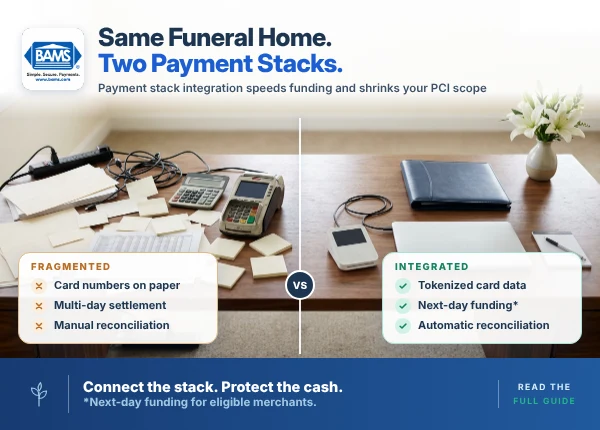
A fragmented payment stack forces data through manual bridges: handwritten card numbers, copied-and-pasted transaction IDs, spreadsheets reconciling what your terminal says versus what QuickBooks shows. With payment stack integration, data moves through encrypted, automated channels. In other words, the difference isn’t just convenience. It’s the difference between a narrow PCI scope (easier to secure, cheaper to maintain) and a wide one (more risk, more cost, more audit exposure).
The Framework: Four Phases of PCI-Compliant Payment Stack Integration
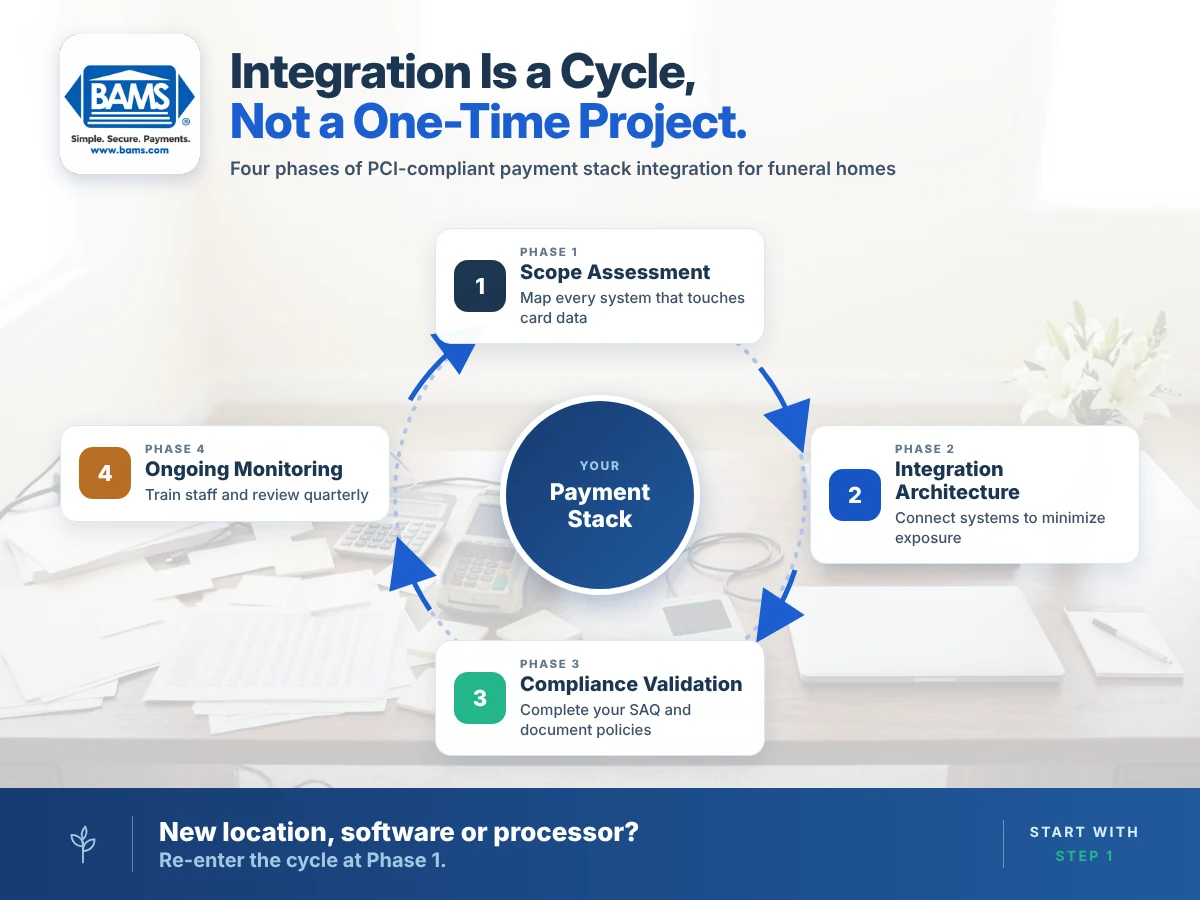
Ensuring PCI compliance in an integrated payment system isn’t a single project. It’s a four-phase cycle that you revisit as your business grows or your tools change.
- Scope Assessment (Phase 1) — Map every system and process that touches cardholder data
- Integration Architecture (Phase 2) — Design (or redesign) how your systems connect to minimize data exposure
- Compliance Validation (Phase 3) — Verify that your integrated stack meets PCI requirements through testing and documentation
- Ongoing Monitoring (Phase 4) — Maintain compliance through transaction monitoring, regular reviews and staff training
These phases are sequential for your first pass, then cyclical. Every time you add a location, change software, or switch processors, you re-enter the cycle at Phase 1. The following step-by-step breakdown walks you through each phase with specific guidance for service businesses handling high-value transactions.
Step-by-Step: Building a PCI-Compliant Integrated Payment System
Step 1: Map Your Current Payment Data Flow
Objective: Identify every point where cardholder data enters, moves through, or is stored in your business, so you can define your actual PCI scope.
Start by tracing a single transaction from the moment a family provides payment information to the moment funds appear in your bank account. Document each system involved. For most funeral homes, this starts at the arrangement conference, where you first collect payment details. From there, data moves through the terminal or online portal, the gateway, the processor and your accounting or case management software.
Pay close attention to the gaps between systems. If your arrangement software generates an invoice but your payment terminal is a separate, unconnected device, someone is bridging that gap manually. That bridge is where compliance risk concentrates. Write down every instance where a staff member sees, writes, types, or verbally communicates a card number. Each instance expands your PCI scope.
Anti-patterns to avoid: Don’t assume your current setup is compliant because “it’s always worked this way.” Don’t skip documenting phone payments. Families who call in card numbers over the phone create a data flow that must be secured and documented, even if it feels informal. Don’t overlook paper forms. If any location still uses carbon-copy card imprinters or handwritten authorization forms, those are in-scope PCI assets.
Success indicators: You have a written diagram showing every system, person and process that touches card data. You can identify exactly where card numbers are visible in plaintext. You know which systems are connected electronically and which rely on manual data transfer.
Step 2: Reduce Your PCI Scope Through Payment Stack Integration
Objective: Eliminate as many manual card-data touchpoints as possible by connecting your systems through secure, automated channels.
The single most effective thing you can do for PCI compliance is reduce scope. Every system you remove from the card-data flow is one less system you need to secure, monitor and document. The goal is a model where cardholder data flows directly from the family’s card (or their online entry) to your payment gateway. As a result, your staff never see it and your local systems never store it.
In practice, payment stack integration means choosing a payment gateway that connects with your arrangement or case management software through a secure API or embedded payment form. When a family pays during an arrangement conference, the transaction should be initiated within your existing software and processed through an integrated terminal. The card data should be tokenized at the point of entry (meaning your system stores a non-sensitive reference token, not the actual card number). Then the transaction result should flow back into your records automatically.
Online and Remote Payments
For online payments (preneed arrangements, installment plans, or remote families paying by link), use a hosted payment page provided by your gateway. This keeps card data entirely off your servers. Watch for hidden fees that some processors attach to gateway services, as these can erode the financial benefits of integration.
Anti-patterns to avoid: Don’t build custom integrations that store card data locally “for convenience.” Don’t allow staff to email card numbers between locations. Don’t use consumer-grade payment apps (Venmo, Cash App) for business transactions, as these fall outside your PCI compliance framework entirely.
Success indicators: Card numbers are never visible on your screens, printed on receipts, or stored in your local files. Your arrangement software and payment terminal communicate directly. Transaction records appear in your accounting system without manual entry.
Step 3: Validate Compliance With Documentation and Testing
Objective: Confirm that your integrated payment stack meets PCI DSS requirements and generate the documentation that proves it.
For most funeral service operators, validation means completing the appropriate SAQ (Self-Assessment Questionnaire) annually. It also means conducting quarterly network vulnerability scans if you process payments over the internet. Your payment processor should provide access to a PCI compliance portal where you complete your SAQ. If yours doesn’t, that’s a red flag worth investigating.
The SAQ you need depends on how you accept payments. Suppose a PCI-compliant third party handles all card data through a hosted payment page or point-to-point encrypted terminal. In that case, you likely qualify for SAQ A or SAQ B-IP, which are shorter and simpler. If your systems touch card data directly, you may need SAQ C or SAQ D, which are significantly more demanding. This is exactly why payment stack integration matters: reducing scope directly reduces your compliance burden.
Document Your Security Policies
In addition, document your internal policies beyond the SAQ. Who has access to payment systems? How are passwords managed? What happens when an employee leaves? PCI DSS requires that you maintain written security policies, even at the smallest business level. Legitimate PCI compliance fees (typically $70-$120 per year) should include access to compliance tools, breach protection insurance and support completing your SAQ. If you’re paying significantly more, or if your processor can’t explain what the fee covers, it’s worth asking questions.
Anti-patterns to avoid: Don’t treat the SAQ as a one-time task you complete and forget. Don’t skip quarterly scans if they’re required for your SAQ type. Don’t assume your processor handles all compliance on your behalf without verifying what’s actually covered.
Success indicators: You have a completed, current SAQ on file. You can produce documentation of your security policies. Your quarterly scans (if applicable) show passing results. You know exactly what your PCI compliance fees cover.
Step 4: Align Settlement and Reconciliation With Your Cash Flow Needs
Objective: Ensure your integrated payment system delivers funds predictably and reconciles transactions automatically, so compliance doesn’t come at the cost of cash flow.
PCI compliance and cash flow optimization are not separate concerns. They’re connected through your payment stack’s architecture. Good payment stack integration doesn’t just protect data. It also accelerates how quickly you see funds and reduces the labor required to verify that every dollar arrived correctly.
Time-consuming payment processes and delays in settlement are reported most frequently by businesses receiving payments through third parties. For a funeral home processing a $15,000 service, a three-to-five-day settlement delay means you’re covering supplier costs, staff payroll and facility expenses out of pocket. Meanwhile, you’re waiting for funds that the card network already authorized. Multiply that across dozens of services per month and the cash flow impact is substantial.
What Good Settlement Looks Like
Your integrated stack should batch and settle transactions daily, with funds arriving the next business day. It should also generate reconciliation reports that match your accounting records without requiring manual cross-referencing. BAMS, for example, offers next-day funding and dedicated account management, which can eliminate the settlement delays that plague fragmented payment setups. With full payment stack integration, reconciliation that once took hours happens in minutes.
Anti-patterns to avoid: Don’t accept weekly or bi-weekly settlement as “normal” for your transaction volume. Don’t reconcile by hand if your systems support automated matching. Don’t ignore discrepancies between your terminal’s batch report and your bank deposits, as these often signal interchange downgrades or undisclosed fees.
Success indicators: Funds from yesterday’s transactions appear in your account today. Your accounting software reflects settled transactions without manual entry. You can identify the exact processing cost of each transaction without pulling multiple reports.
Step 5: Train Staff and Establish Ongoing Security Practices
Objective: Make PCI compliance a daily operational habit rather than an annual paperwork exercise.
Technology handles the data flow. However, people handle everything else. Even the most secure, well-integrated payment system has a weak point. A staff member might write a card number on a sticky note because “the terminal was acting up.” PCI DSS requires that all personnel with access to cardholder data receive security awareness training. For funeral homes, this means every staff member who processes a payment, answers a phone, or accesses your case management software.
Fortunately, training doesn’t need to be elaborate. Cover four essentials. First, never write down or verbally repeat a full card number. Second, never share login credentials for payment systems. Third, always verify that the terminal shows an encrypted connection before processing. Finally, immediately report anything unusual (unexpected prompts, unfamiliar devices connected to terminals, emails requesting payment information). Repeat this training annually at minimum and whenever you onboard new staff.
Your Quarterly Review
Beyond training, establish a quarterly review cadence. Every three months, verify that all payment devices are the ones you authorized (no skimmers, no swapped hardware). Also review user access to payment systems and remove former employees. Then check that your gateway and terminal firmware are current and confirm that your PCI compliance documentation is up to date.
Anti-patterns to avoid: Don’t assume that because staff have “always been careful,” formal training is unnecessary. Don’t allow shared logins to payment systems (PCI requires individual, auditable access). Don’t skip quarterly reviews because “nothing has changed,” as the review itself is the mechanism for catching changes you didn’t notice.
Success indicators: Every staff member with payment access has completed documented training within the last 12 months. No shared logins exist for payment systems. Quarterly device and access reviews are completed and logged.
Step 6: Plan for Growth Without Breaking Compliance
Objective: Ensure that adding locations, payment channels, or service offerings doesn’t create new compliance gaps.
However, funeral service operators managing multiple locations face a specific challenge: each location potentially has its own terminal, its own network and its own staff handling payments. Without a centralized payment stack, every new location multiplies your PCI scope. You’re not managing one compliant system. You’re managing five or ten, each with its own vulnerabilities.
The solution is centralized payment orchestration through payment stack integration. Choose a processor and gateway that support multi-location management under a single merchant account (or linked accounts with unified reporting). This gives you one dashboard to monitor transactions, one reconciliation process and one compliance framework across all locations. When you add a new location, you’re extending an existing compliant system rather than building a new one from scratch.
Adding New Payment Channels
If you’re expanding into online preneed sales, payment links for remote families, or recurring billing for installment plans, evaluate each new channel for PCI impact before launch. A hosted payment page for online sales keeps card data off your systems entirely. Recurring billing should use tokenized card-on-file, where the gateway stores the encrypted card data and your system only stores the token. These decisions are easier with a processor whose dedicated account management team understands your business model. A generic support queue rarely does.
Anti-patterns to avoid: Don’t let individual locations choose their own payment hardware or software. Don’t add online payment options without confirming they use PCI-compliant hosted forms. Don’t assume your current SAQ type remains valid when you add new payment channels.
Success indicators: All locations process payments through the same integrated system. Adding a new location or payment channel follows a documented, repeatable process. Your SAQ accurately reflects your current payment acceptance methods across all locations.
Practical Examples: What This Looks Like in Operation
Scenario A: The Fragmented Stack
A two-location funeral home uses standalone terminals at each location, a separate online payment link from a third-party provider and manual entry into QuickBooks. Staff at Location B sometimes phone card numbers to Location A for processing on a “better” terminal. Settlement takes three business days. Monthly reconciliation requires the office manager to spend roughly 8 hours cross-referencing terminal batch reports, bank statements and QuickBooks entries.
PCI scope: broad. As a result, staff share card data verbally, phone systems may store it and staff key it into multiple systems. The business is likely non-compliant and exposed to both data breach risk and non-compliance penalties. Manual reconciliation at this scale can cost $22,000-$25,000 per year in labor alone for businesses processing $500,000 annually.
Scenario B: The Integrated Stack
Next, the same funeral home invests in payment stack integration. A single processor now connects terminals at both locations to their case management software via a secure API. Online payments use a hosted payment page. Card data is tokenized at the point of entry. Settlement is next-day. Transaction data flows automatically into accounting software. Reconciliation takes 15 minutes per day instead of 8 hours per month.
PCI scope: narrow. Card data never touches the funeral home’s own systems. The SAQ is simpler, compliance costs are lower and the risk of a data breach drops dramatically. In addition, payment stack integration improves cash flow because funds arrive the next business day. Meanwhile, the office manager reclaims hours previously lost to manual reconciliation.
Common Mistakes and Pitfalls
Treating PCI compliance as a processor’s problem. Your processor secures their systems. You secure yours. The gap between the two is where breaches happen.
Optimizing for payment processing fees alone. The cheapest processor means nothing if settlement takes five days and reconciliation eats 10 hours a week. Instead, evaluate the total cost of operation (including payment stack integration), not just the rate on your statement.
Ignoring phone payments. Families calling in card numbers is standard in funeral service. But without a secure process (ideally, directing them to a payment link or using a PCI-compliant phone payment system), you’re creating compliance exposure with every call.
Assuming “we’re too small to be a target.” Small businesses are disproportionately targeted precisely because attackers assume security is weaker. A data breach at a funeral home doesn’t just cost money. It destroys the trust that your entire business depends on.
Letting compliance lapse between annual reviews. PCI compliance is continuous. For example, a system that was compliant in January can become non-compliant in March. A software update might change how data is handled, or a new staff member might miss training.
What to Do Next
Start your payment stack integration with Step 1. Map your current payment data flow. Trace one transaction from start to finish and write down every system and person that touches card data. This single exercise will show whether your PCI scope is as narrow as you think. It will also reveal whether hidden manual processes have expanded it without your knowledge.
Of course, you don’t need to overhaul everything at once. Identify the highest-risk touchpoint (usually the place where card numbers are most visible or most manually handled) and address that first. After that, move through the remaining steps at a pace your team can absorb.
Overall, keep this guide as a reference. Revisit it when you add a location, change software, or switch processors. Neither PCI compliance nor payment stack integration is a destination. It’s an operational discipline that protects your families’ data, your cash flow and the reputation you’ve spent years building.
Frequently Asked Questions
What is a payment stack and why does it matter for PCI compliance?
Your payment stack is every system involved in accepting, processing, recording and reconciling payments. This includes terminals, gateways, processors and accounting software. As a result, payment stack integration matters for PCI compliance because every system in the stack that touches cardholder data falls within your compliance scope. More systems handling card data means more security requirements, more risk and more cost.
How can businesses ensure PCI compliance when integrating multiple payment systems?
With payment stack integration, the most effective approach is to reduce the number of systems that directly handle card data. Use tokenization (where a non-sensitive token replaces the actual card number), point-to-point encrypted terminals and hosted payment pages for online transactions. When your systems exchange tokens instead of card numbers, your PCI scope shrinks dramatically, making compliance simpler and cheaper to maintain.
What are the real costs of payment processing fees for high-ticket service businesses?
U.S. merchants paid approximately $1.57 in processing fees for every $100 in card payments in 2024. For a funeral home processing a $15,000 service, that’s roughly $235 per transaction in processing fees alone. But the total cost includes settlement delays, manual reconciliation labor and potential non-compliance surcharges, which can collectively exceed the visible processing fees.
When should a funeral home consider integrating its payment systems?
Consider payment stack integration if staff manually enter transaction data into accounting software. The same goes for card numbers written down or spoken aloud between locations. Also watch for settlement that takes more than one business day or reconciliation that takes more than 30 minutes per day. Any of these signals indicate that your current setup is costing you money and creating compliance risk.
What PCI compliance fees should a merchant actually be paying?
Legitimate PCI compliance fees typically range from $70 to $120 per year and should include access to SAQ completion tools, quarterly vulnerability scanning (if required) and breach protection insurance. If you’re paying significantly more, or if your processor can’t clearly explain what the fee covers, it’s worth investigating whether you’re being overcharged.
How does next-day funding affect cash flow for service businesses?
For businesses handling high-ticket transactions, the difference between next-day funding and three-to-five-day settlement is significant. A funeral home processing 20 services per month at an average of $10,000 each could have roughly $30,000-$50,000 in transit at any given time under slow settlement. With payment stack integration, next-day funding keeps that capital available for payroll, supplier payments and operating expenses instead of sitting in a processing queue.


