
Reduce Cart Abandonment eCommerce with Payments
Last Updated on October 1, 2026 by Dimitri Akhrin
Speed up deposits, lower fees, and recover lost sales with strategic payment infrastructure changes
Learn how to audit your checkout flow, implement remote deposit capture, and choose payment solutions that cut abandonment rates. This guide covers the payment infrastructure decisions that directly impact conversions and cash flow.
TL;DR
- Cart abandonment averages 69.9% globally – Much of this stems from checkout friction and payment concerns, not product issues. Mobile abandonment hits 84%, making mobile optimization critical.
- Streamline checkout to three steps or fewer – Reducing steps from 5 to 3 decreases abandonment by 27%. Guest checkout alone reduces abandonment by 14%.
- Next-day funding improves cash flow significantly – Standard 2-5 day settlement exists for processor convenience. Negotiate faster deposits or switch to a provider like BAMS that offers guaranteed next day funding as standard.
- Cost-effective processing means understanding your true costs – Interchange-plus pricing typically saves 15-30% over flat-rate pricing for established businesses. Review every fee line item, not just the advertised rate.
- Fraud protection and conversion aren’t opposing forces – Smart fraud detection approves legitimate transactions while blocking fraud. High decline rates often indicate overly aggressive rules hurting good customers.
What This Guide Covers
This guide helps ecommerce managers at established online businesses reduce cart abandonment while maintaining secure, cost-effective payment processing. You’ll learn practical methods to speed up deposits, lower transaction fees, and recover lost sales.
By the end, you’ll understand how to audit your current checkout flow, implement remote deposit capture solutions, and choose payment options that balance security with conversion. This guide focuses on businesses processing significant transaction volumes who need faster access to funds without sacrificing fraud protection.
We won’t cover basic cart design or marketing tactics. Instead, we focus on the payment infrastructure decisions that directly impact your abandonment rates and cash flow.
Why Delayed Deposits Drain Your Business
Delayed deposits create a cash flow gap that forces you to make difficult operational decisions.
According to the Federal Reserve, interchange and processing structures directly impact merchant costs and profitability, making payment optimization critical.
Visa explains that checkout friction, failed authorizations, and payment complexity reduce successful transactions and increase abandonment rates here.
Core Concepts You Need to Understand
Remote Deposit Capture
Remote deposit capture (RDC) allows you to process and deposit payments electronically without physical bank visits. For ecommerce, this translates to faster fund availability through streamlined authorization and settlement processes. The key distinction is between next-day funding (funds available the next business day) and standard 2-5 day settlement windows.
Cost-Effective Payment Processing
Cost-effective processing isn’t about finding the cheapest provider. It’s about understanding your true cost per transaction and eliminating hidden fees. This includes interchange fees (set by card networks), processor markups, and incidental charges like chargeback fees or PCI compliance fees.
The Abandonment-Security Balance
Reducing friction and maintaining security aren’t opposing forces. Modern fraud detection uses behavioral analysis and machine learning to approve legitimate transactions while blocking fraudulent ones. The goal is authorization rate improvement, getting more good transactions approved, rather than simply adding checkout steps.
The Deposit Acceleration Framework

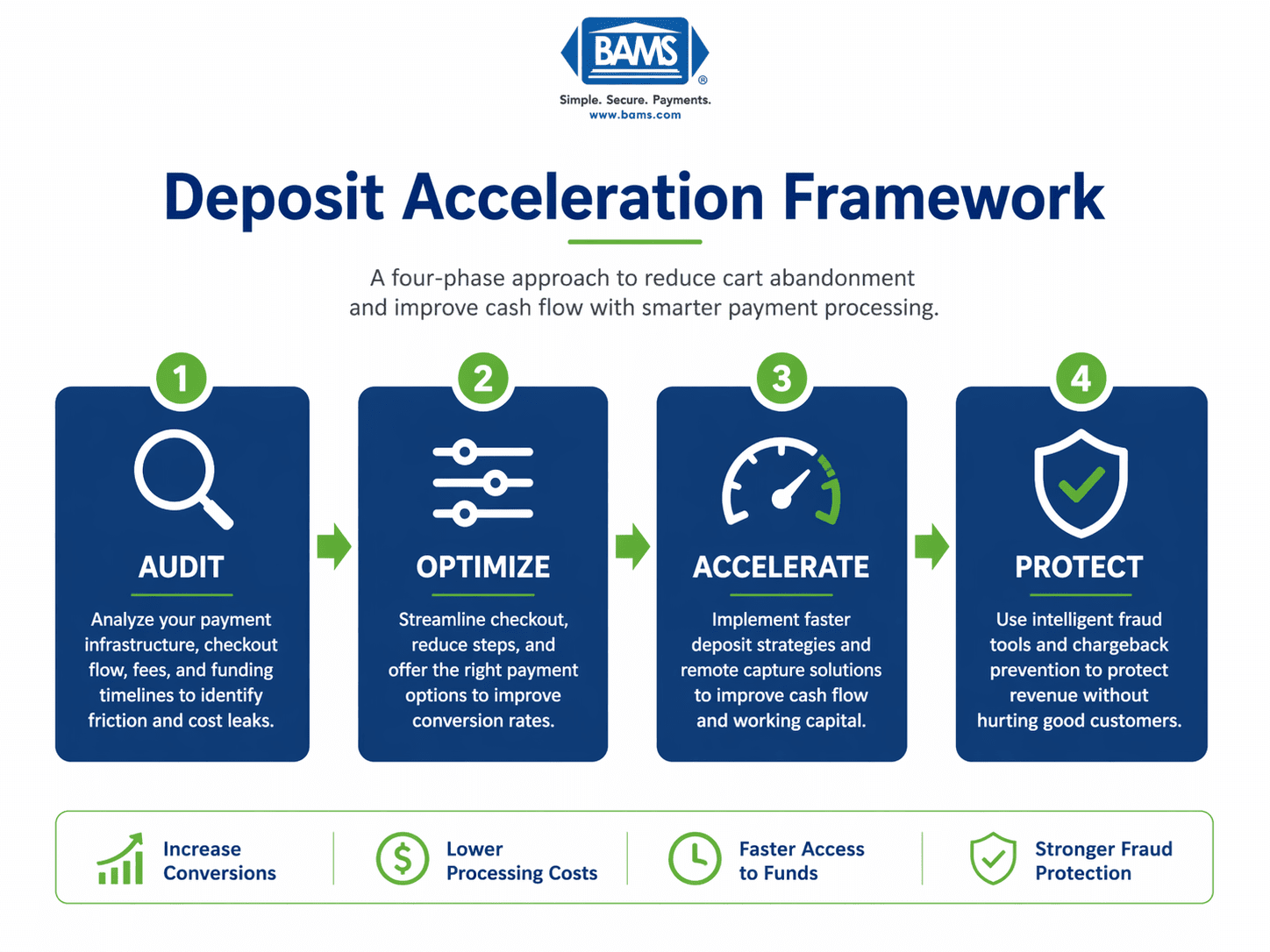
A four-phase framework showing how businesses can reduce cart abandonment, improve payment processing efficiency, and accelerate cash flow.
This guide follows a four-phase approach to reducing cart abandonment while improving cash flow:
- Phase 1: Audit examines your current checkout flow, payment mix, and processing costs to identify specific friction points and cost leaks.
- Phase 2: Optimize streamlines your checkout process and payment options based on audit findings, focusing on changes with the highest impact-to-effort ratio.
- Phase 3: Accelerate implements faster deposit strategies and remote deposit capture solutions to improve cash flow.
- Phase 4: Protect establishes fraud protection measures and chargeback prevention strategies that maintain security without killing conversions.
Each phase builds on the previous one. Skipping the audit phase leads to optimizing the wrong things. Accelerating deposits without proper fraud protection creates new vulnerabilities.
Step 1: Audit Your Current Payment Infrastructure
Objective: Identify exactly where you’re losing money to processing fees and customers to checkout friction.
Start by pulling three months of transaction data. Calculate your effective processing rate by dividing total processing costs by total transaction volume. If you’re paying more than 2.5% on average, you have room to negotiate or switch providers.
According to the Federal Reserve, understanding fee structures is essential to reducing total payment costs. Map your checkout flow step by step. Count every click, form field, and page load between cart and confirmation. Document where customers drop off using your analytics platform.
Review your payment method mix. What percentage of transactions use credit cards versus digital wallets versus buy-now-pay-later options? Compare this to your customer demographics and industry benchmarks.
What to avoid: Don’t assume your current setup is optimal because it’s familiar. Don’t ignore mobile checkout separately from desktop. Don’t skip reviewing your processor’s fee schedule line by line.
Success indicators: You can state your exact effective processing rate, identify your top three checkout friction points, and list which payment methods your customers request but you don’t offer.
Step 2: Streamline Your Checkout Flow
A side-by-side comparison of high-friction and optimized checkout experiences and their direct impact on conversion rates.
Objective: Remove unnecessary friction while maintaining the security signals customers need to trust your checkout.
Implement guest checkout as a default option. Account creation should be optional and offered after purchase completion, not as a barrier.
Consolidate form fields. Use address autocomplete. Auto-detect card type from the first digits. Pre-fill information for returning customers. Every field you remove reduces cognitive load and abandonment risk.
Display trust badges and security indicators prominently. Place SSL indicators, payment logos, and security certifications near the payment form, not buried in the footer.
What to avoid: Don’t remove security steps that protect against fraud. Don’t hide shipping costs until the final step. Don’t require phone numbers unless essential for delivery.
Success indicators: Your checkout can be completed in three steps or fewer. Guest checkout is prominently available. Trust indicators are visible without scrolling on the payment page.
Step 3: Expand Payment Options Strategically
Objective: Offer the payment methods your customers prefer without creating operational complexity or excessive costs.
Add digital wallet options (Apple Pay, Google Pay, PayPal). These reduce friction by eliminating manual card entry.
Consider buy-now-pay-later (BNPL) options for higher-ticket items. However, BNPL typically carries higher processing fees, so calculate whether the conversion lift justifies the cost for your average order value.
Evaluate whether keeping customers on your site during checkout versus redirecting to external payment pages affects your conversion. On-site checkout typically converts better and looks more professional.
What to avoid: Don’t add every payment option available. Each integration adds maintenance burden and potential failure points. Don’t implement BNPL if your average order value is under $100. Don’t ignore the fee structures of new payment methods.
Success indicators: You offer at least one digital wallet option. Payment method mix aligns with customer preferences identified in your audit. No payment option costs more than its conversion lift justifies Add digital wallet options and optimize checkout using a reliable payment gateway.
Step 4: Implement Faster Deposit Strategies
Objective: Reduce the time between transaction completion and fund availability to improve cash flow predictability.
Negotiate next-day funding with your payment processor. Standard settlement windows of 2-5 days exist because they’re profitable for processors, not because they’re technically necessary. Many processors offer next-day funding as a standard feature or for a small additional fee that’s worth the cash flow improvement.
BAMS, for example, offers next-day funding as a core feature for ecommerce merchants, which means you can access yesterday’s sales revenue the following business day instead of waiting through a standard settlement window.
Batch your transactions at optimal times. Most processors have daily cutoff times for same-day processing. Understand your processor’s cutoff and ensure your system batches transactions before it.
Review your authorization and capture workflow. Some businesses authorize at checkout but capture at shipment. While this protects against fulfillment issues, it delays your deposit timeline. Consider capturing at checkout for digital goods or items with reliable fulfillment.
What to avoid: Don’t pay excessive fees for faster deposits if your cash flow doesn’t require it. Don’t change capture timing without understanding chargeback implications. Don’t assume your current processor can’t offer better terms.
Success indicators: You receive funds within one business day of transaction. You know your processor’s batch cutoff time. Your authorization-to-capture timeline matches your business needs.
Step 5: Establish Cost-Effective Processing
Objective: Reduce per-transaction costs without sacrificing service quality or fund availability.
Request a detailed fee breakdown from your current processor. Look for hidden charges like monthly minimums, PCI compliance fees, statement fees, and batch fees. These add up and are often negotiable or avoidable with the right provider.
Evaluate interchange-plus pricing versus flat-rate pricing. For most established ecommerce businesses, interchange-plus is more cost-effective because you pay the actual interchange rate plus a small markup rather than a blended rate that assumes worst-case interchange.
Understand the difference between passing costs to customers versus absorbing them. Surcharges and convenience fees can recover processing costs but often increase abandonment. Reducing your processing costs at the source is typically better for conversion than passing fees to customers.
What to avoid: Don’t focus only on the advertised rate. Don’t ignore the cost of chargebacks and disputes in your total processing cost. Don’t switch processors without understanding contract terms and early termination fees.
Success indicators: You understand every line item on your processing statement. Your effective rate is competitive for your transaction volume and average ticket size. You’re not paying for services you don’t use.
Step 6: Build Fraud Protection That Doesn’t Kill Conversions
Objective: Block fraudulent transactions while approving legitimate ones, improving both security and authorization rates.
Implement address verification (AVS) and CVV checks as baseline fraud prevention. These are low-friction for legitimate customers and catch basic fraud attempts.
Add velocity checks to identify unusual patterns (multiple orders from the same IP, rapid-fire transaction attempts, shipping to different addresses than billing). Configure these to flag for review rather than auto-decline to avoid false positives.
Consider a processor with proactive chargeback defense. BAMS offers dedicated chargeback prevention support, which helps you dispute illegitimate chargebacks and identify patterns before they become costly problems. This protects both your revenue and your merchant account standing.
Review declined transactions regularly. High decline rates often indicate overly aggressive fraud rules that block legitimate customers. Adjust thresholds based on actual fraud rates, not theoretical risk.
What to avoid: Don’t implement fraud rules without monitoring their impact on legitimate transactions. Don’t ignore chargeback patterns until they threaten your merchant account. Don’t assume all declines are fraud.
Success indicators: Your authorization rate exceeds 95% for legitimate transactions. Chargeback rate stays below 1%. You can identify and respond to fraud patterns within 24 hours. Visa explains that fraud tools should balance approval rates and risk management here.
Step 7: Monitor and Iterate
Objective: Establish ongoing measurement to catch problems early and identify optimization opportunities.
Set up weekly reviews of key metrics: cart abandonment rate, checkout completion rate, authorization rate, chargeback rate, and effective processing cost. Create alerts for significant deviations from baseline.
A/B test checkout changes before full rollout. Test one variable at a time (new payment option, form field removal, trust badge placement) to understand what actually moves your metrics.
Review your payment mix monthly. Customer preferences shift. New payment methods gain adoption. Your optimal mix today won’t be optimal in 12 months.
What to avoid: Don’t set and forget your checkout. Don’t make multiple changes simultaneously without measurement. Don’t ignore gradual metric degradation.
Success indicators: You have a dashboard showing key payment metrics. You review performance weekly. You can attribute conversion changes to specific checkout modifications.
Common Mistakes That Undermine Progress
The most common mistake is optimizing for the wrong metric. Reducing processing costs by 0.2% means nothing if it increases abandonment by 5%. Always consider the full picture of conversion, cost, and cash flow together.
Many businesses add payment options without removing friction elsewhere. Adding Apple Pay doesn’t help if your checkout still requires account creation. Prioritize friction removal before option expansion.
Ignoring mobile checkout is increasingly costly. With mobile abandonment at 84%, your mobile experience deserves dedicated attention, not just a responsive version of your desktop flow.
Finally, businesses often tolerate slow deposits because switching processors feels disruptive. The cash flow impact of next-day funding versus 3-day settlement compounds over time. A few days of transition disruption is worth years of improved cash flow.
What to Do Next
Start with the audit. Pull your last three months of processing statements and calculate your effective rate. Map your checkout flow and count the steps. This gives you the baseline to measure all future improvements against.
If your effective rate exceeds 2.5% or your deposits take more than one business day, those are immediate opportunities. If your checkout requires more than three steps or forces account creation, prioritize those fixes.
Use this guide as a reference rather than a checklist. Your specific situation determines which optimizations matter most. Return to relevant sections as you implement changes and measure results.
The goal isn’t perfection. It’s continuous improvement in conversion, cost, and cash flow. Small gains compound. Start with one change, measure the impact, and build from there.
Frequently Asked Questions
What are faster deposit strategies in merchant services?
Faster deposit strategies include negotiating next-day funding with your processor, optimizing batch timing to meet daily cutoffs, and choosing processors that prioritize settlement speed. Some processors offer same-day funding for an additional fee, while others include next-day funding as standard. The key is understanding that standard 2-5 day settlement exists for processor convenience, not technical necessity.
How can I improve my payment authorization rates?
Authorization rate improvement comes from balancing fraud prevention with customer experience. Review your fraud rules to ensure they’re not declining legitimate transactions. Implement smart fraud detection that uses behavioral analysis rather than blunt rules. Ensure your payment gateway sends complete transaction data, as incomplete data triggers more declines. Regularly audit declined transactions to identify patterns of false positives.
Which payment processing fees can I reduce to optimize costs?
Focus on processor markup (the fee above interchange), monthly fees, PCI compliance fees, and chargeback fees. Interchange fees are set by card networks and aren’t negotiable, but everything else is. Request itemized statements to identify fees you’re paying for services you don’t use. Consider interchange-plus pricing if you’re currently on flat-rate pricing and process over $10,000 monthly.
What role does fraud protection play in payment optimization?
Effective fraud protection improves payment optimization by reducing chargebacks (which carry fees and threaten merchant account standing) while maintaining high authorization rates for legitimate customers. Poor fraud protection either lets fraud through (costly chargebacks) or blocks good customers (lost sales). Modern fraud systems use machine learning to distinguish between the two with high accuracy.
When should I consider expanding my payment options?
Expand payment options when your audit shows customers abandoning checkout due to missing preferred methods, when your customer demographics suggest demand (younger customers prefer digital wallets, higher-ticket items benefit from BNPL), or when competitors offer options you don’t. Don’t expand just to have more options. Each integration adds complexity and potential failure points.
How does remote deposit capture help ecommerce businesses?
Remote deposit capture in ecommerce context refers to electronic payment processing that enables faster fund availability without manual intervention. This means transactions authorize, settle, and deposit to your account through automated systems. The benefit is predictable cash flow, as you know when funds will be available, and faster access to revenue for reinvestment in inventory and operations.
Sources


