Fast Funding: The Hidden Cost of Slow Deposits
Last Updated on October 7, 2026 by Dimitri Akhrin
Why the real expense isn’t the fee for speed—it’s the cash flow you’re quietly losing to settlement delays
Discover what standard two-to-three-day settlement windows actually cost your business in lost cash flow. This piece reframes fast funding as a financial decision, not a premium upsell, and shows why opportunity cost matters more than fee comparisons.
TL;DR
- Slow deposits cost more than fast funding fees – The real expense isn’t the premium for speed; it’s the working capital you can’t deploy while revenue sits in a settlement queue for two to three days.
- Same-day funding isn’t always faster for eCommerce – Tight cut-off windows mean evening and weekend sales often miss same-day batches. Next-day funding with a later cut-off can actually deliver cash sooner.
- Your settlement pipeline is a system you can optimize – Gateway batch times, processor cut-offs, and bank posting schedules create a chain. Understanding each link lets you reclaim days of float.
- Funding speed is a cash flow decision, not a feature upgrade – Evaluate processors on deposit timing alongside rates. The cheapest per-transaction fee means little if your money takes a week to arrive.
You Already Earned That Money. So Where Is It?
Here’s the part nobody talks about when they compare fast funding options: the money sitting in your payment processor’s pipeline isn’t “pending.” It’s earned. Your customer paid. Your product shipped. The transaction cleared. And yet, for two or three business days, you can’t touch it.
For eCommerce operators processing real volume, that gap isn’t a minor inconvenience. It’s a structural drain on cash flow that compounds every single week. The real question isn’t whether same-day or next-day funding costs more. It’s what your current settlement delay is already costing you.
The “Standard Funding Is Fine” Myth
Most eCommerce businesses accept two-to-three-day settlement windows because that’s what their processor set as the default. It feels normal. Everyone does it. And when faster funding gets mentioned, the conversation immediately pivots to fees: “What’s the surcharge? Is it worth the premium?”
This framing made sense a decade ago, when payment rails were slower and faster access genuinely required expensive workarounds. But the infrastructure has changed. Same-day ACH is now standard across most U.S. banks. FedNow is expanding real-time settlement capabilities. FedNow Service resources show how real-time payment infrastructure is expanding access to faster settlement rails across the U.S. payment ecosystem.
The technology to move money faster exists. The question is why your processor still treats speed as a luxury add-on instead of a baseline.
The fee-comparison lens keeps merchants focused on the wrong number. It asks, “How much more does speed cost?” when the better question is, “How much is slowness costing me right now?”
Flip the Equation: Fast Funding Is a Cash Flow Decision
We believe the real cost of slow deposits isn’t the fee you’d pay for faster ones. It’s the compounding opportunity cost of capital you’ve already earned but can’t deploy. Every day your revenue sits in a settlement queue, it’s unavailable for inventory, ad spend, payroll, or vendor negotiations that require liquidity.

The real cost of slow funding is not the fee. It is the working capital trapped inside settlement delays.
The Hidden Math Behind Merchant Account Fees and Settlement Delays
Let’s make this concrete. Consider an eCommerce brand processing $100,000 per month. Federal Reserve interchange fee data continues to show how interchange and qualification differences materially affect merchant processing costs over time.
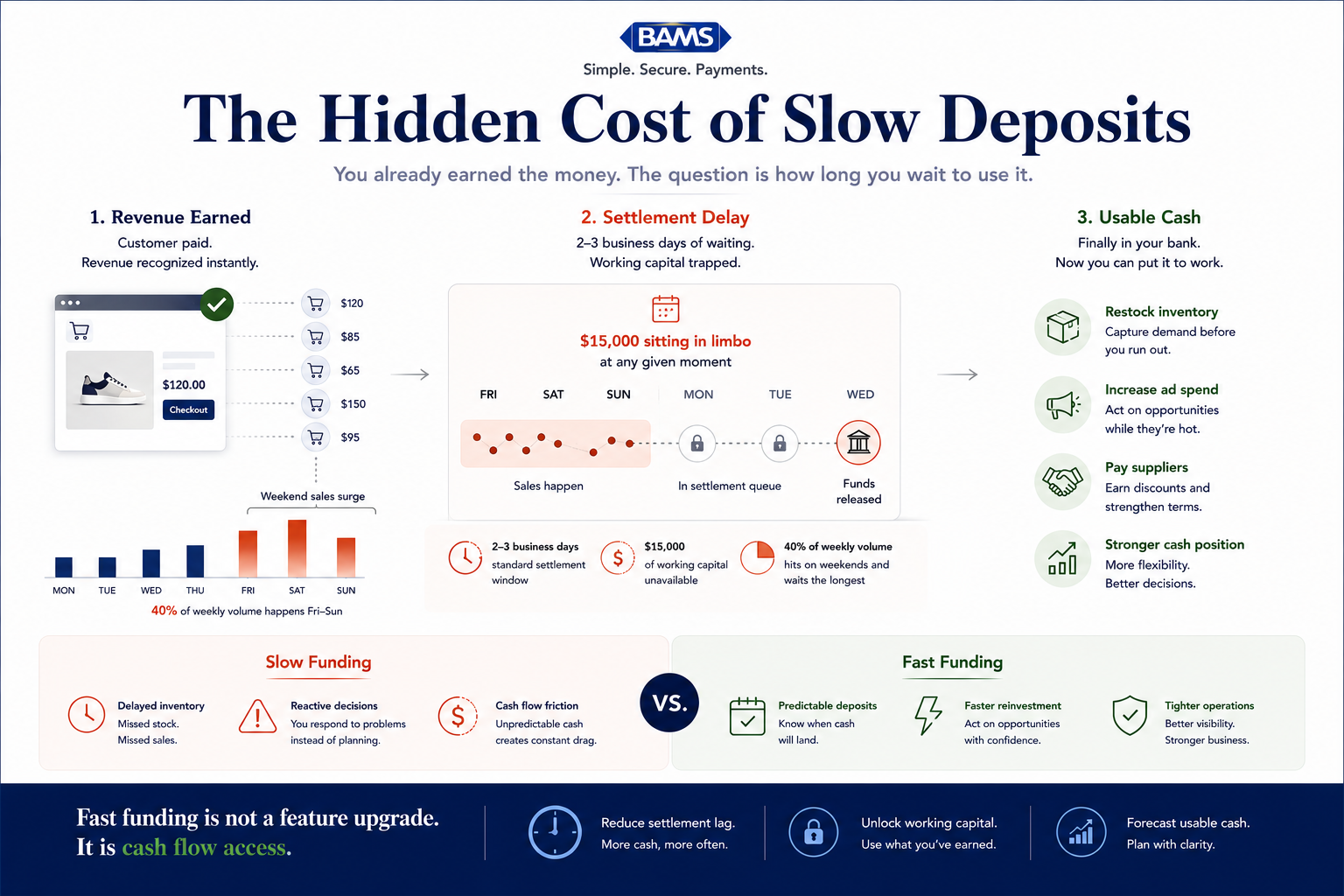
Most merchants obsess over those numbers. And they should. But here’s what gets ignored: if your average settlement window is three business days, at any given moment you have roughly $15,000 sitting in limbo. That’s money you can’t use to restock a bestselling SKU before it goes out of stock. Money you can’t put toward a retargeting campaign during a traffic spike. Money that could be earning a supplier discount for early payment.
Now consider a weekend sales surge. Friday evening through Sunday night, your store does 40% of its weekly volume. Under standard funding, those transactions don’t even begin settling until Monday. You might not see that cash until Wednesday or Thursday. That’s nearly a full week of float on your highest-revenue period.
This is where the “same-day vs. next-day” debate gets interesting. Same-day funding sounds faster, but it comes with tight cut-off windows (often early afternoon) that most eCommerce transactions miss entirely. For online businesses where sales peak in the evening and on weekends, same-day funding frequently doesn’t deliver what the name implies. Next-day funding with a later cut-off time can actually get money into your account faster in practice, because it aligns with how eCommerce revenue actually flows.
The mechanics matter more than the label.
your gateway’s batch time, your processor’s cut-off window, your bank’s posting schedule: these create a chain. One weak link, and “next-day” becomes “next-day-plus-one” without anyone telling you. Merchant Payments Coalition resources continue to highlight how payment friction, swipe fees, and opaque cost structures create operational strain for merchants processing significant volume.
This is where working with a processor that prioritizes transparency makes a measurable difference. BAMS, for example, offers next-day funding as a standard feature alongside interchange-plus pricing, so merchants can see exactly what they’re paying and exactly when they’re getting paid. That combination of cost-effective payment processing and predictable deposit timing turns payments from a black box into a tool you can actually plan around.
And planning is the point. When you know your deposits land by tomorrow morning, you can run tighter inventory cycles. You can approve ad spend with confidence. You can negotiate vendor terms from a position of liquidity rather than scrambling to cover a gap that shouldn’t exist.
For eCommerce businesses, later cut-off times often matter more than same-day funding labels.
What Changes If You Treat Deposits Like a System
If faster funding isn’t a premium feature but a cash flow optimization, then every eCommerce operator should be auditing their settlement pipeline the same way they audit ad spend or conversion rates. The implications are significant.
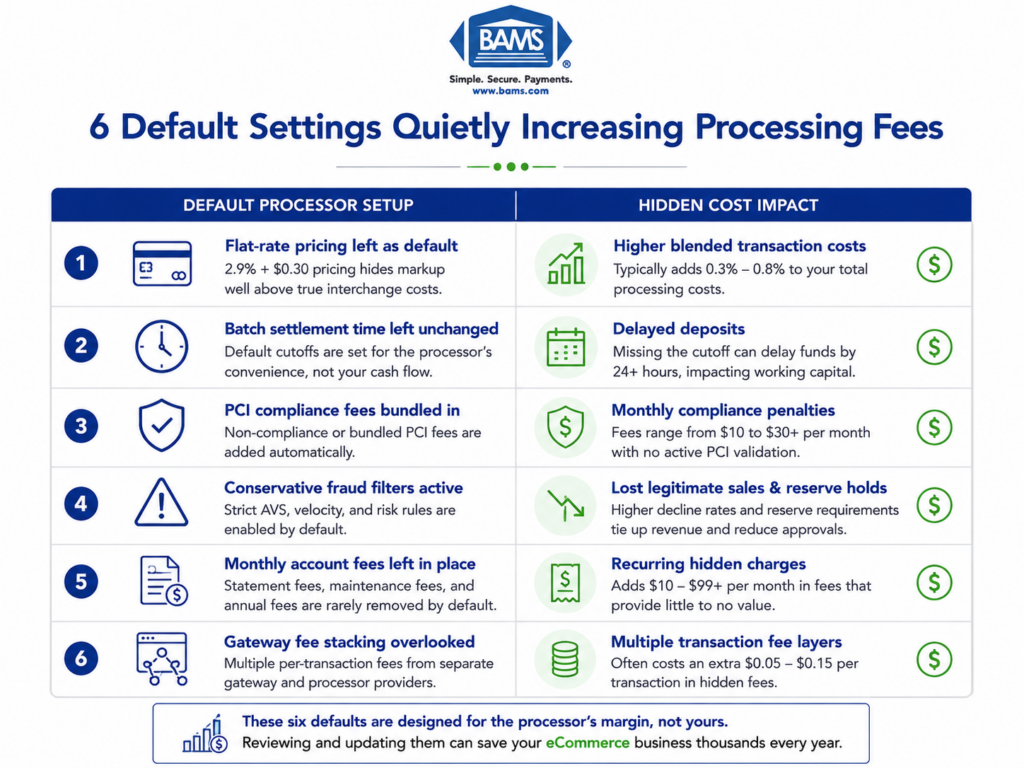
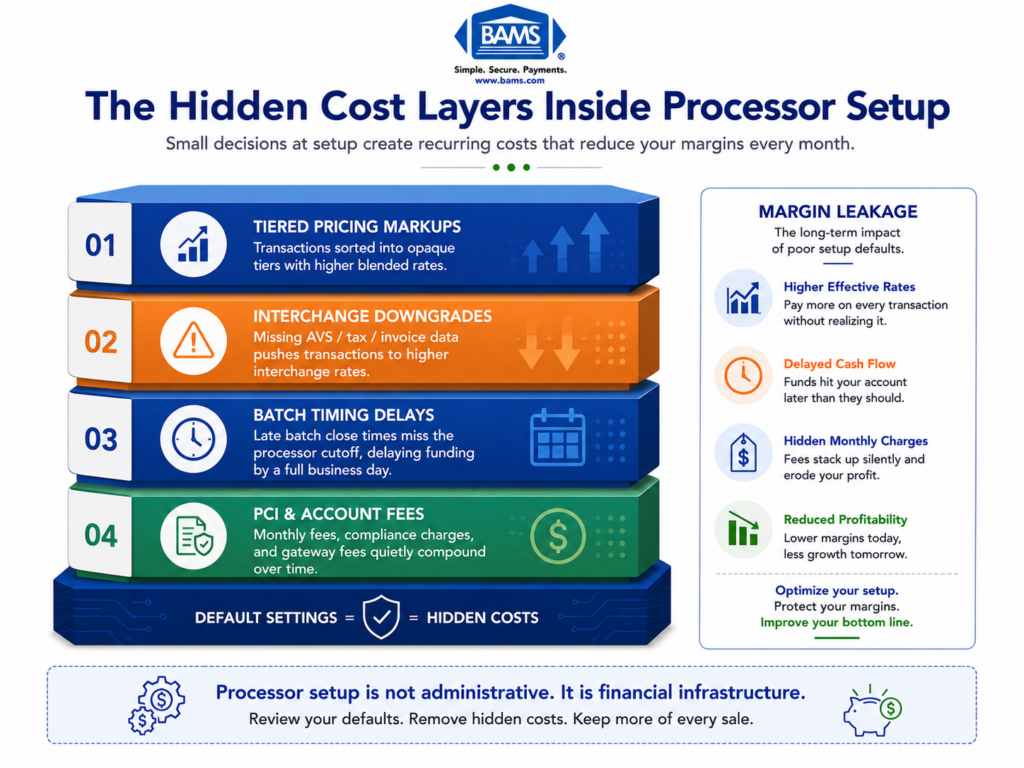
First, processor selection becomes a cash flow decision, not just a fee decision. Choosing a payment processor based solely on the lowest per-transaction rate while ignoring a three-day settlement window is like optimizing your checkout page but ignoring your shipping times. You’re saving pennies while losing dollars in working capital efficiency.
Second, your business model’s specific patterns should dictate your funding setup. If you run flash sales, your cut-off times matter more than your rate. If you process heavy weekend volume, a processor that batches on Saturday matters more than one that offers a marginally lower interchange markup. If you sell cross-border, understanding how international transactions interact with domestic settlement rails is essential.
The businesses that figure this out gain a quiet advantage their competitors never notice.
Stop Comparing Speed. Start Comparing Access to Your Own Money.
Here’s the reframe: funding speed isn’t a feature you buy. It’s friction you remove. The money is already yours. The only question is how many unnecessary days stand between the sale and your bank account.
Think of your settlement window not as “processing time” but as an interest-free loan you’re giving your processor. Every day of delay is a day you’re financing their float with your revenue. When you see it that way, the “premium” for faster funding starts to look less like an added cost and more like reclaiming what was always yours.
Understanding how eCommerce payments actually work from gateway to settlement gives you the leverage to demand better terms, not just lower rates.
Your Deposits Should Work as Hard as You Do
We’re not arguing that every business needs same-day funding. We’re arguing that every business deserves to understand what slow funding actually costs them, in real dollars, before they accept it as the default.
The merchants who win aren’t the ones paying the lowest rate. They’re the ones whose cash flow moves at the speed of their business. If yours doesn’t, the fix might be simpler (and cheaper) than you think.
Frequently Asked Questions
What is next-day funding in merchant services?
Next-day funding means your processed transactions are deposited into your bank account by the following business day instead of the standard two-to-three-day window. The actual timing depends on your processor’s batch cut-off time and your bank’s posting schedule.
How can a business qualify for next-day funding?
Most processors evaluate your transaction volume, chargeback history, and business type. Established eCommerce businesses with consistent processing history and low dispute rates typically qualify without difficulty.
When should a business consider same-day funding over next-day?
Same-day funding makes sense for businesses with high in-person transaction volume during morning hours, since cut-off times are usually early afternoon. For eCommerce brands with evening and weekend sales peaks, next-day funding with a later cut-off often delivers faster real-world access to funds.