Speed Up Payment Deposits Without Raising Costs
Last Updated on June 8, 2026 by Dimitri Akhrin
A practical framework for eCommerce managers to reduce deposit delays while keeping processing fees in check
Learn why delayed deposits cost more than you think and how to fix them. This guide gives you a step-by-step framework to evaluate your payment setup, identify bottlenecks, and implement changes that accelerate cash flow without inflating fees.
TL;DR
- Audit first, optimize second – Document your actual deposit timeline with transaction data before making changes. Most merchants discover delays they did not know existed.
- Batch timing matters more than you think – Aligning batch submission with processor cutoffs can eliminate 24-hour delays at zero cost.
- Faster funding has calculable ROI – Next-day deposits cost more, but the math often favors speed when you factor in supplier discounts, inventory flexibility, and reduced cash flow stress.
- Fraud prevention speeds up deposits – Better fraud screening reduces manual review queues and prevents the chargeback accumulation that triggers reserve holds and funding delays.
- Payment optimization is ongoing – Processor capabilities and your business needs evolve. Quarterly reviews prevent gradual performance degradation and identify new opportunities.
What This Guide Covers
This guide addresses a specific problem: your eCommerce revenue sits in limbo for days (sometimes weeks) before reaching your bank account. You need that cash to restock inventory, pay suppliers, and fund growth.
We cover the mechanics of deposit delays, the hidden costs they create, and a practical framework for payment optimization that balances speed with cost-effectiveness. You will learn how to evaluate your current setup, identify bottlenecks, and implement changes that get funds into your account faster.
This is for eCommerce managers at established businesses who process consistent transaction volume and feel the operational drag of slow deposits. By the end, you will have a clear action plan for reducing deposit times while keeping processing costs under control.
Why Delayed Deposits Hurt More Than You Think
Delayed deposits create a cascade of operational problems that extend far beyond cash flow inconvenience. When your revenue takes 3-5 business days to settle, you are essentially providing interest-free loans to your payment processor.
Consider the math: if your business processes $500,000 monthly and deposits take an average of four days, you have roughly $65,000 perpetually floating in the payment system. That capital could fund inventory purchases, marketing campaigns, or supplier negotiations that require upfront payment.
The problem compounds during high-volume periods. Holiday sales spikes mean larger amounts stuck in transit precisely when you need flexibility most. According to the Federal Reserve, payment economics and interchange structures play a major role in how funds move through the system, which directly impacts deposit timing and cost efficiency.
Delayed deposits also mask cash flow problems until they become crises. You see strong sales numbers but cannot cover payroll because the revenue has not actually arrived. This disconnect between reported revenue and available cash creates planning blind spots that can derail otherwise healthy businesses.
Core Concepts: Understanding the Deposit Timeline
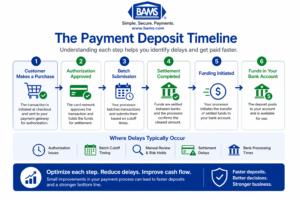
Understanding each step in the payment deposit timeline helps identify delays and optimize cash flow for faster access to funds.
Settlement vs. Funding
Settlement is when your processor receives confirmation that a transaction is valid. Funding is when money actually hits your bank account. These are separate events, and the gap between them is where delays live. The NACHA ACH Network governs how electronic transfers move between banks, which directly affects how quickly funds settle and become available.
Most processors batch transactions daily, then initiate settlement with card networks. After settlement clears, they transfer funds to your account. Each handoff introduces potential delays.
Reserve Holds and Risk Assessment
Processors often hold a percentage of your funds as protection against chargebacks and fraud. New merchants or those in “high-risk” categories face larger reserves and longer hold periods. Understanding your risk classification helps you negotiate better terms.
The Speed-Cost Tradeoff
Faster deposits typically cost more. Same-day or next-day funding often carries premium fees. The goal of cost-effective payment processing is finding the optimal balance where speed improvements justify their costs through operational benefits.
Authorization vs. Capture
Authorization confirms funds are available. Capture actually moves the money. Some eCommerce setups delay capture until shipment, which extends your deposit timeline unnecessarily. Aligning capture timing with your fulfillment process can shave days off deposits.
The Payment Optimization Framework
Optimizing batch timing, reducing risk holds, and improving visibility can significantly speed up deposits without increasing processing costs.
Effective payment optimization follows a four-stage cycle: Audit, Optimize, Implement, and Monitor. Each stage builds on the previous one, creating continuous improvement rather than one-time fixes.
Audit examines your current payment stack, identifying where delays occur and what they cost. Optimize evaluates alternatives and calculates ROI for potential changes. Implement executes changes with minimal disruption to ongoing operations. Monitor tracks results and identifies new optimization opportunities.
This framework applies whether you are addressing deposit speed, authorization rates, processing costs, or fraud prevention. The stages interconnect because changes in one area affect others. Faster deposits might increase costs; better fraud prevention might slow authorization. The framework helps you balance these tradeoffs deliberately rather than reactively.
Step 1: Audit Your Current Payment Stack
Objective: Document exactly where your money goes and how long each step takes.
Start by mapping every transaction touchpoint from customer checkout to bank deposit. Record timestamps at each stage: authorization, capture, batch submission, settlement confirmation, and bank deposit. Most processors provide this data in their reporting dashboards, though you may need to request detailed transaction logs.
Calculate your effective deposit time by averaging the gap between capture and bank deposit across a representative sample (at least 100 transactions over 30 days). Compare this to your processor’s stated funding timeline. Discrepancies reveal hidden delays worth investigating.
Review your payment gateway reporting for patterns.. Do certain card types settle faster? Do transactions above certain amounts face additional holds? Does your batch submission time affect next-day cutoffs?
What to avoid: Do not rely solely on processor-provided averages. They often exclude weekends, holidays, and exception cases that significantly affect your actual experience.
Success indicators: You have documented your average deposit time, identified your largest delay points, and quantified the cash flow impact in dollar terms.
Step 2: Evaluate Your Processor Relationship
Objective: Determine whether your current merchant services arrangement supports your speed and cost goals.
Request a detailed fee breakdown from your processor. Many merchants discover they are paying for services they do not use or facing markups they did not know existed. Compare tiered pricing against interchange-plus models to understand whether your current structure maximizes transparency.
Ask specifically about funding options. What is the fastest available deposit timeline? What does it cost? Are there volume thresholds that unlock better terms? Many processors offer next-day funding but do not advertise it prominently.
Evaluate your processor’s technology capabilities. Merchants adopting payment orchestration reduce integration complexity and development costs by consolidating multiple payment service providers into unified platforms. If your processor cannot support modern routing and optimization features, you may be leaving money on the table.
What to avoid: Do not assume switching processors automatically solves problems. Migration costs, integration work, and learning curves can offset savings if not carefully calculated.
Success indicators: You understand your complete fee structure, know your available funding options, and can articulate what improvements would justify a processor change.
Step 3: Optimize Authorization and Capture Timing
Objective: Reduce the gap between customer payment and fund availability through process improvements.
Improving authorization routing and transaction handling can increase approval rates while reducing delays caused by retries and manual review queues. Higher authorization rates mean more successful transactions on the first attempt, which reduces delays from retry logic and manual review queues.
Review your capture timing settings. If you capture at shipment but ship within hours of order placement, consider capturing at order confirmation instead. This moves your transaction into the settlement queue faster without increasing chargeback risk.
Optimize your batch submission schedule. Most processors have daily cutoff times for next-day funding eligibility. If your batch submits at 11 PM but the cutoff is 6 PM, you are losing a full business day on every transaction. Align your batch timing with processor cutoffs.
Understand how your payment gateway handles authorization holds. Extended holds can trigger customer complaints and card issuer flags that complicate future transactions.
What to avoid: Do not capture before you can fulfill. Capturing payment for items you cannot ship creates chargeback liability and violates card network rules.
Success indicators: Your authorization rate improves, capture-to-settlement time decreases, and you have documented your optimal batch submission window.
Step 4: Implement Faster Funding Options
Objective: Access revenue faster through funding program changes or processor upgrades.
Many established eCommerce businesses qualify for guaranteed next-day funding or same-day funding programs but never request it. Contact your processor to discuss eligibility. Qualification typically depends on processing history, chargeback rates, and business tenure.
Calculate the true cost of faster funding. If next-day deposits cost an additional 0.5% but allow you to capture early-payment supplier discounts of 2%, the math favors speed. If faster funding simply sits in your account earning nothing, the premium may not be justified.
Consider hybrid approaches. You might use standard funding for routine operations but enable expedited deposits during high-volume periods or cash-critical situations. This balances ongoing costs with flexibility.
What to avoid: Do not pay for speed you do not need. If your business operates comfortably on 3-day deposits, premium funding is an unnecessary expense.
Success indicators: You have enrolled in appropriate funding programs, calculated ROI for speed improvements, and established triggers for when expedited funding makes sense.
Step 5: Reduce Friction That Causes Delays
Objective: Eliminate preventable delays caused by fraud flags, verification failures, and manual review queues.
Modern fraud systems evaluate transactions in milliseconds rather than routing them to manual review queues that can delay processing by hours or days.
Implement address verification and CVV matching to reduce false fraud flags. Transactions that pass automated verification move through settlement faster than those requiring additional review.
Streamline your checkout process to reduce abandoned transactions and retry attempts. Customers using one-click checkout features increase spending by 28.5% on average and purchase frequency by 43%. Simpler checkout means cleaner transaction data, which means fewer processing exceptions.
Monitor your chargeback rate carefully. High chargeback rates trigger reserve holds and extended funding delays. Proactive chargeback prevention protects both your revenue and your deposit timeline.
What to avoid: Do not disable fraud protection to speed up processing. The cost of fraud losses and chargeback penalties far exceeds any deposit timing benefits.
Success indicators: Your manual review rate decreases, fraud-related holds become rare, and your chargeback rate stays well below network thresholds.
Step 6: Build Monitoring and Continuous Improvement Systems
Objective: Track deposit performance over time and identify new optimization opportunities.
Create a simple dashboard tracking key metrics: average deposit time, authorization rate, chargeback rate, and effective processing cost per transaction. Review these weekly to catch problems early and measure improvement impact.
High-performing payment systems rely on automation and real-time monitoring to maintain consistent processing speed and reduce delays .While your operation is smaller, the principle applies: automated monitoring catches issues that manual review misses.
Set up alerts for anomalies. If your average deposit time suddenly increases by a day, you want to know immediately rather than discovering the problem when cash flow tightens.
Schedule quarterly reviews of your payment stack. Processor capabilities evolve, your business needs change, and new optimization opportunities emerge. Regular evaluation ensures you are not leaving money on the table.
What to avoid: Do not set up monitoring and ignore it. Data only helps if you actually review and act on it.
Success indicators: You have automated tracking for key metrics, receive alerts for significant changes, and conduct regular optimization reviews.
Common Mistakes That Extend Deposit Delays
Ignoring batch timing: Many merchants submit batches whenever convenient rather than optimizing for processor cutoffs. This single oversight can add 24 hours to every deposit.
Accepting default settings: Processor defaults prioritize their interests, not yours. Funding timelines, capture settings, and fraud thresholds all deserve customization.
Treating all transactions identically: High-value orders, repeat customers, and new buyers have different risk profiles. Applying uniform processing rules means some transactions face unnecessary delays.
Neglecting chargeback prevention: Every chargeback affects your risk classification. Accumulated chargebacks trigger reserve requirements and funding delays that persist long after the disputes resolve.
Optimizing once and forgetting: Payment processing evolves constantly. Settings that worked last year may be suboptimal today. Regular review prevents gradual performance degradation.
What to Do Next
Start with the audit. Before changing anything, document your current deposit timeline with actual transaction data. This baseline tells you where delays occur and helps you measure improvement impact.
Pick one optimization to implement first. For most eCommerce businesses, aligning batch submission with processor cutoffs delivers immediate results with zero cost. That quick win builds momentum for larger changes.
Use this guide as a reference rather than a checklist. Your specific situation determines which optimizations matter most. Return to relevant sections as your business evolves and new challenges emerge.
Payment optimization is ongoing work, not a one-time project. Small improvements compound over time, turning deposit delays from a persistent frustration into a solved problem.
Frequently Asked Questions
What are faster deposit strategies in merchant services?
Faster deposit strategies include enrolling in next-day or same-day funding programs, optimizing batch submission timing to meet processor cutoffs, and reducing manual review queues through better fraud prevention. The most effective approach combines processor-level changes with operational improvements that move transactions through settlement faster.
Why is payment optimization important for businesses?
Payment optimization directly affects cash flow, operational flexibility, and profitability. Delayed deposits tie up working capital that could fund inventory, marketing, or supplier negotiations. Processing inefficiencies increase costs while reducing authorization rates. Systematic optimization addresses both speed and cost, turning payments from an operational burden into a competitive advantage.
How can I improve my payment authorization rates?
Authorization rates improve through better transaction data quality, appropriate fraud screening calibration, and dynamic routing to high-performing processors. Implementing address verification, ensuring accurate billing descriptors, and using payment orchestration platforms that route transactions intelligently can boost authorization rates by 2-3% on average.
Which payment processing fees can I reduce to optimize costs?
Focus on interchange optimization through proper transaction categorization, negotiate assessment fees based on volume, and eliminate unnecessary service charges. Moving from tiered pricing to interchange-plus pricing often reveals hidden markups. Level 3 processing for B2B transactions can significantly reduce interchange rates on qualifying purchases.
What role does fraud protection play in payment optimization?
Fraud protection directly affects deposit speed and processing efficiency. As explained by Modern Treasury, better transaction-level visibility and control help businesses reduce delays and make faster financial decisions. Excessive fraud flags route transactions to manual review, delaying settlement. High chargeback rates trigger reserve holds and funding delays. Modern AI-based fraud systems evaluate transactions in milliseconds while reducing false positives, protecting both revenue and deposit timelines.
When should I consider expanding my payment options?
Expand payment options when you see cart abandonment at checkout, receive customer requests for specific methods, or enter markets where alternative payments dominate. Digital wallets and one-click checkout can increase conversion without adding processing complexity. Prioritize options that your specific customer base actually uses rather than adding every available method.
Sources