Accelerate Cash Inflows: The Reinvestment Edge
Last Updated on September 27, 2026 by Dimitri Akhrin
Why every day your deposits sit in settlement costs you more than you think—and how faster payouts compound into margin advantages
Learn why slow deposit cycles quietly erode your competitive position and how faster cash inflows create a compounding reinvestment advantage. This piece reframes settlement speed as a strategic lever, not a back-office detail.
TL;DR
- Settlement speed is a reinvestment lever, not a convenience – Every day your cash sits in settlement is a missed chance to restock, scale ads, or capture supplier discounts.
- Slow deposits compound into a competitive disadvantage – A business on next-day funding gets roughly 20 more reinvestment cycles per month than one waiting three to five days.
- Your processor choice is a cash flow decision – Evaluating payment processing fees without weighing funding speed gives you an incomplete picture of true cost.
- Forecast accuracy improves dramatically with daily funding – When deposit timing is predictable and fast, your cash flow forecast becomes an operational tool instead of a guessing game.
Your Competitor Restocked Yesterday. You’re Still Waiting on a Deposit.
Every eCommerce operator knows the frustration: a strong sales day hits, orders ship, customers are happy. But your cash? Sitting in a settlement queue for three to five business days. Meanwhile, a competitor running the same margins just used yesterday’s revenue to lock in a supplier discount you’ll miss entirely. The ability to accelerate cash inflows isn’t a back-office detail. It’s the difference between compounding your wins and watching them evaporate in a holding pattern.
The Myth That Settlement Speed Is Just a Convenience
For years, the standard advice for eCommerce cash flow challenges has been sensible enough: tighten your receivables, negotiate longer payables, keep a cash buffer, automate your invoicing. And that advice isn’t wrong. It just misses the real leverage point.
Most content about cash flow management treats deposit timing as a footnote, a “nice to have” feature buried in your processor’s fine print. The assumption is that three to five day settlement is normal, acceptable, just the cost of doing business. Processors benefited from that assumption. Merchant Payments Coalition resources continue to highlight how payment infrastructure and settlement practices create growing financial pressure for merchants processing high transaction volume.
Here’s What Actually Changed

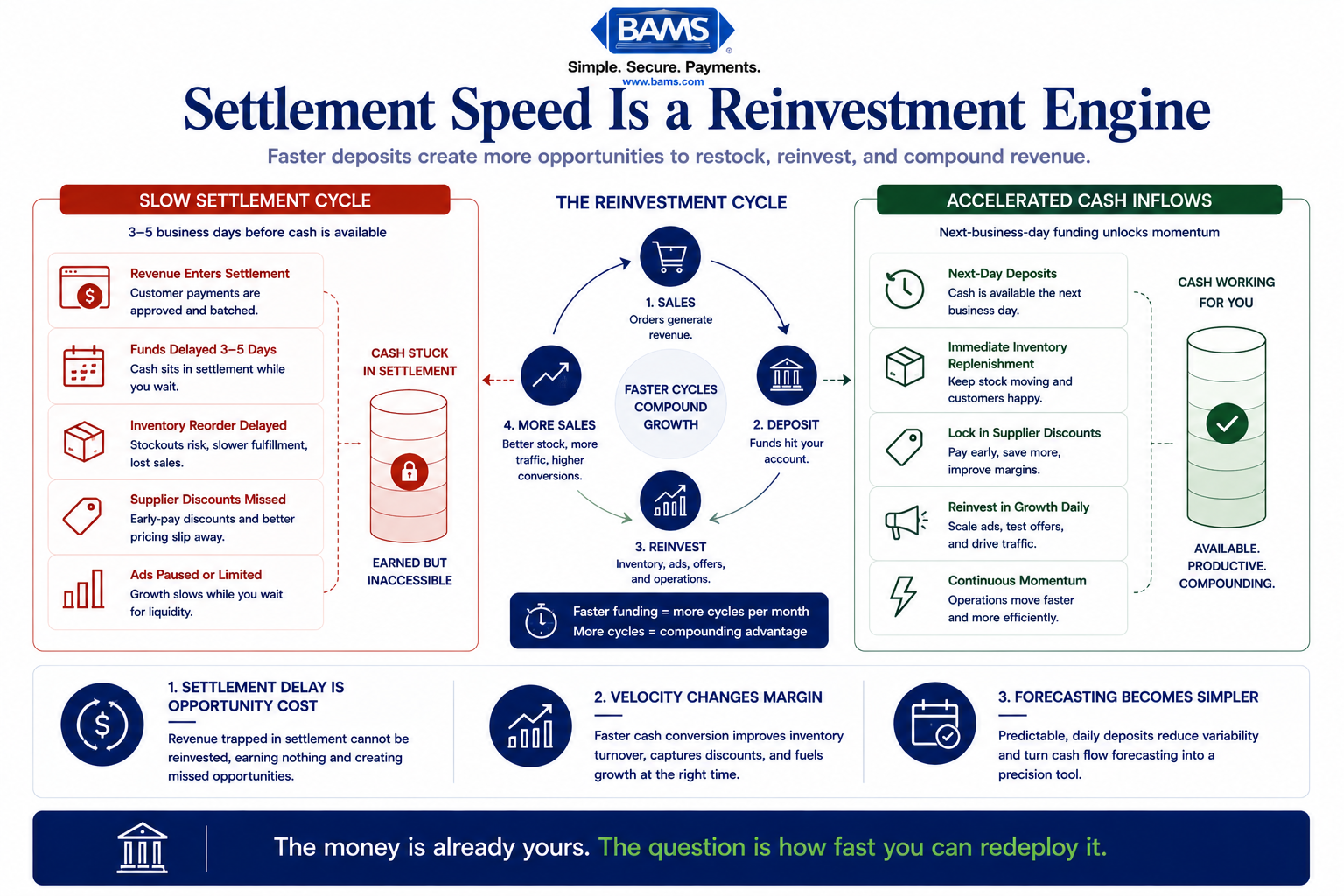
Every day your deposits sit in settlement is a missed reinvestment cycle your competitor may already be using.
Deposit speed isn’t a convenience feature. It’s a reinvestment lever, and every day your cash sits in settlement is a day your competitor compounds while you coast.
That’s the thesis. Not that faster deposits feel nicer (they do). Not that they reduce stress (they do that too). But that the operational gap between a business that reinvests daily and one that reinvests weekly is not linear. It compounds. And in eCommerce, where inventory velocity and ad spend timing dictate margin, that compounding is the game.
How Daily Funding Changes the Math on Cash Flow Forecasting
Let’s make this concrete. Imagine you run an eCommerce brand doing $15,000 in daily revenue. Under a standard three to five day settlement cycle, you’re carrying somewhere between $45,000 and $75,000 in “earned but inaccessible” cash at any given moment. That’s not a rounding error. That’s a full inventory reorder sitting in someone else’s account.
Now compress that to next-business-day funding. Suddenly your cash conversion cycle shrinks by 60% to 80%. You don’t need as large a cash buffer. You don’t need to draw on a credit line to bridge the gap between a weekend sales spike and a Monday supplier payment. Your forecast model gets simpler because the lag between “earned” and “available” nearly disappears.
This matters more than most operators realize. Modern Treasury payment operations resources continue to emphasize how increasing digital transaction volume amplifies the operational impact of settlement timing, reconciliation visibility, and cash flow forecasting accuracy for eCommerce merchants. The volume of money flowing through digital payment rails is exploding. If your processor holds each transaction for three to five days, the absolute dollar amount trapped in settlement grows alongside your sales. Success actually makes the problem worse.
Here’s where the compounding kicks in. A business that receives Tuesday’s revenue on Wednesday can reinvest it into inventory, ad spend, or supplier payments that same day. A business waiting until Friday or the following Monday cannot. Over a month, the faster operator gets roughly 20 additional reinvestment cycles. Over a quarter, that’s 60. Each cycle is a chance to restock a bestseller before it goes out of stock, to capture a volume discount, or to scale a paid campaign while ROAS is hot.
We’ve seen eCommerce operators treat this like a minor operational tweak. It’s not. It’s the difference between a cash flow forecast that’s a guessing game and one that’s a reliable operating tool. When you know deposits arrive the next business day, your forecast becomes a function of yesterday’s sales, not a probability distribution of when your processor might release funds.
Providers like BAMS offer same day funding with a 3:00 AM EST cut-off time and next-day funding with a 9 PM EST cutoff time, which means even late-evening transactions land in your account the following business day. That predictability alone transforms how you plan purchasing cycles and manage cash flow through your merchant services setup.

The longer deposits stay in settlement, the slower every downstream business decision becomes.
The Hidden Cost Nobody Talks About
Payment processing fees get all the attention. And yes, they matter. But the opportunity cost of slow settlement is often larger and almost always invisible. No line item on your P&L says “revenue lost because cash arrived four days late.” No dashboard flags the supplier discount you missed because funds hadn’t cleared.
This is why the standard advice to “shop for lower processing rates” is incomplete. A processor charging ten basis points less but settling three days slower might actually cost you more. The math depends on your inventory velocity, your supplier terms, and your ad reinvestment cadence. But for most eCommerce operators doing meaningful volume, the reinvestment value of faster settlement outweighs marginal rate differences.
What This Means for Your Next Quarter
If this thesis holds (and we believe the math is clear), then several things follow for eCommerce managers running established operations.
First, your cash flow forecast should model deposit timing as a variable, not a constant. Switching from a five-day to a one-day settlement cycle changes your working capital needs dramatically. You may be over-reserving cash or over-relying on credit lines that faster funding would make unnecessary.
Second, your processor evaluation should weight funding speed alongside payment processing fees. The cheapest processor is not always the most profitable one. A tougher capital environment (global FDI fell 11% in 2024) makes internal cash generation more valuable than ever. Every day you self-fund instead of borrowing is margin preserved.
Third, your inventory strategy and your payments strategy should be in the same conversation. They rarely are. But deposit timing directly constrains reorder frequency, and reorder frequency directly drives sell-through rates and margin.
A New Way to Think About Your Processor
Stop thinking of your payment processor as a cost center. Start thinking of it as a cash flow acceleration engine. The question isn’t just “what do I pay per transaction?” The question is “how fast does each transaction become reinvestable capital?”
Here’s the reframe worth remembering: your settlement cycle is your invisible inventory carrying cost. Every day between sale and deposit is a day you’re financing your own growth with your own trapped cash, earning nothing, deploying nothing, while the clock ticks on supplier deadlines and ad windows.
When you see it that way, the conversation about payment processing stops being about basis points and starts being about velocity. And velocity, in eCommerce, is everything.
The Operators Who Win This Decade Will Be the Ones Who Stopped Waiting
Cash flow challenges in eCommerce aren’t going away. Margins stay tight, ad costs stay volatile, and supply chains keep testing everyone’s patience. But the operators who pull ahead won’t be the ones with the best products or the biggest budgets. They’ll be the ones who turned every dollar over fastest.
The money is already yours. The only question is how long you let someone else hold it.
Frequently Asked Questions
What is a cash flow acceleration strategy for eCommerce?
A cash flow acceleration strategy shortens the time between earning revenue and having it available to deploy. For eCommerce operators, the highest-impact lever is often switching to a processor that offers next-day funding, which compresses the settlement gap from days to hours.
How does deposit timing affect cash flow forecasting?
When deposits arrive in one day instead of three to five, your forecast becomes a near-real-time reflection of actual sales rather than a delayed estimate. This reduces the need for large cash buffers and makes inventory and ad spend planning significantly more precise.
Should I prioritize lower processing fees or faster funding?
It depends on your volume and reinvestment cadence, but for most established eCommerce businesses, the opportunity cost of slow settlement often exceeds marginal fee savings. Evaluate both together rather than optimizing for rates alone.