Chargeback Codes: Understanding Chargeback Reason Codes for Businesses
Last Updated on April 28, 2026 by Dimitri Akhrin
Chargeback codes play a critical role in how payment disputes are classified and resolved in the modern payments ecosystem. As credit card transactions continue to grow across eCommerce, retail, and subscription services, merchants are facing a rising number of payment disputes. Understanding chargeback codes and chargeback reason codes helps businesses identify why disputes occur, respond with the correct evidence, and protect revenue from unnecessary losses.
Chargeback reason codes are standardized identifiers assigned by card networks when a cardholder disputes a transaction. These codes explain why the dispute occurred and guide the investigation process for banks and merchants. Without understanding these codes, businesses may struggle to respond properly to disputes or prevent them from happening again.
For business owners, learning how chargeback codes work is essential for improving dispute response, reducing losses, and maintaining long-term merchant account health. This guide explains how chargebacks work, how reason codes are assigned, and how merchants can use chargeback data to improve operational processes and prevent future disputes.
Key Takeaways
- Chargeback codes provide critical insight into why disputes occur and how to resolve them.
- Understanding chargeback reason codes helps merchants respond more effectively and improve win rates.
- Credit card chargeback codes vary by network, making tailored strategies essential.
- Many payment chargebacks stem from preventable operational issues, not fraud alone.
- Expert support, like BAMS Chargeback Defense, transforms chargeback management from a liability into a strategic advantage.
What Is a Chargeback? A Quick Refresher
A chargeback occurs when a cardholder disputes a transaction with their issuing bank and requests that the payment be reversed. In most cases, this process begins when a customer believes a transaction was unauthorized, incorrect, or unresolved. Chargebacks were created as a consumer protection mechanism, allowing customers to challenge unauthorized charges, billing errors, or purchases that were not delivered as promised.
According to Visa, chargebacks are part of the formal dispute process that helps protect consumers when something goes wrong in a card transaction. Visa’s dispute rules explain how card networks classify and manage these cases across the payment ecosystem.
The main parties involved in a chargeback are:
- Cardholder: The customer who initiated the dispute
- Issuing Bank: The bank that issued the customer’s card
- Acquiring Bank: The merchant’s acquiring institution or processor
- Merchant: The business that accepted the payment
Common triggers for a cardholder dispute include:
- Unauthorized transactions
- Duplicate charges
- Items not received
- Refunds not processed
- Subscription confusion
- Billing errors
While chargebacks serve an important consumer protection purpose, they can create significant costs for merchants. In addition to losing the original sale, businesses may face administrative costs, chargeback fees, and potential monitoring from card networks if dispute rates become too high.
How Does a Chargeback Work? Step-by-Step Breakdown
Understanding how a dispute moves through the payment ecosystem helps merchants respond more effectively and improve their internal processes.
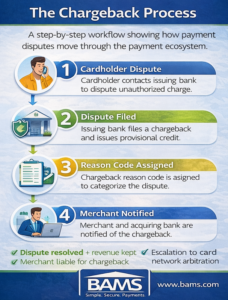
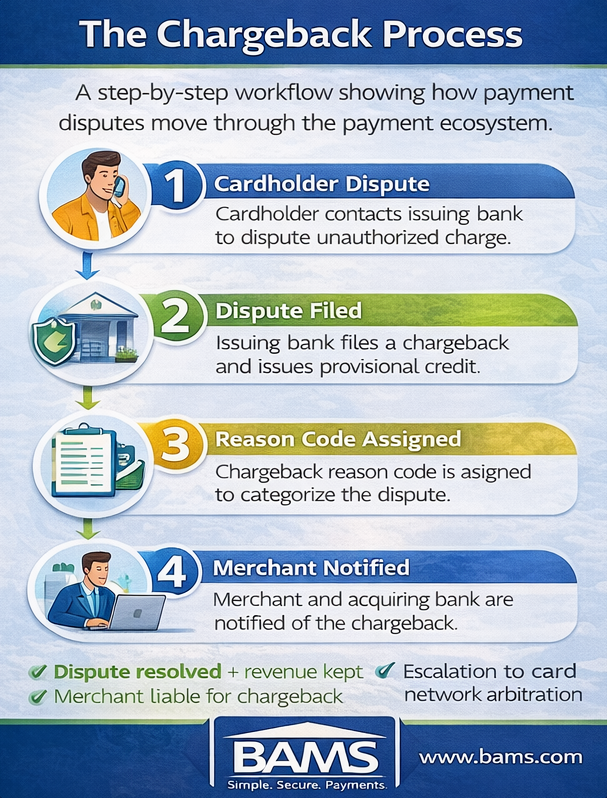
The chargeback process shows how a payment dispute moves from the cardholder to the issuing bank and eventually back to the merchant for response or resolution.
1. Cardholder Contacts the Issuing Bank
The process usually begins when a customer contacts their issuing bank to dispute a charge they believe is unauthorized, incorrect, or unresolved.
2. Dispute Filed and Provisional Credit Issued
In many cases, the issuing bank provides provisional credit to the customer while the claim is investigated.
3. Chargeback Reason Code Assigned
A chargeback reason code is assigned based on the type of dispute. This code categorizes the issue and shapes the next steps for both the bank and merchant.
4. Merchant Notification and Response Window
The acquiring bank or payment processor notifies the merchant about the dispute and provides information about the chargeback code, deadline, and documentation needed for a response.
5. Merchant Response or Acceptance
The merchant may either accept the chargeback or fight it by submitting evidence, a process commonly known as representment.
6. Resolution or Escalation
The issuing bank reviews the evidence and decides the outcome. Some disputes may escalate further depending on the network rules and the strength of the evidence.
What Are Chargeback Reason Codes?
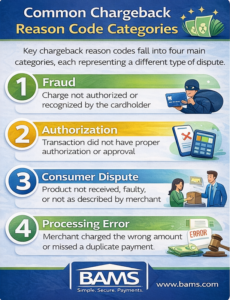
Chargeback reason codes categorize payment disputes into groups such as fraud, authorization issues, consumer disputes, and processing errors.`
These chargeback codes are standardized numerical or alphanumeric identifiers used by card networks and issuing banks to classify the reason behind a dispute. In simple terms, they explain why a transaction is being challenged.
Typical categories include:
Fraud-related disputes – The cardholder claims the transaction was unauthorized.
Authorization issues – The merchant did not obtain proper approval for the transaction.
Processing errors – Duplicate charges or incorrect transaction amounts.
Consumer disputes – Product or service complaints.
Understanding these categories helps merchants select the correct evidence when responding to disputes.
For example:
-
Fraud disputes may require AVS or CVV verification logs.
-
Authorization disputes require approval codes.
-
Product disputes require proof of delivery or customer communication.
Merchants who misunderstand chargeback reason codes often submit incorrect documentation, reducing the chances of winning the dispute.
How Card Networks Assign and Interpret Chargeback Codes
Major card networks such as Visa, Mastercard, American Express, and Discover each maintain their own chargeback structures. Although the broad dispute categories are similar, the actual codes and procedural rules differ by network. Mastercard explains that when a cardholder disputes a transaction, merchants may respond through the representment process by submitting evidence that addresses the specific chargeback reason code.
Visa may classify a fraud dispute using one format, while Mastercard may assign a completely different code to a similar issue. American Express and Discover also use their own internal frameworks. That means merchants cannot rely on a one-size-fits-all approach when reviewing disputes.
Visa’s dispute framework, including Visa Claims Resolution, was designed to streamline dispute management and clarify how different types of cases should be handled.
This variation is important because the same customer complaint may be categorized differently depending on the card network. Merchants that understand network-specific structures are better positioned to respond quickly and choose the right evidence.
How Merchants Should Respond to Different Chargeback Codes
Merchants should tailor their response strategy to the specific chargeback reason code assigned to the dispute. A strong response starts with understanding what the code means and matching it with the right evidence.
For fraud disputes, useful evidence may include:
- Address Verification Service (AVS) results
- CVV match results
- IP address logs
- Proof of customer authentication
- Order history or device data
Authorization disputes, merchants may need:
- Authorization approval codes
- Transaction logs
- Time stamps and terminal records
Product or service disputes, relevant documentation often includes:
- Proof of delivery
- Tracking numbers
- Signed receipts
- Refund or cancellation policy acknowledgments
- Customer service communications
Merchants should also decide whether a chargeback is worth fighting. If the evidence is weak, the value is low, or the customer complaint is valid, accepting the chargeback may be more efficient than investing time in representment.
Timing is critical. Response windows are limited, and missing a deadline will usually result in an automatic loss. A disciplined internal workflow is often just as important as the evidence itself.
Preventing Payment Chargebacks Through Better Processes
Many payment chargebacks are preventable. While fraud is often the most visible cause, many disputes originate from operational issues rather than malicious activity.
Common operational causes include:
-
Confusing billing descriptors
-
Delayed refunds
-
Shipping misunderstandings
-
Poor customer service
-
Subscription cancellation issues
Industry groups such as the Merchant Payments Coalition note that credit card network fees and payment rules can be complex and difficult for merchants to interpret, particularly because hundreds of fee combinations exist depending on card type, transaction type, and merchant category.
Understanding credit card chargeback codes helps merchants identify patterns and improve the underlying processes that create disputes in the first place.
Best practices for reducing chargebacks include:
Clear billing descriptors
Customers should easily recognize your business name on their card statements.
Transparent refund policies
Customers should clearly understand return and cancellation policies before purchasing.
Strong customer service workflows
Resolving issues quickly can prevent disputes from reaching banks.
Fraud detection tools
Modern fraud screening technology helps identify suspicious transactions before approval.
Chargeback data analysis
Merchants should regularly review dispute patterns to identify operational weaknesses.
Preventing disputes is often more cost-effective than fighting them after they occur.
How BAMS Helps Merchants Manage and Defend Against Chargebacks
Managing chargebacks can quickly become overwhelming, particularly for businesses experiencing rapid growth or high transaction volume.
Each dispute requires:
-
detailed analysis
-
evidence preparation
-
strict deadline tracking
-
compliance with network rules
BAMS helps merchants reduce risk and protect revenue through specialized chargeback management support.
With BAMS Chargeback Defense, merchants receive assistance with:
-
chargeback analysis and root cause identification
-
representment evidence preparation
-
card network compliance guidance
-
ongoing monitoring and reporting
This proactive approach helps businesses move from simply reacting to disputes toward actively reducing chargeback rates over time.
Conclusion: Turning Chargeback Codes Into a Competitive Advantage
Chargebacks are an unavoidable part of modern commerce, but they do not have to become a constant drain on revenue and resources. By understanding chargeback codes, merchants gain better visibility into why disputes happen and how to respond effectively.
The real advantage comes from using that knowledge proactively. Instead of treating every dispute as an isolated problem, merchants can use chargeback data to improve policies, strengthen fraud prevention, clarify customer communication, and reduce future risk.
With the right strategy and expert support, businesses can turn chargeback management from a liability into a competitive advantage. Partnering with an integrated payment gateway, merchants can protect revenue, maintain account health, and scale with greater confidence through modern payment infrastructure and merchant-focused support.
Sources