VDA CEO Vlad Rosca on Free Financial Education for Veterans and the Hidden Costs of Small Business
Last Updated on June 10, 2026 by Dimitri Akhrin
Why Veteran Entrepreneurs Get Blindsided by Business Costs (And How Financial Literacy Closes the Gap)
Most conversations about veteran financial wellness stop at personal debt. But for the hundreds of thousands of veterans who launch small businesses after leaving service, financial literacy has to extend further than a personal budget. Business costs, particularly payment processing fees, can erode margins quietly and quickly for veteran entrepreneurs who weren’t trained to scrutinize the fine print on merchant service agreements.
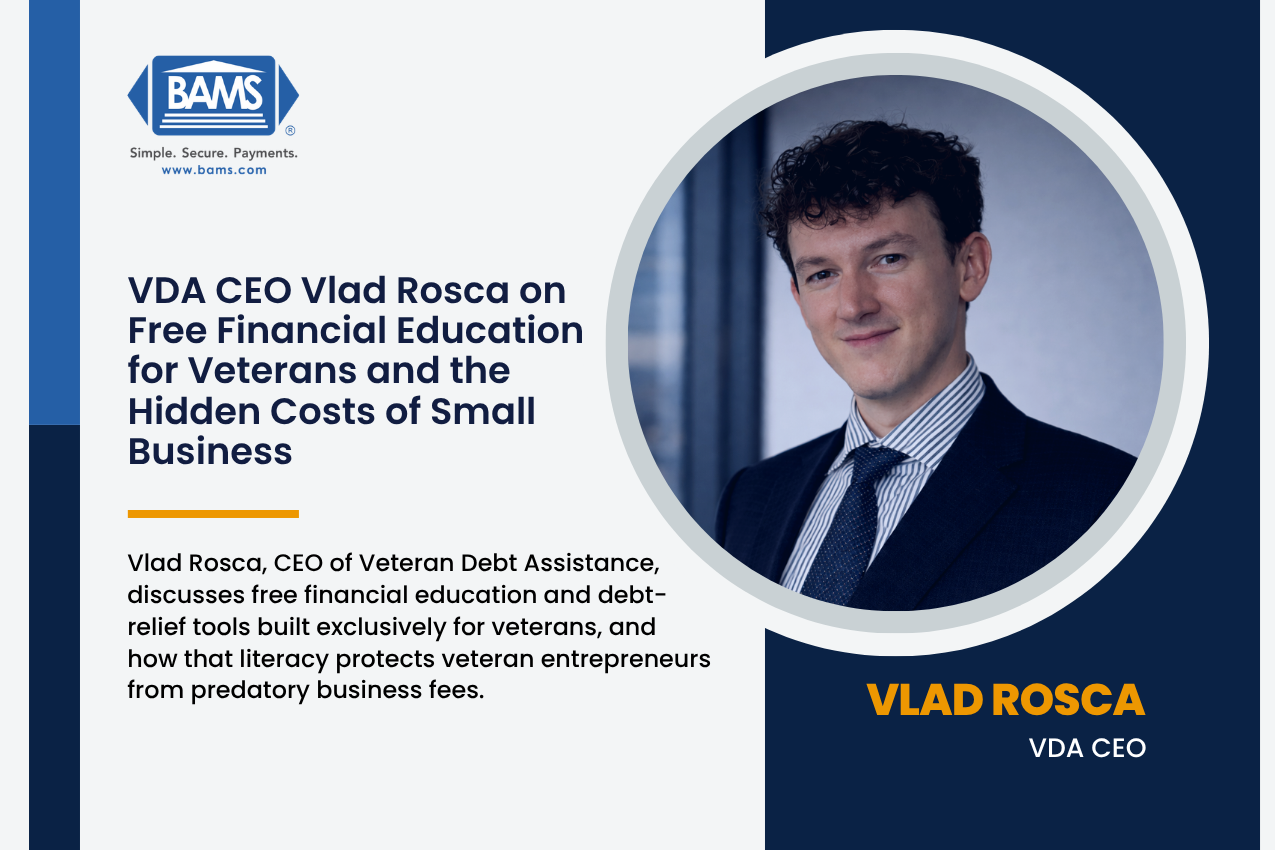
We sat down with Vlad Rosca, CEO of Veteran Debt Assistance, an organization that provides 100% free financial education and debt-relief tools designed exclusively for U.S. veterans and their families; no fees, no upsells, no credit checks required. Rosca, a seasoned expert in credit and lending strategy, has helped veterans navigate financial exploitation at every stage of civilian life. Veteran Debt Assistance is recognized by major veteran organizations, including DAV, the Navy SEAL Foundation, and Fisher House, as a trusted partner in expanding financial literacy nationwide.
At BAMS, we’ve spent 50+ years helping small business owners cut payment processing costs and eliminate the hidden fees that eat into their bottom lines. We wanted Rosca’s perspective on how veteran entrepreneurs can apply the same financial vigilance they use in personal finances to their business operations.
Q: Vlad, you work primarily with veterans on personal debt. How often does that work intersect with veterans who are also running small businesses?
A: More than most people expect. Veterans start businesses at a significantly higher rate than the general population. The discipline, problem-solving instincts, and risk tolerance that made them effective in service translate directly into entrepreneurship. But here’s what rarely gets discussed: many of those veteran entrepreneurs are managing personal debt recovery while launching a business. They’re simultaneously trying to clean up credit card debt from their military transition while also navigating business formation costs, equipment expenses, and operating fees they didn’t fully anticipate.
What I see constantly is veterans who are rigorous about their personal finances but completely unprepared for the ways business costs are structured to extract maximum fees with minimum transparency. They’ve learned to read a debt statement and question interest rates. They haven’t yet learned to scrutinize a payment processing agreement the same way.
Q: What business financial traps do veteran entrepreneurs most commonly fall into?
A: Payment processing fees are one of the biggest. A veteran opens a retail shop or a service business, sets up credit card acceptance, and has no idea that the rate they agreed to contains tiered fees, monthly minimums, batch fees, and PCI compliance charges that weren’t clearly disclosed upfront. By the end of the first quarter, their effective processing rate is double what they thought they signed up for.
This mirrors exactly what I see in personal debt. Predatory lenders and debt relief scams work the same way: bury the real cost in fine print, present an attractive headline number, and collect the difference from people who are too busy running their lives to audit every line. The veterans who do best financially, both personally and in business, are the ones who demand transparency at every level.
They ask for a side-by-side comparison of what they’re paying versus what they could be paying. They work with companies that will actually show them that comparison rather than obscuring it. That’s the standard I apply to personal finance resources at VDA, and it’s the standard veteran entrepreneurs should apply to every business vendor they work with, including payment processing.
Q: How does personal debt impact a veteran’s ability to launch and sustain a small business successfully?
A: It’s an invisible tax on every business decision. If a veteran entrepreneur is carrying high-interest personal debt, they’re constantly making suboptimal choices because they’re operating from financial stress rather than financial clarity. The stress shows up in concrete ways, such as accepting bad clients to cover immediate cash needs, delaying equipment purchases that would improve margins, and sacrificing favorable payment terms for urgent payment.
That’s why VDA’s work exists. We provide 100% free financial education and debt-relief tools with no fees, no upsells, and no credit checks required. When veterans stabilize their personal finances first, they become dramatically better business operators. They negotiate from strength, readcontracts carefully, and recognize when a vendor is using complexity to obscure costs. The financial literacy that helps a veteran escape personal debt is the exact same literacy that helps them run a profitable business.
Q: BAMS has been in payment processing for over 50 years. What should veteran entrepreneurs look for in a payment processor to avoid getting exploited?
A: Transparency is the single most important signal. Any payment processor worth working with should be willing to put their fees side by side against what you’re currently paying and show you exactly where the savings are. If they can’t or won’t do that upfront, that tells you everything you need to know about how the relationship will go once you’re locked in.
After that, look for next-day funding capability. Cash flow is the lifeblood of a small business, and waiting three to five days for transactions to settle can create serious problems for veteran entrepreneurs who are still building their working capital reserves. After 50+ years in the business and billions in volume, BAMS has the scale to offer next-day funding as a standard feature as opposed to a premium they’re squeezing extra money out of you.That’s precisely the kind of operational credibility matters.
Support access is the third factor. When something goes wrong with payment processing, a veteran entrepreneur needs a real human to answer the phone, not a chatbot and a 48-hour ticket queue. This is exactly the same standard I apply to financial resources for veterans on the personal side. At VDA, every resource is genuinely accessible, not buried behind a contact form. The businesses worth working with operate the same way.
Q: What advice would you give a veteran who is simultaneously managing personal debt recovery and launching a small business?
A: Sequence your financial education deliberately. Don’t try to learn everything at once. Start with personal debt: understand your credit profile, create a realistic payoff plan, and access free resources like those at Veteran Debt Assistance to do that without paying anyone. Once you have a clear picture of your personal financial obligations, you can build a business model that accounts for that reality honestly.
Then take the same scrutiny you applied to your debt into your business vendor relationships. Question every fee structure. Request line-item breakdowns. Work with companies that treat transparency as a baseline, not a favor. Payment processing is one of the most significant ongoing costs for any business that accepts cards, and most small business owners overpay it by a margin that compounds every month.
Veterans have an edge here that civilian entrepreneurs often don’t. Military training instills an instinct to question operational inefficiency and eliminate unnecessary friction. Apply that instinct to your financial relationships, personal and business, and you will outperform most of your competition before you ever make a single sale.
VDA provides 100% free financial education and debt-relief tools designed exclusively for U.S. veterans and their families; no fees, no upsells, no credit checks required. Led by CEO Vlad Rosca, VDA has cumulatively donated over $200,000 to Disabled American Veterans (DAV), Fisher House Foundation, and the Navy SEAL Foundation to support the veteran community. And partners with Fisher House Foundation and the Navy SEAL Foundation to support the veteran community.