
Cash Advance Items: A Surcharging Compliance Guide
Last Updated on September 24, 2026 by Dimitri Akhrin
How third-party pass-through costs create hidden pricing and payment risks for funeral directors
Learn how cash advance items create compliance gray zones where FTC disclosure rules, card network surcharge caps, and third-party vendor timing gaps collide. This guide gives funeral directors a clear framework for structuring payment workflows that protect margins and meet transparency obligations.
TL;DR
- Cash advance items create a surcharging gray zone — Applying a blanket credit card surcharge to your full invoice effectively marks up third-party costs you told families are billed at cost, creating both FTC disclosure conflicts and potential state law violations.
- Segment your surcharge by line item — Apply surcharges only to your professional services and merchandise, never to cash advance items. This keeps your itemized statement honest and your surcharging compliant with both card network rules and funeral industry regulations.
- Close the cash flow gap at the arrangement conference — Collect a deposit covering estimated cash advance items upfront, set clear payment terms (net 15 or net 30), and offer card payment immediately rather than waiting for a mailed invoice.
- Your processor setup matters more than your rate — Next-day funding, subtotal-based surcharge support, cost-plus fee transparency, and dedicated account management are more important for funeral home operations than the lowest advertised rate.
- Reconcile monthly, update quarterly — Match every cash advance item billed to families against actual vendor invoices each month. Update your General Price List estimates whenever vendor costs change to prevent disclosure gaps from compounding.
Guide Orientation: What This Covers and Who It’s For
This guide addresses a specific operational challenge that most funeral home payment resources ignore: how cash advance items create timing gaps between what you pay third-party vendors and when you collect from families, and how those gaps interact with surcharging rules, FTC disclosure requirements, and card network regulations in ways that can quietly erode your margins or expose you to compliance risk.
It’s written for family-owned funeral service operators managing one to ten locations who regularly handle high-ticket transactions, often exceeding $15,000, and need clear guidance on structuring payment acceptance around third-party costs.
By the end, you’ll understand how to align your funeral home pricing transparency obligations with your payment processing setup, avoid the most common surcharging mistakes on pass-through costs, and build a payment workflow that protects both your cash flow and your compliance posture. This guide does not cover preneed trust fund accounting or state-specific preneed contract law. It focuses on the at-need payment collection window where cash flow gaps actually occur.

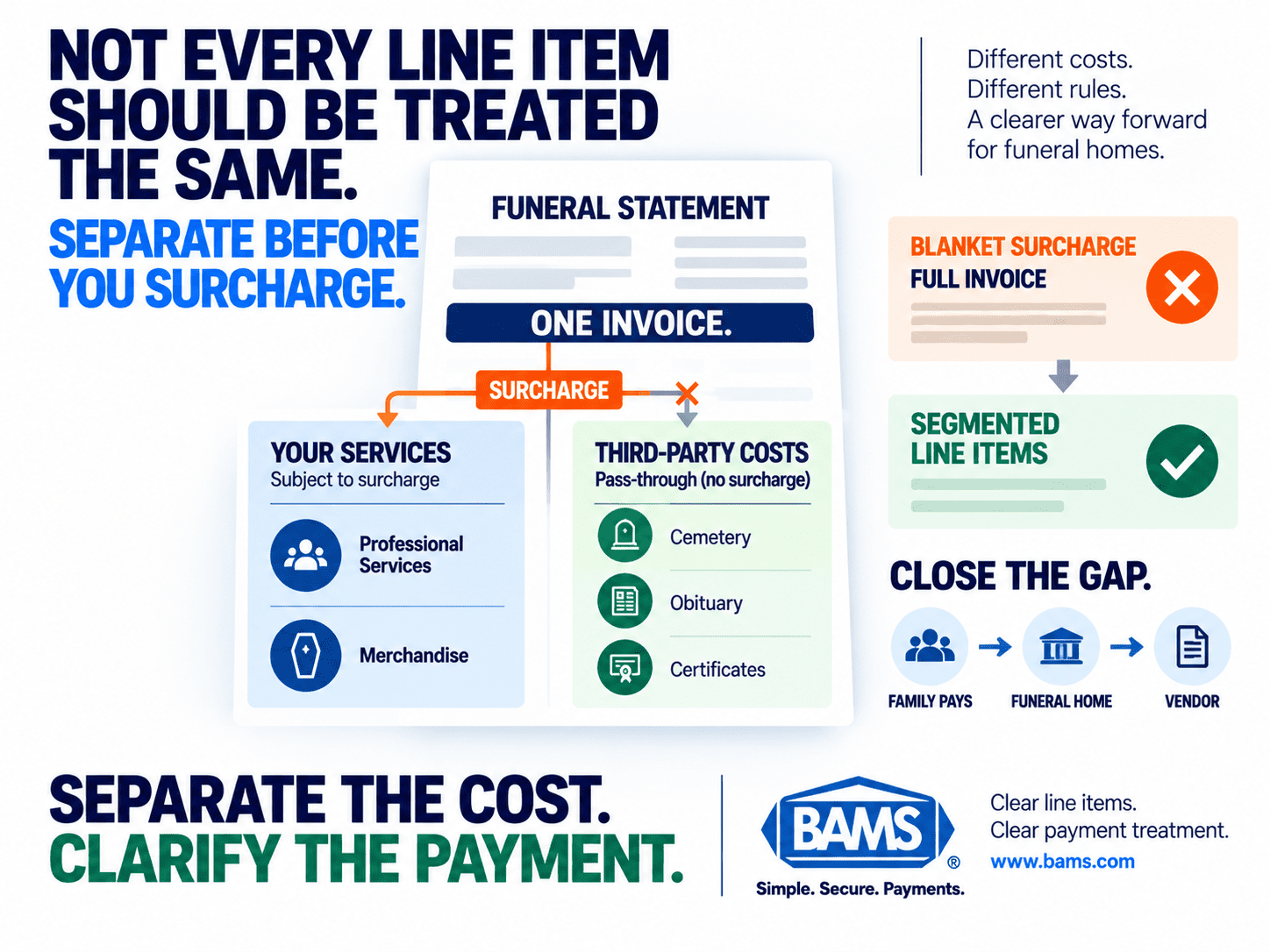
Cash advance items create a different payment challenge from funeral home services and merchandise. Separating pass-through costs before applying payment-method pricing creates clearer disclosures and cleaner payment workflows.
Why Cash Advance Item Timing Matters Now
The FTC is paying closer attention to funeral pricing than it has in years. In its first undercover phone sweep, the agency contacted over 250 funeral establishments and sent warning letters to 39 that failed to provide accurate pricing information. Penalties for Funeral Rule violations can reach $51,744 per infraction. That enforcement momentum means the margin for sloppy documentation on cash advance items has narrowed considerably.
At the same time, more families are paying by credit card, which introduces surcharging questions that didn’t exist when most payments came via check or insurance assignment. When a family’s statement includes $3,000 in third-party costs (cemetery fees, obituary charges, death certificates), and you add a credit card surcharge on the full transaction, you’ve entered a gray zone. Card network rules cap surcharges at the lesser of 3% or your cost of acceptance. But the FTC requires you to disclose whether you’re marking up cash advance items. Those two obligations can collide.
The cost of getting this wrong isn’t theoretical. A family who sees a surcharge applied to items you told them were “at cost” has a legitimate complaint. A state regulator reviewing your itemized statements can flag the same discrepancy. And a payment processor can fine or terminate your account for surcharge violations. The intersection of funeral director obligations under the Funeral Rule and payment processing compliance is where the real risk lives, and almost no one is talking about it.
Core Concepts: Cash Advance Items, Surcharging, and Disclosure Rules
What Cash Advance Items Actually Are
Under the FTC Funeral Rule, cash advance items are goods or services that a funeral home purchases from a third party on the family’s behalf. Common examples include cemetery or crematory fees, newspaper obituary charges, flowers, pallbearers, and certified copies of death certificates. The FTC requires that each cash advance item be listed separately on the Statement of Funeral Goods and Services Selected, with its individual price.
A critical distinction: if you charge families more than what you actually pay the third-party vendor, you must disclose that markup in writing. If the exact cost isn’t known at the time of the arrangement conference, you must provide a written good faith estimate. This isn’t optional. It’s the foundation of funeral home pricing transparency under federal law.
How Surcharging Intersects with Pass-Through Costs
Credit card surcharging allows merchants to pass processing costs to card-paying customers. But card networks (Visa, Mastercard) impose specific rules: surcharges cannot exceed 3% or your effective cost of acceptance, whichever is lower. You must also register your surcharging program, post clear signage, and never surcharge debit cards, even when they’re run as credit.
Here’s where it gets complicated for funeral homes. When you surcharge the full invoice amount, including cash advance items you told the family are billed “at cost,” the surcharge effectively becomes a hidden markup on those third-party items. Some states, like Connecticut, explicitly prohibit billing any cash advanced item unless the net amount paid by the funeral firm equals the amount billed. A surcharge applied to the full transaction total can violate that standard.
The Misconception That Keeps Operators Exposed
Most funeral directors treat surcharging as a simple merchant services decision: turn it on or off. But the Funeral Rule’s itemization requirements mean your pricing structure is more transparent (and more scrutinized) than a typical retail business. You can’t apply a blanket surcharge policy without considering how it interacts with your itemized disclosures. Standard merchant services guidance doesn’t account for this.
The Framework: Four-Phase Payment Alignment
Cash advance item management requires more than correct disclosure. The pricing document, surcharge treatment, collection timing and payment processor all need to work together.
Managing cash flow gaps from cash advance item timing requires aligning four operational phases. Each phase addresses a different source of risk or delay.
- Phase 1: Disclosure Architecture — Structure your General Price List and Statement of Goods and Services Selected so that cash advance items, your service fees, and any payment-method costs are clearly separated.
- Phase 2: Surcharge Segmentation — Determine which line items can legally and ethically carry a surcharge, and which cannot.
- Phase 3: Collection Timing — Align when you collect payment from families with when you must pay third-party vendors, closing the cash flow gap without pressuring families.
- Phase 4: Processor Alignment — Ensure your merchant services setup supports the funding speed, fee transparency, and transaction structure your compliance obligations require.
These phases are sequential for initial setup but become a continuous cycle as you refine your process. Let’s break each one down.
Step-by-Step: Closing the Cash Advance Item Cash Flow Gap
Step 1: Audit Your Current Cash Advance Item Disclosures
Objective: Confirm that every cash advance item on your General Price List (GPL) and Statement of Funeral Goods and Services Selected meets FTC itemization requirements, and that your actual billing matches your disclosures.
Start by pulling your current GPL, your Casket Price List, your Outer Burial Container Price List, and a sample of recent Statements of Goods and Services Selected. For each cash advance item, verify three things: (1) it’s listed as a separate line item, (2) the price shown matches what you actually paid the vendor or is clearly labeled as a good faith estimate, and (3) any markup is disclosed in writing on the statement.
The FTC’s pricing checklist specifies that the itemized statement must be provided before payment and must include good faith estimates when exact costs aren’t yet known. Review whether your arrangement staff consistently provides this document at the right moment, not after the family has already paid.
Anti-patterns to avoid: Bundling cash advance items into a single “third-party services” line. Using outdated vendor pricing on your GPL without updating estimates. Assuming that because you’ve always done it this way, it’s compliant.
Success indicators: Every cash advance item on your last 20 statements can be matched to a vendor invoice within 5% of the disclosed price. No item is listed as “at cost” while actually carrying a margin. Your GPL has been reviewed against current vendor rates within the last 90 days.
Step 2: Segment Your Invoice for Surcharge Compliance
Objective: Separate your invoice into components that can carry a credit card surcharge and components that cannot, so you never inadvertently mark up a pass-through cost through your payment processing.
This is the step most funeral homes skip entirely. When you apply a flat surcharge percentage to the total invoice, you’re surcharging cash advance items. If you’ve told the family those items are billed at cost (as most funeral homes do), the surcharge contradicts that disclosure. In states like Connecticut, where statute explicitly bars billing cash advance items above what you paid, this can create a direct legal violation.
The practical solution is to structure your point-of-sale process so that surcharges apply only to your professional service fees and merchandise, not to cash advance items. This may require running two transactions (one for your services, one for pass-through costs) or configuring your terminal to calculate surcharges on a subtotal that excludes cash advance items. Talk to your payment processor about whether their system supports line-item or subtotal-based surcharge calculation.
Alternatively, consider dual pricing, where you list a cash price and a card price for your professional services, while keeping cash advance items at a single, flat cost regardless of payment method. This sidesteps surcharge registration requirements in many states and is often simpler to explain to families during the arrangement conference.
Anti-patterns to avoid: Applying a surcharge to the full invoice without segmenting. Surcharging debit card transactions (this violates card network rules regardless of your state). Assuming your state allows surcharging without checking current law, as several states prohibit or restrict it.
Success indicators: Your surcharge (if applied) never touches cash advance line items. Families see a clear, itemized breakdown showing exactly what the surcharge covers. Your surcharge percentage does not exceed your actual cost of card acceptance.
Step 3: Restructure Your Collection Timeline
Objective: Align when you collect payment from families with when third-party vendors expect payment, so you’re not financing cash advance costs out of operating capital for weeks or months.
The typical cash flow gap works like this: you arrange services on Monday, pay the cemetery on Wednesday, cover the obituary and flowers by Friday, and send the family a final statement the following week. The family pays 30 to 60 days later. You’ve just floated $2,000 to $5,000 in third-party costs for a month or more. Multiply that across 15 to 20 cases per month, and you’re carrying $30,000 to $100,000 in unpaid cash advance costs at any given time.
Three structural changes reduce this gap without pressuring grieving families.
First, collect a deposit at the arrangement conference that covers estimated cash advance items. Frame it as “covering third-party costs that we’ll pay on your behalf this week.” Most families understand this and appreciate the transparency. Second, set clear payment terms on your Statement of Goods and Services Selected: net 15 or net 30, not open-ended. Third, offer card payment at the arrangement conference rather than waiting for a mailed invoice. Families who intend to pay by card will do so immediately if you make it easy.
If your processor holds deposits for two to three business days, even prompt card payments create a secondary gap. This is where deposit timing becomes a critical factor. A processor that funds next business day closes the gap between the family’s payment and your vendor obligations.
Anti-patterns to avoid: Waiting until after the service to discuss payment. Allowing invoices to go out without clear due dates. Financing all cash advance costs from your operating account without tracking the float as a distinct liability.
Success indicators: Average days-to-collection for cash advance items drops below 15 days. You can cover weekly vendor payments from collected deposits rather than operating reserves. Fewer than 10% of invoices exceed your stated payment terms.
Step 4: Match Your Processor to Your Compliance Needs
Objective: Ensure your merchant services provider supports the transaction structures, funding speed, and fee transparency that funeral home operations require.
Most funeral homes chose their payment processor years ago based on rate alone, without considering how the processor handles high-ticket transactions, surcharge configuration, or deposit timing. But funeral transactions have characteristics that generic merchant services setups handle poorly. Tickets regularly exceed $10,000. You may need to split transactions between service fees and cash advance items. And you need funded deposits fast enough to cover vendor payments within the same week.
Evaluate your current processor on four criteria.
First, funding speed: do you receive deposits next business day, or is there a two to three day hold? For high-ticket funeral transactions, even one extra day of delay can mean paying vendors out of pocket. Processors like BAMS offer next-day funding as a standard feature, which directly addresses the cash advance timing gap.
Second, surcharge support: can your terminal or gateway calculate surcharges on a subtotal rather than the full transaction? If not, you’ll struggle with the segmentation required in Step 2.
Third, fee transparency: do you know your effective rate on a $15,000 transaction? Cost-plus (interchange-plus) pricing models let you see exactly what you’re paying per transaction, which matters when you’re deciding whether to surcharge or absorb processing costs.
Fourth, dedicated support: when a $20,000 transaction gets flagged or held, do you reach a person who understands your business, or do you enter a support queue?
Anti-patterns to avoid: Choosing a processor based solely on advertised rates without understanding effective cost on high-ticket transactions. Accepting a processor that bundles pricing (flat rate) when you need line-item visibility. Ignoring funding delays as “just how it works.”
Success indicators: You know your exact effective processing rate on your average transaction size. Your funded deposits arrive within one business day. Your processor can support subtotal-based surcharging or dual pricing. You have a named account manager you can reach directly.
Step 5: Document Your Surcharge and Pricing Policy
Objective: Create a written internal policy that your arrangement staff can follow consistently, ensuring every family receives the same transparent pricing treatment.
Compliance failures in funeral homes can come from inconsistent pricing practices. One director applies a surcharge; another absorbs it. One explains cash advance items clearly; another bundles them into a verbal estimate. The FTC found funeral homes that provided inconsistent pricing for identical services during its undercover phone sweep, reinforcing the importance of documented pricing policies and consistent staff communication.
Your written policy should cover: which payment methods you accept, whether and how you surcharge (including which line items are subject to surcharge), how cash advance items are estimated and reconciled, when the itemized statement is presented, and what payment terms apply. It should also specify the script or language your arrangement staff uses to explain payment options to families.
Train every staff member who discusses pricing with families. The FTC requires that you provide accurate pricing information by phone when asked. That means your receptionist, your on-call director, and your arrangement staff all need to know the current GPL pricing and your payment policies.
Anti-patterns to avoid: Relying on verbal tradition instead of written policy. Assuming that only the owner or lead director needs to understand surcharge rules. Failing to update the policy when you change processors, adjust vendor relationships, or when state surcharge laws change.
Success indicators: Every staff member can explain your payment and surcharge policy consistently. Your written policy has been reviewed within the last six months. A new hire can read the policy and correctly handle a payment scenario without additional coaching.
Step 6: Reconcile Cash Advance Items Monthly
Objective: Verify that what you billed families for cash advance items matches what you actually paid vendors, catching discrepancies before they become compliance issues or margin leaks.
This step is unglamorous but essential. Cash advance item costs shift: cemeteries raise fees, obituary rates change, death certificate costs vary by county. If your GPL still shows last year’s estimates, you’re either absorbing unexpected costs or inadvertently overcharging families without disclosure.
Set a monthly reconciliation process. Pull every Statement of Goods and Services Selected from the prior month. Match each cash advance line item to the corresponding vendor invoice. Flag any case where the billed amount differs from the paid amount by more than 5%. For items where you provided a good faith estimate, verify that you followed up with the family if the actual cost was materially different.
This reconciliation also feeds your pricing updates. If cemetery fees have increased across the board, update your GPL estimates before the next arrangement conference, not after a family questions the discrepancy.
Anti-patterns to avoid: Reconciling only at tax time. Treating small discrepancies as immaterial (they compound across hundreds of cases per year). Failing to update GPL estimates when vendor costs change.
Success indicators: Monthly reconciliation is completed within 10 business days of month-end. Fewer than 5% of cash advance items show a discrepancy greater than 5%. GPL estimates reflect current vendor pricing within one billing cycle of any change.
Practical Example: The $18,000 Full-Service Funeral
Consider a family arranging a full-service funeral with a total cost of $18,000. Of that, $6,200 consists of cash advance items: $3,500 for the cemetery plot and opening/closing, $1,200 for the obituary, $800 for flowers, and $700 for certified death certificates and permits.
Under the old approach, the funeral home processes the entire $18,000 on one credit card transaction with a 3% surcharge. The family pays $18,540. But $186 of that surcharge (3% of $6,200) applies to cash advance items the funeral home represented as billed at cost. The family’s itemized statement shows those items at the vendor’s price, but the surcharge effectively marks them up. In a state with strict pass-through rules, this is a violation. Even in states without explicit prohibitions, a family or regulator could argue the disclosure was misleading.
Under the corrected approach, the funeral home segments the transaction. The $11,800 in professional services and merchandise carries a 3% surcharge ($354). The $6,200 in cash advance items is collected at face value with no surcharge. The family pays $18,554 total, and every dollar is accounted for on the itemized statement. The funeral home collected a $6,200 deposit at the arrangement conference to cover cash advance costs, and the remaining $12,154 is collected at the service. With next-day funding from their processor, the funeral home has vendor payments covered within 48 hours of collection.
The difference in total cost to the family is only $14. But the difference in compliance posture and documentation clarity is significant.
Common Mistakes and Pitfalls
- Treating surcharging as a binary on/off decision. The question isn’t whether to surcharge. It’s which line items can carry a surcharge without conflicting with your FTC-mandated disclosures.
- Ignoring debit card rules. Surcharging debit cards violates card network rules in every state. If your terminal doesn’t distinguish debit from credit, you’re at risk on every transaction.
- Floating cash advance costs without tracking them. When you pay vendors before collecting from families, you’re extending interest-free credit. Track the float as a distinct number so you can manage it, not just absorb it.
- Assuming compliance is static. State surcharge laws change. Vendor costs change. FTC enforcement priorities shift. A policy that was compliant 18 months ago may not be today.
- Relying on your processor for compliance advice. Most merchant services providers don’t understand funeral industry disclosure requirements. They can tell you how to set up surcharging technically, but not whether it’s appropriate for your specific line items.
These mistakes are common because the funeral industry sits at an unusual intersection of consumer protection regulation and payment processing rules. Recognizing that complexity is the first step toward managing it.
What to Do Next
Start with Step 1: pull your last 20 Statements of Goods and Services Selected and match each cash advance line item to a vendor invoice. That single exercise will show you whether you have a disclosure gap, a pricing gap, or both. It takes about two hours and costs nothing.
From there, work through the remaining steps at whatever pace fits your operation. You don’t need to overhaul everything at once. Segmenting your surcharge calculation (Step 2) and tightening your collection timeline (Step 3) will produce the most immediate cash flow improvement. Processor evaluation (Step 4) and policy documentation (Step 5) are investments that pay off over quarters, not days.
Keep this guide as a reference. Revisit it when you change processors, when your state updates surcharge regulations, or when the FTC announces new enforcement actions. The goal isn’t perfection on day one. It’s building a payment workflow that protects your families, your margins, and your license simultaneously.
Frequently Asked Questions
What is the FTC Funeral Rule and why does it matter for payment processing?
The FTC Funeral Rule requires funeral homes to provide itemized pricing to consumers, including separate line items for every cash advance item. It matters for payment processing because your surcharging and billing practices must align with these disclosure requirements. If your itemized statement says a cash advance item is billed at cost, but your surcharge effectively marks it up, you have a compliance conflict that can trigger penalties of up to $51,744 per violation.
Can funeral homes legally surcharge credit card payments?
In most states, yes, but with important restrictions. Card network rules cap surcharges at 3% or your actual cost of acceptance, whichever is lower. You must register your surcharging program, post signage, and never surcharge debit cards. For funeral homes specifically, the additional challenge is ensuring surcharges don’t apply to cash advance items you’ve represented as pass-through costs. Several states prohibit surcharging entirely, so check your state’s current law before implementing.
How should funeral homes handle cash advance items when the exact cost isn’t known?
The FTC requires you to provide a written good faith estimate when the exact cost of a cash advance item isn’t yet known. This estimate must appear on the Statement of Funeral Goods and Services Selected before the family pays. When the actual cost becomes available, best practice is to reconcile it against the estimate and communicate any material difference to the family. Document everything in writing.
What’s the difference between surcharging and dual pricing for funeral homes?
Surcharging adds a percentage fee to credit card transactions at the point of sale. Dual pricing lists two prices (cash and card) on your General Price List and other pricing documents. For funeral homes, dual pricing can be simpler because you can apply the price differential only to your professional services and merchandise while keeping cash advance items at a single price regardless of payment method. This avoids the segmentation complexity that surcharging requires.
How does deposit timing from my payment processor affect cash advance item management?
When you collect a card payment from a family to cover cash advance items, the time it takes for those funds to reach your bank account determines whether you can pay vendors promptly or must float the cost from operating capital. A processor with two to three day funding delays means you’re financing vendor payments out of pocket, even when the family has already paid. Next-day funding closes this gap and reduces the working capital strain that compounds across multiple cases per month.
Which payment methods are affected by surcharging regulations in the funeral industry?
Surcharging rules apply specifically to credit card transactions. Debit cards cannot be surcharged under any circumstances per card network rules, even when a customer runs a debit card as “credit.” Cash, checks, and ACH transfers are not subject to surcharge rules. For funeral homes processing high-ticket transactions, understanding which card types are in play on each transaction is essential to avoiding violations. Your terminal should be configured to identify and handle debit and credit cards differently.
Sources
- https://www.ftc.gov/news-events/news/press-releases/2024/01/ftc-sends-warning-letters-funeral-homes-after-first-undercover-phone-sweep
- https://www.ftc.gov/business-guidance/resources/complying-funeral-rule
- https://fast.law/statutes/cgs/section/20-230b
- https://consumer.ftc.gov/articles/funeral-costs-pricing-checklist
- https://www.ftc.gov/news-events/news/press-releases/2024/01/ftc-sends-warning-letters-funeral-homes-after-first-undercover-phone-sweep
- https://www.ftc.gov/legal-library/browse/rules/funeral-industry-practices-rule


