
General Price List: A Dual Pricing Compliance Guide
Last Updated on September 23, 2026 by Dimitri Akhrin
How to embed payment-method pricing at the line-item level while staying FTC Funeral Rule compliant
Learn how to structure your General Price List as both an FTC-compliant disclosure document and a dual pricing instrument. This guide covers line-item pricing for cash and credit payments, margin protection strategies, and common mistakes funeral operators make.
TL;DR
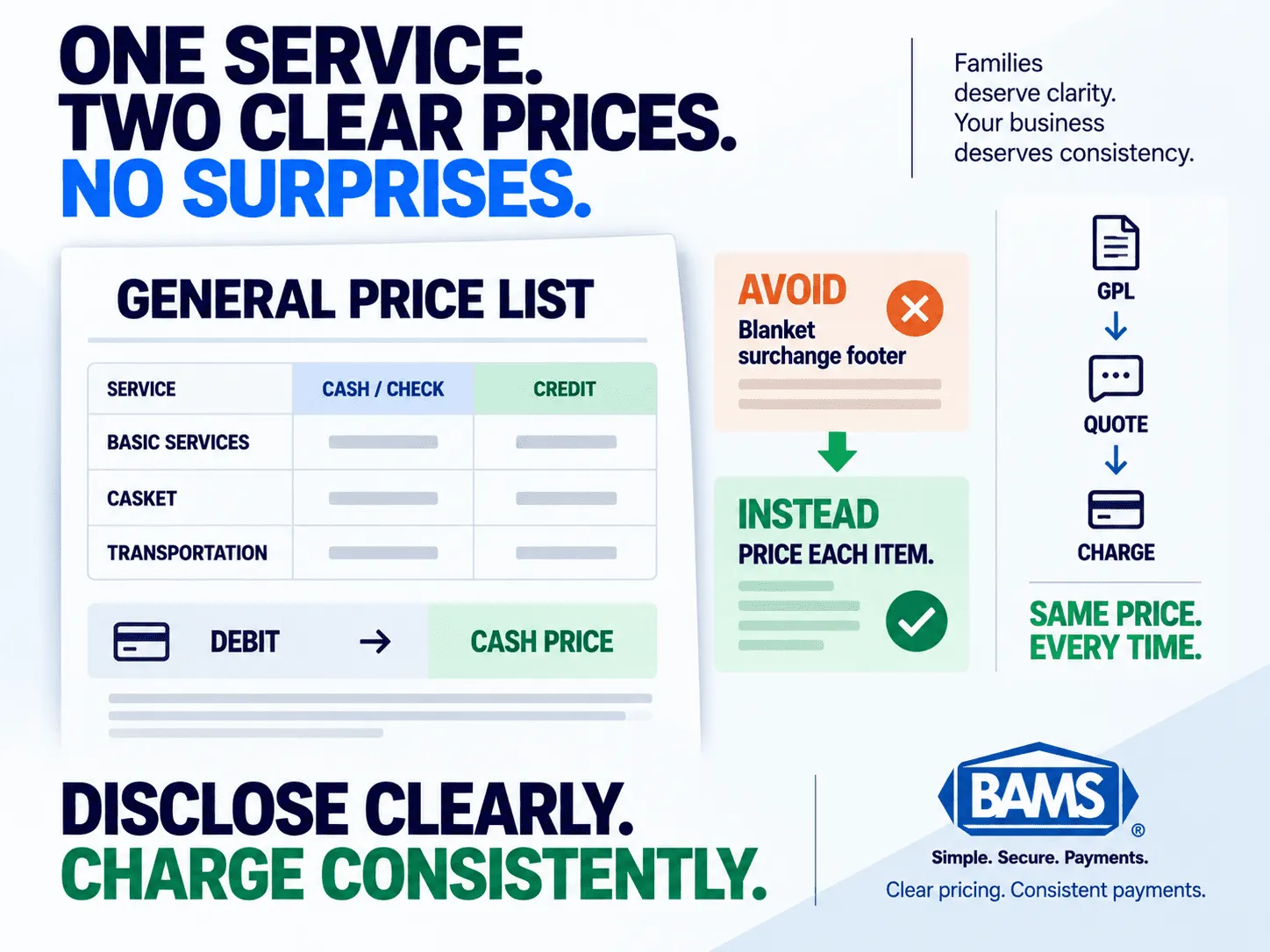
- Your GPL is a pricing instrument, not just a compliance form — It must accurately reflect what families pay based on how they pay, with dual pricing embedded at the line-item level rather than disclosed as a blanket surcharge footer.
- Debit and credit must be treated differently — Card network rules prohibit surcharging debit transactions. Your GPL needs to show debit at the cash price and credit at the higher price, or you risk fines and loss of card acceptance.
- Phone quotes must match the GPL exactly — The FTC found at least 33% of funeral homes gave package-only pricing over the phone. With dual pricing, every staff member needs to quote both payment-method prices for each item consistently.
- Review quarterly, not annually — Processing rates, interchange schedules, and state surcharging laws change. A dual-pricing GPL that reflects last year’s rates is inaccurate today and potentially non-compliant.
- Configure your payment processor for funeral-sized transactions — Default settings designed for retail can freeze funds or delay deposits on high-ticket funeral payments. Next-day funding and proper volume thresholds protect your cash flow.
Guide Orientation: What This Covers and Who It’s For
This guide examines how your General Price List functions as both a compliance document and an active pricing instrument, specifically when you operate a dual pricing structure for credit and cash payments. If you run a family-owned funeral home (one to ten locations) and accept card payments on high-ticket services, this is for you.
By the end, you’ll understand how to embed payment-method pricing at the line-item level on your GPL, maintain FTC Funeral Rule compliance while doing it, and avoid the cash flow gaps that emerge when preneed payment timing and processing costs aren’t accounted for in your price structure.
This guide does not cover preneed trust or insurance funding mechanics, state-specific preneed licensing, or embalming consent regulations. It focuses on the intersection of price disclosure, payment acceptance, and margin protection.

A General Price List is more than a compliance document. Clear line-item pricing helps families understand what they will pay while keeping payment-method pricing consistent from disclosure through checkout.
Why Dual Pricing on Your General Price List Matters Now
The FTC treats the GPL as the “keystone” of the Funeral Rule. It enables comparison shopping, itemized purchasing, and consumer protection. But the FTC wrote these rules before card surcharging became widespread, before processing fees on a $15,000 service could quietly consume $300 to $450 of your margin, and before families started expecting to pay by credit card as a default.
The result is a regulatory framework that demands granular price transparency layered on top of a payment landscape that introduces variable costs depending on how families pay. Most funeral operators treat the GPL as a static compliance checkbox: print it, hand it out, file it away. That approach leaves money on the table and creates compliance risk simultaneously.
A recent FTC undercover phone sweep found at least 37 funeral providers quoted different prices for the same services on different calls. That inconsistency often traces back to informal, undocumented dual pricing: staff quoting one number for cash and another for card without a GPL that supports both. The cost of getting this wrong isn’t just a warning letter. It’s eroded trust with grieving families and potential enforcement action from a regulator that is actively increasing scrutiny.
Core Concepts: The GPL, Dual Pricing, and Funeral Home Compliance
What the Funeral Rule Actually Requires
The FTC’s Funeral Rule requires funeral providers to give a General Price List to anyone who asks in person about funeral goods, services, or prices. The GPL must include itemized prices for goods and services sold, plus six required disclosures: the consumer’s right to choose only desired items, the basic services fee, and explanations of embalming requirements, casket requirements for cremation, alternative containers, and cash advance items.
What Dual Pricing Actually Means
Dual pricing for funeral services is the practice of displaying two prices for the same item: a cash (or non-card) price and a credit card price. This is distinct from surcharging, where a single listed price gets a fee added at checkout. Dual pricing embeds the cost difference into the listed price itself. Both approaches are legal in most states, but they carry different compliance implications when layered onto an FTC-regulated document like the GPL.
The Misconception That Costs Operators Money
Most operators believe they can add a single blanket disclosure (“a 3% surcharge applies to credit card payments”) at the bottom of their GPL and call it compliant. This is the checkbox approach. It fails for two reasons. First, surcharging rules vary by state, card network, and debit-versus-credit classification. Second, the Funeral Rule demands itemized transparency, which means a blanket surcharge disclosure can conflict with the spirit (and potentially the letter) of itemized pricing requirements. The operationally precise approach is to build payment-method pricing into each line item.
The Framework: Four Phases of GPL Pricing Precision
Structuring your GPL for dual pricing compliance is not a single task. It’s a four-phase process that moves from audit to implementation to verification to maintenance. Here’s the high-level structure:
- Phase 1: Audit — Map your current GPL against FTC requirements and identify where payment-method costs create undisclosed price variation.
- Phase 2: Structure — Rebuild line items to reflect dual pricing at the item level, not as a blanket footer.
- Phase 3: Operationalize — Train staff, configure payment systems, and align phone and in-person quoting with the updated GPL.
- Phase 4: Monitor — Establish review cycles that catch drift between your GPL, your actual charges, and your processing costs.
Each phase builds on the previous one. Skipping the audit and jumping to structure is how operators end up with a GPL that looks compliant but doesn’t match what families actually pay.
Step-by-Step: Building a Dual-Pricing GPL That Works
A dual-pricing GPL works only when the document, staff communication and payment system stay aligned. These six steps create a repeatable structure for maintaining pricing consistency.
Step 1: Audit Your Current GPL Against FTC Itemization Standards
Objective: Identify every gap between what your GPL says, what your staff quotes, and what families are actually charged at the point of payment.
Start by pulling your current GPL and comparing it against the FTC’s six required disclosures. Verify that every good and service you offer is individually listed with its own price. Then pull three months of transaction records from your payment processor and compare actual charges to GPL prices. Look for discrepancies: surcharges added at checkout that don’t appear on the GPL, package prices quoted over the phone without itemization, or cash advance items marked up without disclosure.
The FTC’s undercover sweep found that at least 33% of funeral homes provided package pricing for at least one service without giving itemized price information during phone calls. This is the most common audit finding: your GPL is itemized, but your staff defaults to packages when speaking with families. That gap is where compliance risk lives.
Anti-pattern: Treating the audit as a paper exercise. If you only review the GPL document without cross-referencing actual transaction data, you’ll miss the operational gaps that create real exposure.
Success indicator: You can match every line item on your GPL to a corresponding charge in your transaction records, and you can identify exactly where processing fees are currently absorbed versus passed through.
Step 2: Calculate True Cost Per Line Item by Payment Method
Objective: Know the exact margin impact of each payment method on every service and merchandise item you sell.
For each line item on your GPL, calculate the effective cost of accepting payment by credit card, debit card, and cash or check. Credit card processing on a $5,000 casket at 2.9% plus $0.30 costs you $145.30. On a $2,500 basic services fee, it’s $72.80. These numbers compound across a full service arrangement that can exceed $15,000.
Critically, separate debit from credit in your calculations. Most surcharging regulations (and all card network rules) prohibit surcharging debit card transactions, even when the debit card is run as credit. If your dual pricing structure doesn’t account for this distinction, you risk violating card network agreements and state law simultaneously. This is where many operators get tripped up: they treat “card payments” as a single category when the rules treat debit and credit as fundamentally different instruments.
Build a simple spreadsheet: column A lists every GPL item, column B shows the cash price, column C shows the credit card price (cash price plus your processing cost), and column D flags debit card handling. This becomes your pricing reference document.
Anti-pattern: Using a flat percentage across all items without verifying your actual interchange rates. Interchange varies by card type, transaction size, and how the card is processed. Your effective rate on a $12,000 transaction may differ significantly from your rate on a $200 one.
Success indicator: You have a line-by-line cost model that distinguishes credit, debit, and non-card payment methods, and it reflects your actual (not estimated) processing rates.
Step 3: Restructure the GPL with Embedded Dual Pricing
Objective: Produce a GPL that displays two clear prices per item where applicable, satisfies FTC itemization requirements, and eliminates ambiguity for families and staff.
This is the structural core of the process. For each line item, list the cash/check price and the credit card price side by side. The format should be clean and immediately understandable. Consider a two-column layout: “Price (Cash/Check)” and “Price (Credit Card).” At the top of the GPL, include a brief, plain-language explanation: “Prices shown reflect two payment options. The credit card price includes the cost of card processing. Debit card transactions are charged at the cash/check price.”
This approach does several things simultaneously. It satisfies the Funeral Rule’s itemization requirement because every item still has a specific, disclosed price. It eliminates the compliance risk of undisclosed surcharges because the price difference is built into the listed price, not added after the fact. And it gives families a transparent choice rather than a surprise fee at the point of sale.
For cash advance items (fees you pay on the family’s behalf, such as cemetery charges or death certificates), the FTC requires you to disclose whether you’re adding a service fee. If you mark up cash advance items, that markup must be disclosed. If you also apply dual pricing to those items, both the markup and the payment-method differential need to be visible.
Anti-pattern: Adding a single line at the bottom of the GPL that says “3% surcharge for credit card payments” instead of embedding the price difference at the item level. This blanket approach creates inconsistency when staff quote individual item prices and fails to address the debit/credit distinction.
Success indicator: A family reading your GPL can identify the exact price for any item under any payment method without asking a staff member to calculate it.
Step 4: Align Phone and In-Person Quoting with the Updated GPL
Objective: Ensure every price communicated to a family, whether in person, over the phone, or in writing, matches the GPL exactly.
The FTC’s undercover sweep involved calls to more than 250 funeral homes and found 38 calls where providers either refused to answer pricing questions or gave inconsistent pricing for identical services. The FTC has explicitly warned providers not to highlight only package prices during phone conversations about price. With dual pricing, the quoting challenge doubles: your staff now needs to communicate two prices per item accurately and consistently.
Create a phone script reference card that mirrors your GPL’s dual-price structure. When a caller asks “How much is your basic services fee?” the answer should be: “Our basic services fee is $2,500 if you pay by cash or check, or $2,575 if you pay by credit card. I can also walk you through itemized pricing for any other services you’re considering.” This isn’t optional polish. It’s compliance infrastructure.
Train every staff member who handles pricing inquiries. Role-play phone calls. Record and review calls quarterly if your state allows it. The goal is zero daylight between the GPL and the spoken quote.
Anti-pattern: Training staff once and assuming consistency. Quoting accuracy degrades over time, especially when staff turnover occurs. Build quoting accuracy into your regular operational reviews.
Success indicator: You can call your own funeral home from an outside line, ask about pricing, and receive an answer that matches your GPL word for word.
Step 5: Configure Payment Processing to Match Your GPL Structure
Objective: Ensure your payment terminal and processor settings reflect the dual pricing structure on your GPL so that the amount charged matches the amount disclosed.
Your payment processing setup needs to support the pricing you’ve committed to on paper. This means your terminal or point-of-sale system should be configured to present the correct price based on payment method, and your batch settlement timing should support your cash flow needs on high-ticket transactions.
For funeral homes processing transactions that regularly exceed $10,000 or $15,000, deposit timing directly affects cash flow. A $15,000 service paid by credit card on Friday that doesn’t settle until the following Wednesday creates a five-day gap during which you’ve already paid the embalmer, ordered the casket, and covered cemetery fees out of pocket. Next-day funding from your processor can close that gap and keep your operating account healthy.
A payment partner like BAMS offers next-day funding and transparent processing rates, which makes the cost-per-item calculations in Step 2 more predictable and your cash flow less dependent on settlement timing. When your processing costs are stable and your deposits arrive quickly, the dual pricing on your GPL stays accurate longer between reviews.
Review your merchant services default settings to confirm that batch timing, fraud filters, and volume thresholds are configured for the transaction sizes typical in funeral services. Default settings designed for retail transactions can trigger holds or delays on the high-ticket payments you process regularly.
Anti-pattern: Leaving your processor on default settings and absorbing the cash flow consequences. High-ticket transactions in funeral services require processor configuration that matches your actual business pattern, not a generic retail template.
Success indicator: Every card transaction settles within one business day, the amount charged matches the credit card price on your GPL, and no manual adjustments are needed at the point of sale.
Step 6: Establish a Review Cycle That Catches Pricing Drift
Objective: Prevent your GPL from becoming stale as processing rates, state regulations, and service costs change.
A dual-pricing GPL is a living document. Your processing rates may change when you renegotiate your merchant agreement or when card networks adjust interchange schedules. State surcharging laws evolve. Your own service costs shift as supplier prices move. Any of these changes can create a gap between your GPL prices and your actual costs, which means either you’re overcharging families (a trust problem) or undercharging on card payments (a margin problem).
Set a quarterly review cycle. Each quarter, pull your effective processing rate from your merchant statement and compare it to the rate baked into your GPL’s credit card prices. If the variance exceeds 0.25%, update the GPL. Simultaneously, check for any state regulatory changes affecting surcharging or dual pricing in your jurisdiction. Some states prohibit surcharging entirely; others have recently changed their rules. Your GPL must reflect the current legal landscape, not the one that existed when you printed it.
Document every GPL revision with a date stamp and keep prior versions on file. If the FTC or a state regulator ever questions your pricing, you want a clear paper trail showing when each version was active and what prompted each change.
Anti-pattern: Updating the GPL only when you change service prices. Processing cost changes can shift your dual pricing even when your base service prices stay the same.
Success indicator: You have a dated log of GPL revisions, your current GPL reflects processing rates from the most recent quarter, and you can demonstrate compliance with your state’s current surcharging rules.
Practical Example: How This Looks in Practice
Scenario: A Mid-Size Funeral Home with Two Locations
Consider a family-owned operation running two locations, averaging 200 services per year with an average arrangement value of $9,500. Roughly 65% of families pay by credit card. Under a flat 2.9% processing rate, that operator is absorbing approximately $35,900 per year in processing costs on card transactions alone.
Before restructuring, this operator had a single-price GPL with a footer note: “A 3% convenience fee applies to credit card payments.” Staff quoted the single price on the phone and mentioned the surcharge only at the arrangement conference. Two problems: the footer didn’t distinguish debit from credit (violating card network rules on debit surcharging), and the phone quotes didn’t match the final charge (creating FTC risk).
After Restructuring
The operator rebuilt the GPL with dual columns. The basic services fee showed $2,495 (cash/check) and $2,567 (credit card). Every line item followed the same pattern. Staff received updated phone scripts. The payment terminal was reconfigured to present the correct price based on payment method selection. Debit transactions were routed at the cash price.
The result: no more surprised families at checkout, consistent phone quotes that matched the GPL, clean debit/credit separation, and approximately $35,000 in processing costs now transparently recovered through the credit card price column rather than silently absorbed. The operator also switched to a processor with next-day funding, which eliminated the three-to-five-day cash flow gaps that had previously required maintaining a $40,000 operating reserve. That freed capital went toward facility improvements.
Common Mistakes and Pitfalls
Treating debit and credit as the same thing. Card network rules prohibit surcharging debit transactions. If your dual pricing doesn’t separate them, you’re exposed to fines and potential loss of card acceptance privileges.
Quoting package prices without itemization. The FTC has made clear that package-only quoting, especially over the phone, is a compliance failure. Dual pricing makes this worse because a package price that doesn’t specify payment method is doubly ambiguous.
Updating the GPL only annually. Processing rates, interchange schedules, and state laws can change mid-year. A quarterly review cycle is the minimum for a dual-pricing GPL.
Assuming your processor’s default settings work for funeral services. High-ticket transactions behave differently than typical retail charges. Default fraud filters and volume thresholds can trigger frozen funds on exactly the transactions that matter most to your cash flow.
Forgetting cash advance item disclosure. If you mark up cash advance items and apply dual pricing, both layers of cost must be visible on the GPL. Stacking undisclosed fees is a fast path to regulatory trouble.
What to Do Next
Start with Step 1. Pull your current GPL and your last three months of transaction records. Spend one hour comparing them. You’ll likely find at least one gap between what the GPL says and what families are actually charged. That gap is your starting point.
You don’t need to overhaul everything at once. Restructuring a GPL for dual pricing is a process that benefits from careful, incremental work. Get the audit right first. Then build your cost model. Then restructure the document. Each phase makes the next one easier.
Revisit this guide as your processing rates change, as your state’s surcharging rules evolve, or as the FTC updates its Funeral Rule guidance. The goal isn’t a perfect document today. It’s a pricing instrument that stays accurate, transparent, and compliant over time.
Frequently Asked Questions
What is the FTC Funeral Rule and why does it affect my pricing?
The FTC Funeral Rule requires funeral providers to give consumers a General Price List with itemized prices for all goods and services. It exists to enable comparison shopping and prevent bundling that obscures costs. If you accept card payments and want to reflect processing costs in your pricing, the Funeral Rule’s itemization requirements dictate how you must structure and disclose those price differences.
Can I just add a surcharge line at the bottom of my GPL instead of dual pricing each item?
Technically, a blanket surcharge disclosure is one approach, but it creates operational and compliance risks. Staff quoting individual item prices over the phone won’t naturally include the surcharge, leading to inconsistencies the FTC has flagged in recent enforcement sweeps. Embedding the price difference at the line-item level keeps your quotes, your GPL, and your actual charges aligned.
Which payment methods can I apply dual pricing or surcharges to?
Credit card transactions can generally be surcharged or dual-priced in most states, but debit card transactions cannot be surcharged under card network rules (Visa and Mastercard both prohibit it). This means your GPL must treat debit cards at the cash/check price, not the credit card price. Some states also prohibit credit card surcharging entirely, so verify your state’s current rules before implementing any dual pricing structure.
How often should I update my General Price List?
At minimum, review your GPL quarterly. Processing rates, interchange schedules, and state surcharging laws can change mid-year. If your dual pricing is based on a processing rate that has shifted by more than 0.25%, your GPL prices no longer reflect your actual costs. Keep dated records of every revision.
How does the FTC Funeral Rule affect phone pricing inquiries?
The FTC requires funeral providers to give itemized price information over the phone to any caller who asks. The agency’s recent undercover sweep found that at least 33% of funeral homes provided only package pricing without itemization during phone calls. With a dual-pricing GPL, your staff must communicate both the cash and credit card price for each item when asked, not just a single number.
What happens if my GPL prices don’t match what I actually charge?
Inconsistency between your GPL and actual charges is a compliance violation that the FTC actively investigates. Their recent sweep found at least 37 providers quoting different prices on different calls. Beyond regulatory risk, inconsistent pricing erodes trust with families during an already difficult time. Aligning your GPL, your point-of-sale system, and your staff’s verbal quotes is essential.
Sources
- Federal Trade Commission: Complying with the Funeral Rule
- Federal Trade Commission: FTC Staff Issues Report on Undercover Funeral Rule Phone Sweep
- Federal Trade Commission: FTC Sends Warning Letters to Funeral Homes After First Undercover Phone Sweep
- Federal Trade Commission: When Consumers Call Funeral Homes


