
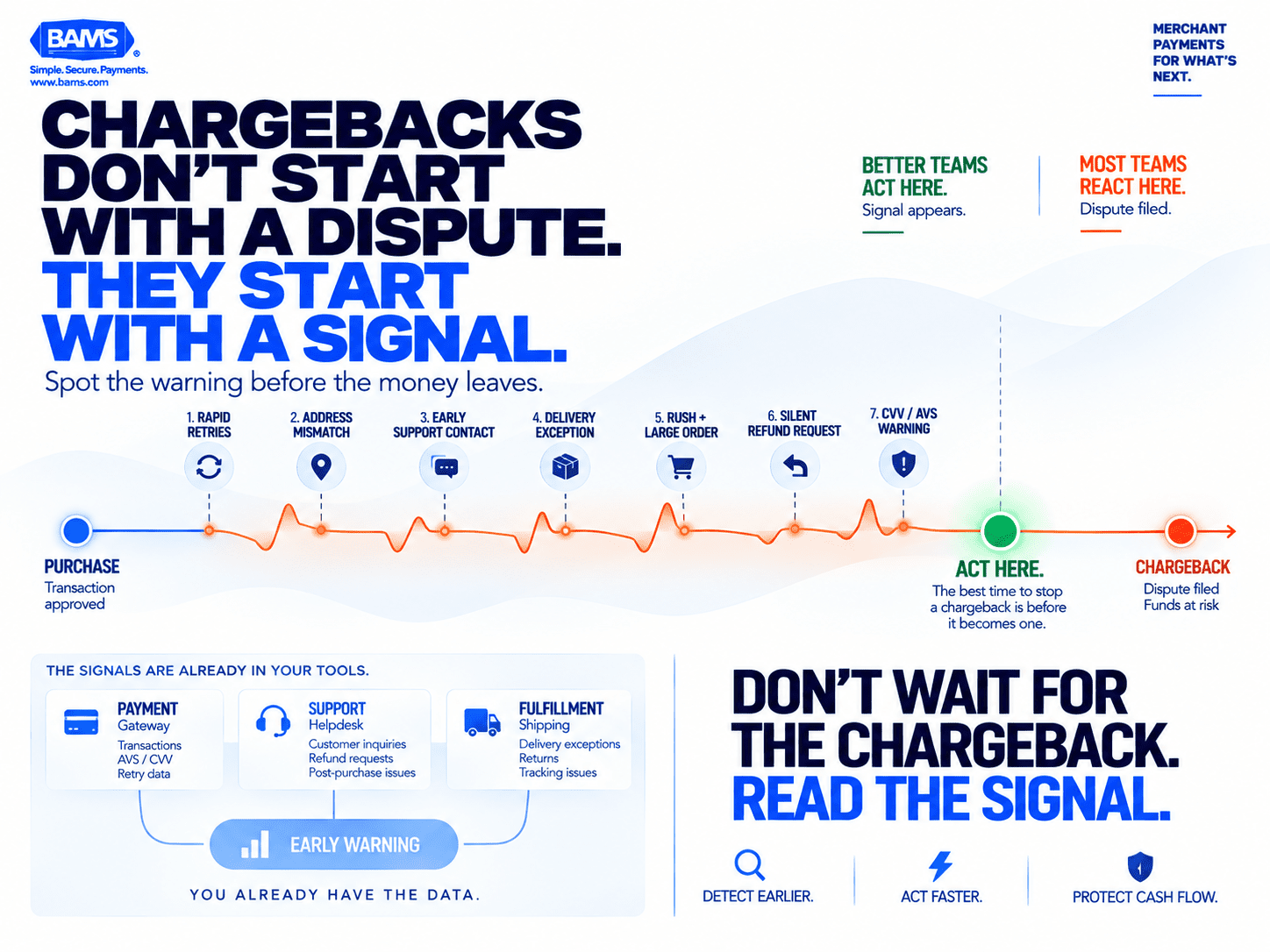
7 Fraud Prevention Signals That Predict Chargebacks
Last Updated on September 23, 2026 by Dimitri Akhrin
Spot transaction red flags before the dispute window opens and protect your weekly cash flow
Learn seven specific transaction signals that predict chargebacks before they hit your merchant account. Each signal comes with a concrete action step designed for eCommerce teams without enterprise tooling or dedicated fraud analysts.
TL;DR
- Chargebacks are predictable – Seven observable signals (velocity retries, address mismatches, early support contacts, delivery exceptions, new-customer rush orders, silent refund requests, and CVV/AVS soft failures) appear before a dispute is filed. Acting on them changes the outcome.
- Your existing tools surface these signals – You don’t need enterprise fraud platforms. Your payment gateway logs, helpdesk tickets, and shipping dashboard already contain the data. The gap is process, not technology.
- Short-term friction protects long-term cash flow – Holding a shipment for 24 hours or proactively issuing a refund feels costly in the moment, but it preserves your dispute ratio, which directly controls your deposit speed and processing rates.
- Dispute ratios affect everything downstream – A climbing chargeback ratio triggers reserve holds, slower funding, and rate increases. Keeping it below 0.5% is the single most impactful thing you can do for predictable cash flow.
- Start with two signals this week – Pull your gateway’s transaction detail report and your helpdesk’s post-purchase tickets. Cross-reference them. Address the two most frequent signals first, then expand.
Chargebacks Don’t Start with a Dispute. They Start with a Signal.
Every chargeback that hits your merchant account started somewhere upstream. A confused customer. A shipping delay. A transaction that looked fine at checkout but carried quiet risk. For eCommerce operators managing cash flow management week to week, the real cost isn’t just the $237 average mid-market chargeback. It’s the deposit hold, the reserve increase, and the processing rate hike that follow.
Most chargeback content tells you what to do after you’ve already lost the dispute. That’s too late. Chargeback volume is projected to reach 337 million transactions by 2026, a 42% increase from 2023. The merchants who protect their revenue are the ones reading the signals before the dispute window opens.
This piece identifies seven specific transaction signals that predict chargebacks, and gives you a concrete action for each one. No enterprise-scale tooling required. No fraud team of 15 assumed.
Who This Is For (and What It Skips)
This is for eCommerce managers at established online businesses with 10 to 50 employees. You process enough volume that chargebacks aren’t rare events, but you don’t have a dedicated fraud analyst on staff. You feel chargebacks in your cash flow, not just your loss reports.
We’re not covering PCI compliance checklists, enterprise fraud orchestration platforms, or post-loss representment strategy. This is pre-dispute territory: the window between a transaction completing and a customer calling their bank. That window is where your money either stays or disappears.
How We Selected These Seven Signals
Each signal meets three criteria. First, it’s observable with tools most SMB eCommerce operators already have (your payment dashboard, helpdesk, shipping platform, or analytics). Second, it appears before the dispute is filed. Third, acting on it changes the outcome. We excluded signals that require machine learning infrastructure or real-time scoring engines outside a mid-market budget.

Chargebacks rarely appear without warning. Transaction behavior, customer contact and fulfillment problems can reveal risk before the dispute window opens.
Seven Payment Decline Signals That Predict Chargebacks
1. Multiple Authorization Attempts on the Same Card Within Minutes
Why it matters: Rapid-fire retries on a single card number often indicate either a stolen card being tested or a frustrated customer hammering the checkout button. Both paths lead to disputes. The first because the cardholder didn’t authorize the charge. The second because the customer may accidentally create duplicate orders, then dispute the extras.
What it looks like today: Your payment gateway logs show two or more authorization attempts from the same card in under five minutes, sometimes with slightly different billing details. Most basic gateway dashboards surface this if you know where to look.
How to apply it: Set a velocity rule that flags or soft-declines the third attempt within a five-minute window. Review flagged transactions manually before fulfillment. If the order looks legitimate, reach out to the customer directly before shipping. This single rule catches a disproportionate share of both fraud and accidental duplicates.
2. Billing and Shipping Address Mismatch on High-Value Orders
Why it matters: Address mismatches aren’t inherently fraudulent. People send gifts. But when the mismatch appears on orders significantly above your average order value, the chargeback probability climbs. Mastercard reports that the average chargeback amount in the U.S. is $110, before internal and third-party costs are added, so a single high-value dispute can wipe out the margin on dozens of clean transactions.
What it looks like today: Your AVS (Address Verification System) returns a partial match or mismatch code. The order total is 2x or more above your store’s average. The shipping address is in a different state or country from the billing address.
How to apply it: Don’t auto-cancel these orders. Instead, hold fulfillment and send a brief verification email: “We want to make sure your order arrives at the right address. Can you confirm the shipping details?” Legitimate customers respond quickly. Fraudsters don’t. A 24-hour hold on flagged orders costs you almost nothing in customer experience but saves you from preventable chargebacks that delay your deposits.
3. Customer Service Contact Within 48 Hours of Purchase
Why it matters: A customer who contacts support immediately after ordering is telling you something is wrong. Maybe they don’t recognize the charge on their statement, maybe they regret the purchase and maybe shipping expectations weren’t clear. David Schneider of Chargebacks911 has noted that “friendly fraud” is now one of the most consequential drivers of merchant losses, and these disputes often start with a customer who felt confused or ignored.
What it looks like today: Your helpdesk shows a ticket or chat initiated within 48 hours of a completed transaction. The subject line mentions “charge,” “cancel,” “didn’t order,” or “when will it ship.” These are pre-dispute conversations disguised as support requests.
How to apply it: Tag these tickets as chargeback-risk in your helpdesk. Prioritize them. Resolve within 24 hours. If the customer wants a refund, process it immediately. A $50 refund today prevents a $50 chargeback plus $25 in fees next month. Train your support team to treat early contacts as revenue protection, not cost centers.
4. Delivery Exception or Tracking Showing “Undeliverable”
Why it matters: A package that never arrives is one of the most common triggers for a legitimate chargeback. The customer paid. They didn’t get the product. Their bank sides with them almost every time. U.S. merchants faced chargeback volumes between $8 billion and $11 billion in 2023, and fulfillment failures account for a significant share.
What it looks like today: Your shipping platform shows a delivery exception, return-to-sender status, or address correction flag. The customer hasn’t received a proactive update from you. They’re checking tracking on their own, getting frustrated, and considering a bank dispute.
How to apply it: Set up automated alerts from your shipping platform for any delivery exception. When one fires, contact the customer within hours (not days) with options: reship, refund, or updated delivery timeline. Document every communication. If a dispute still lands, your proactive outreach becomes compelling evidence in your response.
5. First-Time Customer Using Expedited Shipping on a Large Order
Why it matters: This combination (new account, high cart value, fastest shipping option) is a classic fraud pattern. The fraudster wants the goods delivered before the real cardholder notices the charge. It also correlates with “friendly fraud” where a buyer intends to dispute after receiving the product.
What it looks like today: Your order dashboard shows a customer with no purchase history selecting overnight or two-day shipping on an order that’s 3x or more above your average. The email address may be recently created. The phone number may not match the billing area code.
How to apply it: Add a manual review step for first-time orders above a dollar threshold you set (your AOV multiplied by 2.5 is a reasonable starting point). Verify the email is deliverable. Call the phone number on file. If you can’t verify, delay shipment by one business day and notify the customer. Most legitimate buyers understand. Most fraudsters abandon.
6. Refund Request That Gets No Response After You Ask for Details
Why it matters: A customer who requests a refund, then goes silent when you ask a follow-up question, is likely preparing to dispute through their bank instead. They’ve already decided the merchant channel is too slow or too difficult. That silence is your signal that a chargeback is 7 to 14 days away.
What it looks like today: Your helpdesk shows an open refund request with your follow-up question unanswered for 72 or more hours. The customer hasn’t replied to your email or returned your call. The order status shows delivered.
How to apply it: After 72 hours of silence on a refund request, process the refund proactively. Yes, this feels counterintuitive. But a voluntary refund costs you the product margin. A chargeback costs you the product margin plus the chargeback fee plus a ding on your dispute ratio. If your dispute ratio climbs above processor thresholds, your deposit speed slows and your rates increase. Protecting your ratio protects your cash flow management. Tools like BAMS’ proactive chargeback defense can help you monitor these patterns and intervene before disputes escalate, especially when paired with next-day funding that keeps your operating cash predictable.
7. Transaction Approved Despite CVV or AVS Partial Failure
Why it matters: Many payment gateways are configured by default to approve transactions even when CVV or AVS checks return partial mismatches. This keeps approval rates high but quietly increases your fraud prevention exposure. These “soft failures” are among the most reliable payment decline signals that a transaction will become a dispute.
What it looks like today: Your gateway logs show response codes like “N” (no match) for AVS or “M” (mismatch) for CVV, but the transaction was still approved. You may not even see these codes unless you actively review your gateway’s detailed transaction reports.
How to apply it: Audit your gateway settings. Tighten your rules to decline transactions with CVV mismatches entirely and to flag (not necessarily decline) AVS partial matches for manual review. You’ll see a small dip in approval rates, but the transactions you lose are disproportionately the ones that would have become chargebacks. For a deeper walkthrough on configuring these filters, see this guide on building a chargeback management system that actually works.
Chargeback risk often appears before the dispute itself. These seven signals can help eCommerce teams identify risky transactions and customer issues early enough to intervene.
The Pattern Across All Seven Signals
Notice what connects these signals: none of them require sophisticated fraud-scoring AI. They require attention, process, and speed. Every signal is visible in tools you already pay for (your gateway dashboard, shipping platform, helpdesk, and CRM). The merchants who avoid chargebacks aren’t necessarily spending more on technology. They’re responding faster to the information they already have.
There’s also a common tradeoff running through each item: short-term friction versus long-term protection. Holding a shipment for 24 hours, calling a customer to verify, or proactively issuing a refund all feel like they slow you down. But each action preserves your dispute ratio, which directly affects your deposit speed, processing rates, and reserve requirements. Faster deposits and lower fees are downstream effects of upstream vigilance.
As the Mastercard/Ethoca Outlook Report notes, the gap between transaction growth and dispute-management capacity is widening. The merchants who close that gap at the signal level, not the dispute level, are the ones who turn payments into a growth lever instead of a liability.
Where to Start This Week
You don’t need to implement all seven actions simultaneously. Start with the two that match your current pain point. If you’re seeing duplicate orders and confused customers, begin with Signal 1 (velocity rules) and Signal 3 (early support contact triage). If you’re losing disputes on fulfilled orders, start with Signal 4 (delivery exceptions) and Signal 7 (CVV/AVS settings).
Block 90 minutes this week to pull your gateway’s detailed transaction report and your helpdesk’s post-purchase ticket log. Cross-reference them. You’ll likely find two or three of these signals already present in your data, unaddressed. That’s where your chargeback prevention ROI starts. For a broader framework on connecting these signals to faster deposits and payment optimization, that guide walks through the full infrastructure layer.
Frequently Asked Questions
What are common payment challenges that eCommerce merchants face with chargebacks?
The biggest challenges are identifying disputes before they’re filed, managing the cash flow impact of holds and reserves, and keeping dispute ratios below processor thresholds. Most merchants only engage with chargebacks after they’ve lost the money, which limits recovery options and increases long-term costs through higher processing rates.
How do false declines impact customer relationships?
False declines (legitimate transactions that get rejected) frustrate customers and often push them to competitors. However, the opposite problem is equally damaging: approving risky transactions that become chargebacks. The goal is calibrating your fraud filters to catch genuine risk signals without blocking good customers. Tightening CVV rules while keeping AVS flags as manual-review triggers (rather than hard declines) is a practical middle ground.
When should merchants conduct a payment processing audit?
At minimum, quarterly. Review your gateway’s response codes, your chargeback ratio trend, your average dispute dollar amount, and your deposit timing. If you notice your dispute ratio climbing above 0.5%, audit immediately. Many processors adjust funding speed and reserve requirements based on this ratio, so catching a trend early protects your cash flow.
Which factors affect the speed of payment deposits for eCommerce businesses?
Three primary factors: your chargeback and dispute ratio, your processing volume consistency, and your processor’s funding model. Merchants with low dispute ratios and consistent volume typically qualify for next-day funding. High dispute ratios trigger reserve holds and slower settlement, sometimes extending deposits to 3 to 5 business days.
How does “friendly fraud” differ from traditional fraud, and why does it matter for SMBs?
Traditional fraud involves stolen card data. Friendly fraud involves a real cardholder who makes a legitimate purchase and then disputes the charge, often claiming they didn’t receive the item, didn’t authorize the purchase, or weren’t satisfied. It matters for SMBs because these transactions pass all fraud filters at checkout. The only way to catch them is through post-purchase signals like early support contacts, silent refund requests, and delivery exceptions.
How can NYC eCommerce businesses optimize payment processing to reduce declines and disputes?
Start by auditing your gateway’s AVS and CVV settings to ensure you’re not auto-approving risky transactions. Set velocity rules to catch rapid retry attempts and prioritize post-purchase support tickets that mention charges or cancellations. Working with a NYC merchant services provider that offers transparent pricing and proactive chargeback support can also help you intervene before disputes reach the network level.
Sources
- https://464903.fs1.hubspotusercontent-na1.net/hubfs/464903/2023%20Case%20Studies%20and%20whitepapers/2024%20Outlook%20Report%20Ethoca.pdf
- https://www.mastercard.com/mt/en/news-and-trends/insights/2025/what-s-the-true-cost-of-a-chargeback-in-2025.html
- https://merchantriskcouncil.org/learning/resource-center/member-news/news/2024/chargeback-gurus-releases-comprehensive-suite-of-industry-reports


