PCI Compliance for Funeral Homes: A Practical Guide
Last Updated on November 10, 2026 by Dimitri Akhrin
Guide Orientation: What This Covers and Who It’s For
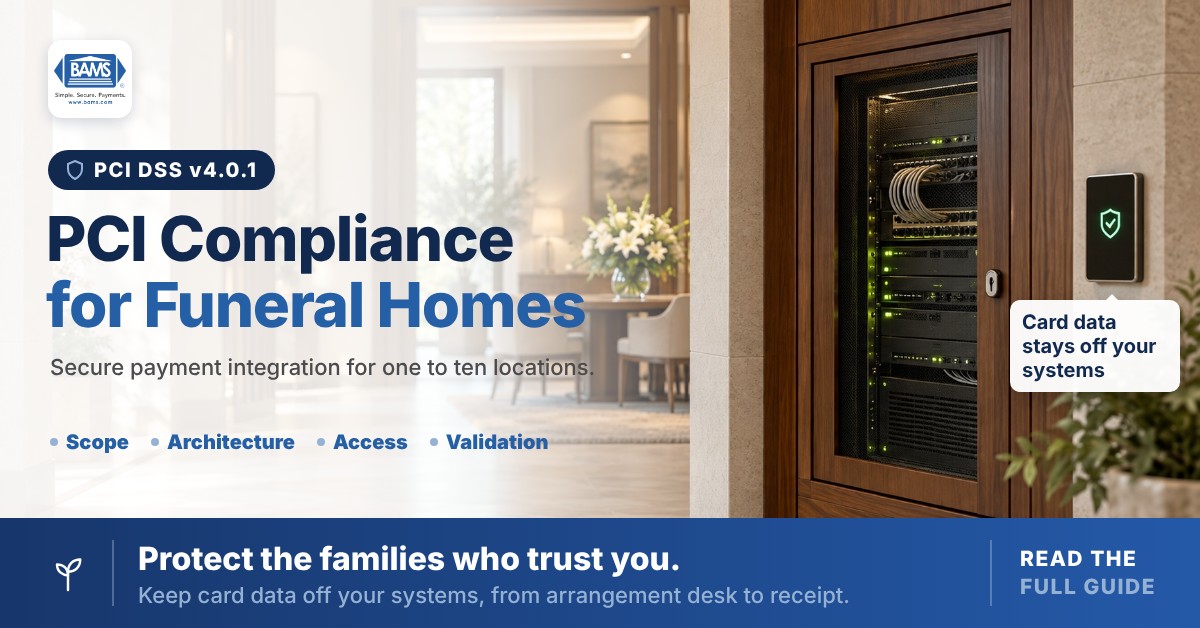
This guide walks you through PCI compliance for funeral homes that use integrated payment systems. It covers the specific requirements, architecture decisions and staff practices that protect cardholder data when you process high-value, sensitive transactions.
It’s written for family-owned funeral home operators managing one to ten locations who regularly handle transactions exceeding $15,000. If you accept credit cards at an arrangement desk, through an online portal, or over the phone, this applies to you.
By the end, you’ll understand how PCI DSS v4.0.1 requirements map to your daily operations, how to choose and configure a secure payment integration that reduces your compliance scope and how to build repeatable practices that protect both your families and your business. This guide does not cover Level 1 merchant requirements or enterprise-scale implementations. It focuses on practical, right-sized compliance for small-to-midsize operators.
TL;DR
- PCI compliance applies to you, even with a third-party gateway – Using a payment gateway reduces your scope but doesn’t eliminate your responsibilities. You still own access controls, network segmentation, staff training and monitoring.
- Architecture choices determine your compliance burden – Hosted payment pages and P2PE terminals keep raw card data off your systems, which can qualify you for shorter Self-Assessment Questionnaires and reduce your risk.
- Staff behavior is your biggest vulnerability – Writing card numbers on paper, sharing terminal logins, or emailing card data are common funeral home practices that create serious PCI violations. Train every person who touches payment information.
- PCI DSS v4.0.1 requirements are in force now – The v4.0 update brought more than 50 enhancements (including expanded multi-factor authentication and web-application controls) and the last of them became mandatory on March 31, 2025. If you haven’t implemented them, you’re behind.
- Compliance is a continuous practice, not an annual event – Map your cardholder data environment, review logs weekly, update systems monthly and revisit your SAQ annually. Build compliance into operations, not onto a project timeline.
Why PCI Compliance Matters for Funeral Home Payment Processing
Funeral homes occupy a unique position in the payments landscape. Your transactions are large, emotionally charged and often completed under time pressure. A family selecting a casket, vault and service package may authorize $8,000 to $25,000 in a single interaction. That dollar volume, combined with the trust families place in your operation, makes your payment environment a high-value target.
PCI compliance isn’t a bureaucratic exercise. It’s the structural decision that shapes whether a data breach becomes a costly forensic investigation or never happens at all. That’s why PCI compliance for funeral homes starts with how payments enter your building, not with paperwork.
The regulatory landscape is also shifting beneath you. PCI DSS v4.0 introduced more than 50 enhancements, including stronger authentication requirements, phishing protections and web-application controls. The PCI Security Standards Council retired v4.0 at the end of 2024 in favor of v4.0.1 and the future-dated requirements became effective on March 31, 2025. This is an active operating requirement, not a one-time certification.
For a funeral home, the cost of inaction isn’t abstract. A breach during an arrangement conference doesn’t just expose card numbers. It fractures the trust that families extend to you during the most vulnerable moment of their lives. Compliance is the infrastructure that preserves that trust.
Core Concepts: PCI DSS, Scope and Your Payment Gateway
What PCI DSS Actually Requires
PCI DSS (Payment Card Industry Data Security Standard) is a set of technical and operational requirements that apply to any entity storing, processing, or transmitting payment card data. As the Federal Reserve Bank of Atlanta explains, these requirements span network security, vulnerability management, access controls, monitoring and written security policies. They cover the complete payment journey, not just the moment a card is swiped.
Scope: The Most Misunderstood Concept
Your “compliance scope” includes every system, person and process that touches cardholder data. Many funeral home operators assume that using a third-party payment gateway eliminates their PCI obligations. It doesn’t. PCI DSS still applies to merchants that rely on third-party gateways. What a good gateway does is reduce your scope by handling the most sensitive operations (encryption, tokenization, storage) so your own systems never see raw card numbers.
Key Distinctions
Tokenization replaces card data with a substitute value that is useless if stolen. Encryption scrambles data so only authorized systems can read it. Segmentation isolates your payment systems from the rest of your network. These three concepts form the foundation of every architectural decision in this guide. Understanding them helps you evaluate vendors, configure systems and train staff with clarity rather than guesswork.
A common misconception: PCI compliance is a product you buy. In reality, it’s a continuous practice. Tools enable it, but your processes sustain it.
The Framework: Four Phases of Secure Payment Integration
PCI compliance for funeral homes with integrated payment systems follows four interconnected phases. Each phase builds on the previous one and skipping ahead creates gaps that auditors (and attackers) will find.
- Phase 1: Scope Assessment – Map every point where card data enters, moves through, or is stored in your operation.
- Phase 2: Architecture Selection – Choose a payment gateway and integration model that minimizes your compliance surface.
- Phase 3: Operational Controls – Implement the staff practices, access rules and monitoring that PCI DSS requires.
- Phase 4: Validation and Maintenance – Complete your Self-Assessment Questionnaire, test your systems and establish a recurring compliance rhythm.
These phases are not a one-time project. They form a cycle you revisit as your business adds locations, changes software, or updates hardware. The goal is a payment environment where compliance is embedded in how you operate, not layered on top of it.

Scope, architecture, access controls and validation, plus the SAQ your setup points to.
Step-by-Step Breakdown: Building PCI-Compliant Payment Operations
Step 1: Map Your Cardholder Data Environment
Objective: Identify every system, device and person that touches payment card data so you know exactly what needs protecting.
Start by tracing a transaction from the moment a family provides payment information to the moment the funds settle in your bank account. In a typical funeral home, card data may enter through a countertop terminal at the arrangement desk, a virtual terminal used for phone orders, an online payment link sent via email, or a card-on-file process for installment plans.
Document each entry point. Then trace where that data flows. Does your funeral management software store card numbers? Does your staff write card details on paper forms before keying them into a terminal? And does your accounting system receive cardholder data from your payment processor? Each “yes” expands your compliance scope and adds systems you must secure.
Anti-patterns: Don’t assume your software vendor handles everything. Don’t overlook paper-based processes (a sticky note with a card number is a PCI violation). Never forget phone-based transactions, which are common in funeral services when families authorize payments remotely.
Success indicators: You have a written diagram showing every entry point, data flow and storage location for cardholder data. Every staff member who touches card data is identified by role. No card data moves through a channel you haven’t documented.
Step 2: Choose the Right Payment Gateway and Integration Model
Objective: Select a gateway architecture that handles the heaviest PCI requirements so your funeral home systems never store or process raw card data.
The single most impactful compliance decision you’ll make is how your payment gateway integrates with your operations. There are three common models and they carry very different compliance burdens:
- Redirect/hosted payment page: Families enter card details on a page hosted entirely by your gateway provider. Your systems never see the card number. This is the lowest-scope option and works well for online payment links.
- Iframe/embedded form: The payment form appears on your website but is actually served by the gateway. Card data goes directly to the gateway without passing through your server. Good balance of branding and security.
- Direct API integration: Your system collects card data and sends it to the gateway via API. This gives you maximum control but maximum compliance scope. Avoid this unless you have dedicated IT security resources.
For most funeral homes, a hosted payment page for online transactions combined with a PCI-validated payment gateway for in-person terminals provides the best balance. Your terminals should support point-to-point encryption (P2PE), which encrypts card data at the moment of swipe or tap, before it ever reaches your network.
What to Ask Payment Gateway Providers
When evaluating providers, ask for their PCI Attestation of Compliance (AOC). Confirm they support tokenization so you can reference past transactions (for refunds or installment plans) without storing actual card numbers. A merchant services partner like BAMS offers PCI Compliance support and tokenized storage of customer payment information, plus next-day funding for qualifying merchants that keeps cash flow moving during busy service periods.
Anti-patterns: Don’t select a gateway based solely on transaction fees without evaluating its PCI architecture. Don’t use a gateway that requires you to store card numbers locally for recurring billing. Never let your web developer build a custom payment form that routes card data through your server.
Success indicators: Your gateway provider holds a current PCI DSS AOC. Card data never passes through or is stored on your own systems. You can process in-person, phone and online transactions through a unified, PCI-validated platform.
Step 3: Implement Access Controls and Staff Protocols
Objective: Ensure that only authorized staff interact with payment systems and that every access event is traceable.
PCI DSS v4.0 expanded multi-factor authentication (MFA) requirements significantly. MFA is now required for all access into the cardholder data environment, which for most funeral homes means every virtual terminal and payment administration portal login. Turn it on wherever your gateway offers it. This means combining something they know (password) with something they have (phone, security key) or something they are (fingerprint).
Assign unique login credentials to each staff member. PCI DSS restricts shared logins (“the front desk password”) because they make it impossible to trace who did what. When a staff member leaves, deactivate their credentials the same day. Review access lists quarterly.
Create a written policy for handling card data during arrangement conferences. If a family provides a card number over the phone, the staff member should key it directly into the virtual terminal. Never write it down, never email it, never store it in your funeral management software’s notes field. If your current workflow involves paper credit card authorization forms, transition to electronic authorizations through your gateway’s secure portal.
Anti-patterns: Don’t allow shared terminal logins. Don’t store card numbers in email, spreadsheets, or CRM notes. Never skip MFA because it feels inconvenient. Don’t assume that low staff turnover means access reviews are unnecessary.
Success indicators: Every staff member has a unique login with MFA enabled. No card data exists in email, paper files, or non-payment software. You have a written card-handling policy that staff have signed and can reference.
Step 4: Segment and Secure Your Network
Objective: Isolate your payment systems from the rest of your business network so that a compromise in one area doesn’t expose cardholder data.
Network segmentation is the practice of placing your payment terminals and payment-related systems on a separate network from your general business computers, Wi-Fi and guest networks. In a funeral home, this might mean your arrangement office terminal connects to a dedicated VLAN (virtual local area network) that cannot communicate with the computers your staff use for email, web browsing, or funeral management software.
If you offer guest Wi-Fi in your facilities (and most funeral homes do), that network must be completely isolated from any system that processes payments. A compromised guest device should have zero path to your payment terminals.
Install and maintain a firewall between your payment segment and everything else. Keep all payment-related software updated. Only about half of organizations in Verizon’s 2024 Payment Security Report maintain a sustainable capability to develop and maintain secure systems and software. You can outperform that benchmark by enabling automatic updates on terminals and scheduling monthly checks on your firewall rules.
Anti-patterns: Don’t run payment terminals on the same network as your office computers. Don’t allow staff to browse the internet on machines connected to the payment network. Never ignore firmware updates on terminals because “they’re still working fine.”
Success indicators: Payment systems operate on an isolated network segment. A vulnerability scan of your general network reveals no path to payment devices. Firewall rules are documented and reviewed quarterly.
Step 5: Establish Monitoring and Incident Response
Objective: Detect suspicious activity in real time and have a documented plan for responding to a potential breach.
PCI DSS requires logging and monitoring of all access to network resources and cardholder data. For a funeral home, this means your payment gateway’s admin portal should log every login, transaction and configuration change. Your firewall should log traffic between network segments. These logs must be retained and reviewed.
You don’t need a security operations center. You need a weekly routine: check your gateway’s transaction logs for unusual patterns (unexpected refunds, transactions at odd hours, repeated declined cards). Check your firewall logs for blocked connection attempts from your general network to your payment segment. Many gateways and processors offer reporting and analytics tools that make unusual activity easier to spot.
Write a one-page incident response plan. It should answer: Who do we call if we suspect a breach? (Your payment processor, your bank and potentially a PCI forensic investigator.) What systems do we isolate? How do we notify affected families? Having this plan before you need it is a PCI requirement and a practical necessity.
Anti-patterns: Don’t assume “no news is good news” with your payment systems. Don’t rely solely on your gateway provider to detect problems. Never wait for a breach to figure out your response plan.
Success indicators: Logs are generated, retained and reviewed on a defined schedule. You have a written incident response plan with specific names and phone numbers. Staff know who to contact if they suspect a payment system compromise.
Step 6: Complete Your Self-Assessment and Validate Compliance
Objective: Document your compliance posture through the appropriate PCI Self-Assessment Questionnaire (SAQ) and address any gaps.
Most funeral homes qualify as Level 4 merchants (under Visa’s definition, fewer than 20,000 Visa eCommerce transactions a year, or up to 1 million Visa transactions a year in total). Level 4 merchants usually validate compliance with a Self-Assessment Questionnaire and your acquirer confirms which one. The SAQ depends on how you accept cards:
- SAQ A: For merchants who fully outsource card data handling to a PCI-compliant third party (hosted payment pages, no electronic card data storage).
- SAQ P2PE: For merchants using only hardware terminals from a PCI-listed, validated P2PE solution, with no electronic cardholder data storage.
- SAQ B or B-IP: For merchants using standalone terminals (dial-out for SAQ B, IP-connected approved devices for SAQ B-IP) with no electronic cardholder data storage.
- SAQ C-VT: For merchants who key phone payments into a web-based virtual terminal on an isolated computer, with no electronic storage.
- SAQ C: For merchants with payment application systems connected to the internet but no electronic cardholder data storage.
- SAQ D: For merchants who don’t fit the above categories. This is the most comprehensive and burdensome questionnaire.
Why a Shorter SAQ Is the Payoff
If you followed Steps 2 through 5, you may qualify for one of the shorter questionnaires, such as SAQ A, SAQ P2PE or SAQ C-VT, instead of SAQ D. Funeral homes that take cards in several ways may need more than one SAQ, so confirm with your acquirer. This is the payoff of making smart architectural choices: less paperwork, lower audit risk and a smaller attack surface.
Run a quarterly external vulnerability scan through a PCI Approved Scanning Vendor (ASV) if your SAQ type requires it. The same Verizon research found only about half of organizations can sustain regular testing, so a recurring calendar item puts you ahead of many businesses.
Anti-patterns: Don’t guess which SAQ applies to you. Don’t complete the SAQ once and file it away. Never treat validation as the finish line; it’s a checkpoint in an ongoing cycle.
Success indicators: You’ve completed the correct SAQ type for your integration model. Any identified gaps have remediation plans with deadlines. Vulnerability scans (if required) are scheduled quarterly.
Practical Examples: PCI Compliance in Funeral Home Scenarios
Scenario 1: The Arrangement Conference Payment
A family selects services totaling $18,500 and wants to pay $10,000 by credit card with the remainder due later. The arrangement director processes the card on a P2PE terminal connected to an isolated payment network. The terminal encrypts the card data at the point of interaction and sends it directly to the gateway. No card number appears on the arrangement director’s screen, in the funeral management software, or on any printed receipt beyond the last four digits.
For the remaining balance, the gateway generates a secure payment link sent to the family’s email. They complete payment on a hosted page. The funeral home’s systems store only a token referencing the original transaction, enabling refunds or adjustments without re-collecting card data.
Scenario 2: The Phone Authorization Gone Wrong
A family calls from out of state to authorize a $12,000 payment. A well-meaning staff member writes the card number, expiration date and CVV on a notepad, planning to key it into the terminal after the call. That notepad is now cardholder data in scope. PCI DSS prohibits keeping the CVV after authorization, so that note must be destroyed the moment the payment is keyed. If it sits on a desk overnight, it’s a breach waiting to happen.
The compliant alternative: the staff member keys the card directly into the virtual terminal during the call, or sends a secure payment link to the family’s email while still on the phone. No paper, no delay, no added risk.
Scenario 3: Multi-Location Complexity
A funeral home group operating four locations uses a single payment gateway with location-specific merchant IDs. Each location’s terminals connect to their own segmented network, but all transactions flow through the same gateway for centralized reporting. The owner reviews transaction logs across all locations weekly, watching for anomalies. Each location manager has unique credentials with role-based access: they can process transactions and issue refunds up to a set amount, but only the owner can modify gateway settings or add new users.
Common Mistakes and Pitfalls
Treating compliance as annual. PCI DSS is a continuous standard. The SAQ is a snapshot, not a guarantee. Systems change, staff turn over and new threats emerge. Build compliance into monthly operations, not annual projects.
Confusing gateway compliance with your compliance. Your gateway provider’s PCI certification covers their systems, not yours. You’re still responsible for how card data enters your environment, who can access payment systems and how your network is configured.
Ignoring phone and paper channels. Funeral homes process a significant portion of payments over the phone or during in-person meetings. These channels carry the same PCI requirements as online transactions. Paper forms with card data are particularly dangerous because they’re easy to overlook and hard to track.
Underestimating staff training. Your best technical controls fail if a staff member emails a card number to the accounting department. Train every person who interacts with payment information, not just your office manager. Repeat the training annually and when processes change.
Falling behind on v4.0.1 requirements. The future-dated PCI DSS requirements became mandatory on March 31, 2025. If you haven’t addressed them, prioritize MFA, web-application protections and your targeted risk analyses now, with help from your processor.
What to Do Next
Start with Step 1. Map your cardholder data environment this week. Grab a blank sheet of paper and trace one transaction from card presentation to settlement. Mark every system, person and process that touches the card data. That single exercise will reveal your biggest compliance gaps and your clearest opportunities to reduce scope.
Then contact your payment processor and ask for their current PCI Attestation of Compliance. If they can’t produce one quickly, that tells you something important. If they can, ask them to walk you through which SAQ type applies to your integration model.
PCI compliance isn’t a destination. It’s a practice, like the care you bring to every family you serve. Revisit your plan for PCI compliance for funeral homes as you add locations, change software, or onboard new staff. Use it as a reference, not a checklist. Each step you complete makes the next one easier and your families’ data safer.
Frequently Asked Questions
Does using a third-party payment gateway make my funeral home automatically PCI compliant?
No. A PCI-compliant gateway reduces your compliance scope significantly, but it doesn’t eliminate your responsibilities. You’re still accountable for how card data enters your environment, who accesses payment systems, network segmentation and staff training. Think of the gateway as handling the hardest technical requirements while you manage the operational ones.
Which PCI Self-Assessment Questionnaire applies to most funeral homes?
Most funeral homes processing fewer than 1 million card transactions a year qualify as Level 4 merchants. A hosted payment page for online payments can point to SAQ A, a validated P2PE terminal solution to SAQ P2PE and a virtual terminal for phone payments to SAQ C-VT. If you use several channels, you may need more than one SAQ. Your acquirer or payment processor confirms which type fits your setup.
How does PCI DSS v4.0.1 change what funeral homes need to do?
PCI DSS v4.0 introduced more than 50 enhancements including expanded multi-factor authentication, stronger password requirements, automated web-application protections and controls against copying card numbers through remote access. Version 4.0.1 replaced v4.0 at the end of 2024 without adding new requirements and the future-dated requirements have been mandatory since March 31, 2025.
Can I take credit card numbers over the phone and stay PCI compliant?
Yes, but only if you follow strict protocols. Key the card number directly into your virtual terminal during the call. Never write card details on paper, enter them into email, or store them in your funeral management software. If direct entry isn’t possible, send the family a secure payment link during the call so they can enter their own card information on a hosted payment page.
How often do I need to validate PCI compliance?
The SAQ should be completed annually. If your SAQ type requires external vulnerability scans, those must be performed quarterly by a PCI Approved Scanning Vendor. Beyond formal validation, PCI compliance is a continuous practice. Review access logs weekly, update systems monthly and revisit your cardholder data map whenever you change software, hardware, or processes.
What happens if my funeral home experiences a data breach?
A breach triggers notification requirements to your payment processor, your acquiring bank and potentially affected cardholders. You may be required to engage a PCI Forensic Investigator at your expense. Card brands can assess fines on your acquiring bank, which typically passes them on to you and your processor may raise fees or end your ability to accept cards. Having a written incident response plan before a breach occurs is both a PCI requirement and your best protection against escalating costs.