Enhanced Data Programs: What Processors Won’t Explain
Last Updated on July 1, 2026 by Dimitri Akhrin
Why the gap between your processing statement and actual interchange tiers is costing you real margin
Learn how enhanced data programs reduce interchange on corporate purchasing cards — and why processors have little incentive to explain the difference. A clear look at what eCommerce operators are missing on every statement.
TL;DR
- Your processing statement hides missed savings – It shows what you paid, not what you could have paid if commercial card transactions had qualified for lower interchange tiers through enhanced data programs.
- Commercial cards in your mix cost more by default – Corporate purchasing cards, small business cards, and government cards downgrade to the highest interchange tier when your gateway doesn’t submit the required data fields.
- Visa’s CEDP offers a 15 basis point reduction – But only if your processor has enabled the program, your gateway supports enhanced data, and transaction data passes Visa’s quality validation.
- Processors profit from your lack of visibility – The industry has no incentive to explain data tiers in plain language. Asking your processor what percentage of your transactions qualify for enhanced data rates is the single most valuable question you can ask today.
The Statement Says You’re Fine. The Statement Is Wrong.
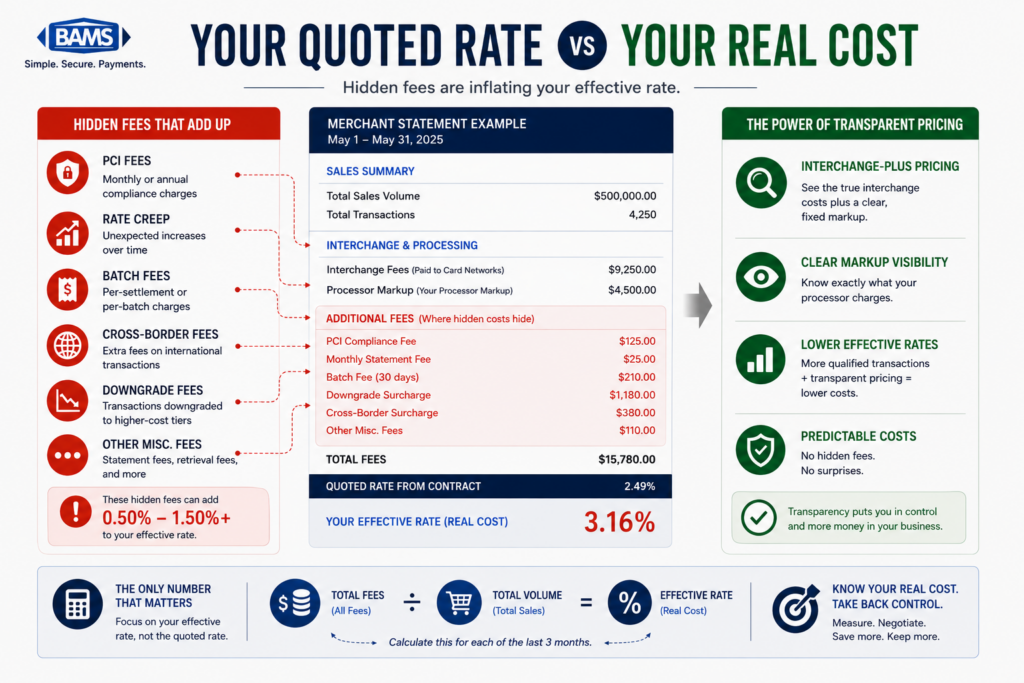
Every month, your processing statement arrives and tells you a story. Costs look stable. Rates seem reasonable. Nothing jumps out. But here’s the friction: that statement was designed by your processor, for your processor. It wasn’t built to show you where money is quietly leaking out of your business on commercial card transactions you might not even realize you’re receiving.
For eCommerce operators running established businesses, the gap between what your statement reports and what’s actually happening at the transaction level is where real margin disappears. Enhanced data programs exist to close that gap, but only if someone explains them to you honestly.
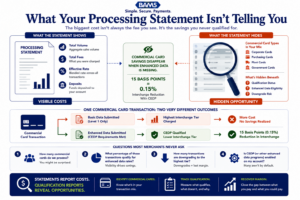
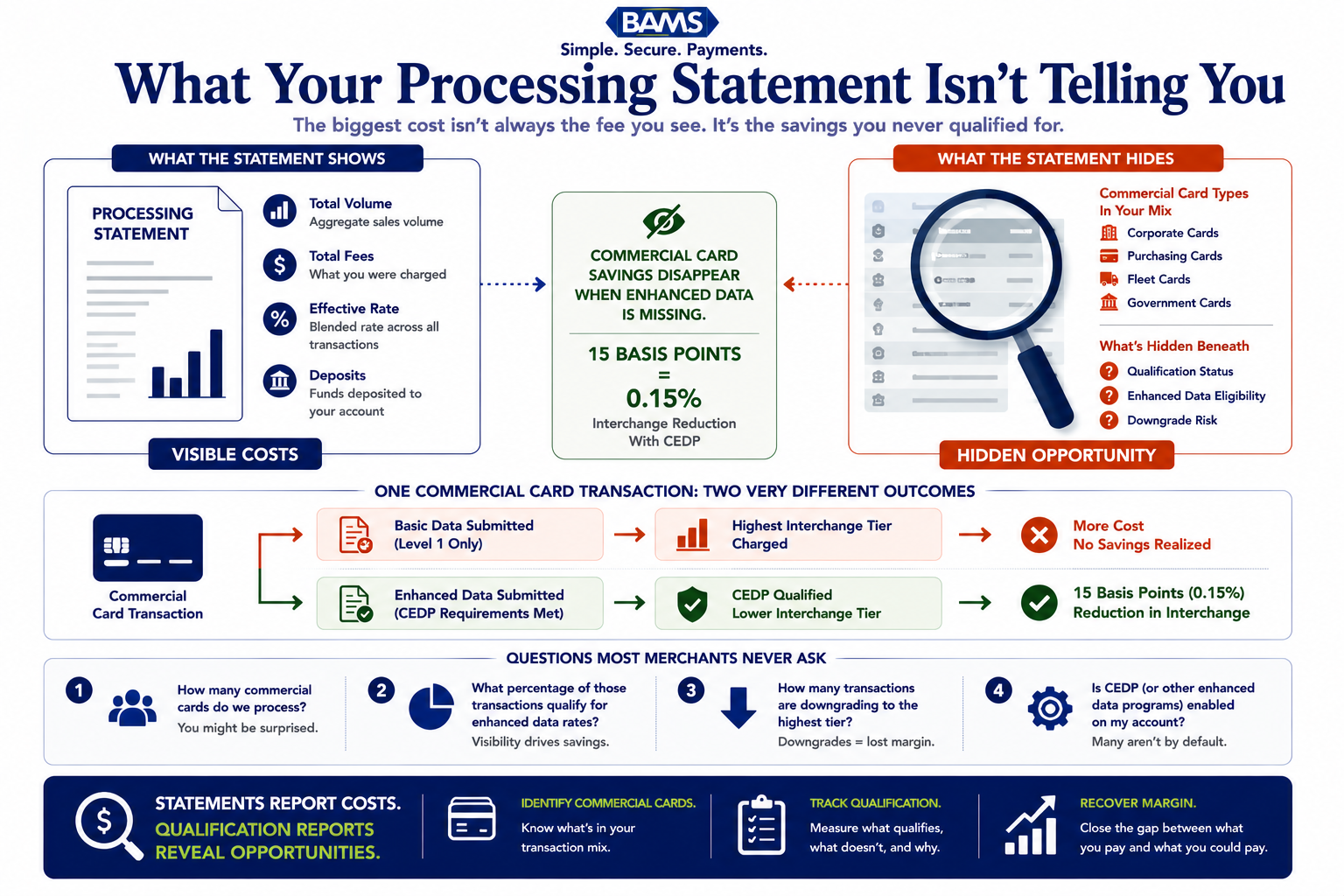
Your statement shows what you paid. It does not show what you could have paid if commercial card transactions qualified for enhanced data rates.
The Comfortable Myth of “One Rate Fits All”
Most ecommerce managers were taught to focus on one number: their effective processing rate. Negotiate it down, watch it monthly, move on. That approach made sense when nearly all your transactions came from personal credit and debit cards with relatively uniform interchange categories.
But the payments landscape shifted. Corporate purchasing cards, small business cards, government fleet cards now show up in your transaction mix more often than you’d expect. Mastercard commercial card acceptance research highlights the continued growth of commercial card usage and the importance of transaction optimization for merchants serving business buyers.
Each of these card types carries a different interchange tier, and many qualify for significantly lower rates if the right data is submitted with the transaction. Your statement doesn’t distinguish between a consumer Visa and a Visa Purchasing Card. It just shows you a blended number and moves on.
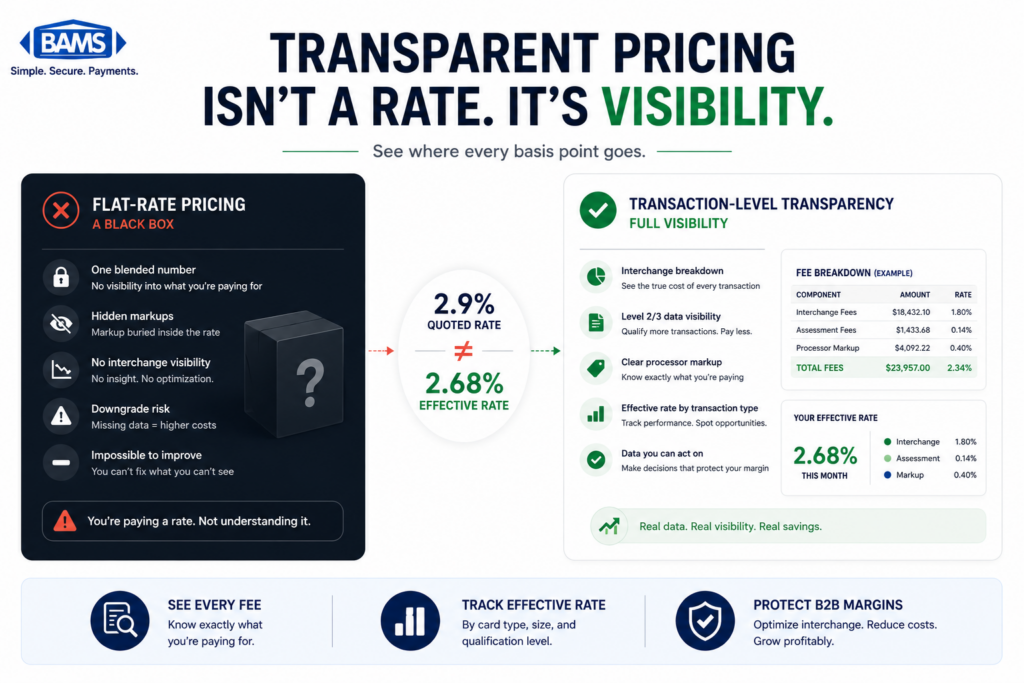
The industry built it this way on purpose. A blended rate is simpler to explain, easier to sell, and far more profitable for the processor when commercial cards are quietly downgrading in the background.
What Your Processor Isn’t Volunteering
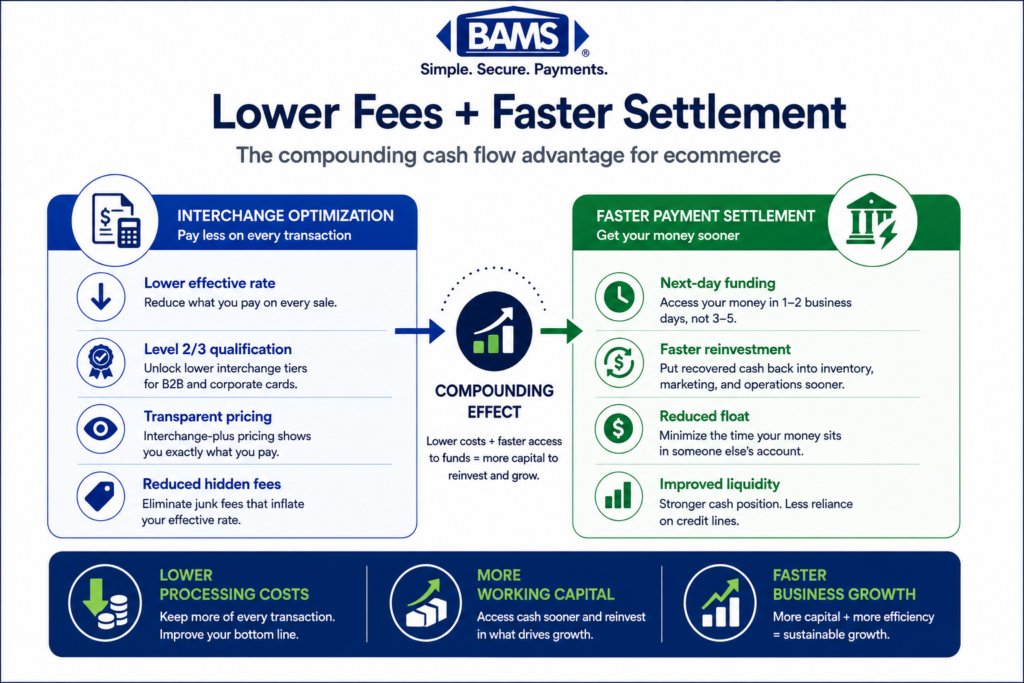
Here’s what we actually believe: the biggest transparency problem in merchant services isn’t hidden fees. It’s hidden opportunity. Your processor benefits when you don’t understand data tiers, and the industry has no structural incentive to explain the difference in plain language.
When a corporate purchasing card hits your ecommerce checkout and you submit only basic Level 1 data (card number, amount, date), that transaction processes at the highest interchange tier for its category. The card network doesn’t care that you didn’t know. It just charges you more.
How Enhanced Data Programs Actually Work (and Who They Really Serve)

The challenge isn’t understanding CEDP. The challenge is knowing whether your transactions are qualifying.
Let’s get specific. Visa recently replaced its legacy Level 2, Level 3, and Large Ticket interchange programs with the Commercial Enhanced Data Program (CEDP). The concept is straightforward: submit richer, invoice-quality data with eligible commercial card transactions, and Visa rewards you with lower interchange rates.
Under CEDP, compliant transactions can receive a 15 basis point (0.15%) reduction in interchange rates. That’s real money, especially if commercial cards represent even 10-15% of your volume. Eligible cards include U.S.-issued Visa Small Business, Corporate, Purchasing, Fleet, Government Purchase, and Government Travel Cards.
But here’s where the sales pitch diverges from reality. Most content about Level 3 data and enhanced data programs targets large enterprises with ERP integrations and dedicated procurement teams. Nobody talks about the mid-size eCommerce merchant running Shopify or WooCommerce who processes a mix of consumer and commercial transactions without any visibility into which is which.
That’s the real problem. You can’t optimize what you can’t see.
Consider what actually happens when a facilities manager at a mid-size company uses their corporate purchasing card to buy $2,400 worth of supplies from your online store. Your gateway captures the card number, the total, maybe a tax amount. It does not automatically capture the line-item detail, commodity codes, or ship-to postal codes that Visa requires for CEDP qualification. The transaction processes. You pay the higher interchange tier. Your statement shows nothing unusual.
Multiply that across dozens or hundreds of similar transactions per month, and you’re looking at interchange savings left on the table that your processor never mentioned. Visa introduced CEDP specifically because “there have been holes in those processes,” and the program aims to close gaps in data quality across commercial payments.
The validation process matters too. Visa’s CEDP examines transaction data quality, and merchants with incomplete or generic data may face higher processing costs and lose access to incentives entirely. Merchants who consistently meet standards earn verified status and become eligible for the best available rates. Those who don’t? They keep paying the old rates and never know the difference.
This is where a merchant services partner focused on transparency makes a measurable difference. BAMS works with eCommerce merchants to identify commercial card volume hiding in their transaction mix and ensure the right data fields are being captured, so interchange savings from programs like CEDP actually reach the merchant instead of staying with the processor. It’s not about overhauling your tech stack. It’s about having a partner who flags what your current setup is missing.
You can also start building visibility on your own. Our breakdown of transaction-level payment analytics shows where interchange qualification failures typically hide, and a line-by-line statement audit can reveal whether your effective rate is masking downgrade costs on commercial transactions.
The Cost of Not Knowing
If this thesis is right, then every eCommerce business processing a mix of consumer and commercial cards is making a decision about enhanced data programs whether they realize it or not. The decision is just being made for them, by default, in the processor’s favor.
The stakes aren’t theoretical. Visa requires merchants to submit complete enhanced data and have the CEDP flag set on eligible transactions, with data submitted at the time of the transaction or within 96 hours. If your POS or gateway doesn’t support it, or your processor hasn’t enabled it, you’re paying a premium on every qualifying commercial card order. That’s not a fee you negotiated. It’s a fee you inherited because nobody told you it was optional. Merchant Payments Coalition resources continue to highlight how interchange qualification differences and payment processing inefficiencies can materially increase merchant operating costs.
For a business processing $500,000 annually in commercial card volume, 15 basis points is $750 per year in interchange alone. Scale that up, and the numbers get uncomfortable fast.
A Better Way to Read Your Processing Costs
Stop thinking of your processing statement as a report card. Start thinking of it as a highlight reel, one that’s been edited by the team that profits from what gets cut.
The better mental model: your statement shows you the cost of transactions. It does not show you the cost of missed qualification. Those are two completely different numbers. The first one is visible. The second one requires looking at what your statement hides, specifically which transactions qualified for lower interchange tiers and which silently downgraded because the right data wasn’t attached.
When you start measuring the gap between what you paid and what you could have paid, you stop optimizing rates and start optimizing data. That’s a fundamentally different conversation, and it’s the one your processor would rather not have.
Your Statement Is a Starting Point, Not the Answer
The merchants who save the most on processing aren’t the ones who negotiate the hardest. They’re the ones who understand what they’re being charged for, and why. Enhanced data programs like CEDP exist. The interchange savings are real. The only question is whether your processor is set up to capture them on your behalf, or whether they’re quietly profiting from the fact that you never asked.
So ask.
Frequently Asked Questions
What is Level 3 data in merchant services?
Level 3 data refers to detailed, invoice-quality transaction information (line items, commodity codes, shipping details) submitted alongside a payment. When included on eligible commercial card transactions, it qualifies merchants for lower interchange rates. Visa’s current Commercial Enhanced Data Program (CEDP) has replaced the legacy Level 2 and Level 3 tier system with a unified validation approach. You can learn more in our guide to Level 3 credit card processing.
Which types of transactions qualify for CEDP interchange savings?
Eligible transactions must involve U.S.-issued Visa commercial cards, including Small Business, Corporate, Purchasing, Fleet, and Government cards. Your payment gateway must support enhanced data capture, and the data must be submitted with the transaction or within 96 hours.
How do I know if my eCommerce business is losing money on commercial card orders?
Most processing statements don’t distinguish between consumer and commercial card transactions, so the losses are invisible at the statement level. A transaction-level audit that checks interchange qualification on each order. It is the only reliable way to identify downgraded commercial card transactions costing you more than they should.