Interchange Overcharges: A Held Funds Escalation Guide
Last Updated on October 7, 2026 by Dimitri Akhrin
The step-by-step playbook for releasing held funds, exposing hidden fees, and forcing faster processor responses
Learn a repeatable escalation sequence for releasing held funds from your payment processor within 48 hours. This tutorial covers who to contact, what documentation to prepare, and how to uncover interchange overcharges hiding in opaque fee structures.
TL;DR
- Treat held funds as an escalation, not a waiting game – Gather your contract, statements, and transaction records before contacting your processor. Specific documentation forces faster resolution than generic requests.
- Always contact your named account manager first – Skipping the general support line and reaching a decision-maker directly can cut resolution time from weeks to days. If you don’t have a named contact, that’s a red flag about your processor’s accountability.
- Create a written paper trail at every step – Email confirmations, formal release requests with deadlines, and documented refusals give you leverage for escalation and regulatory complaints.
- Use regulators when processors stall – CFPB complaints require a response within 15 days and often trigger internal escalations that bypass unresponsive support tiers.
- Review your interchange charges during the process – Funding disputes often reveal interchange overcharges and inflated credit card processing fees that cost you money every month, even when funds aren’t held.
What You’ll Achieve: A Clear Escalation Playbook for Held Funds
By the end of this tutorial, you’ll have a repeatable, step-by-step escalation sequence for getting held funds released from your payment processor. You’ll know exactly who to contact, what documentation to prepare, which questions force a faster resolution, and when to escalate beyond frontline support.
More importantly, you’ll learn how to evaluate whether your current payment partner gives you the direct access and transparency needed to resolve funding issues quickly, or whether you’re stuck navigating anonymous support tiers that cost you time and cash flow. This process also reveals hidden interchange overcharges and inflated credit card processing fees that often accompany opaque processor relationships.
Your success criteria: funds released within 48 hours of initiating contact, a documented paper trail that protects you in future disputes, and a clear framework for deciding whether your processor relationship is worth keeping.
Prerequisites and Setup
Before you begin the escalation process, gather these items. Missing even one can add days to your resolution timeline.
- Your Merchant ID (MID) and processing agreement (the full contract, not just the summary page)
- Recent processing statements covering the last 90 days, including all fees, batch totals, and deposit records
- Bank statements showing expected vs. actual deposit amounts and dates
- Transaction-level detail for any flagged or held batches (export from your gateway or POS)
- Chargeback and dispute records for the current and prior quarter
- Contact information for your assigned account manager, if one exists (name, direct line, email)
- A written timeline of the issue: when you first noticed held funds, amounts, and any communication so far
Time estimate: Gathering documentation takes 30 to 60 minutes. The full escalation sequence typically runs 1 to 5 business days, depending on your processor’s responsiveness. The biggest potential blocker is not having a direct contact, which is exactly the accountability gap this guide addresses.
Why This Approach Works: Escalation Over Patience
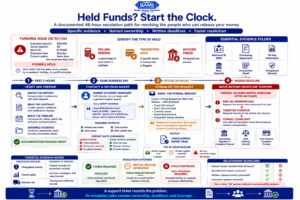
A step-by-step merchant funding escalation guide covering hold verification, contract review, written requests, risk-team contact, and external complaints.
Most merchants treat held funds as a waiting game. They call a general support line, open a ticket, and hope for the best. This passive approach works in the processor’s favor, not yours. Every day your funds sit in a reserve or hold account, your cash flow suffers and your processor earns interest on your money.
The escalation method flips this dynamic. Each step creates documented pressure and a clear paper trail. You move from frontline support to decision-makers with specific, time-bound requests that processors are contractually or regulatorily obligated to address.
This approach works best when you have a processor that offers direct account management and transparent communication. It becomes significantly harder (and slower) when you’re navigating anonymous ticket queues. That gap in accountability is one of the most important factors in merchant account optimization.
Step-by-Step: The Funding Recovery Escalation Sequence
Step 1: Confirm the Hold Is Real and Identify Its Type
Before contacting anyone, verify that funds are actually held and not simply delayed by normal settlement timing. Log into your payment gateway and compare your batch settlement report against your bank deposits for the last 5 business days.
Action: Export your settlement report and match each batch to a corresponding bank deposit. Flag any batch that is more than 2 business days past its expected deposit date. Note the exact amounts, batch IDs, and dates.
Expected result: You’ll identify one of three hold types: a rolling reserve (percentage withheld from each batch), a specific-transaction hold (single flagged transaction), or a full account freeze (all deposits paused). Each requires a different escalation path.
Common failure: Merchants sometimes confuse weekend/holiday settlement delays with actual holds. Check your processor’s funding schedule and cutoff times before escalating.
Step 2: Review Your Processing Agreement for Hold Provisions
Open your merchant processing agreement and search for sections labeled “Reserve,” “Holdback,” “Funding Delay,” or “Risk Management.” These clauses define when your processor can legally hold funds, for how long, and under what conditions they must release them.
Action: Highlight the specific clause your processor is likely invoking. Note any time limits, notification requirements, or conditions for release. If your agreement says the processor must notify you within a certain period before establishing a reserve, check whether they actually did.
Expected result: You’ll have the exact contractual language to reference in your escalation call. This shifts the conversation from “please release my money” to “your contract requires X, and here’s where you haven’t met that obligation.”
Common failure: Many merchants never received (or can’t locate) their full agreement. If this is the case, your first support request should be for a complete copy of your current terms, which processors are required to provide.
Step 3: Make First Contact with Your Account Manager (Not General Support)
If you have a dedicated account manager, call them directly. Do not use the general support line. If you don’t have a dedicated contact, this is a critical red flag about your processor relationship, but proceed to the general line and immediately request escalation to the risk or underwriting department.
Action: Call your account manager and state the following: “I have [amount] in held funds from batch [ID] dated [date]. My agreement section [X] requires [notification/time limit/condition]. I need a specific reason for the hold, the name of the person who authorized it, and a documented timeline for release.”
Expected result: A competent account manager will either resolve the hold during the call or provide a specific escalation path with a named contact in the risk department. You should receive a case or reference number.
Common failure: You reach a call center agent who can only “submit a ticket.” If this happens, ask for the agent’s full name, their supervisor’s name, and the ticket’s SLA (service level agreement) for response time. Document everything.
Step 4: Submit a Formal Written Request with Documentation
Regardless of what happens on the phone, follow up immediately with a written request via email. This creates a timestamped paper trail that becomes critical if you need to escalate further.
Action: Send an email to your account manager (and CC the risk department if you have that contact) with the following:
- Subject line: “Formal Request for Held Fund Release — MID [your MID] — [Date]”
- The specific amount and batch details
- The contractual clause you identified in Step 2
- Your bank statements showing the missing deposits
- A clear deadline: “I am requesting release of these funds within 48 business hours or a written explanation of the specific risk concern preventing release.”
Expected result: A written response within 24 to 48 hours. If your processor has strong accountability practices, you’ll get a named contact and a specific resolution path.
Common failure: Auto-reply with no follow-up. If you receive only an automated ticket confirmation, set a 48-hour timer and prepare for Step 5.
Step 5: Escalate to the Risk or Underwriting Department
If 48 hours pass without a substantive response, escalate directly to the risk or underwriting team. These are the people who actually authorize holds and have the power to release them. Frontline support typically cannot.
Action: Call and request a direct transfer to the risk or underwriting department. Reference your case number and state: “I submitted a formal release request 48 hours ago and have not received a substantive response. I need to speak with the person who authorized this hold.”
Expected result: A risk analyst should explain the specific reason for the hold (high chargeback ratio, unusual transaction volume, industry risk category) and outline what documentation you can provide to expedite release.
Common failure: You’re told the risk department “doesn’t take inbound calls.” This is a major accountability gap. Document the refusal, note the agent’s name, and proceed to Step 6.
Step 6: Provide Targeted Documentation to Address the Risk Concern
Once you know the specific reason for the hold, respond with targeted evidence that directly addresses the processor’s concern. Generic responses slow things down. Specific evidence accelerates release.
Action: Match your documentation to the stated concern:
- High chargeback ratio: Provide your chargeback response records, win rate data, and any fraud prevention tools you use
- Unusual volume spike: Provide purchase orders, invoices, or marketing campaign records that explain the increase
- Industry risk: Provide business licenses, customer testimonials, and delivery confirmation records
Expected result: The risk team reviews your documentation and releases funds, adjusts your reserve, or provides a specific release date.
Common failure: The processor asks for documentation but provides no timeline for review. Always respond with: “When will this documentation be reviewed, and who is the reviewing analyst?”
Step 7: File a Formal Complaint If Resolution Stalls
If you’ve followed Steps 1 through 6 and your processor still hasn’t released funds or provided a clear justification, it’s time to file formal complaints. This step creates external pressure that processors take seriously.
Action: File complaints with the following entities simultaneously:
- Consumer Financial Protection Bureau (CFPB): File at consumerfinance.gov/complaint
- Your state’s Attorney General office: Search for your state’s consumer complaint form online
- The card network: Visa and Mastercard both have merchant complaint processes for acquirer behavior
Expected result: Processors are required to respond to CFPB complaints within 15 days. This often triggers an internal escalation that bypasses the support tiers you’ve been stuck in.
Common failure: Merchants skip this step because it feels extreme. It isn’t. Regulators exist specifically for situations where a financial services provider is unresponsive. Use them.
Step 8: Evaluate Your Processor Relationship and Plan Your Exit
Once your funds are released, take 30 minutes to evaluate the experience. The speed and quality of your resolution reveals everything about your processor’s accountability structure.
Action: Score your processor on these criteria:
- Did you reach a named human within 24 hours?
- Did you receive a specific reason for the hold within 48 hours?
- Were funds released within 5 business days of your first contact?
- Did anyone proactively communicate with you during the process?
If you answered “no” to two or more of these questions, your processor lacks the accountability structure your business needs. Start evaluating alternatives with a clear checklist of what to look for in a new partner.
Expected result: A clear, data-backed decision about whether to stay or switch processors, not an emotional reaction.
Configuration and Customization: Adjusting for Your Business
The escalation sequence above works for most eCommerce merchants, but several variables should be adjusted based on your specific situation.
Hold threshold sensitivity: If your average transaction value exceeds $500, your processor’s risk algorithms are more likely to trigger holds on volume spikes. Proactively notify your account manager before running large promotions or seasonal campaigns. This single habit prevents most holds before they happen.
Chargeback ratio targets: Most processors begin holding funds when your chargeback ratio exceeds 0.9% of transactions. If you’re between 0.5% and 0.9%, invest in proactive chargeback defense now rather than waiting for a hold. Processors like BAMS offer proactive chargeback defense as part of their merchant services, which can keep your ratio below the threshold that triggers reserves.
Funding speed as a risk indicator: If your processor takes 3 or more business days to fund settled transactions, that delay itself is a form of hold. Merchants with next-day funding spot discrepancies faster because the gap between expected and actual deposits is immediately visible.
Verification and Testing: Confirm Your Escalation System Works
Don’t wait for the next funding crisis to test your escalation path. Run a verification check now.
Test procedure: Call your processor’s support line and ask for a direct transfer to your account manager. Time the process. Then ask your account manager (or the agent you reach) the following: “If my funds were held tomorrow, who specifically would I contact, and what is the SLA for resolution?” Document the answer.
Success definition: You should reach a named human in under 10 minutes, and that person should be able to articulate a clear escalation path with specific timelines. If you get vague answers like “it depends” or “our team will review,” your processor’s accountability structure has gaps that will cost you during a real hold event.
Edge cases to verify: Ask about weekend and holiday holds (who monitors?), holds triggered by card network compliance reviews (not just processor-initiated), and the process for partial releases (getting a portion of held funds while the review continues).
Common Errors and Fixes When Recovering Held Funds
Error: “Your account is under review” with no further detail
Symptom: You receive a generic notification that your account is under review. No hold amount, no reason, no timeline. Cause: Automated risk flagging with no human review yet completed. Fix: Respond in writing requesting the specific risk trigger, the reviewing analyst’s name, and the review SLA. Reference your contract’s notification requirements.
Error: Funds released but with a new rolling reserve applied
Symptom: Your held batch is deposited, but you notice future batches are short by 5% to 10%. Cause: The processor established a rolling reserve as a condition of releasing the original hold. Fix: Request the reserve terms in writing, including the reserve percentage, the hold period (typically 6 months), and the release schedule. Negotiate the percentage down by providing documentation of low chargeback rates and stable processing volume.
Error: Processor claims hold is required by the card network
Symptom: Your processor says Visa or Mastercard requires the hold, not them. Cause: Sometimes true (MATCH list, excessive chargebacks), but often used as a deflection. Fix: Ask for the specific card network program or compliance notice that triggered the hold. If they can’t produce it, the hold is processor-initiated and subject to your contract terms, not network rules.
Error: You can’t find your processing agreement
Symptom: You signed up online and never received a full contract. Cause: Many processors bury terms in click-through agreements. Fix: Request a complete copy of your current merchant processing agreement in writing. Processors are required to provide this. While you wait, check your email for the original signup confirmation, which often links to the terms.
Error: Interchange overcharges discovered during the review
Symptom: While reviewing your statements for the hold dispute, you notice credit card processing fees that don’t match your agreed-upon rate schedule. Cause: Processors sometimes apply incorrect interchange categories, especially for card-not-present transactions. U.S. banks collected nearly $66 billion in interchange fees in 2025, and misclassification is one way those costs get inflated at the merchant level. Fix: Compare each line item on your statement against the published interchange tables for your card type and transaction method. Request a retroactive audit from your processor for the last 6 months. If they refuse, this is a strong signal to switch to a provider with interchange-plus pricing that shows you the actual interchange cost on every transaction.

A funding dispute often exposes a second problem: transaction costs and deductions that were never clearly explained or properly classified.
Next Steps: Building Long-Term Payment Accountability
Recovering held funds is a reactive process. The real win is building a processor relationship where holds are rare, communication is proactive, and you always know exactly what you’re paying.
Here are three ways to extend this work:
- Audit your processing costs quarterly.U.S. merchants paid over $224 billion in total card fees in 2023, and a significant portion of that includes avoidable overcharges. A quarterly review of your effective rate catches problems before they compound.
- Establish a proactive volume notification process. Email your account manager before any promotion or seasonal spike that will increase your processing volume by more than 20%. This one habit prevents most risk-triggered holds.
- Evaluate your processor’s accountability structure annually. Use the scorecard from Step 8 and review your merchant service provider selection criteria to ensure your partner still meets your business needs as you grow.
Frequently Asked Questions
How long can a payment processor legally hold my funds?
The hold period depends on your merchant processing agreement. Most contracts allow processors to hold funds for 30 to 180 days for risk-related reasons, but they are typically required to notify you and provide a specific reason. If your agreement includes notification requirements and your processor didn’t follow them, you have grounds to demand immediate release. Always check the “Reserve” or “Holdback” section of your contract for exact terms.
What’s the difference between a rolling reserve and a full account freeze?
A rolling reserve withholds a percentage (usually 5% to 10%) of each batch settlement and releases it after a set period, typically 6 months. A full account freeze stops all deposits entirely. Rolling reserves are common for higher-risk merchants or those with elevated chargeback ratios. Full freezes are more serious and usually indicate a compliance concern, a card network flag, or a contract violation. The escalation approach differs for each type.
Can interchange overcharges contribute to funding problems?
Indirectly, yes. When your processor misclassifies transactions at higher interchange tiers, your effective processing rate increases. This inflates your costs and can mask the true impact of a hold on your cash flow. Interchange fees on debit and prepaid cards alone totaled $34.12 billion in 2023, and incorrect categorization at the merchant level is a common source of overcharges. Reviewing your interchange classifications during a hold dispute often uncovers additional savings.
Should I switch processors after a funding hold, or try to fix the relationship?
Use the scorecard from Step 8 of this guide. If your processor provided a named contact, a clear reason, and resolved the hold within 5 business days, the relationship may be worth keeping. If you spent days navigating anonymous support tiers with no clear answers, that’s a structural accountability problem that won’t improve. Switching to a processor with dedicated account management and transparent pricing is often the faster path to stability.
What role does chargeback ratio play in fund holds?
Your chargeback ratio is the single biggest trigger for processor-initiated holds. Most processors and card networks flag merchants when their ratio exceeds 0.9% to 1.0% of transactions. At that point, processors may impose rolling reserves, increase processing fees, or freeze your account entirely. Proactive chargeback defense, including alerts, rapid response, and dispute documentation, keeps your ratio below the threshold and prevents holds before they start.
Is filing a complaint with the CFPB effective for merchant disputes?
Yes. Processors are required to respond to CFPB complaints within 15 business days. Filing a complaint creates an external record and often triggers an internal escalation that bypasses the support tiers you’ve been stuck in. It’s not a nuclear option; it’s a regulatory tool designed for exactly this type of situation. Pair it with a state Attorney General complaint and a card network complaint for maximum pressure.
Sources
- https://www.stlouisfed.org/on-the-economy/2026/apr/banking-analytics-credit-debit-card-fees-collected-banks-rose-2025
- https://www.consumerfinance.gov/complaint/
- https://www.commonsenseinstituteus.org/ResearchUploads/CSI%20Report%20-%20US%20Interchange%20Fees%20(2).pdf
- https://bankingjournal.aba.com/2025/12/fed-releases-report-on-interchange-fee-revenue/