
Merchant Funding Speed: A Complete Guide
Last Updated on October 6, 2026 by Dimitri Akhrin
How your platform, bank, cut-off times, and transaction mix shape when deposits actually arrive
Learn why your deposit timing rarely matches what your processor promised. This guide breaks down the payment rails, hidden delay variables, and system-level factors that determine how fast eCommerce revenue reaches your bank account.
TL;DR
- Funding speed is a system, not a feature – Your deposit timing is determined by five variables working together: batch cut-off times, payment rails, bank posting speed, transaction risk profile, and platform/gateway layers. Optimizing one without understanding the others won’t fix delays.
- Know your payment rail – Standard ACH, same-day ACH, and FedNow each carry funds at different speeds and costs. Most merchants don’t know which rail their processor uses, and that’s the ceiling on how fast deposits can arrive.
- Weekend and off-hours revenue creates hidden delays – If a large portion of your sales happen outside banking hours, your effective funding speed is slower than advertised. Map your peak sales hours against your batch cut-off time.
- Communicate volume spikes before they happen – Flash sales, product launches, and seasonal surges trigger automated risk holds. A single proactive notification to your processor can prevent a 72-hour funding freeze.
- Calculate the cost-benefit before upgrading – Same-day funding isn’t always worth the premium. Measure your cash gap, compare the cost of faster rails against freed working capital, and choose deliberately rather than defaulting to the fastest (or cheapest) option.
Guide Orientation: What This Covers and Who It’s For
This guide breaks down the real differences between same day merchant funding and next day funding, not as a feature comparison, but as a system-level analysis of how your money actually moves from customer checkout to your bank account. If you manage eCommerce operations at an established online business and you’ve noticed that your deposit timing doesn’t match what your processor promised, this guide explains why.
By the end, you’ll understand the payment rails that carry your funds, the specific variables in your business setup that create hidden delays, and how to make informed decisions about optimizing your funding speed. This guide does not cover merchant cash advances, business loans, or general financing products. It focuses exclusively on the mechanics of how and when you receive the revenue you’ve already earned.
Why Merchant Funding Speed Actually Matters
Funding speed is a cash flow management issue disguised as a payments issue. When your deposits arrive a day late, or two days late, or unpredictably, the downstream effects compound. You delay vendor payments. You miss early-pay discounts. You hold off on restocking during peak demand. The cost isn’t theoretical.
The landscape is shifting in ways that make this more urgent. 37% of small employer firms sought financing in 2023, according to Federal Reserve data, often to bridge exactly the kind of cash flow gaps that slow funding creates.
According to the Federal Reserve’s 2025 Small Business Credit Survey, many businesses continue to seek outside financing to support operations and manage cash flow challenges. Faster access to earned revenue can reduce dependence on short-term financing solutions.Younger businesses are borrowing more, partly because their payment infrastructure isn’t optimized to keep cash flowing.
For eCommerce operators specifically, the stakes are higher. Your revenue patterns don’t follow banking hours. Weekend surges, flash sales, and cross-border transactions all interact with settlement mechanics in ways that traditional retail never had to consider. Understanding the system that determines when you get paid isn’t optional anymore. It’s a competitive advantage.
Core Concepts: The Funding Pipeline Demystified
What “Funding” Actually Means
When a customer pays you, that money doesn’t teleport into your bank account. It moves through a chain: your payment gateway captures the transaction, your processor batches and submits it, the card network (Visa, Mastercard) facilitates the interchange, the issuing bank releases the funds, and your acquiring bank deposits them. “Funding speed” refers to the last mile of this chain, specifically how quickly the settled funds land in your operating account.
Payment Rails: The Infrastructure Under the Hood
Three primary rails move money between banks in the U.S.:
- Standard ACH processes in overnight batches. Funds typically arrive in 1-2 business days after settlement. The ACH Network remains one of the primary mechanisms used to move funds between financial institutions and continues to support expanded settlement capabilities, including Same-Day ACH.
- Same-Day ACH offers multiple processing windows per day, enabling funds to arrive within hours, but with per-transaction fees and strict cut-off times.
- FedNow is the Federal Reserve’s real-time payment rail, operating 24/7/365. It enables near-instant transfers, but adoption among processors and banks is still growing.
Settlement vs. Funding: A Critical Distinction
Settlement is when the card network confirms the transaction and allocates the funds. Funding is when those funds actually appear in your bank. These are separate events. Your processor may settle in hours but fund in days, depending on the rail they use and the intermediaries involved. Most merchants conflate the two, which is exactly where confusion about “next-day” promises begins.
The Funding Speed Framework: Five Variables That Determine When You Get Paid

Deposit timing is the result of multiple systems working together.
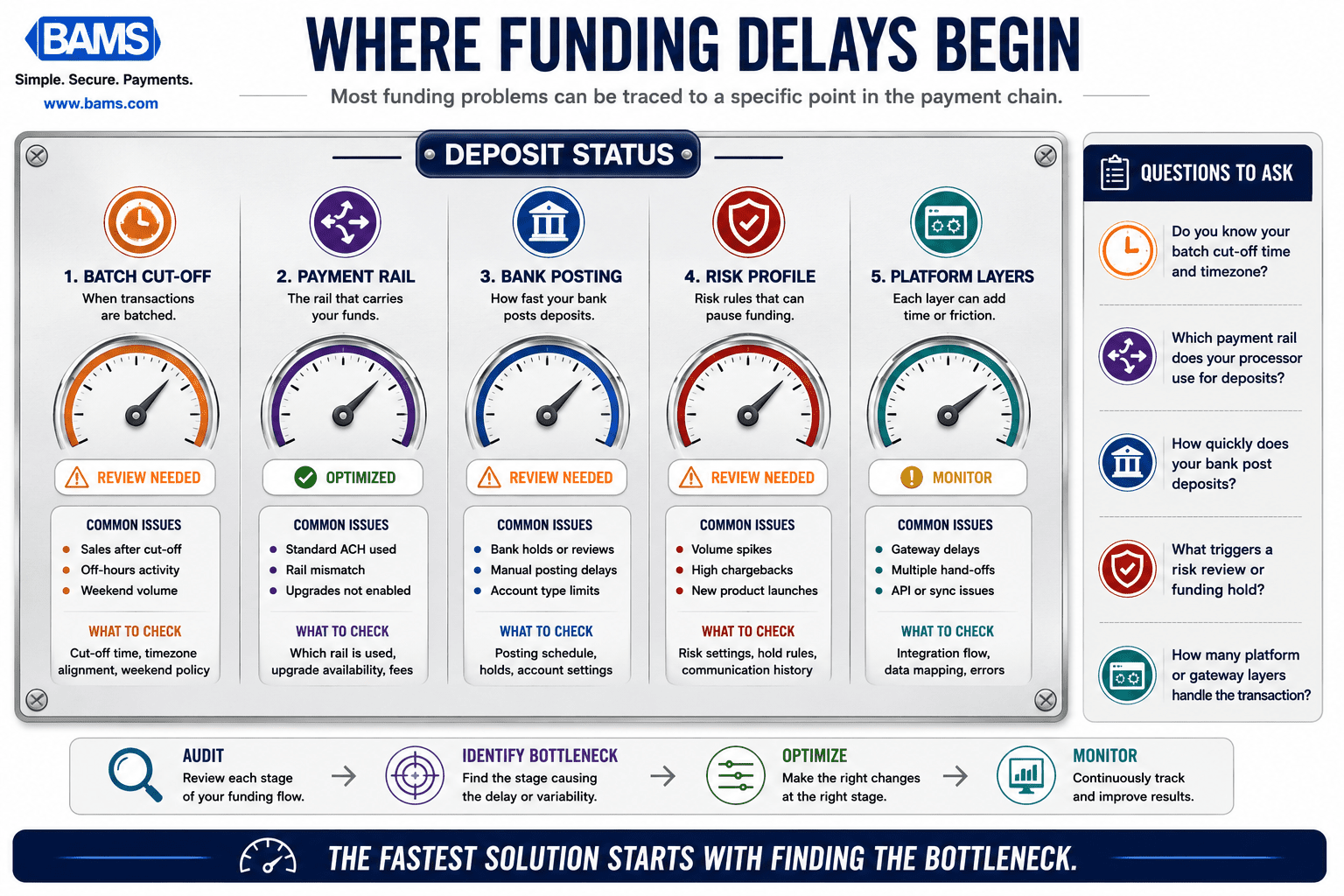
Funding speed isn’t a single setting you toggle on. It’s the output of five variables working together (or against each other). Think of it as a pipeline with five potential bottlenecks:
- Batch timing controls when your transactions enter the settlement queue.
- Processor infrastructure determines which payment rail carries your funds.
- Bank relationship affects how quickly your acquiring bank credits your account.
- Transaction mix introduces risk flags that can trigger holds or delays.
- Platform and gateway configuration adds intermediary layers that extend the chain.
Each of these variables is individually manageable. Together, they form the system you need to optimize. The following breakdown walks through each one with specific guidance for eCommerce operations.
Step-by-Step: Optimizing Your Funding Pipeline
Step 1: Audit Your Batch Cut-Off Times
Objective: Confirm that your daily transactions enter the settlement queue at the earliest possible window.
Every processor has a batch cut-off time, the daily deadline by which transactions must be submitted to qualify for the next settlement cycle. If your cut-off is 9:00 PM ET and your highest-volume sales happen between 9:00 PM and midnight, those transactions roll into the next day’s batch. For eCommerce businesses with customers across time zones, this is a common source of hidden delays.
Execution guidance: Contact your processor and ask for the exact batch cut-off time in your time zone. Then map it against your sales data. If you’re running a Shopify or WooCommerce store, your analytics dashboard will show hourly transaction volume. If a significant percentage of daily revenue falls after the cut-off, you’re losing a full business day on those funds. Some processors allow you to configure your own batch submission time. Others batch automatically. Know which model you’re on.
Anti-patterns: Don’t assume your batch time matches what’s listed on your processor’s marketing page. Batch times can vary by account type, risk tier, and even the gateway you use. Don’t ignore weekends. Transactions processed Saturday and Sunday typically don’t enter the settlement queue until Monday, meaning weekend revenue may not fund until Tuesday or Wednesday.
Success indicators: You can state your exact batch cut-off time. You know what percentage of daily revenue falls after that cut-off. You’ve confirmed whether your batch submission is automatic or configurable.
Step 2: Understand Your Processor’s Payment Rail
Objective: Identify which rail your processor uses for merchant deposits and whether faster options are available.
The difference between standard ACH and same-day ACH can be 24 to 48 hours. The difference between same-day ACH and FedNow can be the difference between “tomorrow morning” and “tonight.” But most merchants never ask which rail their processor actually uses. The payment rail your processor operates on sets the ceiling for how fast your funds can possibly arrive.
Execution guidance: Ask your processor directly: “Which payment rail do you use for merchant deposits?” Follow up with: “Do you support same-day ACH or FedNow, and if so, what are the additional costs?” For most eCommerce businesses processing between $50K and $500K monthly, same-day ACH adds marginal cost per transaction but can meaningfully improve cash flow. FedNow is still emerging, but if your processor and your bank both support it, real-time settlement becomes possible.
Anti-patterns: Don’t confuse “same-day funding” marketing with actual same-day ACH. Some processors advertise same-day funding but are actually using standard ACH with an early morning deposit, which technically arrives “the same day” the batch settles but is still a full business day after the transaction occurred. The terminology is deliberately vague across the industry.
Success indicators: You know the specific rail (standard ACH, same-day ACH, or FedNow) your deposits travel on. You’ve compared the cost of upgrading rails against the cash flow benefit for your transaction volume.
Step 3: Evaluate Your Bank’s Role in the Chain
Objective: Determine whether your receiving bank is adding unnecessary delay to the final deposit step.
Your processor can settle funds in hours, but if your bank takes an additional business day to post incoming ACH credits, you’ve added a full day of delay at the very end of the pipeline. This is especially common with larger national banks that process ACH in overnight batches rather than intraday cycles. Federal Reserve data shows small banks approved 75% of applicants for at least some financing, and these smaller institutions often have more responsive deposit posting schedules as well.
Execution guidance: Run a simple test. Ask your processor to confirm the exact time funds are released to your bank. Then check your bank statement for the actual posting time. If there’s a gap of more than a few hours, your bank is the bottleneck. Some banks offer “early availability” for ACH credits, especially for business accounts with consistent deposit history. Ask your bank’s business banking team about this.
Anti-patterns: Don’t overlook the bank variable because you assume all banks post at the same speed. They don’t. And don’t assume switching banks is the only fix. Sometimes upgrading your account tier or enabling early ACH availability is enough to close the gap.
Success indicators: You’ve measured the time gap between processor release and bank posting. You’ve confirmed whether your bank offers early ACH availability for business accounts.
Step 4: Account for Your Transaction Mix and Risk Profile
Objective: Understand how the types of transactions you process affect your funding eligibility and timing.
Processors don’t treat all transactions equally. High-ticket orders, international cards, first-time customers, and industries with elevated chargeback rates can all trigger risk reviews that delay funding. For eCommerce businesses, this is particularly relevant during sale events, product launches, or seasonal spikes when your transaction mix shifts suddenly.
Execution guidance: Review your processor’s risk and underwriting policies. Ask specifically: “What transaction characteristics trigger funding holds or manual reviews?” Common triggers include single transactions exceeding a threshold (often $5,000 to $10,000), sudden volume spikes beyond your approved monthly cap, and high percentages of international card transactions. If you know a flash sale or product launch is coming, notify your processor in advance. Most processors, including partners like BAMS, offer dedicated account management that lets you flag anticipated volume changes before they trigger automated risk holds.
Anti-patterns: Don’t assume that because you’ve been funded consistently, a sudden spike won’t cause a hold. Risk systems are automated. A 300% volume increase during a Black Friday sale will flag your account regardless of your history if you haven’t communicated with your processor beforehand. Also, don’t ignore chargeback ratios. Even a modest increase can shift your risk tier and slow your funding.
Success indicators: You know your processor’s hold triggers. You have a communication protocol for anticipated volume changes. Your chargeback ratio is monitored monthly.
Step 5: Map Your Platform and Gateway Dependencies
Objective: Identify intermediary layers between your storefront and your processor that add settlement delay.
If you sell on Shopify, BigCommerce, WooCommerce, or a marketplace, your transactions pass through at least one additional layer before reaching your processor. Shopify Payments, for example, batches and settles on its own schedule. If you use a third-party gateway like Authorize.Net or Stripe Connect on top of your platform, that’s another intermediary with its own batch timing and settlement rules.
Execution guidance: Draw out your transaction flow from checkout to deposit. Identify every entity that touches the money. For each intermediary, document: their batch cut-off time, their settlement schedule, and whether they hold funds for any period before forwarding to the next entity. If you’re using Shopify Payments, note that their standard payout schedule is 2 business days for U.S. merchants, regardless of what your downstream processor offers. Switching to a direct processor integration (where your platform supports it) can eliminate an entire intermediary layer.
Anti-patterns: Don’t stack gateways or intermediaries without understanding the cumulative delay. Each additional layer can add 12 to 24 hours. Don’t assume your platform’s default payment integration is optimized for speed. It’s optimized for the platform’s convenience and risk management, not yours.
Success indicators: You have a documented transaction flow showing every intermediary. You know each entity’s batch and settlement schedule. You’ve evaluated whether a more direct processor integration is feasible.
Step 6: Choose the Right Funding Speed for Your Business Model
Objective: Make a deliberate, informed decision about whether same-day, next-day, or standard funding best fits your operational needs and cost tolerance.
Same-day funding isn’t universally better than next-day, and next-day isn’t always worth the premium over standard 2-day funding. The right choice depends on your cash conversion cycle, your operating expenses timing, and your margin structure. A business that pays suppliers on net-30 terms has different urgency than one that pays for inventory COD.
Execution guidance: Calculate your “cash gap,” the number of days between when you pay for goods/services and when you receive customer payment. If your cash gap is tight (under 7 days), faster funding directly reduces your need for working capital lines. If your cash gap is 30+ days, faster funding helps but may not justify premium pricing. For most eCommerce businesses with regular inventory turns, next-day funding hits the sweet spot between cost and benefit. Same-day funding makes sense for businesses with daily cash obligations (restaurants, perishable goods) or during high-volume periods where float costs become material.
Anti-patterns: Don’t pay for same-day funding across all transactions if only a portion of your revenue needs accelerated access. Some processors allow you to designate specific transaction types or thresholds for faster rails while keeping routine transactions on standard settlement. Don’t choose funding speed based on marketing alone. Calculate the actual dollar impact on your operations.
Success indicators: You’ve calculated your cash gap. You’ve compared the cost of faster funding against the working capital it frees up. You’ve made a deliberate choice rather than accepting a default.
Professional infographic helping merchants identify the most common causes of slow deposits and funding delays.
Practical Examples: How This Plays Out in Real eCommerce Operations
Scenario 1: The Weekend Surge Problem
An online apparel brand does 40% of its weekly revenue between Friday evening and Sunday night. Their processor’s batch cut-off is 10:00 PM ET on weekdays, but weekend transactions don’t enter the settlement queue until Monday morning. With standard ACH, those funds arrive Tuesday or Wednesday. That’s a 3-4 day gap between earning revenue and accessing it. By switching to a processor offering next-day funding with weekend batch processing, they close the gap to Tuesday morning for Saturday transactions. The cash flow improvement eliminated their need for a $50K revolving credit line.
Scenario 2: The Flash Sale Freeze
A consumer electronics eCommerce store runs a 48-hour sale that generates 5x normal daily volume. Their processor’s risk system flags the spike and places a 72-hour hold on all funds pending manual review. The merchant had no prior communication with their processor about the event. Meanwhile, they’ve already committed to expedited shipping costs for the orders. The fix: establish a pre-notification protocol with your processor. A single email or call before a planned volume spike can prevent automated holds entirely.
Scenario 3: The Hidden Gateway Layer
A subscription box company uses WooCommerce with a third-party gateway and a separate processor. Transactions pass through three entities before reaching their bank. Each entity adds roughly 12 hours to the settlement timeline. Total time from transaction to deposit: 3.5 business days. After mapping their transaction flow, they consolidated to a direct processor integration, cutting deposit time to next-business-day. The only cost was a few hours of technical setup.
Common Mistakes and Pitfalls
Treating funding speed as a feature, not a system. Merchants frequently switch processors expecting faster deposits, only to find the same delays because the bottleneck was their bank, their platform, or their batch timing. Always diagnose before you switch.
Ignoring weekend and holiday economics. If 30-40% of your revenue occurs on non-banking days, your effective funding speed is much slower than advertised. Factor non-banking days into your cash flow projections.
Failing to communicate volume changes. Automated risk systems don’t understand context. They see anomalies. A 200% revenue spike during a planned promotion looks identical to fraud from the system’s perspective. Proactive communication prevents holds.
Optimizing for speed without calculating cost. Same-day ACH fees, premium processing tiers, and faster-rail surcharges add up. Improving your overall cash flow through better invoicing, recurring billing, and operational efficiency can sometimes achieve the same result at lower cost than simply paying for faster rails.
What to Do Next
Start with Step 1. Pull your sales data and map it against your batch cut-off time. This single action will tell you whether your funding delays are a timing issue, a rail issue, or something else entirely. It takes about 30 minutes and costs nothing.
From there, work through the remaining steps at your own pace. You don’t need to overhaul your entire payment infrastructure at once. Each variable you optimize removes one bottleneck from the pipeline. Some merchants find that adjusting batch timing alone recovers a full business day. Others discover their bank was the constraint all along.
Treat this guide as a diagnostic reference, not a one-time checklist. Your transaction mix, platform, and volume will change over time. Revisit your funding pipeline quarterly, especially before peak seasons, to confirm that your system is still working for you rather than against you.
Frequently Asked Questions
What is next-day funding in merchant services?
Next-day funding means the revenue from your credit and debit card transactions is deposited into your bank account by the next business day after the batch is settled. The key phrase is “business day.” Transactions processed on Friday evening may not fund until Tuesday if your processor doesn’t batch over weekends. The specific timing depends on your processor’s batch cut-off, the payment rail they use (typically standard or same-day ACH), and how quickly your bank posts incoming credits.
What’s the actual difference between same-day and next-day funding?
Same-day funding deposits settled transactions into your account on the same business day the batch is processed, typically using same-day ACH or FedNow rails. Next-day funding deposits arrive the following business day, usually via standard ACH. The practical difference is 12 to 24 hours of float. Same-day funding generally carries higher per-transaction fees and stricter cut-off times. For a detailed rail-by-rail comparison, see this breakdown of same-day vs. next-day payment rails.
How can a business qualify for next-day funding?
Qualification typically depends on your processing history, chargeback ratio, average ticket size, and industry risk category. Processors evaluate these factors during onboarding or account review. Businesses with consistent transaction volume, low chargeback rates (generally under 1%), and a track record of stable processing are most likely to qualify. Some processors also require a minimum monthly volume. Ask your processor for their specific eligibility criteria rather than relying on general marketing claims.
Why do my deposits sometimes take longer than my processor promised?
Several factors create delays beyond your processor’s control. Your bank may take additional time to post ACH credits. Your eCommerce platform or gateway may batch on its own schedule, adding an intermediary step. Weekend and holiday transactions don’t enter settlement queues until the next banking day. And sudden volume spikes or high-ticket transactions can trigger automated risk holds. The deposit time your processor advertises assumes ideal conditions. Your actual experience depends on the entire pipeline.
When should a business consider paying for same-day funding?
Same-day funding makes the most financial sense when your business has daily cash obligations (like perishable inventory purchases or daily payroll), when your cash conversion cycle is very tight, or during high-volume periods where the float on large revenue amounts becomes material. If your operating expenses are structured around weekly or monthly payment cycles, next-day funding typically provides sufficient speed at a lower cost.
Which factors affect funding speed the most for eCommerce businesses?
For eCommerce specifically, three factors tend to have the largest impact: batch cut-off timing relative to your peak sales hours, the number of intermediary layers between your storefront and your processor (platforms and gateways each add delay), and weekend transaction volume. eCommerce businesses with significant evening and weekend sales often experience effective funding delays of 2-4 business days even when their processor advertises next-day funding.


