5 Signs Your Processor Is Slowing Fast Funding
Last Updated on June 17, 2026 by Dimitri Akhrin
Hidden configuration gaps that trap your weekend revenue until midweek — and how to audit each one
Learn to diagnose five specific processor signals that quietly delay your weekend deposits. This guide walks through gateway cut-off times, batch windows, and settlement mismatches so you can reclaim faster business capital access.
TL;DR
- Gateway cut-off times matter more than processor promises – If your peak sales hours fall after your batch close time, Friday revenue won’t settle until Monday or Tuesday.
- Your bank can be the hidden bottleneck – Even with a fast processor, slow ACH posting at your receiving bank adds 12 to 24 hours to every deposit.
- Platform-bundled processors add an extra settlement layer – eCommerce platforms that mediate payouts can delay funding by an additional business day compared to direct merchant account deposits.
- Risk review holds are silent and costly – Processors may quietly hold batches during your highest-revenue periods (sales events, seasonal spikes) without notifying you.
- Start your audit with two items – Check your gateway cut-off time and your platform’s payout structure first. These are the fastest fixes with the largest impact on cash flow timing.
The Weekend Settlement Problem Nobody Talks About
Your eCommerce store does 30% to 40% of its weekly volume between Friday evening and Sunday night. But if your payment processing setup has hidden configuration gaps, that revenue might not land in your bank account until Tuesday or Wednesday. Sometimes later.
The difference between fast funding and delayed funding is rarely about your processor’s headline promise. It’s about the specific mechanics underneath: gateway cut-off times, batch settlement windows, bank processing schedules, and how those pieces interact with your business patterns. Most eCommerce operators treat funding speed as a feature they either have or don’t. In reality, it’s a system you can diagnose and optimize.
With Federal Reserve Small Business Survey data continuing to show that liquidity management and working capital access remain major operational concerns for growing businesses, it’s worth asking whether your existing sales revenue is simply stuck in a settlement pipeline you haven’t audited.
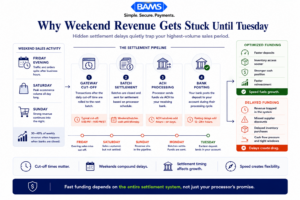
Most weekend funding delays are caused by configuration gaps, not a lack of sales volume.
What This Guide Covers (and What It Doesn’t)
This guide is for eCommerce managers at established online businesses who process consistent transaction volume and suspect their deposits arrive slower than they should. If you’re running a team of 10 to 50 people, every day of delayed business capital access creates real operational drag: delayed inventory purchases, missed supplier discounts, tighter payroll windows.
We’re not comparing processor brands or listing generic “benefits of faster deposits.” Instead, we’re walking through five specific diagnostic signals that reveal your processor is quietly extending your weekend settlement window. Each signal maps to a concrete cost your business absorbs by Monday morning and an actionable fix you can pursue this week.
How We Selected These Signals
Each signal was chosen because it meets three criteria: it’s invisible unless you know where to look, it compounds over weekends and holidays, and it’s tied to a configuration or relationship you can actually change. These aren’t complaints about the industry. They’re checkpoints for your specific setup.
5 Signals Your Processor Is Quietly Extending Your Weekend Settlement Window
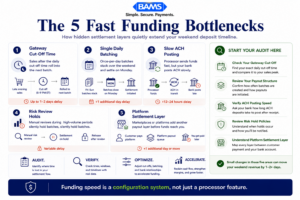
Most funding delays come from layered settlement bottlenecks that merchants never audit directly.
1. Your Gateway Cut-Off Time Doesn’t Match Your Peak Sales Hours
Why it matters: Most payment gateways have a daily cut-off time (often between 5:00 PM and 9:00 PM ET) that determines which transactions land in today’s batch versus tomorrow’s. If your store’s peak hours run past that cut-off, a significant chunk of Friday sales rolls into Saturday’s batch. Saturday’s batch doesn’t process until Monday. Monday’s deposit arrives Tuesday at the earliest.
What this looks like today: Your gateway dashboard shows batch timestamps that consistently fall after your cut-off. Friday evening sales appear in Monday’s settlement report. You see a pattern where weekend revenue takes 72+ hours to reach your account, even though your processor advertises next-day funding.
How to fix it: Log into your gateway settings and locate the batch auto-close time. Compare it against your analytics for peak transaction hours. If your heaviest volume hits between 7:00 PM and 11:00 PM, you need a cut-off window that captures those sales in the same business day’s batch. Some processors let you adjust this directly. Others require a support call. Either way, this single change can shift thousands of dollars forward by a full business day.
2. Your Processor Batches Once Daily Instead of Multiple Times
Why it matters: Single daily batch processing means every transaction that occurs after the batch closes waits until the next cycle. On weekends, this creates a compounding delay where Saturday and Sunday transactions stack into a single Monday batch. For eCommerce businesses with steady order flow, this turns two days of revenue into one delayed deposit.
What this looks like today: Your settlement reports show large, lumpy deposits early in the week and smaller ones later. You can’t correlate specific deposit amounts to specific days of sales. Your cash flow forecasting feels like guesswork because deposit timing is inconsistent.
How to fix it: Ask your processor whether multiple daily batch settlements are available on your current plan. Some processors offer this as a standard feature; others reserve it for higher-volume merchants. If your processor doesn’t support it, this is a meaningful differentiator to evaluate when comparing payment processor options. Providers like BAMS offer next-day funding with transparent settlement windows designed for businesses that need predictable deposit timing, not just a speed promise on a marketing page.
3. Your Receiving Bank Holds ACH Credits Over Weekends
Why it matters: Even if your processor sends funds promptly, your receiving bank might not post ACH credits until the next business day it processes incoming transfers. Some banks batch incoming ACH on their own schedule, adding an extra 12 to 24 hours. Over a weekend, that means funds your processor released Friday afternoon may not appear in your available balance until Monday afternoon or Tuesday morning.
What this looks like today: You see your processor’s dashboard showing “funded” status, but your bank balance doesn’t reflect it for another day. Monday morning cash positions are tighter than your sales volume would suggest. You’ve assumed the processor is slow, but the bottleneck is actually on the bank side.
How to fix it: Contact your bank and ask specifically about their ACH credit posting schedule. Ask whether they process same-day ACH credits and whether your account type qualifies. Some business checking accounts at smaller institutions lag behind on FedNow and same-day ACH adoption. If your bank can’t match the speed your processor offers, consider whether a secondary operating account at a bank with faster posting could serve as your deposit account.
4. Your Risk Profile Triggers Manual Review Holds You Don’t Know About
Why it matters: Processors use automated risk scoring to flag transactions or batches that look unusual. If your eCommerce business runs seasonal promotions, flash sales, or sees spikes in average ticket size, your processor’s risk engine may place temporary holds on settlement. These holds rarely trigger notifications. They just quietly add 24 to 48 hours to your funding timeline.
What this looks like today: Deposits after a big sale event arrive a day or two later than normal. Your processor’s support team mentions “review” or “verification” when you ask about the delay. You notice that funding speed is consistent during normal weeks but degrades during your highest-revenue periods, exactly when you need that capital most.
How to fix it: Proactively communicate upcoming promotions or expected volume spikes to your processor’s risk team. Ask for documentation of your account’s risk thresholds and what triggers a manual review hold. Some processors let you pre-authorize expected volume increases. If yours doesn’t, or if you can’t get a clear answer about what triggers holds, that opacity is itself a signal worth acting on. Dedicated account management (where a human knows your business patterns) reduces these friction points significantly.
5. Your Platform’s Built-In Processor Adds a Settlement Layer You Can’t See
Why it matters: If you sell through Shopify, BigCommerce, WooCommerce, or another platform that offers integrated payment processing, there may be an additional settlement layer between the payment gateway and your bank. The platform collects funds, reconciles them, and then initiates a separate transfer to you. That extra step can add 24 hours to your funding timeline, and on weekends, it compounds.
What this looks like today: Your platform dashboard shows “paid” orders, but your payout schedule runs on a fixed cycle (e.g., every two business days or weekly). You can’t find a way to change the payout frequency within the platform’s native settings. Your eCommerce payment setup uses the default processor that came bundled with your platform rather than a dedicated merchant account.
How to fix it: Check whether your platform allows you to connect an external payment processor with its own settlement schedule. Many platforms support third-party gateways that deposit directly to your merchant account, bypassing the platform’s payout queue. This is one of the clearest upgrades available to eCommerce operators: moving from a platform-mediated settlement to a direct processor relationship where you control the funding timeline.
The Pattern Across All Five Signals
Every signal above shares a common structure: a configuration mismatch between your business’s transaction patterns and your payment processing pipeline’s default settings. None of these delays are inevitable features of how payments work. They’re artifacts of default configurations that were set up for a generic merchant, not your specific operation.
The compounding effect is what makes this expensive. One misaligned cut-off time costs you a day. Add a bank that posts ACH slowly and a platform that queues payouts, and you’re looking at three to four days of float on your weekend revenue. For a business processing $50,000 per week, that’s $15,000 to $20,000 routinely sitting in limbo when it could be funding inventory, ad spend, or payroll. Merchant Payments Coalition resources continue to highlight how settlement inefficiencies and payment processing friction create real operational strain for growing merchants.
Where to Start: Prioritizing Your Audit
You don’t need to fix all five signals this week. Start with the two that require the least effort and produce the largest timing improvement. For most eCommerce operators, that means checking your gateway cut-off time (Signal 1) and your platform’s settlement layer (Signal 5). Both can be investigated in under an hour and changed within a few days.
If your audit reveals that multiple signals point to the same root cause (your processor’s infrastructure doesn’t support the funding speed your business needs) treat that as a clear signal to evaluate alternatives. Cash flow management isn’t a feature you hope for. It’s a system you build, one configuration decision at a time.
Frequently Asked Questions
What is next-day funding in merchant services?
Next-day funding means your payment processor deposits your settled transaction revenue into your bank account by the next business day. The processor typically fronts the funds before the full clearing cycle completes, so you get access to your sales revenue faster than the standard two-to-three business day window. Qualifying usually depends on your business type, processing volume, and risk profile.
Why does my deposit take longer on weekends even though I have next-day funding?
“Next business day” excludes weekends and bank holidays. If your gateway closes its batch on Friday evening, that batch enters the ACH system on Monday. Your bank then posts the credit on Monday or Tuesday depending on its processing schedule. Transactions from Saturday and Sunday stack into Monday’s batch, adding further delay. The result is that weekend revenue often takes 72+ hours to become available.
How can I check if my gateway cut-off time is costing me money?
Log into your payment gateway dashboard and look for the batch auto-close or settlement time setting. Compare that timestamp to your store’s peak transaction hours from your analytics. If a significant portion of your daily sales occur after the cut-off, those transactions roll into the next day’s batch. On Fridays, this means they won’t settle until Monday.
What is the difference between same-day funding and next-day funding?
Same-day funding deposits your revenue into your bank account on the same day the batch settles, typically using same-day ACH or FedNow rails. Next-day funding deposits arrive the following business day. Same-day funding is faster but may carry additional fees or require your receiving bank to support same-day ACH credits. For most small-to-midsize eCommerce businesses, next-day funding provides a strong balance of speed and cost.
Does my bank affect how fast I receive deposits from my processor?
Yes. Even if your processor releases funds quickly, your bank’s ACH posting schedule determines when those funds appear in your available balance. Some banks process incoming ACH credits multiple times per day. Others batch them once daily or delay weekend credits until Monday. Asking your bank about their specific ACH credit posting schedule can reveal a hidden bottleneck.
Which factors affect approval for next-day funding?
Processors typically evaluate your monthly processing volume, average transaction size, chargeback ratio, business type, and time in business. High-risk industries or merchants with elevated chargeback rates may face longer settlement windows. Maintaining a clean processing history, communicating volume spikes proactively, and working with a processor that offers dedicated account management all improve your chances of qualifying.
Sources